Author: Kat

  • Can I Move to The UK Without a Job? How I Did

    Can I Move to The UK Without a Job? How I Did

    One of the most frequently asked questions before moving to the UK is, can I move to the UK without a job?

    Yes, you can move to the UK without a job if you have enough money to support yourself and if you are born to British parents or qualify for one of the following visa’s:

    • Tier 5 Youth Mobility (this is country and age-restricted)
    • UK Ancestry
    • Right to Abode
    • Spousal Visa (this includes if you have an EEA partner as well, will change for EEA after Brexit)
    • Student Visa (limited working hours)
    • Investor/ Set-up or run your own business
    • Exceptional Talent
    • And a few others…

    To check if you qualify for any of the visa’s above there is a check UK Visa questionnaire you can use here.

    Breakdown of Common UK Visa’s

    Tier 5 Youth Mobility Visa

    If you are from Australia, Canada, New Zealand, Japan, Monaco, Hong Kong, Taiwan or the Republic of Korea and between the ages of 18 and 30 the Tier 5 Youth Mobility visa could be the one for you.

    It’s a perfect visa for those who want to move aboard, plus the UK is a great base for travel. Although this visa cannot be extended and means after the 2-year term has ended you will have to leave the UK, obtain sponsorship or another visa.

    What you will need for a Tier 5 Youth Mobility Visa:

    • Your passport
    • £1,890 in the bank
    • Visa fee plus the healthcare surcharge

    Some professions will require you to be certified in the UK or have restrictions on certain jobs so do some research beforehand. For example, my friend couldn’t work as a pharmacist on her New Zealand qualification so she’s had to work as pharmacist’s assistant.

    UK Ancestry Visa

    If you have a grandparent born in the UK and are a Commonwealth citizen you may be eligible for a UK Ancestry Visa. Not only does this visa cover you moving to the UK but this visa can be extended to your family members or dependants (including unmarried and same-sex partners).

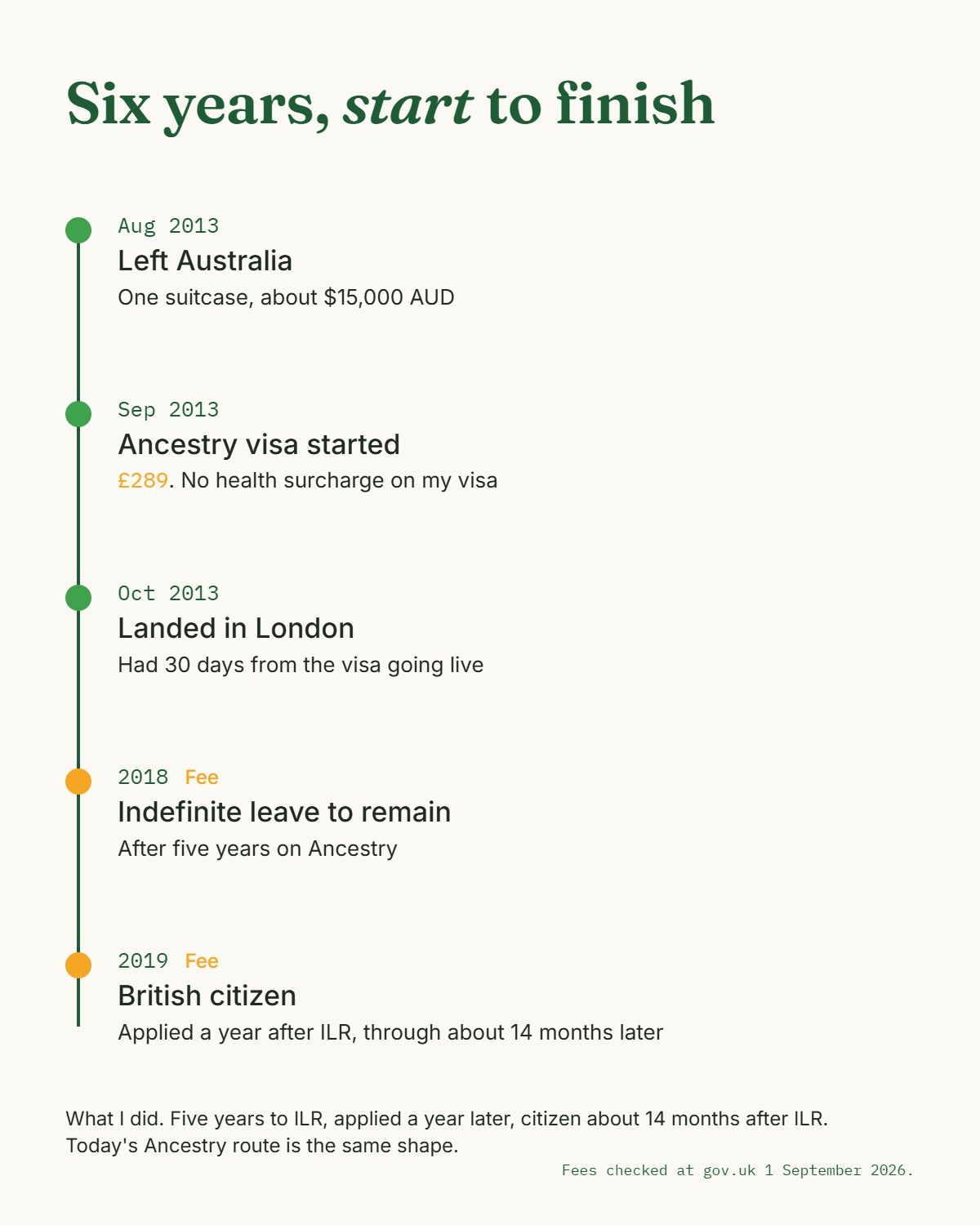
    After spending 5 years in the UK, you can switch from the UK Ancestry to Indefinite Leave to Remain (ILR) which is permanent residency and then naturalise after being on IRL for a year.

    What you will need for a UK Ancestry Visa:

    • Your Passport
    • Birth certificate
    • Parent birth certificate
    • Grandparent birth certificate
    • Potentially your grandparents’ and parents’ marriage certificates
    • Savings in your bank account – no official guidelines
    • Visa fee plus the healthcare surcharge.

    Read more about applying for your UK Ancestry Visa here…

    Right to Abode

    If you have a British parent then you might be eligible to apply for a ‘right of abode’. Essentially as the child of a British citizen, you have the right to permanent residency. This is a right you inherited at birth.

    What you will need for Right to Abode:

    • One of your parents was born in the UK and a citizen of the United Kingdom and colonies when you were born or adopted
    • You were a Commonwealth citizen on 31 December 1982
    • You didn’t stop being a Commonwealth citizen (even temporarily) at any point after 31 December 1982.
    • Evidence of employment in the UK (if applicable)
    • Financial evidence – bank statements, term deposit statements etc.
    • Letter of invitation from a British citizen living in the UK (not mandatory, but preferential)
    • Proof of relationship documents – your birth certificate, your mother’s birth certificate (grandparents are not required)
    • Evidence of accommodation upon arrival (this can be a hotel booking or your referee in their letter of invitation can state that you are staying with them, even if this is not a long-term arrangement).

    Read more about applying for your Right to Abode here…

    Spousal Visa

    Are you or your partner a British citizen, EEA National or settled in the UK (they have ‘indefinite leave to remain’ or proof of permanent residence) and you’ve been living together for more than two years or are married? Then you could be elidable for a spousal visa.

    What you will need for a Spousal Visa:

    • A civil partnership or marriage that’s recognised in the UK; or
    • Prove that you have been living together in a relationship for at least 2 years
    • A plan that you will marry or enter into a civil partnership in the UK within 6 months of arriving
    • Be capable of speaking English to a good level
    • Proof that you can financially support yourself
    • Visa fee plus the healthcare surcharge.

    Can a US Citizen Live in the UK?

    US Passport money and flag

    It’s not as easy for an American to move to the UK like it is for Australian, Canadian or Kiwi. The most common type of visas for US citizen is a student, work or family visas.

    Tier 2 Sponsorship visa is your best bet unless you have met the love of your life that’s a UK Citizen or someone that can have a spouse on their visa like the UK Ancestry. Sponsorship does defeat the purpose of moving without a job but it is a great option if you can find a placement.

    Another option is if you have a UK heritage where your mum, dad or yourself were born in the UK you can get a passport.

    If you have a Canadian (or another Commonwealth country) passport you could also look into your eligibility to get a youth mobility visa.

    The Tier 4 Student visa is also an option but there will be restrictions for the adult and child visa types. The adult visa will allow you to work up to 20 hours as long as it doesn’t interfere with your studies.

    Lastly the Tier 1 visa’s can be an option if you have enough money to get an investor, get an entrepreneur or bring your own business to the UK.

    Use the link in the above section to see what you qualify for or consult with an immigration lawyer for the best options for you.

    How to Move to the UK Without a Job

    Many people have made the move like myself and it’s totally doable to move to the UK without a job. So how were myself and other successful? And if so, how did we go around finding employment once they got there?

    From here on out I am going to assume you’ve figured out that you have the ability to work in the UK and you are now ready to start with the next steps. This guide will walk you through the two to three fundamental steps of moving to the UK:

    • Do you have enough funds ready for the move?
    • Applying for your visa (if required)
    • How to successfully job search (with hints and tips)

    Do You Have Enough Funds Ready for the Move?

    How much money should you bring to the UK

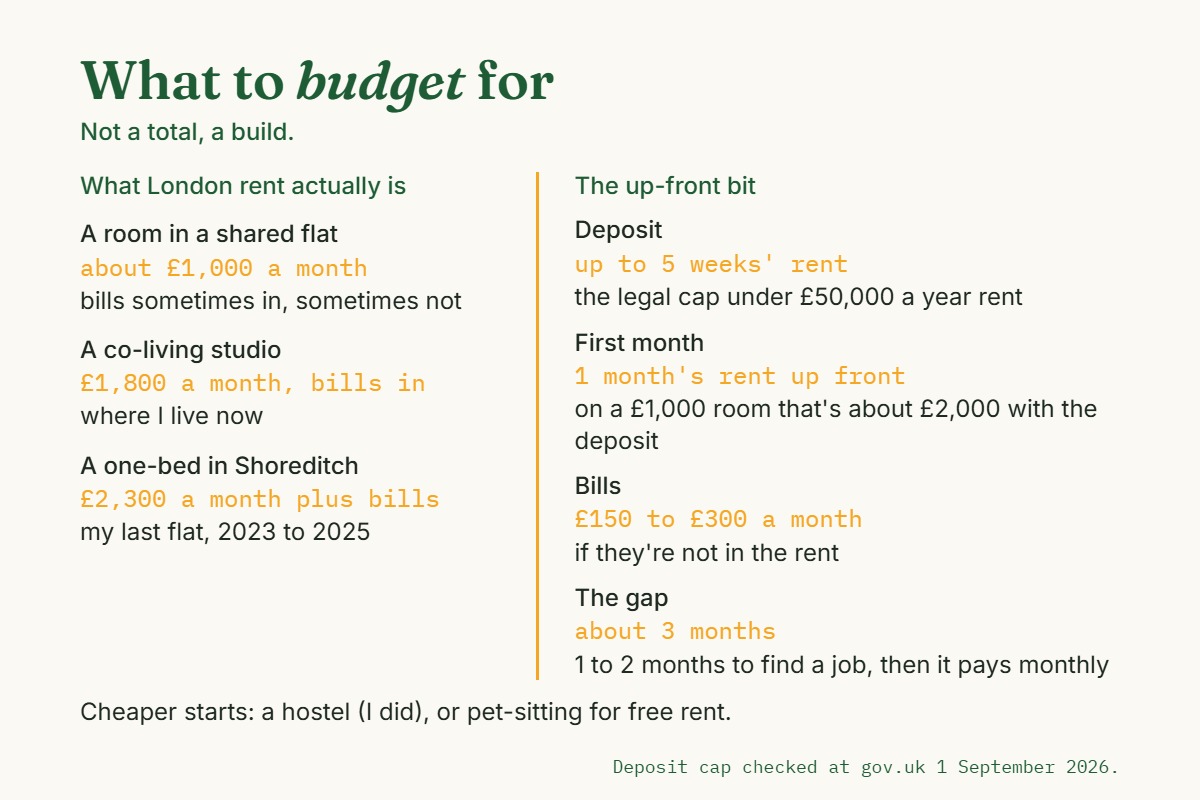
    In my article how much money should I save to move to the UK I recommend bringing over £5,000 as a single person. The budget based on getting cheap accommodation like living in a hostel or moving into a shared house and without the visa cost included.

    You should consider an amount that will cover three months’ worth of accommodation, travel, food, six weeks’ worth of bond money, being without a job and some money for fun activities per person.

    You should also factor initial travel costs which can be another £50 to £1000 per person.

    If you are lucky enough to have friends and family to stay within the UK they will be a life saver. Saving you a ton of money on accommodation!

    You can also save money on travel cost by locating yourself near to a high street which will give you access to shops, parks and other facilities you may need. Being savvy with your money in general and knowing where to spend it will help the pocket too!

    Planning to move to a new place without any funds is always risky. It’ll put you in positions like:

    • accepting a job you may not want to do
    • not being able to support yourself if there are issues with the market
    • many other issues that crop up when finding a job
    • or 2020 hits the world and we have no idea whether they will have a job.

    Of course, this is fine if you are happy to accept the risk of not having enough savings.

    Speaking from experience, I didn’t have enough money saved when I moved here and it ended up with a ton of credit card debt.

    By making this mistake it meant having to go to my family and asking for my first months’ rent and bond.

    Moving overseas was totally worth it but if I had put it off by three to fourth months to have enough money would have been better for my financial stability. I ended up spending four years paying off my debt each month.

    How to Apply For A UK Working Visa (If Required)

    The biggest part of getting a UK work permit is the preparations, mainly, the time to save (unless you’ve got that all sorted). All working permits will have pre-requisites and the two common ones are:

    • English language requirement.
    • Financial maintenance for yourself and any family members.
    • Valid Passport – No matter where you’re from, you’ll need a valid passport in order to enter the UK.

    As a minimum, you will need to meet the financial requirements for your visa even if you don’t plan on moving with the recommendation mentioned above.

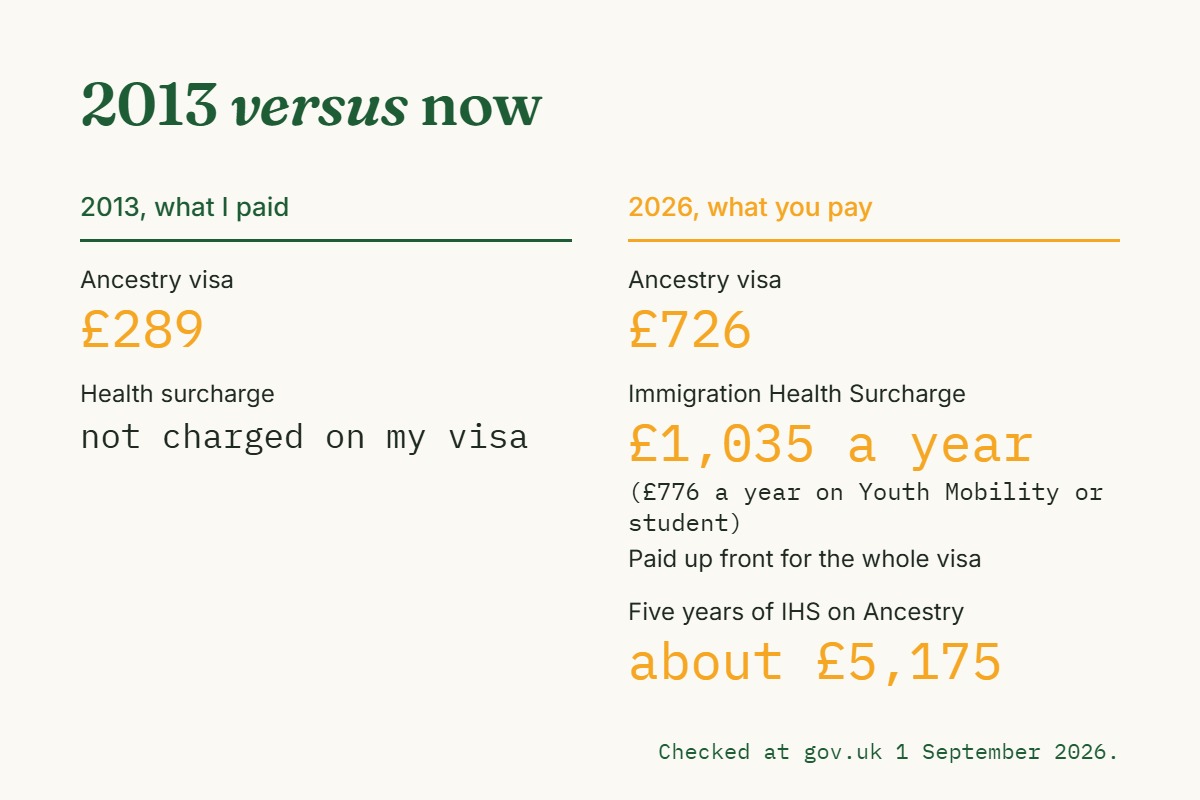
    Additionally, the visa cost can be quite expensive in itself with the IHS surcharge.

    I moved over on a UK Ancestry visa which is a 5-year working visa. It’s one of the more expensive visas as you have to pay for the IHS fee for every year of your visa a UK Ancestry Visa (i.e. 5 times £400 plus visa fee) which will set you back around £2,000 in fees alone.

    Not all visas are clear in the financial requirements so to be safe I always recommend using the Youth Mobility requirement which is £1,890 per person if there is no definition.

    Process for Applying for UK Visa’s

    Six to three months before you intend to arrive in the UK you can apply for a UK visa depending on your visa type. Applications go through the British Embassy or High Commission closest to you and tend to be quicker when dealt with in Commonwealth countries. Processing time, in general, is around 3 weeks but it is visa dependent.

    You can check the likely processing time for different nationalities on the UK government website.

    Applications are started online, some visas are required to have your fingerprints and other biometric data recorded. This means that you will need to visit your nearest visa application centre (in your home country) to have your biometric data processed.

    If you’re already in the UK (and need to switch your visa type or extend it for example) then you can apply at a UK based application centre. It’s highly unlikely you will be eligible to apply within the UK.

    The general application process will be as followed:

    • fill in the application form and answer in English
    • pay the health surcharge
    • pay for the visa fee online (in most cases)
    • print out your form
    • book and attend an appointment at a visa application centre
    • have your biometrics taken (fingerprints and photo) for a biometric residence permit

    What Happens If I Don’t Qualify for One Those Visas?

    If you can’t meet any of the above then you will need to look into sponsorship which will require a job before you can move to the UK.

    The visa structure means that your employer needs to be licensed before you can be considered for sponsorship.

    Depending on the Tier 2 visa types you could also be evaluated against the points system and appear on the shortage occupation list. Make sure you double-check that the employer has a license or is willing to apply for one and for a better chance that your job is on the shortage list.

    Alternatively, tier 1 visas could be an option if you have the exceptional talent, business or investor.

    How to Successfully Job Search (Hints And Tips)

    Finding a job in the UK can either be really easy or hard depending on your profession. London is very competitive and generally always has been.

    It’s never affected my ability to get a job, with motivation and determination you will get there.

    However, some industries are having a rough time with Brexit like the property industry and there have been redundancies with the downturn of the market.

    My day job is as an IT project manager and on average each job it has taken me one month to land a job. I was willing to accept any job when I arrived so my first job in the UK was actually as an Information Manager not as a Project Manager.

    After 9 months of deciding I wanted to stay in the UK I took a lower-level role as Project Coordinator. After another 9 months I moved on to be a Project Manager again and since then all my jobs have been as a Project Manager for the last 4 years.

    The main ways I applied for these jobs was through jobs boards, connecting with recruiters and individual companies.

    Here are 10 tips to get you started:

    1. In this day and age social media plays a big part in our lives. Check that your Facebook and social media presence is boss proof. Google yourself. Might be a bit awkward if they find a compromising photo of you.
    2. Update your resume, LinkedIn, any portfolios and general documents that go with job hunting. Then ensure on LinkedIn that you have ticked that you are open to new opportunities and are following influencers in your industry. LinkedIn is a popular tool in the UK to find jobs, I get a message at least every week from recruiters asking whether I want to apply for xyz job.
    3. Have a UK number – no one wanted to speak to my mum whilst she had an Australian number.
    4. In the UK the majority of jobs go through recruiters and they typically specialise in fields. Target recruiters that may suit your career by looking at who is advertising the job suitable for you.
    5. Register with the largest employment websites like Monster, Indeed, Total Jobs, and Job Site.
    6. Upload your resume to these job sites like Monster and Indeed. One of my bosses always recommended doing this on a Sunday so you are in the first batch that week recruiters are sifting through.
    7. When you find a job to apply to tailor your application to suit. You should be demonstrating your experience and utilising examples of how you meet the job description.
    8. In your cover letter and resume you could go beyond the role itself and look at the objectives of the organisation at large then help solve for those in your application.
    9. Be ready to write your resume to address different application requirements.
    10. Allow extra time for travel in case of some unforeseen event especially if you are new to the area. It is almost impossible to recover from being late to an interview.

    More Living in the UK Articles

  • Do You Need Air Conditioning in London? What to Know.

    Do You Need Air Conditioning in London? What to Know.

    Many of us have become accustomed to having air conditioning when travelling so it can be concerning when you start reading that most of London does not have air-conditioning available.
    Let’s get to the important question, do you need air-conditioning in London? No, you don’t, unless London is experiencing a heatwave. The temperature during summer is an enjoyable mid 20’s (70°F) during the day and mid 10’s (55°F) in the evening. Most British housing will not have air-conditioning and will opt for heating instead.
    Along with British houses don’t expect air-conditioning when you walk into cafes, pubs and restaurants. It’s always a surprise when a place does have air conditioning with the exception of shops and workplaces.

    If you do need air-conditioning then you will need to research your hotels well. It will be harder to find Airbnbs for the above reasons and hostels that are equipped with this facility.

    London Temperatures During Summer

    London is generally in (the) mid-20s (70°F) as you can see in the table below but low 30s (86°F) isn’t unheard of. When London does get hot it can get stuffy and a bit humid).

    Month
    Average Temperature
    June
    21°C / 13°C or 70°F/ 55°F
    July
    23°C / 15°C or 73°F / 59°F
    August
    23°C / 15°C or 73°F / 59°F

    In 2018 London and the UK had a massive heatwave with temperatures over 30°C / 86°F that lasted for quite a few weeks. An unusual event for the UK – where the grassed died in parks, Londoners melted from the heat, shops sold out of fans and trains struggled to run.

    As an Australian I don’t find these heatwaves too bad, I actually quite enjoy them! It’s a nice break from the normal drizzly days. If you are from a cold country or used to air-conditioning then this weather could be a challenge for you.

    How To Survive A Heatwave In London

    Found yourself in a London heatwave? I’ve got some practical tips as well as fun activities to make the most of summer!

    Let’s Start with the Practical Tips!

    Fans Are Your Saviour

    Get a little fan to take around with you, like those ones you get in Asia or a little electronic one.

    Ask your hotel for a fan if they don’t have air conditioning. In my experience hotels will have these available.

    Carry Water

    During a heatwave you will have constant messages from the London Underground reminding you to carry water. The messages can get pretty annoying but when you are stuck at a red signal dying from the heat you will be thankful. Some of those lines can get pretty hot!

    Lately, I have noticed a rise in water fountains available at National Rail stations which is great for refilling your bottles. At main attractions, there is (are) generally water fountains too!

    Avoid Public Transport at Rush Hour

    Catching the tube in London

    The tube can be almost unbearable in the summertime. The central line has been recorded to have a temperature of 40°C (104°F) with no air-conditioning or ways to cool the train down it can be unbearable. Then when you mix the heat with rush hour you get lots of hot sweaty people! Imagine the fun of summer rush hour is. It’s a major complaint amongst Londoners. P.s. Air conditioning varies on the public transport you are taking so sometimes you luck out but most times there will be none. It will change on some lines when they finally roll-out the new trains.

    Look for other alternatives like buses or travelling in non-peak times. Sometimes I will head out for a drink until the peak hour has died down a little.

    Invest in a Mist Spray

    The adult version of running in the sprinklers! Facial mist spray! It is great for when you are overheating and need something to cool you down.

    Fun Activities to Stay Cool in London Summer!

    Go Swimming

    London has lidos located around the city which are ideal for cooling down during the heat. It’s a popular way to cool down so during peak times you’ll have to queue to get your cold-water fix.

    Here are a few lidos in London:

    • Hampstead Heath Swimming Ponds – Hampstead Heath
    • Oasis Sports Centre – Covent Garden
    • Tooting Bec Lido – Streatham Park
    • London Fields Lido – Hackney
    • Serpentine Lido – Knightsbridge
    • Brockwell Lido – Herne Hill

    Have a Picnic

    Londoners love having a picnic and head to the park when it’s warm. At any chance during summer I will grab my dinner, picnic blanket and head to the park to catch the sun, light and fresh air. Some recommendations:

    Hyde Park

    Most popular with tourists, it’s a London attraction in itself and close to other London Landmarks so great if you are a tourist and only have a short time to explore.

    Primrose Hill

    Amazing view of the city while you enjoy a drink or some cheese, yes please! The hill is perfectly located to give you views of the London skyline.

    Richmond Park

    The best thing about Richmond park is the deer! Instead of people watch you can deer watch while enjoying your lovely picnic.

    Crystal Palace

    Crystal Palace was once a holiday destination for Londoners and was home to the famous Crystal Palace until it burnt down. You’ll discover the foundations of the Crystal Palace, the first illustrated statue version of dinosaurs, a maze, a local farm plus the kids can interact with the animals and lots of park space for a picnic.

    Enjoy a Drink at a Rooftop Bar

    All the advice says to avoid alcohol when it’s too hot! Boo, frozen cocktails on a rooftop is a magical way to cool down in my opinion.

    A few recommendations:

    • Bussy and Franks – Slightly outside of the tourist area (still in zone 2) these two rooftop bars give amazing views of London
    • Queen of Hoxton – Located in Shoreditch, this bar is transformed twice-yearly into some cool themes.
    • Skylight London – A new addition to the rooftop bars in London. In summer it’s an urban lawn club with Croquet, Pétanque and Street Food.
    • Bar Elba – Has a happy hour every day until 6 pm and then from Sunday to Thursday from 9 pm to 11 pm.

    Enjoy a Cold Beer in a Beer Garden

    Green space can be hard to come by in some areas of London so the next place we flock to is pubs with beer gardens or riverside pubs. Sitting in a lovely garden enjoying a cold beer to cool down is the best way to enjoy the summer.

    Pub with beer gardens:

    • Canonbury – Canonbury
    • Alwyne Castle – Canonbury
    • The Albion – Barnsbury
    • Earl of Essex – Islington
    • The Edinboro Castle – Camden
    • Magic Garden – Battersea
    • The Ship – Wandsworth
    • The Half Moon – Herne Hill
    • The Duke of Edinburgh – Brixton
    • The Faltering Fullback – Finsbury Park
    • The Sun – Camberwell
    • The Rose Pub and Kitchen – New Cross
    • The Windsor Castle – Kensington

    Riverside pubs:

    • Crate Brewery – Hackney Wick
    • Cutty Sark Tavern – Greenwich
    • The Lighterman, King’s Cross – King’s Cross
    • Lockside Lounge – Camden
    • Mason & Company – Hackney Wick
    • The Narrowboat – Hoxton

    Find the Best Ice-cream

    Ice-cream at Milk Train

    London is a foodie’s destination and there is nothing better than enjoying a nice cold ice-cream when the weather is sweltering.

    • Milk Train Cafe – Covent Garden: Most famous for its cones wrapped in fairy floss and delicious matcha ice-cream
    • Udderlicious – Barnsbury: I first discovered this place when I was living in Islington and went back almost every hot day it was acceptable to eat ice-cream! The ice-cream flavour is amazing!
    • Yorica – Soho: A vegan’s dream place! or anyone on a plant-based diet. It’s the first dairy, egg, nut and gluten-free ice-creamery.

    Do you have any recommendations to survive the heat or any accommodation you found that has air-conditioning? Let me know in the comments below!

    More London Articles

  • Should You Keep Your Passport with You in London?

    Should You Keep Your Passport with You in London?

    Passports are one of the most important items when travelling and there can be so many different rules regarding them. The internet is filled with debates on whether you should or shouldn’t carry your passport.

    Should you keep your passport with you in London? The times you should keep your passport with you are; at the airport, international train station, checking in to a hotel or hostel, changing money, hiring a car, picking up event tickets, buying alcohol or proving you’re old enough to get into a pub or club.

    Your licence can suffice as proof but some companies can be sceptical whether it’s real or a fake licence if you are providing an international version. There have been times when I’ve tried to buy alcohol on my Australian licences and have been rejected.

    There is a counter-argument that you don’t need to bring any ID with you when you are in the UK but I disagree, especially if you are driving or younger-looking and plan on buying alcohol or are heading to a pub, bar or club. Of course, if you aren’t driving or no longer get asked to prove your age then it’s purely your choice if you bring ID.

    I don’t carry my passport with me unless it is required, instead, I carry my licence in my wallet. I’m in my late 20’s and I still to this day get asked to prove my age, the easiest way to do this is with my UK licence.

    Before I got my UK licence I was using my Australia licence as proof for my age. However, any time I needed to go to the bank I also had to bring my passport to prove who I was.

    What Is A Valid Form of Identification?

    This really depends on the reason you need the identification for, here are acceptable forms of ID in the UK:

    • A photo driving licence
    • A passport
    • Proof of age card, such as the PASS card from the national Proof of Age Standards Scheme
    • Biometric Residency Permit.
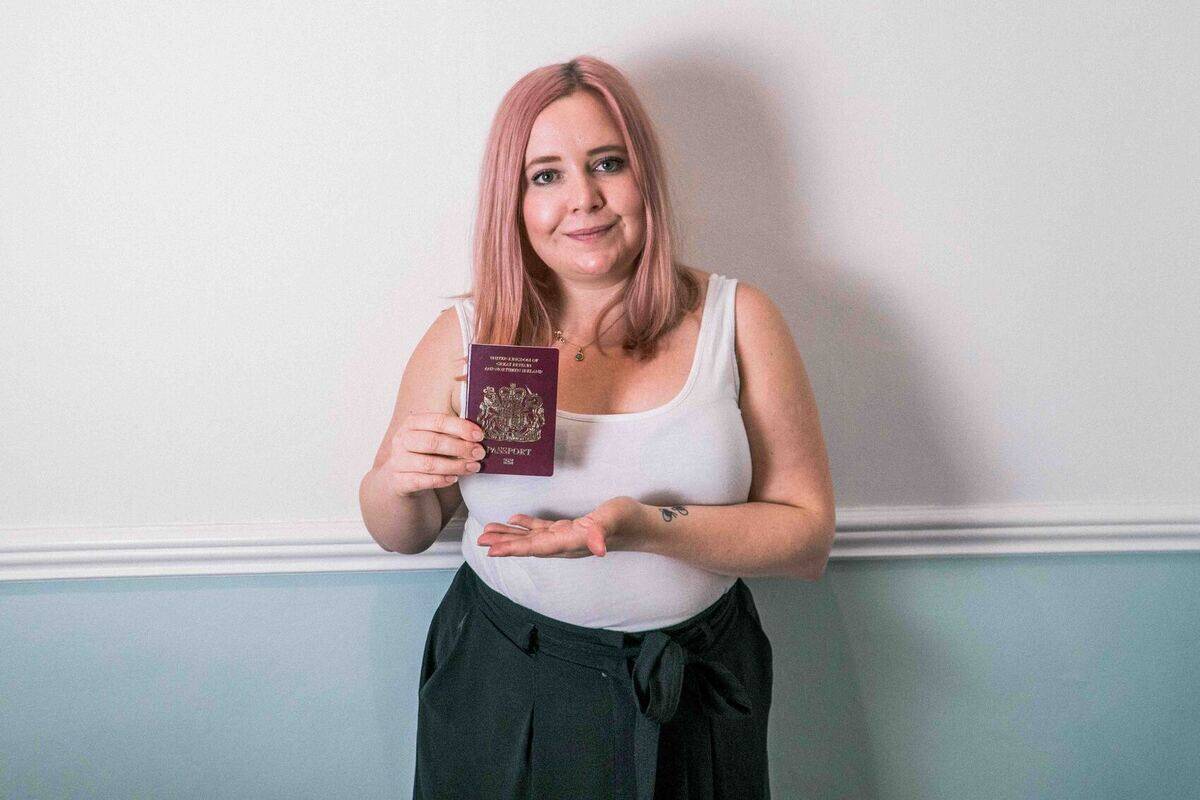
    Kat with her British Passport

    4 Tips to Keeping Your Passport Safe

    Lock it Up

    Lock your passport away in either the safe or locker provided by your accommodation. If a lockable space is not provided secure your bag with a travel lock. You can ask your accommodation to keep your passport safe as well. I personally prefer keeping it in my room or with my belongings but I am aware that some people prefer to carry it with them.

    Have Electronic Copies

    Before you head on your travels make sure you have electronic copies. Save these to your cloud or non-cloud drive and e-mail a copy to yourself and family or friends.

    Things can happen when you are not careful, like my dad. One day he was doing a bit of washing and didn’t check his pockets. He likes to keep his passport in his pocket along with his wallet (no idea why). Next thing he knows he’s pulling out a totally ruined passport from his trouser pocket. Not so helpful when you live in another country as fly in and fly out. Luckily, he had copies of his passport and was given an exception by the airline and immigration to get to the nearest embassy to replace his passport.

    It’s easier to prove your identity when you have copies available when the original isn’t around or if the physical copy is damaged.

    Some people do take photocopies and carry those instead of carrying around the physical version.

    Hide It

    When travelling in public areas ensure your passport is secure. I keep my passport in a zip pocket within a bag that would be hard to grab without me noticing. Whatever method you choose to keep your passport safe make sure it’s hard for people to snatch it without you noticing or the person just wouldn’t be able to find it.

    Protect Your Passport

    Damaging your passport is another pain! I covered my dad’s incident of damaging his passport but there are other things than washing machines that ruin your passport.

    The UK is famous for its drizzle and rain so keep it as safe as possible to prevent water damage and travel with a waterproof cover. Additionally watch out for anything that can cause rips and tears.

    Not sure how I managed to get tears in my passport, I think it was from the plane tickets, immigration cards and then pulling them out caused wear and tear. At one point the Australian Immigration officer was advising me to replace my passport soon before I lost the most important page. The passport managed to withstand quite a number of years more of use with a bit more TLC.

    Have you had any incidents with your passport? Let me know your stories in the comments below.

    More London Articles

  • Are London Hostels Safe? With 11 Safety Tips

    Are London Hostels Safe? With 11 Safety Tips

    Staying in a hostel in London was my first solo hostel experience and it turned out to be really positive. After years of staying in hostels in London and around the world I can say that having concerns about the safety of a hostel is a common feeling, especially if you are new to travelling.

    Are London hostels safe? Yes, they are safe. Don’t worry you are not alone with this doubt, safety it is quite a popular question. You do need to take a couple of steps to ensure that you and your belongings can remain safe. These aren’t anything outside of common sense.

    In this guide, I will share my experience and tips for staying safe.

    Who Stays in London Hostels?

    London hostels tend to attract two types of people, those who are looking for budget-friendly accommodation and those who have just moved to the UK.

    As travellers you will find that most people are looking to meet like-minded people so those who are up for new experiences and enjoying what London has to offer.

    The chances that the people staying in the same room want to steal or attack you is not very high on their list. We all just want to be mates right?

    Here Are 11 Tips for Staying Safe in London Hostels

    1. Research The Hostel Location

    London is a big place and when researching a location to stay can be overwhelming! London is a set of little towns put together to make a city with their own vibes so making the right choice is important. Before choosing a place you should decide what kind of experiences you want to have, do you want to be able to walk to the landmarks easily, do you want to party, are you looking for some peace and quiet? This will all affect where you should stay in London.

    From there you can then look at narrowing down the locations and safety of those areas of London. The London crime map is great for comparing safety in different areas.

    A few recommendations of what areas to stay in London:

    Bermondsey & London Bridge

    Area vibe: It’s the perfect place to stay if you love to discover new street-food, craft beer and gin.

    Safety: I commute into London Bridge and work in the City of London so I am really familiar with the safety in this area. At no point have I ever felt unsafe walking around this area, however, there was an incident in the area which upped the safety. You will find that London Bridge and other parts that have bollards protecting the pedestrian pathways.

    Covent Garden and Soho

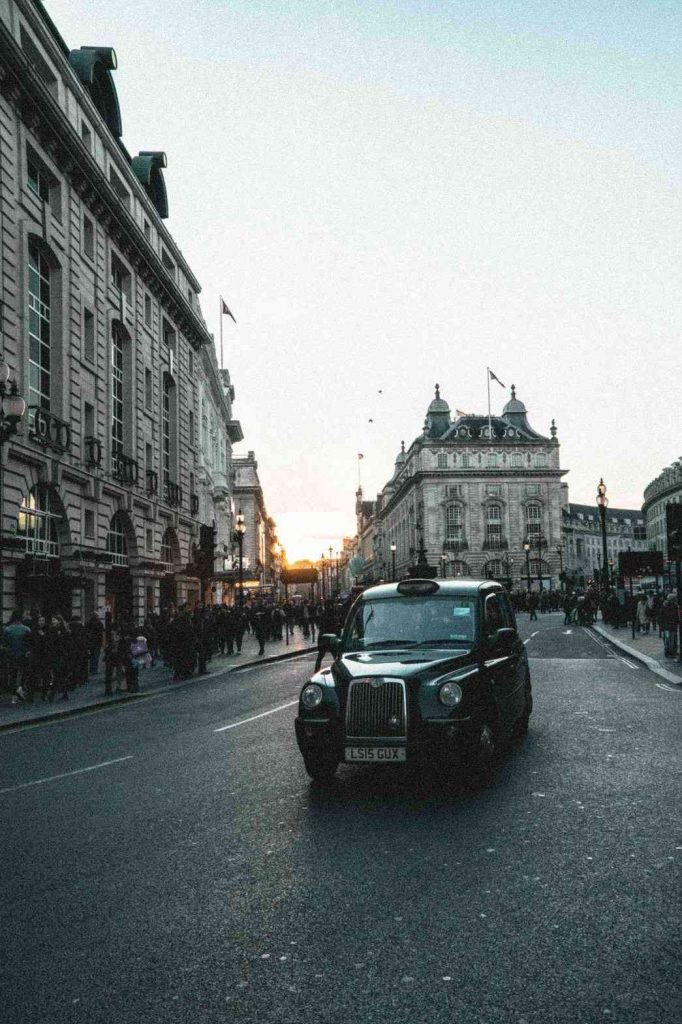
    Classic shot of Piccadilly circus with Black Cab.
    Classic shot of Piccadilly circus

    Area Vibe: Right in the middle of the action, always bustling, surrounded by restaurants and bars and in the theatre district.

    Safety: In the heavy populated areas you will see police presence and also in high traffic pedestrian pathways bollards protecting those areas. Being a high tourist area it does attract people stealing phones, wallet, cash and anything that is easy to grab. Just make sure you are aware of what you are doing with your belongings.

    Greenwich

    Area Vibe: It is further out to see the main attractions of London but the attraction is that it is a little quieter, full of open space and greenery. Plenty of restaurants, markets, bars or a great place to have a picnic when the sun is shining.

    Safety: It’s a reasonable place to stay as far as safety, lots of tourists during the day and local around.

    Shoreditch

    Shoreditch Street Art and Graffiti Tour
    Shoreditch Street Art and Graffiti Tour

    Area vibe: There is always something happening in Shoreditch from the curry mile, vintage shopping, street art and cool bars there is something to keep you occupied every day of the week.

    Safety: It’s one of the nightlife areas so you will see more drunk people and an occasional argument but nothing you wouldn’t see in any nightlife area. The area has incidents of theft like bikes riding by and stealing your phone. Make sure you are aware of what you are doing with your phone and belongings.

    2. Read The Reviews of The Hostel

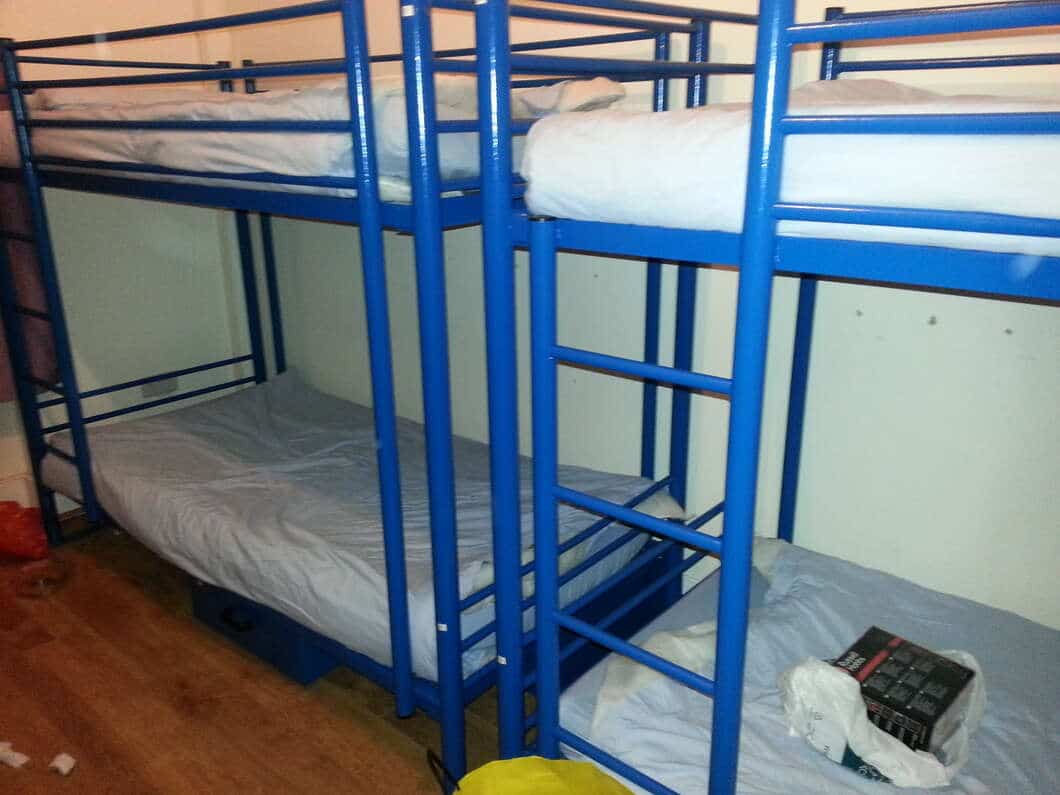
    Hostel Dorm Room in London
    Hostel Dorm Room in London

    Reading reviews of the hostel can help you determine whether it’s worth staying there, for example, value for money, security, location, staff, atmosphere, cleanliness and facilities.

    If the reviews start highlighting that people feel unsafe in the area, their stuff was stolen or they felt harassed then it’s a big red flag! As a rule, I will read a minimum of 10 reviews on each hostel I am considering staying at to get a feel of people thought of the place.

    3. Consider Female-Only Rooms and/or Hostels

    Not everyone is comfortable staying in mixed rooms but thankfully for us ladies there female-only rooms and hostels.

    Benefits of staying in female-only accommodation:

    • The rooms are better equipped for the female traveller with a high-quality mirror, lots of hooks and hairdryers.
    • Dorm rooms can be smaller e.g. you could find yourself in a 6-bed dorm instead of a 12 bed one.
    • It’s easier to get changed in female only dorms, you don’t have to worry about boys looking at you.
    • Guys aren’t allowed so you won’t have those awkward moments if someone picks up.

    Disadvantages:

    • Female dorms cost more than mixed dorms so will have an impact on your budget.
    • Girls can be just as messy!

    4. Know How to Get to Your Hostel When You Arrive

    My first experience of trying to get to my hostel in London was a disaster. After landing in London after a 20+ hour flight from Australia, I was really tired lugging a heavy suitcase and thought a print out of the hostel directions (no map) would be enough to get me to the hostel.

    I had never been to London and had no understanding of the complicated transport connections (I’m for a small city where the train only goes in 4 directions). Totally oblivious that the hostel was in Kingscross which is a major hub for public transport in London with about 20 exits to get out of the tube station.

    After spending about an hour walking around in circles and asking for help I finally found my hostel.

    Make sure you know how to get to your hostel when you arrive! This is super important if you are arriving late at night. With the increase of free WiFi and the ability to download offline maps finding your way is a lot easier! In doubt grab a taxi so you get there safely.

    5. Speak to The Staff if You Have Concerns

    Hostel staff will be very familiar with the area so raise any concerns you have with them. They should be able to tell you what to watch out for, scams and places to skip. It’s common the staff will be living at the hostel or in London so they are a great source for information.

    6. Use The Lockers

    Before you start travelling pick up a good travel lock. Look for locks that cannot be easily damaged, cut or otherwise accessed with some effort and the right tools. Fourdigit padlocks are great as you can have over 10,000 combinations and almost impossible for people to figure it out.

    A good hostel will offer lockers to store your belongings in. When you get into your room check that the locker is tack, nothing is damaged and then just lock it on your way out.

    7. Watch Your Belongings You Care About

    As someone that travels with lots of tech items, this is something I am most worried about when travelling. First, have good travel insurance to cover high-value items so if anything does happen you aren’t out of pocket.

    Every time you leave the room put your high-value items in the locker and lock it. Even if you feel safe in your dorm rooms you never know what could happen. Private rooms don’t always have lockers so consider locking your bag and distributing it so it’s harder to find.

    8. Copy Your Passport and e-mail it to Yourself

    Take copies of your passport, any visa or important documents before you travel. E-mail copies to yourself and your family as a safety measure. It’s way easier proving who you are when there are photocopies!

    I also only take out one form of ID so if I take my licence I don’t take my passport, if I take my passport I leave my licence behind.

    9. Know Where Your Nearest Embassy Is

    London has a pretty good police force, after all it’s a big city and they deal with a lot of crap! Knowing where your embassy is will help you if something like your passport gets lost or stolen. Luckily London is a hub for embassies so there is a good chance your embassy will be in London to support you.

    10. Drink Responsibly

    It’s sad that I have to include this in the tips as there is still a culture that it’s ok to take advantage of people when they are intoxicated. Whether it’s sexual assault or stealing your belongings and it can happen across both genders.

    It’s easy to get carried away when making new friends and I am definitely guilty of having too many drinks on more than one occasion when travelling.

    I’ve never been in an incident myself where I have been assaulted but I have definitely been robbed on a night out (both in London and in Australia) so it doesn’t matter what city you are in this can happen anywhere!

    Carry the hostel business card with you so you can give it people (taxi driver, police officer etc) if you need help. If you feel like you are unsafe or just want to make sure people know where you are at all times text a friend your location even if they are not in the same country or awake.

    11. Hide Some Backup Money in a Different Pocket

    Find a few secret pockets to hide cards and money in as another precaution. This tip is more than just safety it protects you if anything happens to your money.

    As an example on a recent trip to Thailand, I decided to take one travel card and then my credit card plus my normal bank card. I got off the plane after a full day of work and then 18 hours of travel, put my travel card in the ATM and then forget to take it out! The receiving cash before taking my bank card through me off and I never took it out in my tired state ?.

    After losing out on covering everything back to pounds next thing I know I’m looking at my American express statement thinking how on earth has my balance gone down £500! Turns out someone got my credit card details and went on a spending spree. Thankfully it’ll all get refunded and my boyfriend is travelling with another travel card so I didn’t end up getting all the bank fees. It just goes to show always travel with multiple cards!

    If you have any questions about the areas and whether they are safe, let me know in the comment below. Plus if you have any safety tips I would love to hear about them.

    More London Articles

  • Exchanging a Foreign Licence for a UK Drivers Licence

    Exchanging a Foreign Licence for a UK Drivers Licence

    Now that you have finally settled down in the UK it’s time to exchange your license to a UK drivers license. It’s a pretty easy process to exchange your licence once you’ve been here for over 185 days.

    Why Should You Change Your Foreign Driving License To The UK One?

    The reason I changed my licence is because I was tired of everyone looking my Australian licence asking is this “valid” when I was buying alcohol, using it as proof of ID and I couldn’t use it as proof of address. The main benefits for you changing your licence are:

    • Proof of Address – One of the benefits of having a UK licence is that it is the most convenient Proof of Address you can have. Before having my licence I needed to carry my passport around when I needed to something at the bank and requiring me to remember in advance with having my UK licence I didn’t need to worry.
    • Cheaper Car Insurance – Most companies offer cheaper car insurance for full UK driving license holders. I recently tested this on confused.com to see whether it was true using VOLVO V60 SE T3 as the car model of choice. The first quote with my Australian licence came to £2924.32 and the second quote using my UK licence came to £937.56. It’s worth making the switch if you are planning to buy a car to save those £££’s.
    • Continue driving in the UK – If you wish to continue driving in the UK you must change your licence after 12 months of staying in the UK on a foreign licence. I waited 3 years before exchanging mine however I don’t really drive in the UK. You can exchange it up to 5 years after becoming resident if it hasn’t expired.

    Can You Get A UK Driving Licence On A Visa?

    As long as your visa allows you to hold a permanent address in the UK and have lived in the country for at least 185 days of the last year you will be able to get a UK drivers licence. For example:

    • Tier 5 Youth Mobility
    • UK Ancestry
    • Right to Abode
    • Spousal Visa
    • Student Visa
    • And others…

    How to Exchange a Foreign Licence for a UK Drivers Licence

    The process for exchanging your licence is (note that this is only for England, Scotland and Wales, Northern Ireland has its own process).

    Check If Your Country Has A Reciprocal Exchange Agreements

    To exchange your licence your home country must be a ‘designated country’ (countries with exchange agreements with Great Britain), the countries in this agreement are; Andorra, Australia, Barbados, British Virgin Islands, Canada, Falkland Islands, Faroe Islands, Gibraltar, Hong Kong, Japan, Monaco, New Zealand, Republic of Korea, Singapore, South Africa, Switzerland and Zimbabwe.

    The application does ask which country your licence was issued in and where you passed your test. If you didn’t pass in one of the above countries you will have to complete a driving test. You will be able to drive on your licence for 12 months before requiring to exchange.

    Complete driving test (if required)

    Countries that don’t have a reciprocal agreement you will need to apply for a UK provisional licence and pass the UK practical test. It’s not required that you take any driving lessons before taking the test but it could be helpful to familiarise yourself with the UK rules.

    Check out this handy little tool to see if you can drive in the UK on your non-UK drivers licence.

    A Copy of Your Licence or Proof of Entitlement Letter From The Issuing Authority

    You need a copy of your drivers’ license or proof of entitlement letter from the issuing authority confirming your licence is valid with all of your details etc. and send that in with your application in the UK. Saves you having to re-order another licence.

    When I was in Australia I said my licence was lost and paid for a new one. Plus got a new photo whilst I was at it.

    If you passed your driving test in Canada or New Zealand you will need to provide proof that you can drive a manual gearbox if you want a manual license.

    Manual or Automatic Licence

    Your licence should be switched to the type of licence you had in your home country so in Australia I had a manual licence and when I exchange I also received a manual drivers licences. The same happened when my sister applied, she has an automatic licence and received an automatic licence back.

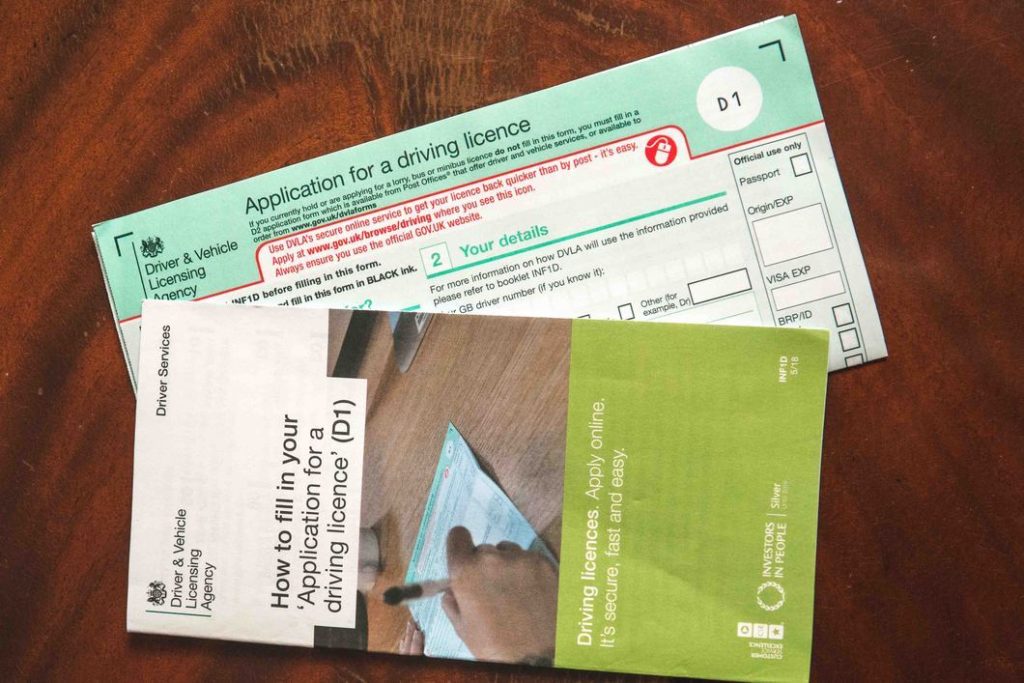
    Order Form D1 From The Driver And Vehicle Licensing Agency (DVLA)

    D1 Instructions and Form
    D1 Instructions and Form

    The easiest way to get a D1 form is by ordering it online, otherwise post offices should have copies of the form.

    Get A Passport Sized Photo

    You will one standard UK Passport size photo to send with your application. Just like a passport the photo is valid for 10 years so make sure you look your best ?.

    Where to get photos? I always end up going to Snappy Snaps for my passport photos as there are so many around. They will ask you what type of photo you require and provide the correct type.

    Complete the D1 Form

    Simply complete the two page form. If you need any help there is also a guide to support the application.

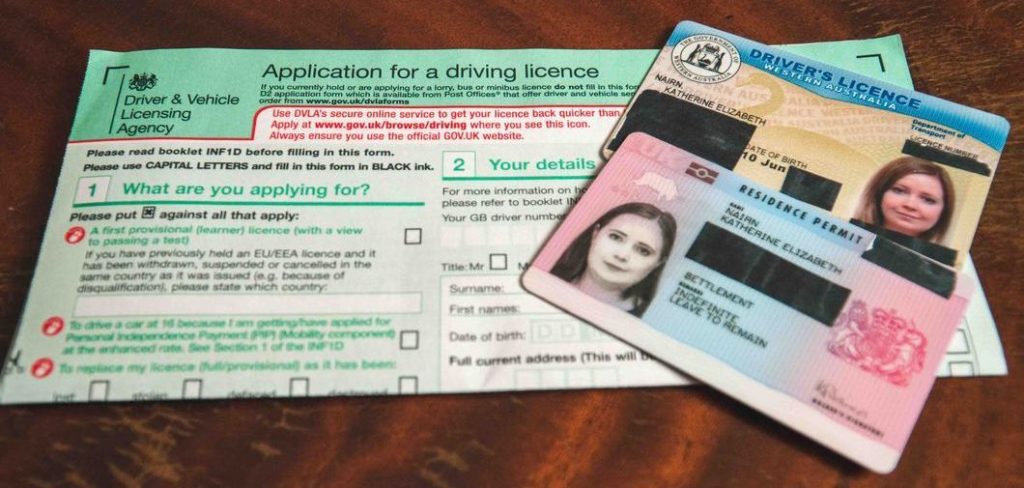
    Send the Application with Your Documentation

    D1 form and ID
    D1 form, Australian license and biometrics card.

    You will need to include:

    • Completed D1 form
    • Passport Photo
    • Biometric Residence Permit (BRP) (if you’re on a visa)
    • Your licence or proof of entitlement letter from the issuing authority
    • £43 fee – As I don’t have cheque book I decided to get a postal order to pay the £43
    • Self-addressed registered post envelops (optional)

    If you arrived in the UK on a British passport then you just need to add your passport in the application and you will not need to send your passport off with the application.

    Please note: If you don’t provide a self-addressed registered post envelope then your documents will be posted back to you in second class post. DVLA will not compensate for any loss or delay in the return of your documents. I highly recommend paying extra for the registered post envelope for a piece of mind.

    How to Pay Via Postal Orders and Checks

    For some reason the DVLA only accepts cheques! The easiest way to get one is a postal order from the post office. The cheque will cost 12.5% of the value order which will be £5.37 on top of the £43. Simply go up to the counter, ask for a postal order to the DVLA Swansea and one will be produced with the correct amount.

    Alternatively, you can visit your bank or credit union’s branch to request a counter cheque. Make sure you check with your bank branch before you make a trip there and see if counter cheques are available. If you use an online bank like Monzo this option won’t be open to you.

    Make sure you add your name and date of birth or licence number on the back of the cheque.

    Where should I send the application?

    The application should be sent to:
    DVLA
    Swansea
    SA99 1BT

    I sent mine by registered post and included an addressed registered post envelope so it could be tracked when my documents were returned. Your new UK licence and identity documents will be sent separately.

    How long does it take to get a driving license UK?

    Allow about 3 weeks for your driving licence to be sent to you. This can take longer if they need to check your health or personal details.

    Understanding Your UK Driving Licence and the Codes

    On the back of your UK licence there will be a table of vehicles (categories) and licence codes which state what you can and can’t drive.

    If you have a standard licence then chances are yours will say something similar to mine. My exchanged licence it says I can drive the following categories and with the associated conditions:

    • AM which is a 2-wheeled or 3-wheeled vehicle with a maximum design speed of over 25km/h (15.5mph) but not more than 45km/h (28mph) if I comply with code 122 (see below).
    • A with restriction of 79 (3) which is motor tricycles with a power output more than 15kW.
    • B1 which is basically a quad bike.
    • B the one we are most likely to drive, a car. It’s exchanged to a full licence, if you had an automatic licence it would say 70, 78 which is restricted to vehicles with automatic transmission.
    • BE I can drive a car with a trailer.

    The codes determine what conditions are on your licence. Here is a quick highlight of the codes I think are most common:

    • 01 – eyesight correction, for example, glasses or contact lenses
    • 70 – exchange of licence
    • 71 – a duplicate of the licence
    • 78 – restricted to vehicles with automatic transmission
    • 79 – restricted to vehicles in conformity with the specifications stated in brackets on your licence
    • 79 (2) – restricted to category AM vehicles of the 3-wheel or light quadricycle type
    • 79 (3) – restricted to tricycles
    • 122 – valid on successful completion: Basic Moped Training Course 125 – tricycles only (for licences issued before 29 June 2014).

    For more information on the code here.

    Video on How to Get a UK Driving Licence

    More Living in the UK Articles

  • How to Build a Credit Score as a New UK Resident

    How to Build a Credit Score as a New UK Resident

    When moving to the UK I had no idea I would be starting from scratch with my credit score (totally naïve of me!). No matter how good or bad your credit score is in your home country you will be starting from zero when you move to the UK.

    Whether you’ve just moved to the UK or been here for a couple of year this article will cover who the credit agencies are, what they generally look for and how to build your credit score as a new resident.

    Stay tuned until the end to hear about the drama I had getting a phone contract and contactless card.

    Who Are the Credit Reference Agencies (CRA) in the UK?

    The UK has three Credit Reference Agencies (CRA) that lenders generally use to verify you when you are applying for credit. Just to keep us on our toes the credit scores are not standardised so each one will score your credit differently.

    Here is Experian, Equifax and TransUnion (the three CRA’s) score breakdown from very poor to excellent:

    Agency
    Score
    Rating
    Experian
    0-560
    561-720
    721-880
    881-960
    961-999
    Very poor
    Poor
    Fair
    Good
    Excellent
    Equifax
    0-279
    280-379
    380-419
    420-465
    466-700
    Very poor
    Poor
    Fair
    Good
    Excellent
    TransUnion (formerly Callcredit)
    0-550
    561-565
    566-603
    604-627
    628-710
    Very poor
    Poor
    Fair
    Good
    Excellent

    Here’s what my basic credit report looks like with Experian:

    basic credit report

    What is Included and Not Included in my Credit Score Rating?

    Even though your credit score will be totally blank as a new resident of the UK it’s good to know the factors that you are measured on.

    What’s included:

    • Name, address and date-of-birth.
    • Past credit applications.
    • Credit repayment history, including late or missed payments.
    • Your existing debt.
    • Your electoral register presence.
    • Any joint credit cards or loans.
    • If you’ve been declared bankrupt or have an IVA.
    • Any county court judgements (CCJs).
    • Current account turnover.

    What’s not included:

    • Student loans.
    • Medical history.
    • Council tax arrears.
    • Criminal record.
    • Parking or driving fines.

    What Credit Scores Affect

    Here’s a quick overview of how your credit score can affect major finance areas:

    • Mortgages – Poor scores will simply get you rejected. Work to improve this before you look at buying a property. 
    • Credit cards – whether you will be accepted and the rates you will be offered, 
    • Loans – same as credit cards. 
    • Utility bills – as they share data between themselves it’s important you pay your bills on time. 
    • Mobile phones – generally as you are spreading the price of the handset so this is counted as a loan. If you are rejected you won’t get a contract and will need to pay as you go.
    • Car and home insurance – Opting for monthly payments means that the insure is giving you a loan for the money over the year and generally charging you interest. They will run a credit check for this. It’s cheaper to get yearly insurance due to this. Even when you use comparison markets for insurance they will run soft credit checks to provide you quotes from insurance companies.

    Here are 12 Simple Steps You Can Do to Build Your Credit Score as a New UK Resident

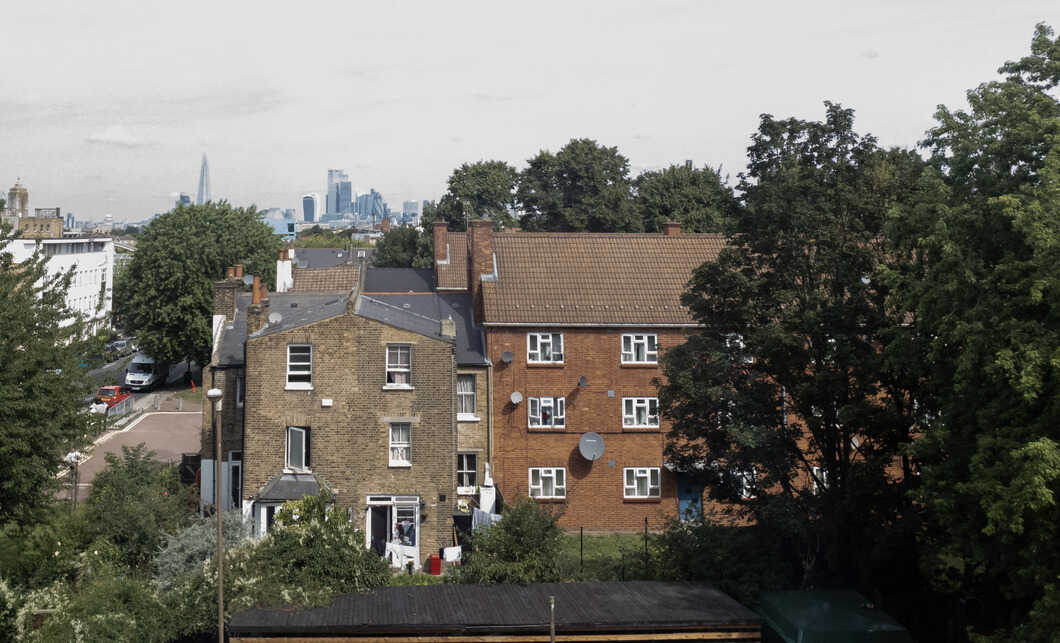
    1. Get a UK Address

    London flat block in Peckham.
    London flat block in Peckham.

    As a new UK resident finding accommodation will be high on your list anyway as you need somewhere to live! Having a UK address is one of the few common denominators that is shared across your credit accounts. Therefore, you do need a permanent address in order to get credit as it forms part of the data shared with credit agencies.

    What do credit agencies use your address for?

    • to confirm your identity.
    • to match all your credit information to you.

    When providing your address it’s important to always write it in the same format. For example, Flat 5, 64 verse 5/64 can impact some of your applications. It’s best to keep it consistent so you don’t have any issues with your credit reports.

    Another thing to be mindful of is any type of credit, the lender will ask you to address history over the past three years. For example, if you apply for a sim-only contract on a phone companies website you might get rejected whereas going into a store you can be accepted. This has happened to me, I was accepted in store but rejected online as I was unable to provide the address history. 

    How Does Your Address Affect Your Credit Score?

    Credit agencies use your address to determine how you have handled credit in the past.

    ClearScore states that things like what area you lived in and who lived at your address before you shouldn’t have an impact on your score.

    The one thing to be careful of is how much you move could indirectly affect your ability to get credit. Lenders look for stability in people’s credit scores so moving can indicate that you have a number of issues.

    At the end of the day, you can’t avoid moving so don’t worry too much but be mindful if you move 3 or 4 times a year then lenders will be cautious about lending money.

    2. Open and Manage a Bank Account

    Setting up a HSBC UK Bank Account

    Opening a bank account can be challenging in the UK and a bit of a catch 22 as a new resident. You need proof of address to open a bank account but then you don’t have the proof and so on it goes.

    Get a Bank Account Before Moving

    To make things simpler before moving to the UK, see if you can open a bank account for the UK in your home country, banks like Citibank and HSBC offer these services. Just be aware that this could cost you money to open an account internationally.

    Allow at least one month before you leave to open one of these.

    Get a Traditional Bank Account in the UK

    To get an account with one of the high street banks like Lloyds, Santander, Barclays, HSBC or NatWest you will need to do this by attending an interview and bring the following information:

    • Your passport (mandatory).
    • Biometric Residence Permit (mandatory if you are on a UK visa).
    • A letter of employment (bank-dependent), proof of address which can be a rental contract or bills in your name to a UK address (mandatory) and potentially a letter from your current bank advocating you as a customer (bank-dependent).

    When I struggled to get a bank account, I used Britbound service to help me. They have a package for a UK Bank Account and Sarah makes the process really easy. The only downfall is the appointments must be in London with the bank they have the relationship with. If you are moving somewhere else in the UK this might not be the best option. 

    Challenger Bank/App Focused Bank Account

    Challenger banks were created as digital-only banks in the UK. They are an alternative to the traditional high street banks. They will provide you an app as the base to run your banking needs. 

    I recommend looking into Starling, Monzo and Revolut as options for your banking needs. Both Starling and Monzo are FSCS protected which means if they go out of business your money is protected up to £85,000. 

    Revolut and Wise use safeguarding as their means of protecting your money which means they have to hold the equivalent amount of money in a safeguarded account. If they went under then this money is used to return your money. 

    I currently use Monzo for my everyday spending and Wise for all of my international transfers, plus parts of my business banking. Most of my income is paid in USD so this is a perfect solution as in between the bank and saves on exchange fees. 

    To open an account with a Challenger Bank:

    • Have a UK phone number (you generally will get rejected if you don’t have a UK number).
    • Download the app of your prefered bank.
    • Provide proof of your identity by taking a photo of your passport.
    • An address where you can receive the debit card.

    How Does Your Bank Account Affect Your Credit Score?

    Bank accounts will affect your scores if you do things like switch banks too regularly or if you switch before you apply for a big loan, an overdraft or credit card when you don’t need it.

    As a new resident, you may end up with a bank account that wasn’t exactly what you wanted to start off with. Once you’ve got yourself settled, shop around until you find the right bank or financial institution and then switch.

    If you plan on switching bank accounts look for the seven-day switching service. This means that you are not stuck in limbo when switching bank accounts and if you forget to change a payment like your salary or direct debits and standing orders these will be transferred into your new account.

    3. Show Proof of Employment

    Getting a job is probably high on your to-do list when! The benefit of having a job is to show that you have a regular income and a salary to pay for things like debt.

    How Does Your Employment Affect Your Credit Score?

    When you first arrive, you may struggle get a mobile phone contract or a credit card. Once lenders see regular payments into your bank accounts this should make the process easier.

    4. Get on the Electoral Roll

    When you register to vote, your electoral details are recorded on your credit report. The confirmation of your name and address boosts up your credit rating after 30 days.

    This is only applicable if your nationality allows you to be eligible to vote. For example; EEA citizens and Commonwealth countries like Australia, New Zealand and Canada.

    If your nationality isn’t one that allows you to vote, for example, US citizens then you can request a Notice of Correction to your credit report. You will need to sign-up to a credit agency and get a report run first and then explain the reasons why you can’t register to vote.

    You can register vote two ways, either online or by post. The local council will send a letter to your household each year requesting you to confirm the voters at that address.

    How Does Your Electoral Roll Affect Your Credit Score?

    You could be missing out on additional points which will boost your overall credit score rating.

    Voting isn’t mandatory in the UK so if this isn’t something that you don’t wish to do then it’s fine.

    5. Manage Small Credit Accounts

    Stack of credit cards

    Building credit through forms of credit such as a mobile phone contract or credit card will help build your score steadily. When you have no credit history the types of credit cards you can apply for will have higher interest rates and lower credit limits.

    With mobile phone contracts, you may find you can only apply for a SIM-only contract while you build your credit score (I have a funny story about this which I will add to the end).

    Showing lenders that you can manage a line of credit and pay those bills on time is key to level up to kick-a** adulting skills/ building your score. Once established you can move on to the actual type of credit cards or phone contract you wish to have.

    Just to answer questions on forums like:

    Can I get a credit card on a Youth Mobility Visa or UK Ancestry Visa?

    Yes, you can! Being a resident, you will be able to apply for a card, you just may need to start with a credit builder credit card as it’s likely you have no credit score.

    At the moment I only have one credit card with American Express and a phone contract which I will be changing to a SIM-only contract. I did have an overdraft which I cancelled as I no longer need to after having a credit card. This was all while I was on my UK Ancestry visa.

    Credit Builder Credit Cards

    Here are a few options for cards to start off building your credit with are:

    • Capital One Balance Transfer Card
    • Chrome Credit Card
    • Tesco Bank Foundation Clubcard Credit Card
    • Chrome Credit Card
    • Aqua classic Credit Card

    Find out more about Credit Builder Credit Cards at uSwitch or Money.

    AMEX Card

    American Express makes the move abroad seamless for 20 countries. This is a great option if you’re an existing member or look at applying for one a few months in advance so you can make the switch. Once you move, let them know and they will transfer your card across. 

    What you must have: 

    • An eligible American Express Card.
    • A home address.
    • A phone number.

    Don’t have an Amex Card? Use my referral link to get started. I currently have the British Airways points card. This is great for collecting air miles and if you meet the companionship vouchers these are amazing for long-distance flights. I’ve flown to Mexico for £300 return in the past. 

    How Does Your Small Credit Accounts Affect Your Credit Score?

    Several factors can affect your credit score when it comes to credit like payment history, length of credit history, types of credit and new credit lines. It all comes down to managing your credit lines, so:

    • Making sure your payments are on time and you don’t miss any.
    • Establishing a longer-term credit line so getting accounts you actually want in the long run.
    • Type of credit you have has an impact so having a mortgage, student loans, credit card debt, medical bills or retail accounts will be factored in when applying for credit.
    • Opening too many new credit lines, this will increase your risk factor and flag to lenders.

    6. Set Up Direct Debit Payments

    Look at setting up direct debits for your personal loans, credit cards, phone bill, rent or household build as it allows you to pay your bills on time.

    As each accommodation arrangement is different this will depend on how your bill arrangement is set up, live in or private landlords may want to manage the household bills whereas renting or owning your own bills means you can manage it however you want. The more you establish yourself in the UK you can build on establishing direct debit payments.

    How Does Direct Debits Affect Your Credit Score?

    Late payments will damage your credit score, even one late payment can affect your credit score. Direct debits help ensure that you always pay your bills on time and don’t have to worry about remembering all those dates.

    7. Don’t Apply for Credit too Often

    Hard searches (when credit is applied for) are noted on your report so applying for credit you are not ready for will have an impact. It’s best to wait until you have built a credit score before applying for bigger credit lines.

    Check with Experian, Equifax or TransUnion before applying to see if you will make the cut and be successful with that credit line. See if you can find any information about what the lenders are looking for as well.

    You can run soft searches for credit that you are likely to be accepted for. This is used in things like when you get a quote for car insurance and it doesn’t affect your credit score. 

    How Does Applying for Credit too Often Affect Your Credit Score?

    I’ve mentioned this just above it will be noted on your report so having 10 hard searches on your report won’t make you look favourable to lenders.

    When I was having issues getting a mobile phone I only tried twice over the year before I was successful the third time. I wanted to make sure that I didn’t have too many marks on my score.

    8. Close Accounts You No Longer Use

    Keeping nice and tidy accounts shows to financial companies your suitability for credit and how much credit you already have available to you.

    This is a balancing act as you don’t want too many short relationships and it can be better to leave them inactive. It can give you a short-term boost closing them when you need it. 

    How Does Having Too Many Account Affect Your Credit Score?

    A bit of a balancing act is needed as the length of the accounts also is factored into your credit score. Have a look at your report before closing accounts. Potentially you could see a dip in your credit score but nothing that should stop you from getting credit.

    9. Check Your Credit Report and See If There Are Any Errors

    Finance error report

    After you’ve been here a while and are established, start looking at ordering a copy of your credit file. These can be ordered online for a small fee from the websites of the three main credit reference agencies: Experian, Equifax and TransUnion. Alternatively, you can sign up to the websites to monitor your score (some do come with a monthly fee).

    Check if you have any errors and ensure any notice of corrections are added to your file.

    I currently use Experian to check my credit scores as they offer a free report to see how my score is growing and then a paid service if you want to dive deeper into your records.

    10. Consider Tools like LOQBOX To Improve Your Score

    Companies like LOQBOX help build your credit score. Think of it as a digital piggy bank but it’s reported as loan repayments to the credit reference agencies. This shows that you can handle credit and improve your score. 

    When using this option make sure you can make the payments, if you are unable to make the payments then do cancel your account and avoid any impacts on your reports. 

    Read the fine print before joining these companies. Here’s some feedback from a friend on their experience with LOQBOX: 

    For LOQBOX make sure you currently have income and your credit score is high enough to apply for an overdraft. There’s nothing to imply the account they link you to set up does a credit check but it does. It is a savings account with TSB that has an “optional overdraft”, however in their experience this was not optional. Since the “savings” account required a credit check and she was unemployed their application got declined and their credit score went down. 

    They thought from LOQBOX was only a savings account and didn’t require employment for using the service. 

    12. When Applying for Credit

    Here are some things to be mindful of when applying for credit. 

    The application form – fill in the form correctly with your key details, one slip such as entering your salary wrong can impact your application. Also, inconsistency can raise your fraud scoring like different job titles, the way you write your address, phone number, etc. 

    Previous dealings with the lender – companies will assess your past data/dealings with them. For example, you may find your bank is more willing to lend you money than an alternative bank as you have a rapport with them. However, if you’ve had problems then they might make it harder to get accepted there as well. 

    Equifax, Experian, and TransUnion credit files – I’ve detailed at the start of this article what credit agencies will look for but in summary: 

    • Electoral roll information.
    • Court records.
    • Search, address and linked data. 
    • Utilities such as gas and electricity firms (as they do hard checks).
    • Account data. Banks, building societies, credit cards etc.

    Fraud data – if you have committed fraud or someone has stolen your identity and committed the fraud then this will be held on file. 

    Why I Couldn’t Get A Mobile Phone and How It Was Resolved

    A couple of years ago I tried to get a phone on a contract and I was rejected! I couldn’t understand why it was so I mentioned this to my boyfriend and he’s like have you checked your credit score? I had not even considered that I needed a credit score to get a phone! I look at my credit score and it was fair but not good or excellent.

    I spoke to my boyfriend again, he’s like have you register to the Electoral Roll? Nope, I had not done and at the time had no idea it would affect my credit score so much. Off I go to apply to be on the Electoral Roll. Waited a couple of months for it to apply on the credit report (it takes around 30 days) but during this time I had been given a new work phone so I just switched over to that one for a while.

    Year and a half later I try again! It fails yet again, no idea why! Since then I had applied for a credit card and I was enrolled to vote. I also had bills in my name for quite sometime, these were on direct debit and managing my credit lines well. I didn’t check my credit score because I was trying to save money by not paying the fee with Experian as I had already completed the free trial.

    Fast forward a couple of months I was trying to pay my credit card and the payments were failing. My bank calls me and asks me to confirm my details, but they kept failing. I had no idea what was going on, I was getting my birthday right, after all, it’s my birthday.

    After back and forth with the bank, I have to go into the bank to show my ID to prove who I am. Turns out that my birthday was out by 5 days! All this time my birthday had been incorrect, super strange.

    When the whole birthday sager settles down I reapply for the phone and it was successful.

    Huzzah I finally got there after a series of being rejected.

    Not Being Approved for Contactless

    My sister moved here a couple of years after I had been living here. She applies for a bank account and upon opening an account she was given a contactless card but I wasn’t. I ask my bank to switch me to contactless and they just tell me I’m not eligible for one with no explanation. As she didn’t have any credit score yet again I am confused why I can’t get contactless.

    I ask a couple of times confused why I couldn’t get one and still no answer. I forget the whole issue for while, after all, it stops quick spending.

    Then not long ago I lose my wallet (after the whole birthday incident) and ask for a replacement card. Open the mail a couple of days later and to my surprise, there was a contactless card. It seems that the birthday issue had been affecting my finances this whole time.

    Do you have any tips building your credit score in the UK? Any disastrous stories that impacted your score? Let me know in the comments below.

    More Living in the UK Articles

  • Moving to the UK from Australia Checklist (Epic Guide!)

    Moving to the UK from Australia Checklist (Epic Guide!)

    You’re thinking about moving to the UK from Australia but you’re not sure of the steps you need to take to do so? In this guide, I’ll walk you through a moving to the UK from Australia checklist and things you should consider preparing if you are moving for a few months to indefinitely.

    Australia has quite a few reciprocal agreements with the UK and a few more visas available, so it does make the transition to the UK a little easier.

    Pssst. there are plenty of helpful tips in this post even if you’re not from Australia! Even if you’re moving from Australia to another country.

    Rights to Work and Employment

    Can Australians Live and Work in the UK?

    Yes, Australians can live and work in the UK. First you need to determine whether you can get a UK passport or what visa will allow you to do so. Here are the most common visas Australians move to the UK on:

    • Tier 5 Youth Mobility (age restricted to between 18 to 30)
    • UK Ancestry (grandparents were born in the UK)
    • Right to Abode/ UK Passport (parents were born in the UK)

    You can also move here on:

    • Spousal Visa (this includes if you have an EEA partner as well, (however this) will change for EEA after Brexit)
    • Student Visa (limited working hours)
    • Investor/ Set-up or run your own business
    • Exceptional Talent
    • And a few others…

    To check if you qualify for any of the visas above there is a check UK Visa questionnaire you can use here.

    Check That Your Job Is Transferable to the UK

    Some professions will require you to be certified in the UK or will have restrictions on certain jobs so do some research beforehand. For example, my friend couldn’t work as a pharmacist on her New Zealand qualification, so she’s had to work as pharmacist’s assistant.

    Yes, I know I am talking about New Zealand here and not Australia, but this is just one example that did affect my friend.

    Do I Require Any Qualifications or Permits?

    As the standards and permits are different in the UK some professions will require you to be certified or registered with a governing body for certain jobs, especially in health and construction.

    Check if you have restrictions, permits or qualifications required for your job in the UK, the lead time, supporting information and process.

    To see if they your higher education qualifications are transferrable use the NARIC website.

    What You Need to Organise as an Australian Moving Overseas

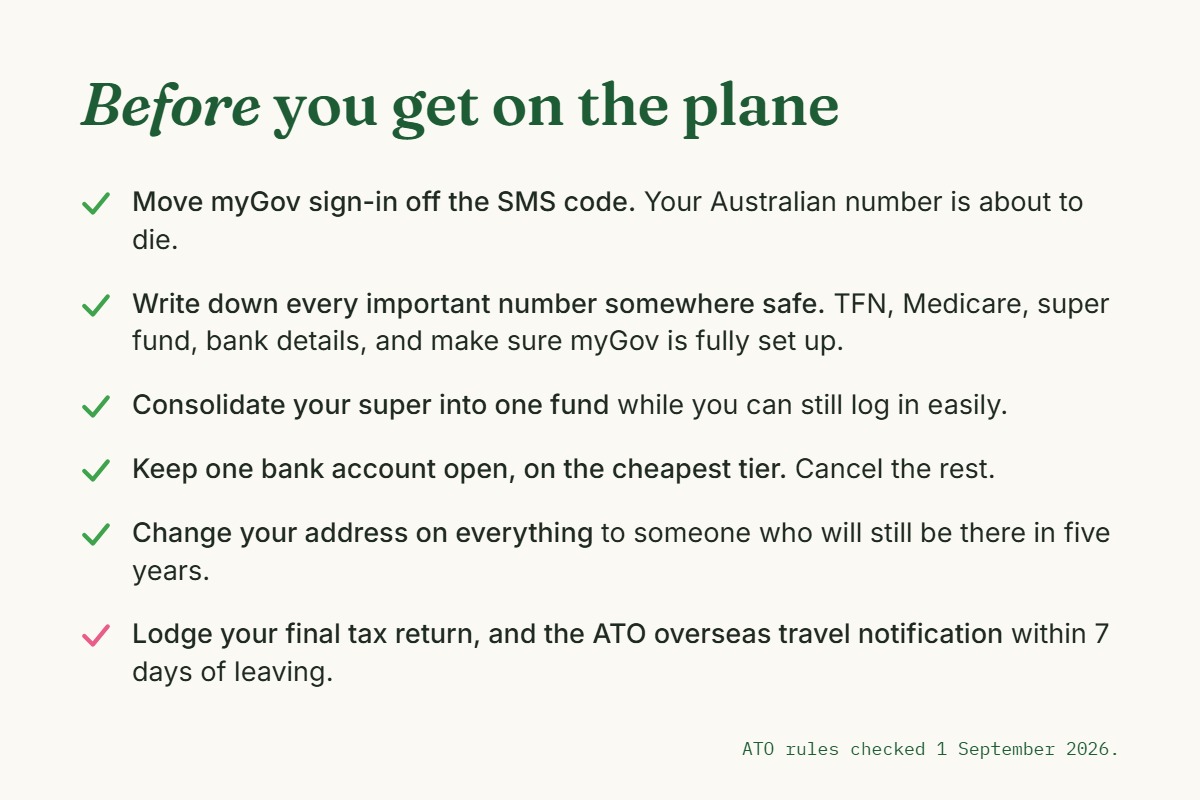
    In every guide I read it’s about what you need to do to set-up your life in the UK which is fantastic, but what about all the elements you need to do when leaving Australia? This guide will cover everything you need to know as an Aussie leaving Australia. I’ll cover things like tax, voting, banking and much more.

    Australian Tax

    ato website

    Being a resident of Australia, you will still need to do some tax activities while living overseas like non-lodgements, repaying HELP or TSL and paying tax on interest or investments. A few things you should consider before leaving are:

    Ensure myGov Account is Set-up

    This is one of the biggest mistakes I made when moving overseas, I always used an account so I never set-up a myGov account. Make sure you have set-up your account and have your passwords saved so you can get into the account. It will save you money when you need to do non-lodgements, tax returns or anything else you need to check.

    If you don’t have an account ATO will need to ask you two questions about:

    • Bank account details – this evidence failed for me as it was linked to my accountant.
    • Notice of assessment (one from the last 5 years) – scan copies of your assessments in case you need to the details.
    • Superannuation account details (one from the last 5 years)

    Repaying HELP and TSL Overseas (If Applicable)

    The Australian government announced a few years back that you will need to pay your HELP and TSL debt when living overseas. For those who only plan on being here a short time this won’t apply to you but those who plan on being out of the country for more than 183 days or more in any 12 months will need to pay.

    As of the 2017 to 2018 tax year these were the rules (the ATO have not updated for the 2018 to 2019 tax year).

    Your worldwide income
    What you need to do
    If your worldwide income for the 2017–18 year is at or below $13,968 (AUD). This is 25% of the minimum repayment threshold.
    You need to lodge a non-lodgement advice form.
    If your worldwide income for the 2017-18 year is above $13,968 (AUD).
    You need to report your worldwide income.  

    You can find all the details about what to do here.

    Foreign Residence Tax

    I mainly wish I had known about tax (super boring). Basically, I kept all my accounts in Australia including saving accounts which earned interest. As a foreigner any investment like properties, savings, shares and whatever earns you money within Australia will mean you fall into the foreign tax bracket.

    The outcome of being a foreigner means if you earn more than $1 you will need to pay tax.

    In the 2017/2018 tax year, I earnt $2 of interest and what an expense it was sorting this out. I have spent $90 sorting out 20 cents I owe the tax department for $2 of interest I earned. The ATO spent more on sending the letter to the UK than what I owed – ridiculous!

    For savings accounts it’s easy and you have two choices that your bank can support you with by withholding taxes:

    • Remove your TFN number (the bank will automatically withhold tax)
    • Ask the bank to withhold tax

    I can’t comment on the other areas as I’ve not had any investments and suggest talking to an accountant before making the move if your tax will be complicated.

    To find out if you need to pay tax or what to lodge you can use the ATO calculator as a guide.

    Money

    Banking in the UK

    Accessing your money overseas is handy (how else would we get those plane tickets?) and one of the most important items on the to do list. Not only can you save money by making the right decision, but it creates a stress-free environment when relocating.

    Most of this section is optional as it’s up to you how you want to manage your finances.

    How Much Money Should I Save to Move to the UK?

    Your savings might look big in Australia but then you exchange to pounds, next thing you’re your Aussie dollars are cut in half (depending on exchange rates at the time). Your poor savings account will take a hammering when moving to the UK. As a single person I recommend bringing over $10,000 to cover three months’ accommodation, travel, food, six weeks’ worth of bond money, being without a job and some money for fun activities. You will need to adjust your budget if you are moving as a couple or a family.

    I breakdown the cost of moving to the UK here and the cost of living in London based on my experience here.

    Tell Your Bank

    As I mentioned in the tax section, ensure that you tell your bank that you are leaving the country so they can set you up as a foreigner and ensuring they don’t block your cards and anything else they may do whilst you are overseas.

    Bank Fees (optional)

    Investigate whether there are accounts you can move to without fees or have minimal fees. With my bank there are no accounts I can move to that didn’t have fees that came with debit cards and all the banking needs I have. I now pay $5 every month to keep my account open which is about £60 a year. There was no point having the online savings account because I can’t transfer any money in and out without a current account attached to it.

    Setting up an HSBC UK Bank Account (optional)

    Setting up a HSBC UK Bank Account

    Setting up a bank account in the UK can be a bit of a nightmare if you don’t have proof of address. One of the ways around this is a month before or earlier you plan on leaving for the UK set up an HBSC overseas account.

    Simply get the below documents ready as evidence for your application and apply on online.

    • Passport
    • Proof of income
    • Source of income
    • Other documentation such a visa may be required subject to qualifications, status and local country laws and regulations.

    Once the application is completed one of their International Banking Specialists will get in touch with you to arrange a meeting to verify your documentation, alongside your application form.

    Of course, there are more options available but without out proof of address in the UK it’s hard to set-up a bank account. I’ve detailed the bank accounts you can get without proof of address here.

    Don’t forget to read how to build a credit score as a new UK resident.

    Apply for a Stop-gap Card (Optional)

    If HSBC isn’t your preferred option, then you will be an overseas credit card or travel prepaid card before you leave. There are so many to choose from: NAB, Commonwealth Bank, ANZ, Qantas Card, Travelex, Australia Post, Velocity Frequent Flyer, St. George, Westpac, Travel Money O and many more!

    I used the 28 degrees Master card as my travel credit card as you pay no foreign transaction fees on purchases when travelling or shopping online and it had no card fees. Plus, a credit card comes in handy for emergencies.

    It gives you a convenient way of accessing money before you have all your finances set-up.

    Cancel Credit Cards (Optional)

    Cancel any credit cards that have a fee associated with them. You will need to remember to pay the yearly fees and spending money on your Australian cards means you will be hit with exchange rates. Instead look at getting a UK credit card when you are ready which will help with your credit score. 

    Loans (Optional)

    In 2018 the Australian population borrowed $2.54 billion in personal loans and therefore there is a chance that you could have a personal loan that you’ve not paid off. No judgement here, I moved over with a personal loan when moving to the UK. The biggest thing to factor in is:

    • Can you afford to pay it whilst you are looking for a job?
    • Can you fund it with your UK salary?

    It’s also important to know when your loan ends and any details you need to know about your accounts.

    For my loan I just made the repayments every week and then finally had enough funds to pay it off (only) to realise my loan company had changed! It wasn’t hard to get in touch and pay off the loan in the end, however it did require me to have a BPAY account, so I had to get my mum to step in.

    p.s. BPAY doesn’t exist in the UK.

    Transferring Money

    Transferring money with your bank can be a costly expense and I know very well from experience. Generally, banks will give you bad exchange rates and super high fees with the transfers. Look into companies that specialise in transferring money overseas like Wise, Western Union and World Remit. I still can’t believe today how much money I lost by using banks and not investigating the best way to transfer my money!

    Personally, I now exclusively use Wise as I tend to find they give the best Aus to UK and UK to Aus rates. If you are interested in Wise here is my referral code.

    Superannuation

    As a citizen of Australia, your superannuation is locked in place until you meet the conditions of release (i.e. reach preservation age and retire or satisfy another condition of release) – even if you have no intention of returning.

    The one thing to be mindful of is if your super fund cannot contact you then they could transfer your superannuation to the ATO. You can read more about the ATO managing your funds here.

    Notify your super fund that you are moving overseas so that they can continue managing your fund. 

    The UK has pensions which UK employers will pay into, so you won’t be receiving funds into your super unless you decide to self-contribute while living aboard.

    Combining Your Superannuation (optional)

    To save on fees and charges you should look at combining your superannuation and will make it easier to keep track of your super.

    Before I really knew how to manage my funds, I had three super funds managing my money and two smaller funds which I basically just lost money with, plus I had no idea who was managing them. Your main super fund will be able to track your other accounts and once you give them permission, they will request for the money to be transferred. It was super easy, and I didn’t have to do any of the leg work.

    Welfare Benefits

    Any government benefits you receive in Australia you will not receive if you move overseas with a few exceptions. To find out more check the Department of Human Services.

    Voting

    Australia still requires you to vote overseas if you plan on returning within 6 years. By registering as an overseas voter, you will be provided with an option to become a general postal voter so you will automatically receive a postal vote in the mail approximately 2–3 weeks after the announcement of the federal election.

    The other way you can vote is by going to the Australian Consulate in London if you don’t wish to do postal votes.

    If you plan on moving overseas indefinitely then you can unenroll to vote.

    All information about voting overseas can be found here.

    Driving in the UK

    Can I Drive in the UK on an Australian License?

    Australia and the UK have a reciprocal agreement which means you can drive and exchange your licence in the UK. For the first 12 months in the UK you won’t need to exchange your licence but after this you will if you wish to continue driving.

    Planning on purchasing a car? Insurance will be super expensive with your Australian licence (i.e. 3 times the price). I suggest waiting until you qualify for a UK licence as it will save you a ton of money.  To qualify for exchange, you need to have lived in the UK for 185 days.

    Suggestion for Car Insurance Companies

    Occasionally on the Aussies in London Facebook group car insurance question will pop up, there are two companies’ people normally recommend:

    As a general rule, Third Party is often cheaper than comprehensive insurance. Being under the age of 25 will also increase your car insurance.

    International Driving Permit (Optional)

    When travelling, rental car companies and other countries may wish for you to have an International Drivers Permit (IDP). For ease of renting cars, you may wish to get one before leaving Australia. They don’t cost a lot of money and it’s just another thing you don’t need to worry about if you do decide to drive around.

    You will also get cases where the car companies might not ask for the IDP but if you get pulled over by the police, they will be expecting to see this document.

    IDP in Australia are state specific, here are the following authorities you will need to contract to get one in your state:

    Health

    Healthcare in the UK

    Before we get into organising your health it’s important the note that your health may take a hit when moving to the UK. The strains of colds, flu and other bugs are different in the UK than Australia. People complain about the levels of sickness they experience when they first arrive here. Once you have adjusted to the changes your body will get back to normal (at least that’s what happened to me).

     Health Checks and Vaccinations

    Consider seeing your doctor, specialist or medical professional before you depart, especially if you have an existing medical condition. Just a general health check, ensure your vaccinations are up-to-date and anything else you need to discuss. 

    Medication

    If you take medication you should consider looking to:

    • Ensuring that you have enough for 2-3 months to get you through the initial set-up in the UK. For ladies this includes your pill (even though it’s free in the UK it will save you stressing).
    • Get a letter from your doctor supporting the medication you take, how much, why you take it and any medical documents to support this. Also, not all medication is the same in the UK so it might be worthwhile asking your doctor to investigate UK alternatives.
    • Keep the original packaging when travelling.
    • Check with your doctor that it’s legal in the UK or some medication in Australia might not be available over counter for example.

    Vaccination Card (Tip for Travelling)

    Bringing your vaccination card over with you is super handy when you need to travel. It’s one of those things I just added in with my documents I was bringing with me and came in handy when I was getting vaccinations for a trip to Vietnam. They knew exactly when I had my last jabs, so it was easy to determine the ones I needed to get for the trip, plus some countries require you to take the vaccination card with you to enter. Please note this is if you wish travelling whilst you are in the UK to countries like Africa or Asia, the UK doesn’t require you to have any vaccinations as a mandatory requirement for Australians.

    Prescription Glasses or Contact Lenses

    If you wear glasses take along a spare pair and/or a copy of the prescription so that they can be replaced if lost or broken.

    Bring enough contacts to last you for a few months or if they get lost.

    Reciprocal Health Care Agreements

    Australia has reciprocal health care agreements with the UK and as a tax paying resident you will get access to the NHS.

    Read more about the reciprocal health agreements and who is eligible
    There are a few questions I see popping up in forums whether NHS replaces travel insurance, the reciprocal health agreement with Australia nor the National Healthcare replaces your travel insurance. When you are travelling I suggest getting travel insurance as it will give you more coverage.

    Cancelling Private Health Insurance (Optional)

    Cancelling private health insurance is something to consider if you are moving over for a long time as it won’t provide you any benefit in the UK.

    An important thing to note if you are still earning a taxable income in Australia is that you may be subjected to the Medicare levy surcharge even if you are living in the UK. So, if you cancel your private health insurance while travelling overseas, you may be liable for the Medicare levy surcharge if your income exceeds the relevant threshold.

    Speak to your private health insurer about what it will mean to you if you cancel or suspend your cover.

    Travel Insurance

    One of the biggest reasons why us Aussies move overseas is to travel. I recommend that you get travel insurance to cover your first 6 months in the UK. Generally, travel insurance companies in the UK will not cover you in the UK until you have been living here for 6 months but you can always review the policies to see if the insurer has different rules.

    The other thing to consider with travel insurance is if you are insured in the UK the treatment will be in the UK. If you wish during an emergency to be sent back to Australia, then you need Australian Travel Insurance.

    Very generic but insurance is normally determined on if you are citizen or resident:

    A citizen is described as passport holder with:

    • a permanent residential address
    • with unrestricted right of entry to the country.

    A resident is a holder of a residency visa with:

    • unrestricted right of entry into the country
    • access to long-term medical care
    • a permanent residential address in the country.

    Important Documents

    Packing your passport and credit cards is great but if you intend to stay overseas for an extended period then you should consider bringing those important documents with you like:

    • birth certificate
    • marriage certificate
    • citizenship certificate
    • divorce and custody arrangements
    • tax documents (tax assessment etc)
    • educational qualifications.

    Scan all your important documentation along with your passport and visa.

    Packing for the UK

    Kat with a suitcase and clothing items covering What to Pack When Moving to the UK
    Watch the UK packing list video!

    Minimising your belongings is scary and exciting. It is the one and only time I would consider myself being a minimalist! At the end of the day, the UK has plenty of shops so whatever you miss you will be able to buy here.

    A full UK packing list can be found here. There are a few items that I think need an honourable mention, they are:

    • Australian power board- if you have a few devices this will make your life easier when charging devices.
    • Comfortable shoes – you will be walking a lot!
    • Interview outfit – got to look good for those interviews.
    • And stock up on your favourite things! There are some things that you can get in the UK like vegemite but if you are a chicken salt lover this won’t be available in the shops. Same goes with beauty products as some brands may not be available in the UK.

    Other Things to Organise

    An epic amount of organising was covered in this article and it’s not the end of the list of things to do before moving to the UK. Here another pre-departure article and checklist covering all the other areas not mentioned in the article.

    More Moving to the UK Articles

  • How to Travel Through the Balkans (6 Modes Explained)

    How to Travel Through the Balkans (6 Modes Explained)

    One of my favourite places to travel is the Balkans. It’s super cheap, everyone’s really friendly however getting around can take a little planning or long-winded searches on the internet as I found out. The initial questions I had when planning my trip were:

    • What’s the best way to travel across these destinations?
    • Rent a car? Are the roads good in those countries?
    • Should we catch the train? Are the connections between the countries easy? Is it worth buying an InterRail Pass?
    • Is Bus or Coach easier?
    • What other modes of transport are available?

    In this guide, I will cover everything you need to know about transport in the Balkans. From travel tips, modes of transport you can take, useful website, safety travelling in the Balkans and much more. 

    How to get to the Balkans by Plane

    While low-cost carriers like Ryanair, Wizzair and Easyjet fly to destinations in the Balkans it’s not always cheap to fly into some of the destinations. In my experience flying into cities like Sofia, Zagreb, Athens or Budapest is way cheaper than flying into Belgrade from London for example. Plus, there is generally more flights into these cities. 

    It does mean that if you are planning a short trip it can either make the travel time longer or you end up spending more to get to the places you want to go to.

    To find flights I use websites like Skyscanner and Kayak to find the right flights, play around with routes etc. To get you started here are the major international airports in the Balkans:

    Flying to Albania
    Tirana International Airport Nënë Tereza.

    Flying to Bosnia and Herzegovina
    Sarajevo International Airport and Banja Luka International Airport.

    Flying to Bulgaria
    Sofia Airport, Plovdiv Airport, Burgas (Bourgas) Airport and Varn Airport

    Flying to Croatia
    Dubrovnik Airport and Zagreb Airport

    Flying to Kosovo
    Priština (Pristina International Airport)

    Flying to Macedonia
    Skopje International Airport and Ohrid St. Paul the Apostle Airport

    Flying to Moldova
    Chișinău International Airport

    Flying to Romania
    Bucharest Henri Coandă International Airport

    Flying to Serbia
    Belgrade Nikola Tesla Airport, Niš Constantine the Great Airport and Vršac Airport

    Flying to Montenegro
    Podgorica Airport

    Flying to Slovenia
    Ljubljana Jože Pučnik Airport

    Flying to Greece
    Athens International Airport

    How to get around the Balkans by Trains

    Train station in Mostar Bosnia and Herzegovina

    Trains aren’t my preferred mode of transport in the Balkans as the connections between the countries are not always straightforward as it is by bus. When you do get trains, the scenery is absolutely stunning and is a great way to travel.

    An example of the difficulty of travelling by train is Dubrovnik to Split and seems like such an easy route to take but it’s not possible by train, you will only be able to catch a bus, ferry or Minibus there. Additionally, there are absolutely no trains to Greece or Albania, between Macedonia and Bulgaria, Croatia and Montenegro or Serbia and Bosnia and Herzegovina.

    Then you get journeys like Mostar to Sarajevo which is totally possible by train! My main point to this section is to do your research on train routes before travelling. Some countries it will be easier to reach from western Europe by train, so it can be another great way to enter the area and go by bus from there on.

    Of course, there are benefits by travelling overland by train like catching an overnight train to save on a night’s accommodation like we did when catching an infamous overnight train from Belgrade to Budapest.

    Before you travel check out these websites which will give you more detailed information:

    • Rail Europe – Provides information on fares and passes as well as schedules for the most popular routes in Europe.
    • Man in Seat 61 – Provides excellent independent information and advice.

    Classes

    The classes on the trains will be based on whether you are taking a short trip or a trip that has sleeping options.

    As a general rule:

    • Hard seats – What I would say is as comfortable as a park bench. I had this style of seating on a train from Novi Sad to Belgrade which is fine for an hour or two’s train ride.
    • Soft seats – Available for both short travel and overnight trains. The seats are quite comfortable and were the option we ended up with on our train ride from Mostar to Sarajevo and Belgrade to Budapest. 
    • Third Class Berths – A six-person sleeping berth in a closed compartment. These styles of the cabin can be quite crowded with little room for your things and stuff. Although the cheapest option if you are looking to save money. This option isn’t as widely available.
    • Second Class Berth – A four-person sleeping berth in a closed compartment. If there are two of you, you will share with two other people but if there are three of you, you will often have the compartment to yourselves.
    • First Class Berth – A two-person sleeping berth and generally fancier with a washbasin and decoration. A high price tag will come with this option.

    Reservations

    Mostar to Sarajevo train tickets with reservations

    All our train reservations were made on the day or when we arrived at the city we were travelling from. Online booking is not common and will be dependent on the country or train provider. For Bosnia and Herzegovina and Serbia we were unable to book tickets online.

    It was super simple:

    • Buy tickets at the station (there are always places)
    • Some require having a seat reservation with your ticket (the ticket office should give you this). Seat reservations several days in advance are also recommended for busier routes and during peak summer periods, but this is only necessary if the timetable specifies that seat reservations are required.

    Rail Passes

    An option to consider is rail passes for your journey in the Balkans. Keep in mind that not all the countries covered by rail passes; Kosovo and Albania are notable exceptions.

    Discount prices are offered to travellers under the age of 26 and children aged four to 11 are eligible for a child rate. Discounted fares are also available if you are travelling in a group of two to five people (although you must always travel together).

    With the passes there are two options you can choose from:

    • Single-Country Passes – Simply it gives you train travel for one country, with the freedom to explore its numerous cities and towns. 
    • Multi-Country Passes – Allows you to travel across to multiple countries with a single rail pass. For the Balkans, these are offered by EuroRail.

    For more information look at Rail Europe.

    InterRail

    The InterRail Global pass is available for the following Balkans countries: Bosnia and Herzegovina, Croatia, Macedonia, Montenegro, Serbia and Slovenia.

    Europeans residents (living in Europe for over 6 months), some resident of Turkey and parts of North Africa are eligible for the InterRail pass. It’s not valid for the country you live in essentially so it’s good to check the terms and conditions before booking. The pass is not available to non-European residents.

    Check InterRail for more information.

    Eurail Global

    Just like the rail passes EuroRail offers single and multi-country passes which are available for non-European residents.

    Single country passes are allowing unlimited travel in Croatia, Greece, Serbia and Slovenia. 

    The multi-country pass allows travel in three, four or five neighbouring countries, including Croatia, Slovenia, Montenegro and Serbia. For some of the country’s combinations, two countries may be classified as one like Montenegro and Serbia are classified as one country for the purposes of this pass, as are Croatia and Slovenia.

    Check EuroRail for the latest information and purchases.

    Coach (Bus) Travel in the Balkans

    Coach (Bus) Travel in the Balkans

    Travelling around the Balkans by bus is quite easy! As with any bus travel, the journey can be quite long but with some entertainment, it’s a great way to catch up on some reading or movies. Unlike train travel buses operate in all countries both internally and internationally.

    Night buses are a good way to save on accommodation. For my Balkans trip, I decided not to do night travel in the end since most seemed to arrive at 4am in the morning and the accommodation was really cheap.

    Quick tips for bus travel:

    • Bring spare cash with you, some to cover the baggage charge and some to cover the toilet costs, you’ll be stuck otherwise!
    • Bring snacks and drinks, an obvious point but the food stops are not great.
    • There’s border control, so stay alerted and keep your belongings close to you.

    Bus Travel Within Countries

    Bus travel within countries is a lot cheaper than travelling internationally and can get you to more of the surrounding towns and areas. If you are struggling to get where you need to head to the bigger the towns which will have better connections.

    In most countries, bus routes are operated by multiple companies, each with its own timetables and fares. It can be hard to find a schedule or price information online and I’ll leave the best links and way to book in the booking section. 

    International Buses in the Balkans

    Travelling by Coach (Bus) from Skopje to Tirana

    Most of our travel within the Balkans was international buses. Personally, I found this was the best way to get to the places we wanted to go. It did take a bit of planning to understand the routes and schedules and go to the bus stations beforehand to find the timetables and purchase tickets.

    Generally, our journeys were pretty easy going. The road can quality vary between countries making the comfortability and journey length different. For example, the road quality was poor in Albania and there is a tremendous number of potholes to endure on the trip! When we entered Montenegro, the road is better quality but they do have very windy roads along the coast added time to your bus journey.

    Border crossing can take a while depending on the traffic, lanes open or if they decide that they wish to search every bag individually.

    Here are detailed guides on the following routes:

    Booking Balkan Bus Travel

    Booking in advance isn’t a must and can be quite hard with the lack of online systems available. In countries like Slovenia and Croatia, it will be a lot easier to book online than somewhere like Macedonia or Albania.

    I would suggest when you arrive at your departure destination going to the bus station to get the latest timetable, understand which company you will be travelling with and just purchasing your ticket while you are there. With the more popular touristic places like Dubrovnik, there will be more demand during the summer months, so this would be the only time I recommend purchasing in advance.

    In doubt ask your hostel or hotel for help on getting the latest schedules and prices.

    Booking at the stations you will encounter two main types of a bus station, one in a parking lot and one in a building. In general, you needed to shop around or know the company you wished to travel in countries like Bulgaria and Albania, alternatively, sometimes there would just be central ticket desks selling tickets for all providers like in Montenegro, Bosnia and Herzegovina, and Croatia.

    For the central ticket, desk takes note of the carrier, so you can find the bus stand and bus you are meant to be on.

    The ticket price will not include the baggage fee so ensuring you have about 1 euro per bag in local currency is a must. We had a few awkward moments on our journey where we didn’t have the right change and ended up holding up the bus.

    How to Search Balkan Bus Routes

    The websites I used for searching bus routes in the Balkans were:

    It’s important to note that the websites may not give you reliable information. A good example was when we were travelling from Sofia to Skopje the bus, we were aiming for which was the 15:00 to Skopje arriving at 19:25. As a precaution, we went to the bus station to ensure we had the right times, bus companies and what not. When we arrived, it turned out the schedule was different than the ones available online, instead, there were buses running daily at 09:30, 16:00 and 19:00. However, when we were travelling the 19:00 was cancelled for the day we were catching a bus to Skopje.

    Border Crossings

    Bosnia and Herzegovina border crossing

    Border crossings were generally easy in our experience. The guard would board the bus to check everyone’s passports or you would get off the bus to a passport counter. The passports were then taken for processing and once clear handed back to the passports back to the owners.

    There were brief checks underneath the bus in the luggage compartments or in some cases you were asked to take your luggage to a room with tables where the luggage would be checked by the guards. They may do stricter spot checks, but we were not subjected to these on our trip.

    Another thing to be mindful of when planning your trip is the complication with the Kosovo-Serbia border. Currently, Kosovo is not recognised by Serbia as an independent state so if you entered Kosovo via Albania, Macedonia or Montenegro, officials at the Serbian border will deem that you entered Serbia illegally and you will not be let in. To avoid this exit Kosovo via another country and then enter Serbia. Alternatively, if you enter Kosovo from Serbia then there is no issue entering Serbia.

    Minibuses

    Minibus (car) travel in the Balkans i.e. guy driving you in his 4-seater car
    Minibus (car) travel in the Balkans i.e. guy driving you in his 4-seater car

    About halfway into our Balkans trip, we discovered that lots of hostels had teed up with companies to provide minibus options between countries. The minibus options are surprisingly not too pricey compared to catching a bus and much quicker. 

    The minibuses can be anything from a large van to a guy driving you in his 4-seater car while you are squished together. Some are even door to door service which is a luxury!

    Booking Minibus Travel in the Balkans

    Sign in the hostel to book minibus travel in the Balkans

    The best way to book minibus travel is via the hostel or hotel you are staying at. Normally in the reception area, there will be a sign stating the route and cost. Just tell the receptionist the route you wish to take and next thing you know it will be all booked, plus provided with all the details you need.

    You will be matched with other passengers travelling the same route as most services have a minimum number of 3 to 4 people before they will schedule your departure. In Sarajevo, we were lucky that another hotel/couple were heading to Belgrade when we needed too.

    To book online you can look at:

    • GoOpti for minibuses in northern Croatia, Slovenia, Italy and Austria.
    • Gea Tours have a range of route in the Balkans but there seem to be a few issues with their website and someone hacking their site, so I would use this with caution.
    • Taxi Travel operate transfers to the main cities in Austria, Croatia, Hungary and Serbia.

    Minibus routes

    There isn’t a definitive list available online, here is an example of routes available from Belgrade to other nearby cities:

    • Belgrade to Budapest
    • Belgrade to Sarajevo
    • Belgrade to Timisoara
    • Belgrade to Vienna
    • Belgrade to Zagreb

    Ferries

    Local ferries in the Balkans

    Ferries are a limited way of getting around the Balkans. Lots of the boats that go between the destinations are organised day tours like the popular day trip route Dubrovnik to Kotor and Budva in Montenegro.

    The routes you can take are:

    Travelling by Car

    The best way is definitely by car, preferably your own, because it’s difficult and expensive to take rental cars across borders. It’s the best strategy to get you to the offbeat destinations that you can’t get public transport too.

    An important thing to mention and I cover this above in the bus section (skip above) is how you enter and exit Kosovo. Make sure you plan this correctly so you don’t get into any trouble.

    Renting a Car

    Car rental within a country is great but as soon as you leave the country you’ve rented the car from there are fees or restrictions with crossing borders and one-way car hire. The option is best suited to those wanting to explore the country in-depth and dropping the car to the same destination.

    Things to consider before renting a car

    • Renting a car anywhere (apart from your home country) will require you to have your passport and driver’s license.
    • As a general rule for those that hold a European Union driving license, you will not need to obtain an International Drivers Permit (IDP). For example, if you are driving from London to the Balkans you may decide to drive through Italy which will require you to have an IDP if you don’t have EU license.
    • Check the simple things like no hidden fees, how many drivers you can have or that you have unlimited mileage.
    • One of the biggest ways that car rental companies earn money from you is via insurance. Picking up third-party insurance will save you a ton of money.
    • Can you drive manual transition? Most cars offered in Europe will be manual so if you can only drive automatic this may drive up the price.
    • Consider emailing the hire car company to negotiate the price of the rental.
    • Not all countries have the Latin alphabet some will be in Cyrillic alphabet making it interesting understanding where you need to go.
    • The Green Card Insurance System – you need a green card to show that you have insurance. Car hire companies will usually charge extra for this card (actually a piece of paper).

    Driving your own car

    Driving your own will give you the freedom to cross borders without all the costs that a hire car comes from. The crucial part of driving your own car is knowing the documentation you will need for your car to drive across borders. The main one is the Green Card Insurance System.

    Green Card Insurance System

    As I mentioned above the Green Card Insurance System is something you need to be aware of when driving your own car in the EU. This is your proof of insurance and shows on it the countries you’re insured to drive in. Ensure you are clear with your insures about which countries you can and can’t go to within your policy.

    Before you leave your home country make sure you have the green card otherwise you could end up paying double insurance to get another green card to enter your destination. It’s not applicable in all countries so check the countries you are travelling to and through.

    Is it Safe to Drive in the Balkans?

    Being a confident driver helps greatly with driving overseas. It’s an experience driving in the Balkans and not for the faint hearted. The roads can be the width of 1 to 1.5 cars, meaning you need to pull to the side of the road and let people pass. That doesn’t mean the locals will follow the same rules, generally they will be speeding past you whilst you are trying to be safe! Take it slow and keep to the road rules, at the end your safety is the most important part of driving.

    Animals on the road are another hazard of driving in the Balkans. You can stumble across all types of farm animals and wildlife.

    The road quality will be a mix of some good roads, some bad roads and some horrible roads. Researching the road quality and route you wish to take will ensure you get there safely and quickly. Here are some tips:

    • Check between different navigation systems
    • Look at Google Satellite to see the road quality
    • Search YouTube or Google to see if there are any videos, photos or comments about the roads
    • Ask locals for advice as the roads are constantly being re-done and the locals will know the best routes.
    • Travelling on a sealed road will be beat driving on an unsealed road. Sometime navigation systems send you via the quicker route but later you find out it’s a dirt track taking 5x times longer.

    In conclusion: Travelling in the Balkans requires a bit more flexibility and accepting of a mix of transport options available. Take the trains, if there are no trains take buses and rent a car here and there to explore regions more deeply.

    Have you ever been to the Balkans? What was your experience with transportation?! Any tips you recommend?

    More Balkans Articles

    How to Travel Through the Balkans
    How to Travel Through the Balkans: Everything you need to know about the different modes of transport in the Balkans from Bus, Train, Plane, Minibus, Ferries and Car. Balkan travel tips include how to get to your Balkans Destinations, useful website, safety travelling in the Balkans and much more. #Balkans #Croatia #BosniaandHerzegovina #Slovenia #Serbia #Montenegro #Kosovo #Macedonia #Bulgaria #Albania #Greece
  • Driving in Italy: 18 Tips on How to Drive as a Tourist

    Driving in Italy: 18 Tips on How to Drive as a Tourist

    Driving in Italy can be a stressful experience especially if it’s not in the language you speak or the side of the road you drive on. Personally, as long as it’s not city driving it’s well worth getting a car in Italy to explore the towns and regions.

    As a tourist, it’s always great to study up on the rules of the road before renting a car and driving yourself around in it. This everything I learnt when driving in Italy. P.s. if you happen to be visiting Tuscany check out the beautiful town of Radda.

    Do I need an International Driving License in Italy? (Officially known as International Drivers Permit (IDP))

    Renting a car anywhere (apart from your home country) will require you to have your passport and driver’s license. However, some countries also require an International Driving Permit (IDP).

    For those that hold a European Union driving license you will not need to obtain an International Drivers Permit (IDP). I drove in Italy with my UK license which is the pink format UK license (full license), however, if you are on the green format license (provisional) you will not be able to drive in Italy.

    If you have a non-European Union driving license you will need to obtain an IDP before arriving in Italy.

    How to Obtain an International Driving Permit?

    You can get an IDP at your local association for example;

    Make sure you go via an official website as there is a scam out there for IDP’s.

    It is the traveller’s responsibility to ensure that they have the appropriate paperwork. Even though you may not be requested to show your IDP by the car company or travel agent, if you get pulled over by the police they will be expecting to see your IDP. I recommend even though it seems a silly process it gives you peace of mind while driving legally during your trip to Italy for only a small fee.

    Cheap is not always best when renting

    Cheap is not Always Best When Renting a Car in Italy

    For our trip to Italy, I rented a car from a cheap hire company. It’s not awful but make sure to read the fine print and know exactly what comes with your rental. They really lure you in with their great offers!

    Check the simple things like no hidden fees, how many drivers you can have or that you have unlimited mileage.

    I may have hit a sign with our rental car (whoops…) thankfully it was exactly where there was damage on the car previously and no one was the wiser of my minor accident. Otherwise, those nasty fees would have definitely stung me.

    Driving in a new country can be stressful (especially Pisa!) and caused my minor accident so make sure you have insurance. One of the biggest ways that car rental companies earn money from you is via insurance. Picking up third party insurance will save you a ton of money.

    Manual Transmission is the Preferred Choice

    In Europe, it’s very common to get manual transmission cars and will be the option provided to you unless you specified otherwise. Make sure you let the car company that you want to rent an automatic or choose it as the option on the booking site and be prepared to pay a lot more.

    What else do I need to carry in my car when driving in Italy?

    You need to carry triangles in your car when driving in Italy

    I had no idea there were certain things that you need to carry in your car when driving in Italy. Thankfully the rental car companies will provide you with these items which they did for mine. Being in Tuscany I did not think I would need snow chains in March!

    Double check when you pick up the car just in case. Planning to drive your own car in Italy you will need to consider purchasing some of these items. So what do they expect you to have?

    • Warning triangles and reflective jackets (compulsory attire) – in case you need to pull over on the side of the road
    • UK cars will without a GB-euro symbol number plate to display a GB sticker
    • Snow chains during the winter months

    Other items to add to your checklist:

    • Full and valid driver’s licence
    • IDP card (if required)
    • Proof of Insurance
    • Passport/national ID
    • Headlamp beam deflectors (if required)
    • Proof of ownership (original V5C document, not a photocopy)

    Get a GPS or a Map

    Get a GPS or a Map When Driving in Italy

    I totally recommend that you get some sort of map or navigation as the roads or routes to get to places aren’t that straightforward. There is no way I would be able to navigate driving around without a GPS or a map.

    Which side of the road do you drive in Italy?

    In Italy they drive on the right-hand side of the road. Being a part of the small third-party of countries that drive on the left it can be a tad confusing (at least for me).

    How Do Petrol Stations Work In Italy?

    As I went with a cheap car hire company we had to fill up the car before going on a road trip the first lesson that we learnt and ended up with some pretty expensive full. There are two options to fill up your car, by an attendant or self-service.

    Turns out when the attendant fills up your car you get charged extra €16 cents per litre or gallon (I can’t remember). So make sure you find the self-section to save yourself some serious cash. It also seems to be the option that has the least amount of fill-up points.

    Look out for these signs to tell the difference between self-service and attendant service:

    Self service will look like this at an Italian service station.
    Self service will look like this at an Italian service station.
    Attendant service will look like this at an Italian service station
    Attendant service will look like this at an Italian service station

    Service stations are very frequent along all of the motorways just like most of Europe.

    Speed Limits in Italy

    Speed Limits to remember when driving in Italy
    Speed Limits to remember when driving in Italy.

    Speed limit signs seem to be very limited i.e. the ones that actually show what speed you are meant to go. Most signs are the national speed limits signs so they expect you to know the speed limits before you drive. Make sure you memorise this speed limit in the table below and don’t forget the speed limits vary depending on the weather.

    Speed Limits in Italy
    Motorway
    Dual Carriageway
    Open Road
    Town
    Dry Weather
    130 km/h
    110 km/h
    90 km/h
    50 km/h
    Wet Weather
    110 km/h
    90 km/h
    80 km/h
    50 km/h

    It Might Be Close But It Can Take You Long Time To Get There

    Italy has a lot of windy Roads not very many highways and the roads can be in quite a poor condition (which they introduce speed restrictions for instead of fixing the road). It might be 7 miles away but it can take up to 40 minutes to drive due to this unless you are a rally car driver.

    Everyone Goes Faster Than You In Generally

    Coming from Australia we would only have pretty strict road rules whilst some people break the rules we tend to be careful in breaking the rules as there are massive fines if you are caught. However in Europe you can get some people are going 50 kilometres over the speed limit. As a left lane is generally where people speed or overtake you keep to the right-hand lane. This way you don’t feel pressured to speed and save yourself a speeding fine.

    What is the alcohol limit in Italy?

    Drinking wine in Italy is definitely alluring especially with lunch or dinner. The alcohol limit in Italy is 0.05% so no more than 1 to 2 wines or the safest option don’t drink at all.

    How are fines issued in Italy?

    Speed Cameras in Italy
    Speed Cameras in Italy.

    Police officers usually do not patrol the roads but if are and pull you over the fine will be issued on the spot. The police can collect 1 quarter of the maximum fine and must give you an official receipt for the amount of the fine paid.

    If there is a sign showing with a police officer with a hand raised or orange autovelox boxes this indicates that there will be speed traps and check points.

    There are lots of cameras set up to register a car’s speed and if you are running over the limit it will automatically issue a ticket. If you’ve rented a car in Italy, the ticket will be sent to the car rental company and they will generally charge it to the credit card they have on file plus admin fees.

    Signs on the Autostrada

    Italy uses international road signs. You will see signs like national speed limit which is white and black, green background signs that indicate road names/ types and general signs saying:

    • Uscita meaning Exit
    • Entrata meaning Entrance
    • Tangenziale meaning tangential, usually a ring road around a large town

    Tolls

    Motorways in Italy can have tolls which are really easy to identify as they will have toll stations. There are three ways to pay for the tolls:

    • Cash
    • Credit Cards: Visa, Mastercard, American Express, Diners Club are accepted.
    • Telepass – unlikely method as a tourist, it requires you to have a transponder and linked up to your bank account.

    Depending on how you would like to pay, look out for the following signs:

    • Cash follow the white signs
    • Credit card follow the blue signs
    • Telepass follow the yellow signs.

    Be Careful at Entrances and Exits on the Motorway

    You will generally find that the entrance and exit ramps for the motorways in Italy can be very short or have quite tight corners so be careful when approaching these.

    Tailgating is Common

    Coming from a country where you are supposed to give space on the road, this is the total opposite in Italy. Italian drivers drive much closer to each other than we’d be used to especially when overtaking. They can come right up to your rear bumper and be a little daunting so the easiest thing to do is slow down, let them overtake and continue to drive safely.

    Never drive in the ZTL!

    They have these zones called Zona Traffico Limitato (“ZTL”) also referred to as the“Area Pedonale” which are areas restricted to limited traffic and/or pedestrians only. It’s illegal to drive in these zones unless you have a special permits to do so. Most permit holders are police, public transport and emergency vehicles so not us tourists!

    Watch where you park!

    Ah parking in Italy can be a nightmare in certain areas especially the big cities. Its best to check with your hotel where the best places to park and how to pay for parking as they will have the insider knowledge.

    Always make sure you have a ticket from the nearest parking meter and display it, the fine can add up really fast. The meters are normally coin only so have a few euros prepared.

    Other tips

    • No brainer tip, wear your seat belt.
    • Age limits apply to where people can sit in a car, for example children up to the age of 12 cannot travel in the front seat.
    • Don’t use your mobile phone while driving (again common sense).
    • Always have your headlights on, they are compulsory when you are driving on motorways, dual carriageways and on all out of town roads.
    • In some countries I know they allow you to turn right on a red traffic signal but this is illegal in Europe.

    Let us know in the comments below your tips for driving in Italy!

  • A Travel Guide to Radda in Chianti, Italy (A Dreamy Italian Town)

    A Travel Guide to Radda in Chianti, Italy (A Dreamy Italian Town)

    Dreaming about holidaying to a picturesque Italian town that is full of good wine and food, plus has incredible views like this?

    View of Radda
    View of Radda

    Look no further than the Tuscany region and the beautiful town of Radda. The town was originally built as a fortified town, some of Radda’s original city walls and towers are still intact. It’s architecture isn’t the main attraction its primary claim to fame is as a wine destination.

    With that there are a variety of wine bars, wine-centric restaurants and numerous well-known wineries in the surrounding countryside. So you can imagine it’s the perfect place to base yourself in Tuscany, it’s close to restaurants, surrounded by good wine and a drive away from major sites.

    What to do in the Dreamy Town of Radda in Chianti

    With an introduction like that you can guess that most of your time in Radda is spent drinking the fantastic wine, wandering the vineyards, eating and a day exploring the nearby towns. Here are 8 things to do in Radda, technically it’s 10 as point 8 is two day trips to neighbouring towns.

    Wander the Street (Town Walls, the Government Building and Medieval Walkways

    Streets of Radda
    Streets of Radda

    Radda was one of the towns in the Chianti region built as a fortified town to protect Florence from their “enemies”. The town had a few hiccups along the way and was completely destroyed in the invasion of 1478. Not to fear, the town was rebuilt (otherwise we wouldn’t be here)!

    So take a wander around the cobblestone streets and explore the history of Radda, discover the hidden and the city walls surround the town.

    Discover the Local Wineries

    Bar Dante in Radda
    Bar Dante in Radda

    Of course, wine lovers will have a great time during a Tuscany break, as outside the town the vineyards stretch for miles and the local shops all stock a good supply of famous Chianti wines.

    I made a massive assumption when I was planning to visit the wineries that they would be open! You need to book with the local wineries to try their wine, especially during low season. We surprised this Italian lady when knocking on her cellar door, she really didn’t expect tourists to be wandering around wanting to try wine.

    To find out what wineries are in the area skip to the next section.

    Learn about Chianti Wine

    Black Rooster of Chianti Wine
    Black Rooster of Chianti Wine

    Over 700 hundred years ago a wine brotherhood formed called Lega del Chianti. They were there to protect the Chianti region and improving agriculture, in particular, wine growing and making. Basically, they are the reason we have commercialised wine from the area.

    The famous rooster on the Chianti classic wines used to distinguish the wine from the area actually comes from the middle ages when Chianti has a “black rooster against a golden background” as its emblem symbolizing the close relation to the land.

    I wish there was a wine walking tour in the region that covers the history as it sounds absolutely fascinating, however, there isn’t so this would be a self-learning activity. Or ask one of the locals/ winemakers to tell you about the region and the wine!

    Slightly further out in Greve there is a Wine Academy. They offer several tastings and tour options. The Lords of Tuscany wine tasting will teach you about the history of Tuscany while guiding you through a tasting of some of its great wines.

    Eat lots of Italian Food

    Classic Italian Pizza
    Classic Italian Pizza

    Naturally in Italy you need to eat all the delicious Italian food. From casual trattoria (less formal than a restaurant, generally with no menus and wine served from a decanter) to restaurants offering a range of food from traditional dishes, cheese and wine pairings to pizzerias.

    I’ve listed all the restaurants we visited in Radda below. 

    Try Cantuccini with Vin Santo for Dessert (Biscotti di Prato)

    Try Cantuccini with Vin Santo for Dessert (Biscotti di Prato)
    Try Cantuccini with Vin Santo for Dessert (Biscotti di Prato)

    We were introduced to dipping cantuccini with Vin Santo (Biscotti di Prato) in Radda. This dessert is one of the more famous desserts from Tuscany. Either pick up the combination in one of the local stores or order at one of the restaurants (it’s a popular item on the menu). Simply dip the cantuccini in the wine. As the biscuits are quite hard the wine dipping softens the biscuit a little before eating.

    It’s the most amazing biscuit and food combination ever! Replace my coffee and biscuits with this any day!

    What is Vin Santo? It is a sweet dessert wine and golden yellow in colour. The wine is made from dried malvasia and trebbiano grapes from Tuscany that is aged in barrels for over three years.

    What is Cantuccini? It is a twice baked almond biscuits.

    Enjoy the views

    The Chianti region is an area Tuscany that stretches between Florence and Siena. Have you seen the gorgeous photos around of Tuscany? If not, here is just a perfect example of how stunning the area is….

    Find a spot where you can enjoy the endless views of vineyards, olive groves, the magical sunsets and just the scenery in general. A bonus if you find a balcony where you can have a glass of the locally produced wine!

    Pick up a souvenir

    Stove Espresso Machines
    Stove Espresso Machines

    Browse the boutique shops for traditional gifts and souvenirs, find locally made crafts and goods, and stock up on quality olive oils and wines. Buying souvenirs is not something I normally recommend but I love boutique shops especially ones that are selling kitchen gear! All the shops here are run by the locals so you will be supporting them as well.

    Explore the Neighbouring Towns

    The two choices I would recommend visiting on a day trip is San Gimignano and Sienna. The towns are roughly an hour’s drive from Radda.

    The towns are hot spots for tourists so if you want to avoid crowds of tourist buses and vendors fighting for your dollar then head early or later in the day to get the full charm of the towns. 

    San Gimignano

    Streets of San Gimignano
    Streets of San Gimignano

    Located up in the Tuscan hill side you will discover a visually striking and perfectly preserved walled town of San Gimignano. An iconic feature of the town is the 14 towers which once used to be 72. The locals used to have competitions on who could build the tallest towers until the Florentines decided to knock them down (except for San Gimignano lucky 14 towers).

    Here’s a quick half a day itinerary:

    At the centre of town is Pizza della Cisterna, a lively square filled with history, rustic façade and most importantly the best ice-cream is located in the square! Gelateria Dondoli. Make sure you grab some gelato here as it’s amazing then perch somewhere and people watch.

    Icecream from Gelateria Dondoli
    Icecream from Gelateria Dondoli

    Wander to the Piazza del Duomo where the Romanesque cathedral stands. You’ll find Sienese Gothic art from the 14th century. Admire the pair of towers nearby that have stood by each other for more than 700 years. The towers were built by the Salvucci family as vanity towers to show off.

    Get a bird eyes view of the city by heading to the newer City Hall, at 200 feet it is the tallest tower in the town. In side the City Hall there is a museum that documents how people dressed, lived, worked and warred in the 14th century.

    Other places to consider visiting:

    • Torre Grossa
    • Palazzo Comunale
    • Collegiate Church of San Gimignano
    • Sant’Agostino Church

    Siena

    Located slightly south of Florence is the wonderful Tuscan city Siena. Immerse yourself in the Gothic wonders of the city, dramatic architecture and one of world’s most unique piazza. 

    Piazza del Campo
    Piazza del Campo

    Here’s a quick half a day itinerary:

    At the heart of Siena is the Piazza del Campo and should be the starting point of your visit. It is one of the biggest medieval squares in the world and has an unmistakable peculiar shell-shape. 

    Make your way to the top of the square to find Fonte Gaiaits one of the most beautiful fountains in Siena. Unfortunately, it is a copy but you can see the original at the Museum complex of Santa Maria della Scala. 

    Head to Torre del Mangia for a bit of exercise and breathtaking views. Once you’ve climbed the 400 stairs you will be presented with views of Piazza del Campo, Cathedral and the distant hills of Tuscany. 

    Climbing stairs certainly makes me hungry and there are lots of restaurants to choose from but I find the best places are the little hole in the wall types. Look no further than La Piccola Ciaccineria it’s a great little pizza place. There are no seats so you will need to find somewhere to perch but for the price and quality, I have no complaints. 

    Siena Cathedral
    Siena Cathedral

    Other places to consider visiting:

    • the Cathedral
    • the Baptistery
    • the Complex of Santa Maria della Scala
    • the Public Palace of Siena
    • the Civic Museum
    • the Church of San Domenico

    Local wineries that offer tours and wine tastings near Radda

    Don’t be disappointed like we were and make sure you book in advance! All the websites, email address and phone numbers are included below to make the booking process super easy.

    Vignavecchia

    Vignavecchia winery
    Vignavecchia winery

    Only a short walk from town is Vignavecchia winery. It’s a winery that has been run by the Beccari family since the 1870’s producing a number of well-made red, white and rosato wines.

    Website: https://www.vignavecchia.com/
    Phone: +39/0577 738090

    Castello di Volpaia

    Winery in a castle anyone? A short drive away from Radda is the town of Volpaia. The village was built in the 11th century and most of the original architecture is still intact. The winery produces several highly-regarded Chianti, Chianti Riserva and Super-Tuscan wines and the whole village seem to be involved in the production!

    Reservations are required to tour the cellar and/or taste wines. The price for this is 16 euros If you miss booking a tour then there is a restaurant plus it comes with a terrace on the castle walls.

    Website: https://www.volpaia.it/
    Phone: +39 0577-738-066.
    e-mail: [email protected].

    Azienda Agricola Il Barlettaio

    Azienda Agricola Il Barlettaio
    Azienda Agricola Il Barlettaio

    Azienda Agricola Il Barlettaio is a local winery run in Radda run by the Minacci family. The winery is known for producing classic Chianti wine and produce a small number of bottles each year.
    We tried the:

    • Barlettaio 2014
    • Barlettaio 2013
    • Barlettaio Riserva 2011
    • Barlettaio 2012

    Just outside the shops is some picnic tables where it is the perfect place to enjoy a glass of wine overlooking the stunning landscape of Tuscany.

    Website: https://www.barlettaio.it/home%20gb.htm
    Telephone and Fax: +39 0577 738322
    e-mail: [email protected]

    Castello d’ Albola

    Castello di Albola is a drive away from Radda, whilst close the winding Tuscan roads will take you a little time to get there. It’s the highest vineyard in the Chianti Classico region with elevations from 1,150 to over 2,000ft above sea level.

    It’s beautiful estate that you can immerse yourself in Chianti Classico. The winery has been established since the 11th century and then bought by the Zonin Family in 1979. The family are passionate, dedicated and engaging winemakers. The estate upholds old practices of winemaking since it was opened. Try their Albola wines, including their awarded Chianti Classico and Classico Riserva. They also make an 8year old Vin Santo which means you can totally have Biscotti di Prato!

    The tour and wine tasting is 15 euros.

    Website: https://www.albola.it/
    Phone: +39 0577 738019
    e-mail:[email protected]

    Castello di Radda

    On the east hill of the village you will find Castello di Radda. It’s one of the newer wineries in the area and produces Chianti Classico with 100% Sangiovese grape.

    The Beretta family bought the winery in 2003 to expand in their winemaking. As an already establish sparkling winemaker through their other business Lo Sparviere which produces the precious Franciacorta sparkling wines. 

    Website: https://www.castellodiradda.com/en/
    Telephone: +39 0577 738992
    e-mail: [email protected]

    Casa Chianti Classico

    Casa Chianti Classico
    Casa Chianti Classico

    A short 5 minute walk outside the main centre of the town, down the hill and cannot be missed on your trip to the region. 

    The winery is set inside an old convent and is just magical. On a chilly evening you can warm up with the roasting fire but in the summer they have tables in the courtyard which will be an enchanting setting.  A very friendly welcoming staff and superb food and wine. 

    P.s.  no beer is served here, just their fantastic wine. 

    Website: https://www.casachianticlassico.it/en/who-we-are/
    Phone: 0577 738187 or 0577 7382278
    e-mail: [email protected]

    Food and Drink in Radda in Chianti

    Bar Dante

    Cheese at Bar Dante
    Cheese at Bar Dante

    Our first meal in Radda was at Bar Dante. The staff were so welcoming the minute we walked in the door. After an extremely hard time trying to decide on the amazing selection of food we opted for something simple and went with the cheese board and wine pairing. 

    A great introduction to Chianti wine and the cheese was delicious. 

    La Loggia Del Chianti

    Tiramisu at La Loggia Del Chianti
    Tiramisu at La Loggia Del Chianti

    We stopped here for dinner one night and the food was exceptional. Starting off with olive oil served with bread was particularly outstanding. I couldn’t get enough of it (mainly the olive oil).

    We then moved into pasta courses which again were incredible. My only disappointment was when my dish of ravioli arrived it only came with 5 pieces but this happens with this type of dish. To top off the food we got tiramisu. 

    The waiters did struggle to speak English but having a little Italian behind us we were fine. 

    Pizza Pie

    Pizza at Pizza Pie
    Pizza at Pizza Pie

    For a slightly cheaper and filling meal go to Pizza Pie. I swear the pizza was 20″+ and only cost around 20 euros. Again the food quality was amazing. I definitely rolled out of the restaurant… 

    La Bottega di Giovannino

    Good, authentic Tuscan food, excellent wine bar and really lovely staff. When I told them it was my boyfriends birthday they surprised us Cantuccini with Vin Santo. It was the first time I have ever tried this and now I think is now the best thing in the world. 

    Pasticceria Gelateria Sampoli & Lapis

    Perfect place to grab coffee and breakfast. Walk up to the bar, place your order, find a seat and enjoy the buzz of the local doing the same thing around you. 

    When to Visit

    When wine and good Italian wine is involved any time of the year is perfect for a visit. Of course there will be times of year that suit other more. Summer is perfect for the sun-worshippers as you will enjoy 30-degree weather. Prefer fewer crowds and milder temperature then Autumn and spring will be the perfect time with the temperature around 15c to 25c.
    The winters do get chilly being surrounded by the mountain which means that there will be snow. If you love winter then these are the best months for you.

    Where to stay in Radda

    As the town is small there is a limited amount of hotels and price ranges to choose from but there are enough options to suit most people budgets. Airbnb is also another option for the area. We stayed at the Palazzo Leopoldo during our time in Radda. 

    Palazzo Leopoldo Dimora Storica & SPA

    Palazzo Leopoldo Dimora Storica and SPA
    Palazzo Leopoldo Dimora Storica and SPA

    Located in the middle of town the hotel is walking distance to the restaurants and local wineries. Plus any hotels have Scenic views especially of the Tuscan landscape is a winner.

    The rooms are spacious with lush bathrooms and stunning views. The hotel offers an indoor pool and hot tub in the cellar, beneath the vaulted brick ceilings. General amenities are offered like free Wi-Fi and there is free parking in the town. 

    The staff were super friendly and knowledgeable about the area so if you have any questions about the area don’t forget to ask. In the rooms you will also find a folder detailing things to do in the area. 

    Palazzo San Niccolo

    Palazzo San Niccolo is the sister hotel of Palazzo Leopoldo and located just across the road. Similar style as Leopoldo tastefully decorated rooms, spacious, clean, with modern finishing, the bathroom are spacious and beautifully decorated.

    How to get to Radda

    For our trip we flew in Pisa and drove to Radda from there. It’s a cheaper destination to fly into and it’s only a 2-hour drive away. Florence is slightly closer to Radda and only an hours drive.

    Driving is the best option to get to Radda, there are buses but not very frequent. I highly recommend getting a GPS for your journey if you decide to drive. 

    For bus options:

    • From Florence you will need to take SITA 365A to Lucarelli (64 bus stops btw!) and swap to the Siena line S101 which will go first to Radda.
    • From Siena you will take the bus 125.

    Parking in Radda

    The parking in Radda is either around the city wall or on the main street. There is limited parking available but there will be both free and paid. Just look out for the white lined parking areas to score the free parking. The areas that have a blue outline will be the paid sections.