The Islander Bag Experience: What to Know Before You Book
A girls’ day out where you each build your own handbag is the best excuse going to add another one to your collection. You all walk out with a bag that’s yours and a story to go with it.
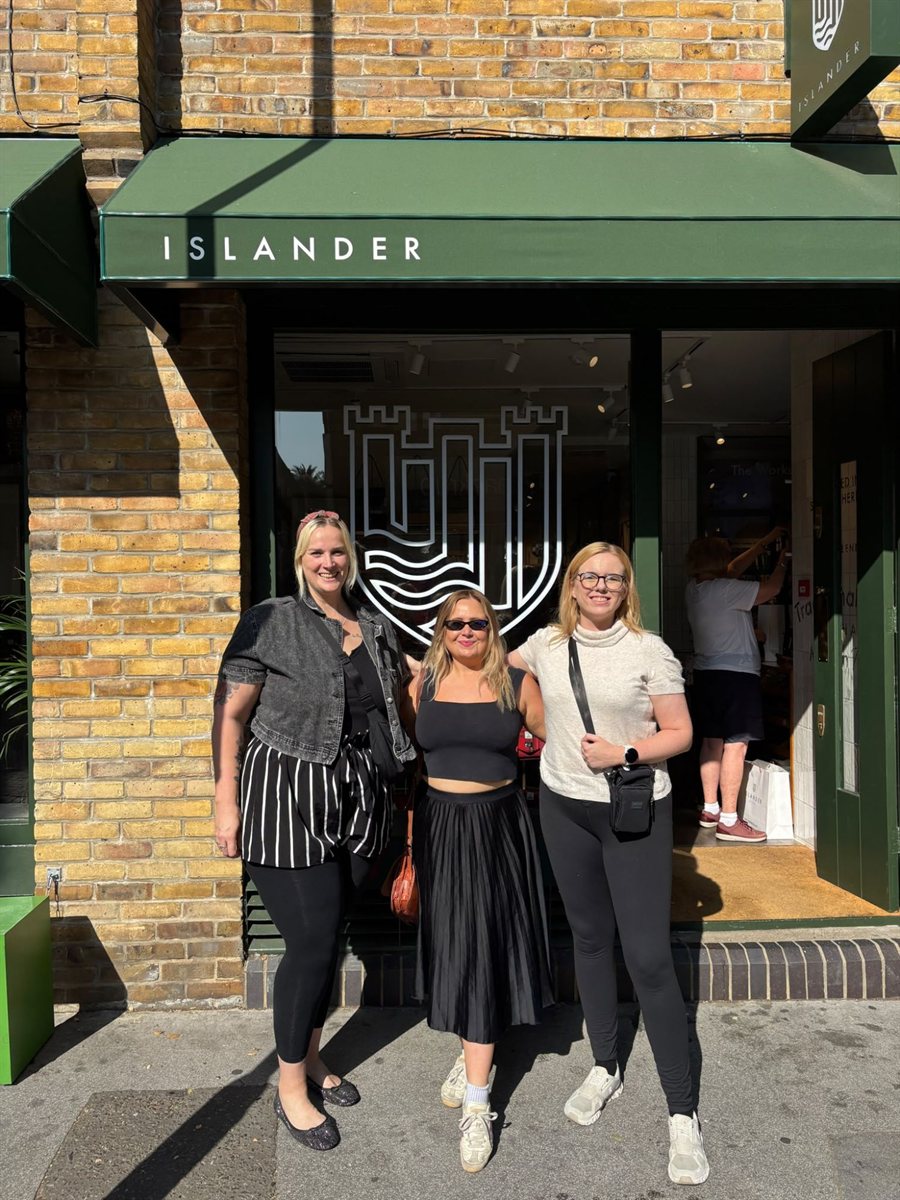
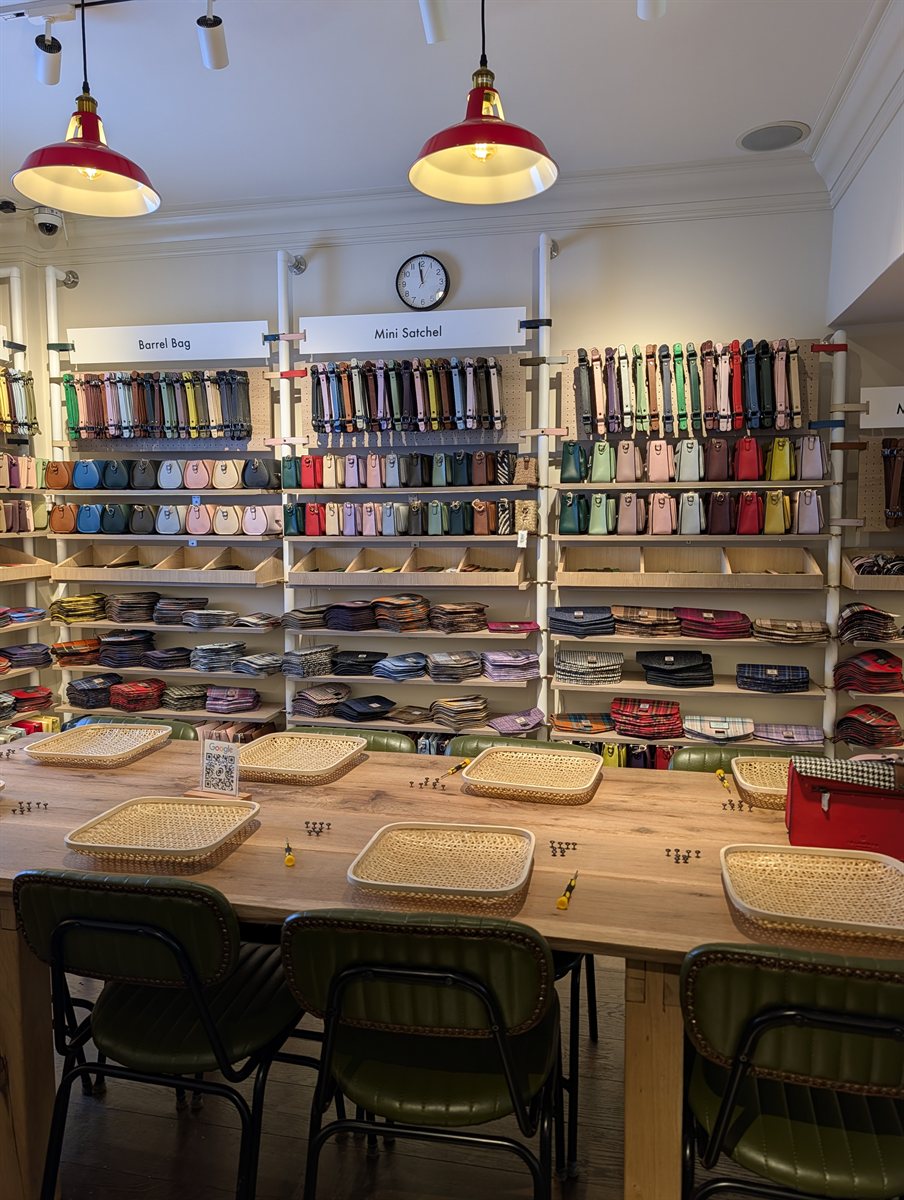
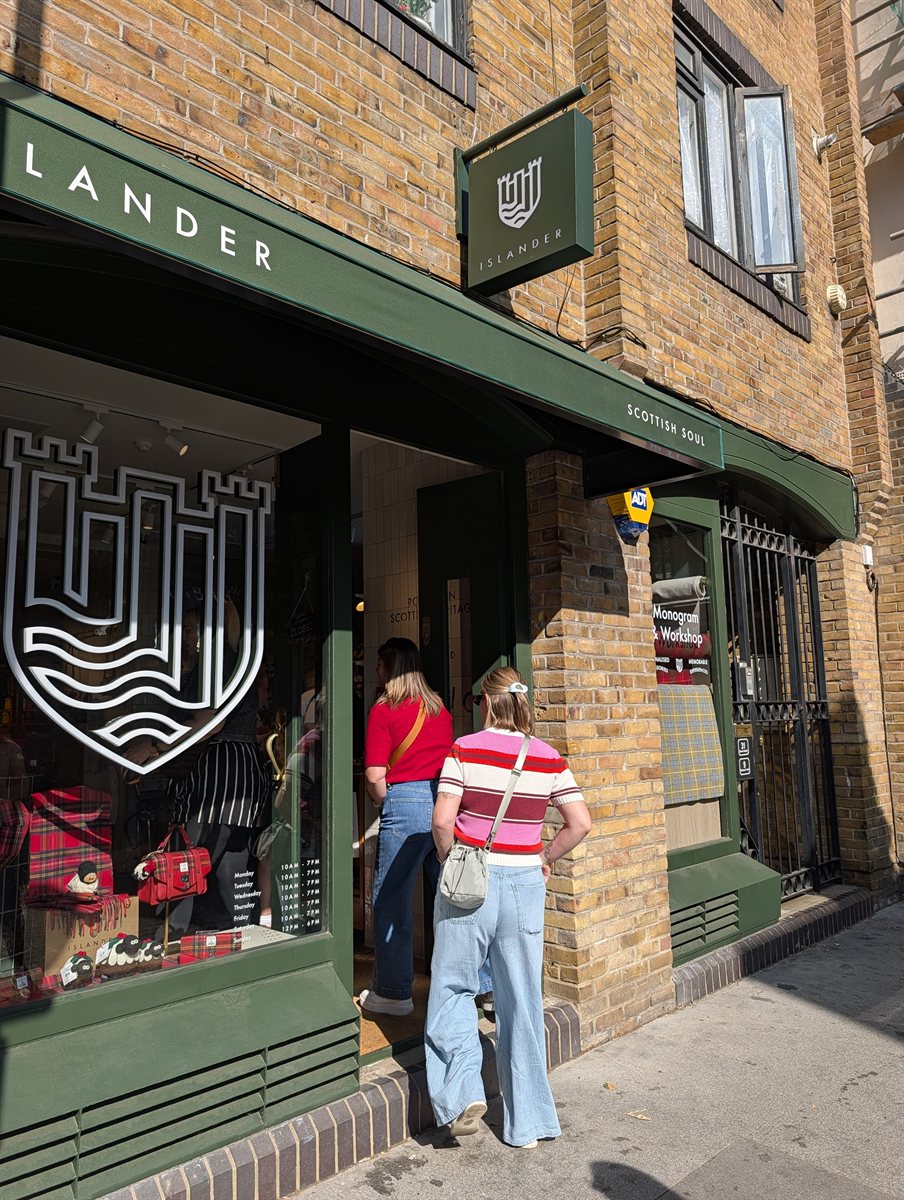
Islander is a classic Scottish handbag maker that’s just recently opened up in Covent Garden. At their workshop you build your bag out of Harris Tweed or tartan and pick every colour from the base up, so it ends up looking like you.
They run quite a few slots through the day but I’d book the one just before lunch so you can head off for a glass of wine after, because what’s better than that on a girls’ day out?
The hard part is the choosing. You’ve got your lid, your body, your straps, your handles and the big tartan or tweed call to make in 15 minutes. My friend told me to piss off at one point because we kept checking each other’s picks, since we know exactly what each other’s into. The clock was going tick tock so we had to get cracking.
Then you all head out with the bags you made on your arms and that’s a day you’ll be yapping about for a good while after.
Spend
£70 for the mini plus a booking fee, see the table
Booking
online, before you go
Where
Covent Garden, London
Works for
a girls’ day out, a souvenir you take home
Fact check
The prices are the shop’s own pages and what I paid on the day. The shop hours are from the Covent Garden directory and the shopfront. All of it is as of 30 September 2026 and I’m not Islander, so have a look at their booking page before you go.
Worth it and who it’s for
The bag goes into your wardrobe as one of those pieces you look back on and remember where it came from, which is how I build mine out of my trips, same as my things you can only buy in London list.
Mine is made from pieces I really like, so it’s designed to my likes and my style and I can’t wait to wear it out.
Anyone 12 or over can join a class, so the whole group can come along.
Worth It
It’s worth it but be aware there are extra costs if you want real leather or a bigger bag. The website wasn’t clear about what you were signing up to, so here’s your pre-warning.
What you pay and what you get
The price you book at gets you the vegan mini and everything on top of that is an upgrade you pay for on the day.
I paid £73.50 all in, which was £3.50 on top for the booking. Everything we’d seen on social media made it look like you get a leather bag, so there was a lot of debate in our room when they started explaining the pieces. The booking page doesn’t say what the bag is made of and the shop’s workshop FAQs call it microfibre leather.
Upgrade on the day
On top of the mini
Mini Leather Satchel
+£45
Medium Leather Satchel
+£55
Medium Satchel or Medium Backpack
+£10
Backpack Satchel
+£20
Washbag or Mini Barrel
+£0
Going leather in the class takes it to £115 on the shop’s list before the fee goes on. Staff walk you through every upgrade on the day.
If you like a challenge, the wash bag costs nothing extra and has 21 screws, so it’s the hardest to build but probably not one many people end up picking. No one in our class picked it.
You can buy extra pieces too, so if you can’t choose between two lids you can take the second one home and swap it over. And if you’d rather skip the making, you can walk into the shop and buy a bag.
Before you book
With all those extras on offer, the smart move is to book the mini and upgrade on the day. If you book a bigger bag and drop down you get store credit or an extra piece rather than your money back.
That’s what I did and starting with the mini is definitely better, because the medium was a lot bigger than I wanted. Going up is easy since every bag takes the same time to build. They even tell you as you walk in to have a quick look first and then decide.
We sorted ours from the couch the day before when we realised we were all free and we still got a 12 o’clock class. The shop recommends booking four weeks ahead though. The shops in Scotland are the ones that sell out, so the busier it gets the earlier you’ll want to book.
What happens in the hour
On the day you tell them at the counter you’re there and someone ticks off your name. Then you’re put in a room with your friends so you can all sit together.
They start by explaining what each piece is and then you pick yours. After that they walk you through putting each part together with screws that are easy to do. Someone comes round to check it’s all screwed on properly and you’re done.
The shop’s workshop page says around an hour and its FAQs say 60 to 90 minutes, while ours was done in an hour.
Choosing your bag
The choosing is where it turns into your bag, because you pick the bottom, the lid, the handle, the straps and the carry strap in any colours you like and mix them however you want.
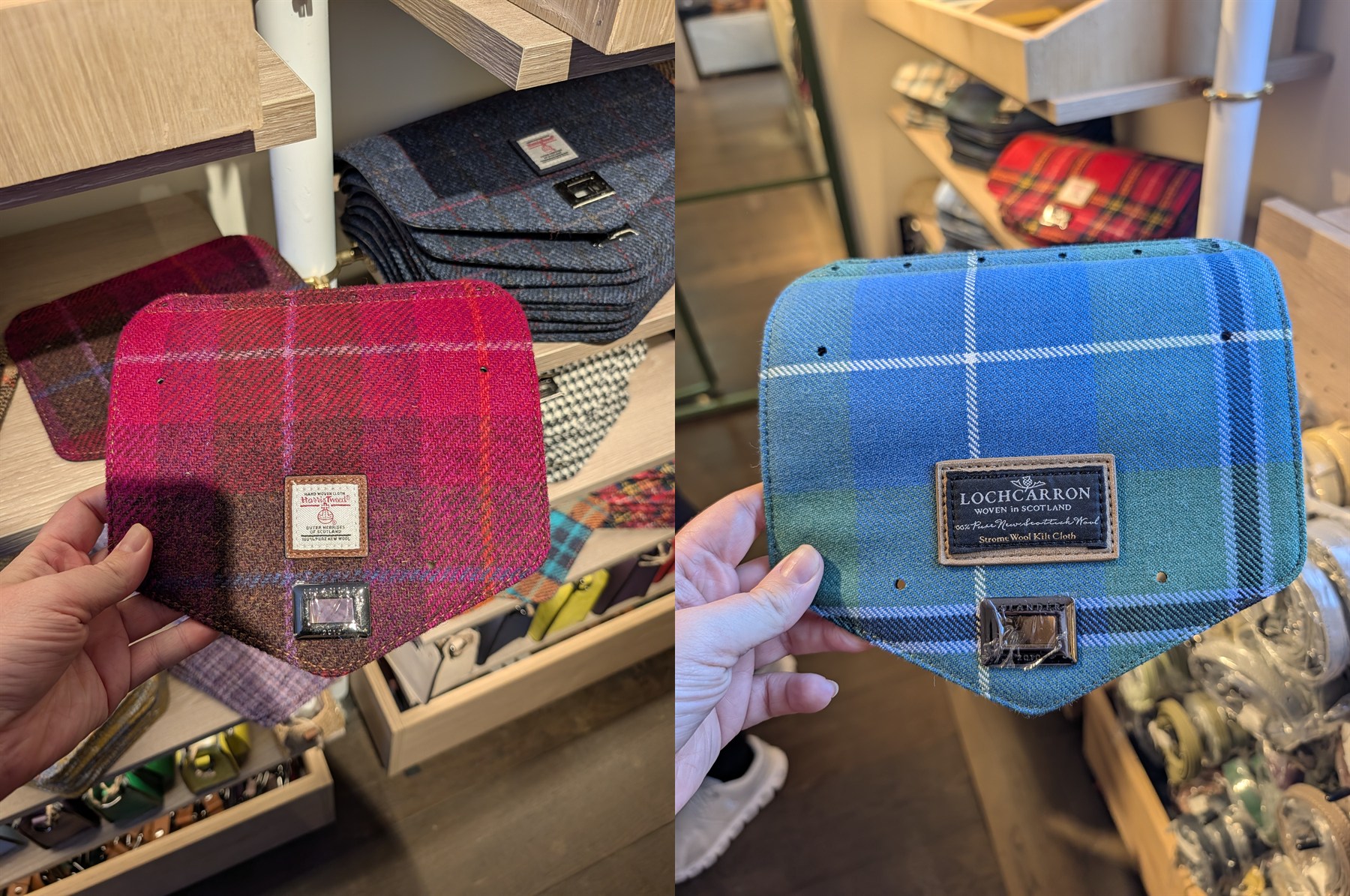
The lid is the big call, so it helps to know the difference between tartan and Harris Tweed before you’re stood at the wall of lids with the clock going. Staff told us all about the history of the lids while we were there, including that the Harris Tweed colours come from nature and animals, so the black and white one was sheep.
A tartan is basically coloured stripes that cross over and repeat into a check, while a clan tartan is one the clan chief has signed off on. There are no laws about who wears which one, just traditions, so you can pick any lid you love.
Harris Tweed has its own Act of Parliament, so it has to be handwoven by islanders in their homes in the Outer Hebrides from wool dyed and spun there. The Harris Tweed Authority says it’s woven on foot-powered looms without electricity, so the Orb mark on the cloth is how you know it’s the real thing.
If you want to spot a vegan bag, look inside, because the lining has a flower print and the edges are black, while the full leather ones have a different lining.
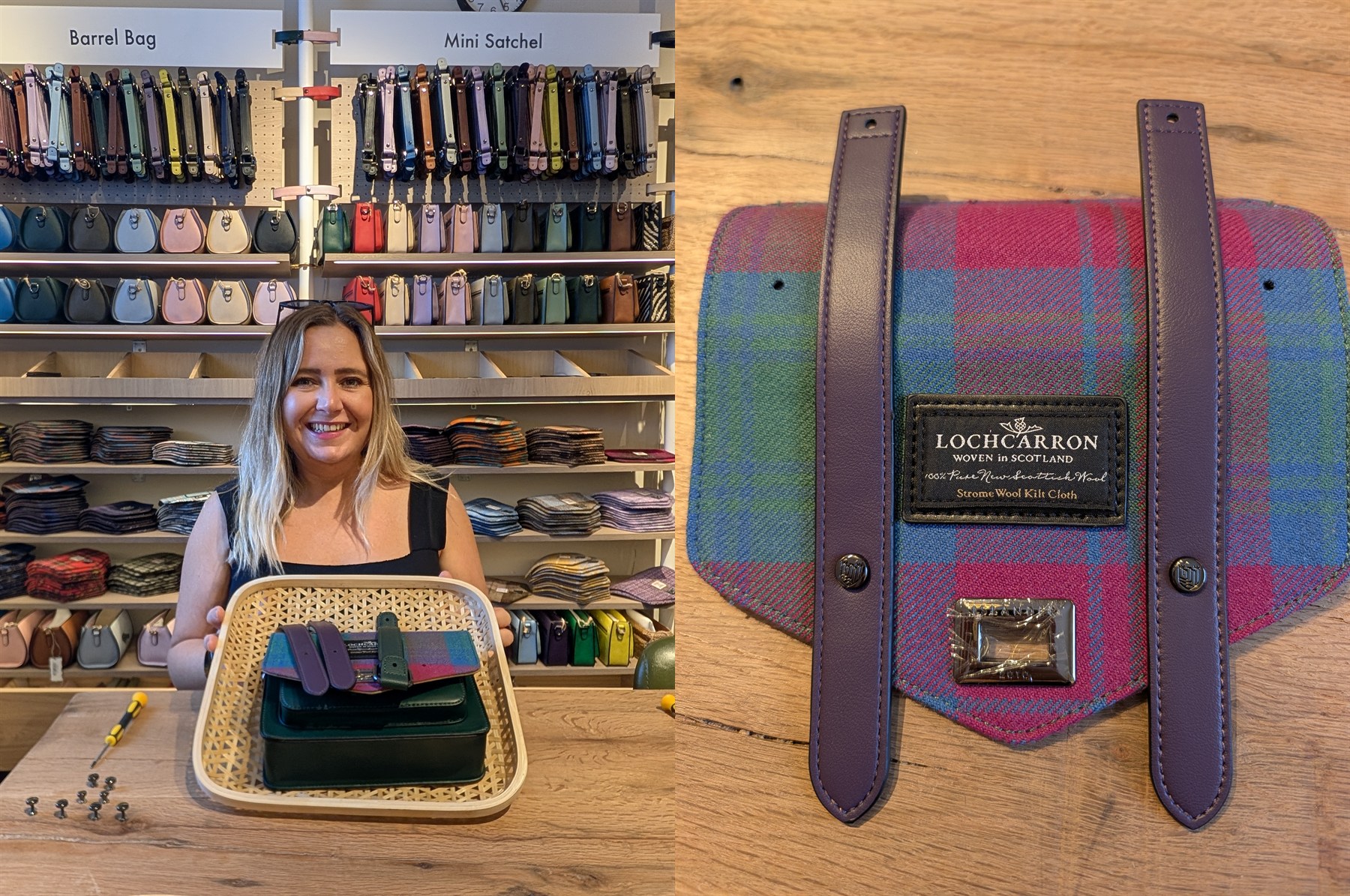
Mine ended up with a pink magenta lid with a blue and green check in Lochcarron wool, purple straps and a green body and handle.
The one thing I did wish I’d thought about was my family tartan, because I got to move to the UK through my Scottish grandparents and it would have been nice to carry something around that matched it.
It wasn’t an exact match on the wall but there was definitely a similar one, so if you’ve got Scottish heritage and know your tartan it could well be up there and it’s worth getting those pictures out before you go.
Looking after it
Looking after it is easy once it’s built, because they give you spare screws to take home in case you lose one off your bag.
Staff told us that for a spill you can take the lid off and get it dry cleaned, while for marks a soft cloth with a little water does the job if it needs it.
Where, when and how to book
If you’re going for the slot before lunch, this is all you need to find the shop and book it.
Address: 29 Shorts Gardens, London WC2H 9AP
Tube: Covent Garden, two minutes
Shop hours: Monday to Saturday 10am to 7pm, Sunday 12pm to 6pm
In Scotland: Islander’s other nine shops are all in Scotland
I wouldn’t do anything differently, although next time I might buy a second lid that goes with my straps so I can change it up and it’s a new kind of bag when I’m going out. But would I really faff around changing it? I don’t know.
What I do know is this has started a bit of a theme for us, because we’ve lined up a perfume class and a make-your-own-lipstick class next, so there’s already another day out with the girls on the cards.
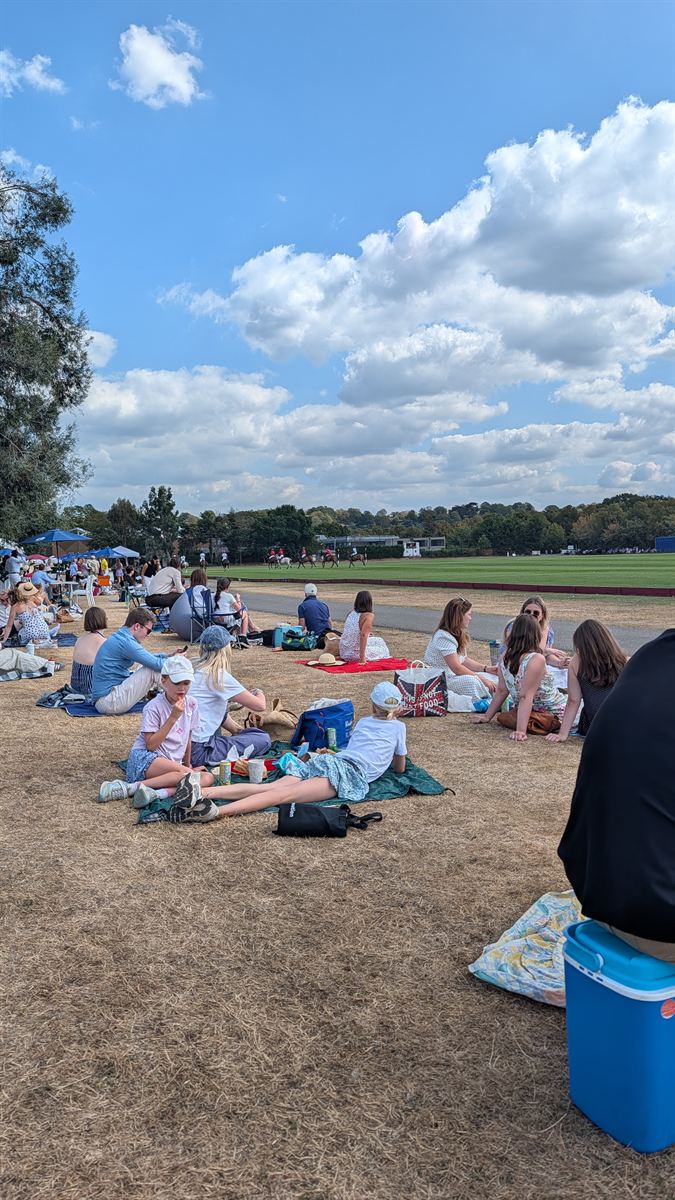
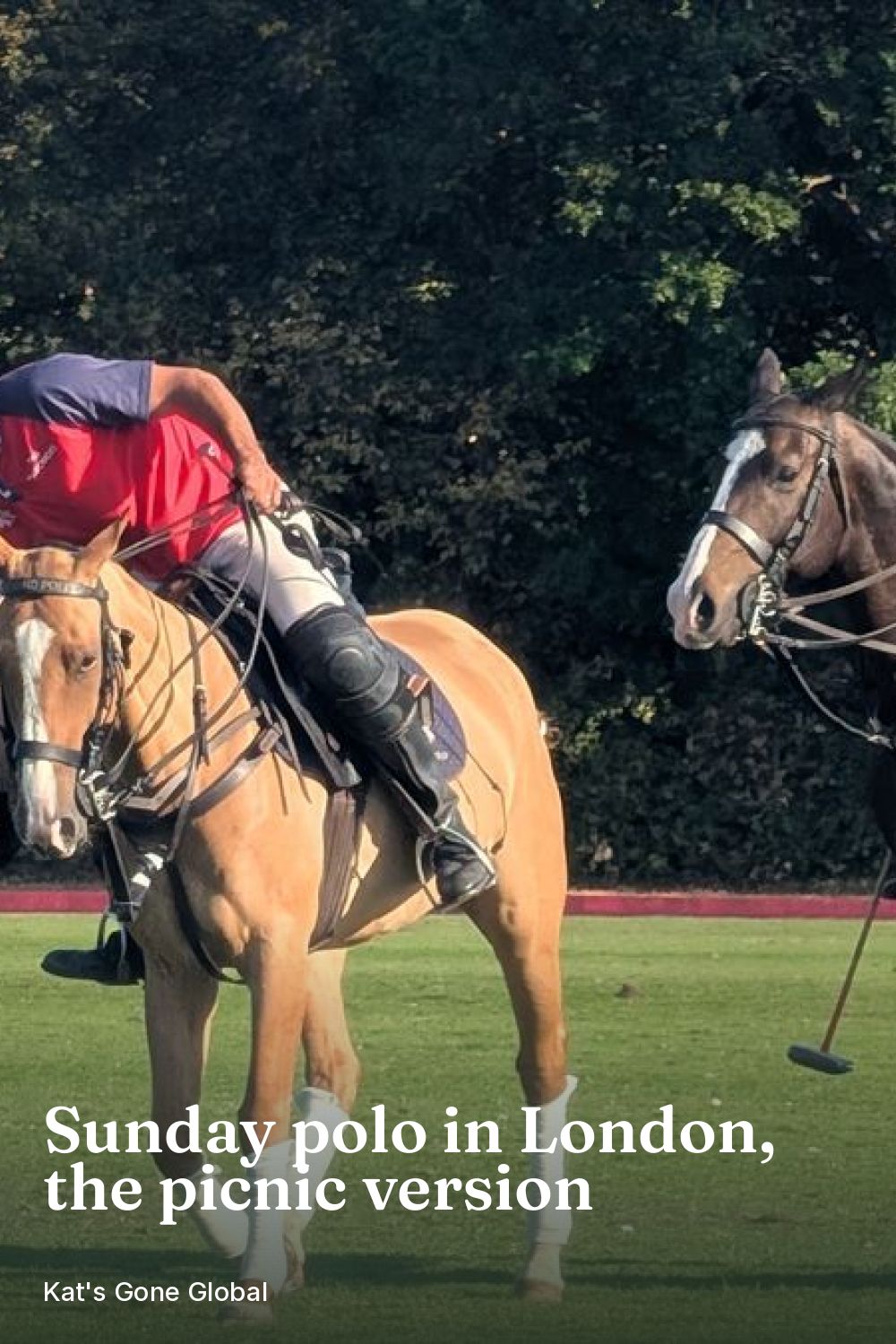
It’s not your usual Sunday, going to watch people on horses hitting a ball around at a fast pace. But that’s essentially polo. Ham Polo Club in Richmond runs Sunday polo from May to September. You get to watch a sport you pretty much have no clue about and have a few glasses of wine. The picnic ticket is £25 and you bring your own food and wine. Get dressed up and bring a picnic. You’ll come home with photos of your mates in suits that aren’t from a wedding.
By the second chukka you’ll have picked a side like it’s the football. I was honestly yelling and the commentators were the funniest I’ve heard. Imagine someone’s uncle who’s drunk a bottle of wine and then been handed a microphone, but is actually funny. If the commentators don’t get you, the pace of the sport will make you a polo convert by the end.
Spend
about £50 an average day with a grocery shop of your choice. We spent £70 plus transport.
Girls, a nice summer’s day dress, slightly dressed up, flowers and bright colours. Guys, linen trousers.
Who it works for
the girls or your mates. More fun with a group.
Fact check · 23 August 2026. Prices are what I paid on 23 August 2026, the club’s own site read again a fortnight later.
Disclosure
Some links on this page are affiliate links. They don’t change what I paid or what I’d tell you to do.
Worth it
a fun day out with your friends, dressed up, taking photos, making the effort. That’s what memories are made of. Bring the picnic and wait to get called into the Clubhouse.
Train or tube to Richmond, then a bus or a short Uber. Driving works too. Parking’s free for picnic guests and you can picnic beside the car. We had no car between us, so it was an Uber to the gate. My friends did it cheaper on the train.
Be settled before the games start. We rolled up at 12:34 to a full lawn and got away with it, because the final was running late. If you turn up once a match has started, you just wait until it finishes. No biggie either way.
Pick your side before play starts, because you stay put once it does. If you can handle the heat, sit on the sunny side. That’s where the Clubhouse is. There’s a bit of tree cover but be mindful on a thirty degree day. We sat in the sun and some of our group struggled with it.
The polo itself, from 12:00
Think croquet, where you hit the ball through little goals on the grass. Polo is the horse version. Picture a football pitch with goals at both ends and a ball hit through them at pace with a stick. Golf with a bit of football. And not to be confused with water polo. Before I went, that was all I knew. Nothing about chukkas, nothing about handicaps, nothing about only hitting on the right side.
A match is split into chukkas of seven minutes. A bell rings when time is up and a second bell ends the chukka.
Between chukkas the players change ponies. Three minutes to do it, five at half time.
After every goal the teams swap ends.
Every player has a handicap, minus two for a beginner up to ten for the best, the reverse of golf. The weaker team starts with the difference on the scoreboard.
Depending on the day you get two to four matches of about an hour each. You can leave at any point. Ours was the championship, the Roehampton Cup, four matches from 12:30 running till about six. The cup is Great Britain’s oldest polo trophy. It’s faster than you realise live and the commentators don’t stop.
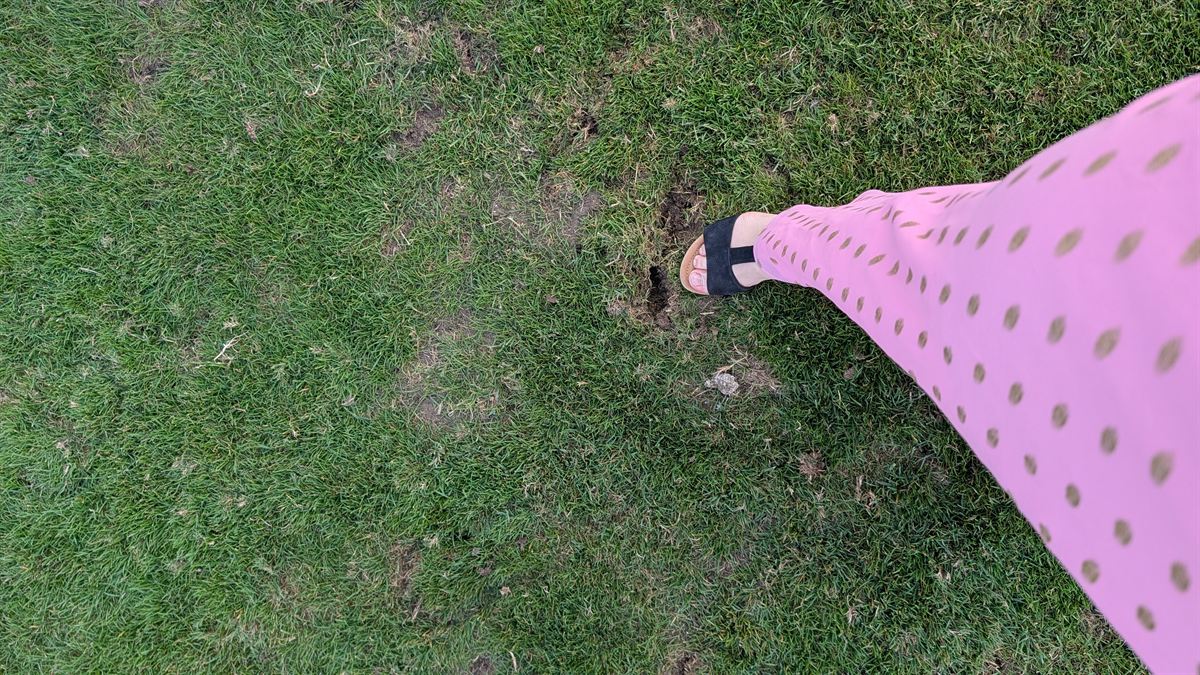
Get out on the pitch at half time for divot stomping. The horses leave divots across the field and you put the turf back down with your feet. Everyone does it and it takes a few minutes.
Mid-game divot stomping. The horses leave divots across the field, so I’m stomping them back in with my wedges.
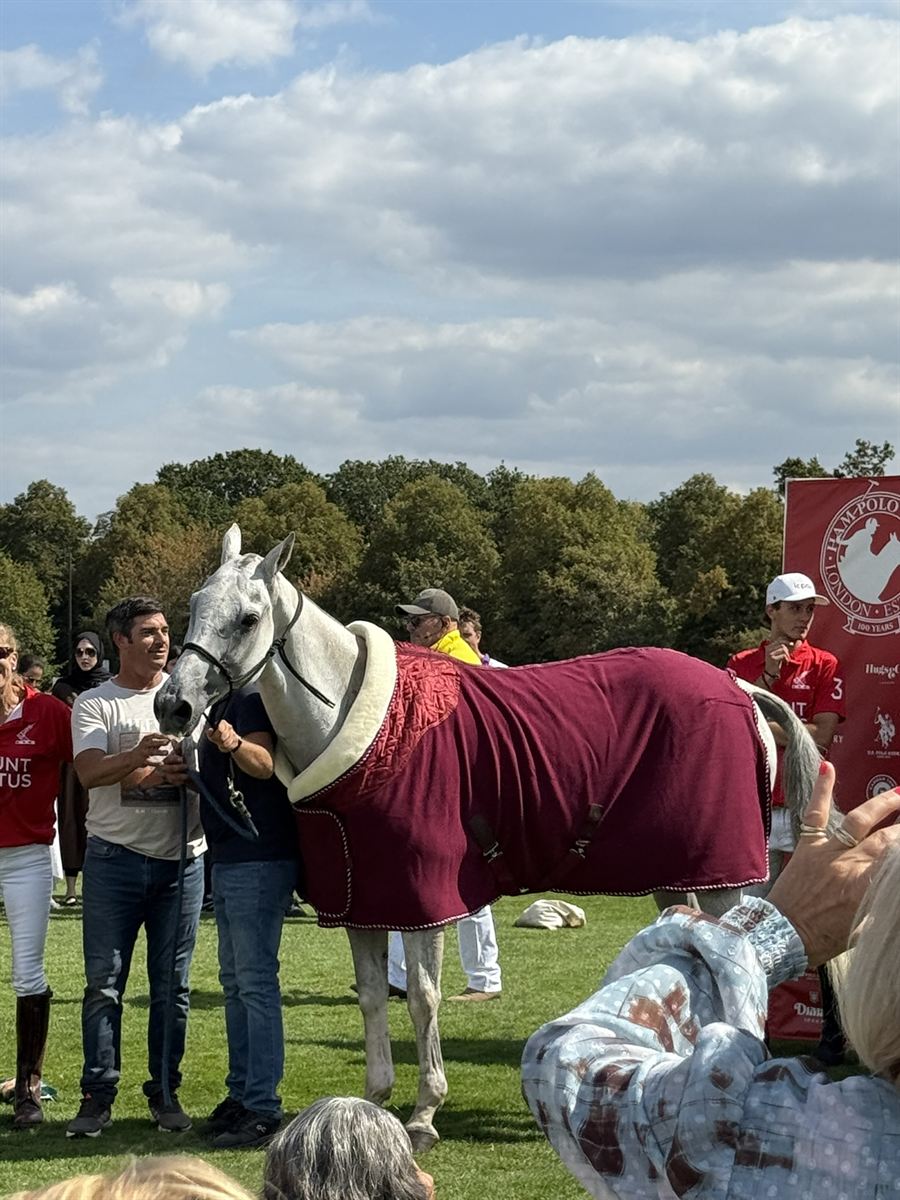
Stay for the presentations. The funniest was the horse of the day. Not sure what the horse thought it was winning! Maybe a good feed at the end of the day.
The picnic and the wine, about 13:30
The picnic is yours to shape. Easy version, go pot luck or pick up some picky bits from the grocery store. But if you’re like me and can’t do anything in half measures, it’s full on hosting mode.
Bring your own wine too. We bought six bottles from Majestic for the day, so it was always going to be a boozy one.
To elevate it even more, give the wine a theme. Ours was cold, to match the summer’s day. I know, very original. I run a wine club, so I do take the wine seriously. We opened the Chapel Down sparkling rosé for a cheers as the first chukka started. It was a favourite with the group. Here’s what we drank, if you want some picks for yours:
Chapel Down English Sparkling Rosé, Kent
Mythral Rosé, Côtes de Provence
Beato Bartolomeo Pinot Grigio Rosato, Delle Venezie
Emma Marris Sauvignon Blanc, Marlborough
Cave Vinicole de Hunawihr Kuhlmann-Platz Cuvée Prestige Pinot Noir, Alsace
Bread and Butter Pinot Noir Winemaker’s Selection, California. Ten out of ten, buy the bread and butter one.
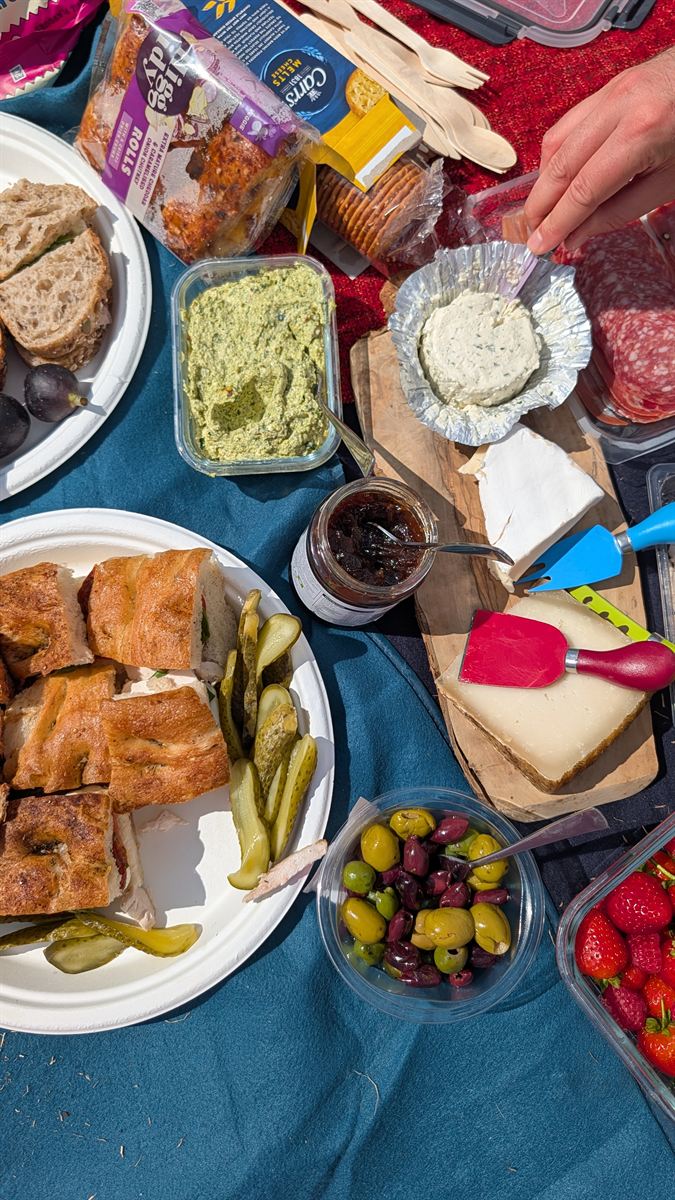
Go afternoon tea with the food, with sandwiches you’d choose yourself. Nothing worse than an egg sandwich, imo. It likely wouldn’t have lasted in the heat either! My pick is something along these lines, on Lockdown Bakehouse sourdough:
Ham, cheddar, pickle and chutney
Pesto chicken, mozzarella and tomato
Brie, fig and rocket
Then the dip, cheese, crackers and olives. Hundred percent recommend. You can’t shoot down your own food!
Plan how you’ll carry it all. If the food’s good you’ll carry less home. I slightly overdid it, so I definitely needed some extra help carrying ours.
Budget for the picnic, not just the ticket. Ours came to about £45 a person, my figure from memory. That covered the food, the wine and the bottles in the Clubhouse. Go pot luck or bring your own. It flexes to whatever your group wants.
Worth it
the picnic ticket, but only if you get there early and pick your side. Compared to buying bottles in town it’s a lot more bang for your buck and we ordered plenty.
The Clubhouse, about 16:00
Don’t plan on the Clubhouse. Say yes if it happens. A man drove round in a golf cart telling us to head over. He asked a few times, which was kind of funny. You’ve paid for the day, so go.
I think they wait for lunch to finish in the Clubhouse and then invite the picnic side over. Inside there’s live music and a bar, exactly what you want after a couple of hours in the sun. We had two more bottles in there, including a Corbarol rosé at £32. There’s a bar and food trucks on the other side too, though we’d brought enough.
For the full version, a Clubhouse Day Pass is £70 a person. Tables need booking by the Wednesday before.
Worth it
both experiences in one day. The picnic lawn, then the Clubhouse. It was the perfect Sunday.
What to wear
Go properly. Think “elevated casual” attire, a long summer or cocktail dress for the girls, linen or a shirt for the boys. The Clubhouse has its own dress code, so dress for it from the start if you want in later. Overdressed beats underdressed every time.
Picnic ticket holders can get away with being a little bit casual. There were guests wearing shorts on the grass, a mix of general day wear. They went home and we didn’t see anybody dressed like that in the Clubhouse. I’d generally avoid activewear and flip-flops. You’re on a picnic all day, so make sure you’re comfortable.
The receipt, if you want it: the pink Sophie Dress with Gold Fleck. Right at home in the Clubhouse, a little much on the picnic side. I felt really pretty, which was the point.
The only thing the group really said about their outfits was that they felt slightly too dressed up for the picnic side. That was mainly the men. The women were dressed up nicely. It was a hot day. My boyfriend went in linen and definitely felt better.
It was too hot for blazers. The guys definitely did not need them. We didn’t have any issues in the Clubhouse without blazers.
Before you go
This summer was unbearably hot and the last thing you want is sunstroke. Pack for a hot day.
Sunscreen. Slip, slop, slap is the slogan every Australian grew up with: slip on a shirt, slop on sunscreen, slap on a hat.
Water for the day. Plenty of it, the lawn is hot.
A hat for the sun side. A shawl too if your shoulders want covering later.
Something to keep it all cold. Ice blocks, an esky or wine sleeves all work. It’s almost impossible to keep the wine cold without one. I had a cooler bag with some ice and it semi did the job in the heat.
Picnic blankets. No one’s sitting on the bare grass. Some people brought folding chairs. I didn’t want the effort of carrying them.
FAQ
How much is the ticket?
£25 a person for the picnic ticket, whether it’s a general Sunday or a finals day like ours. The Clubhouse is £70 a person. Lunch is extra. The three-course menu I saw was about £30.
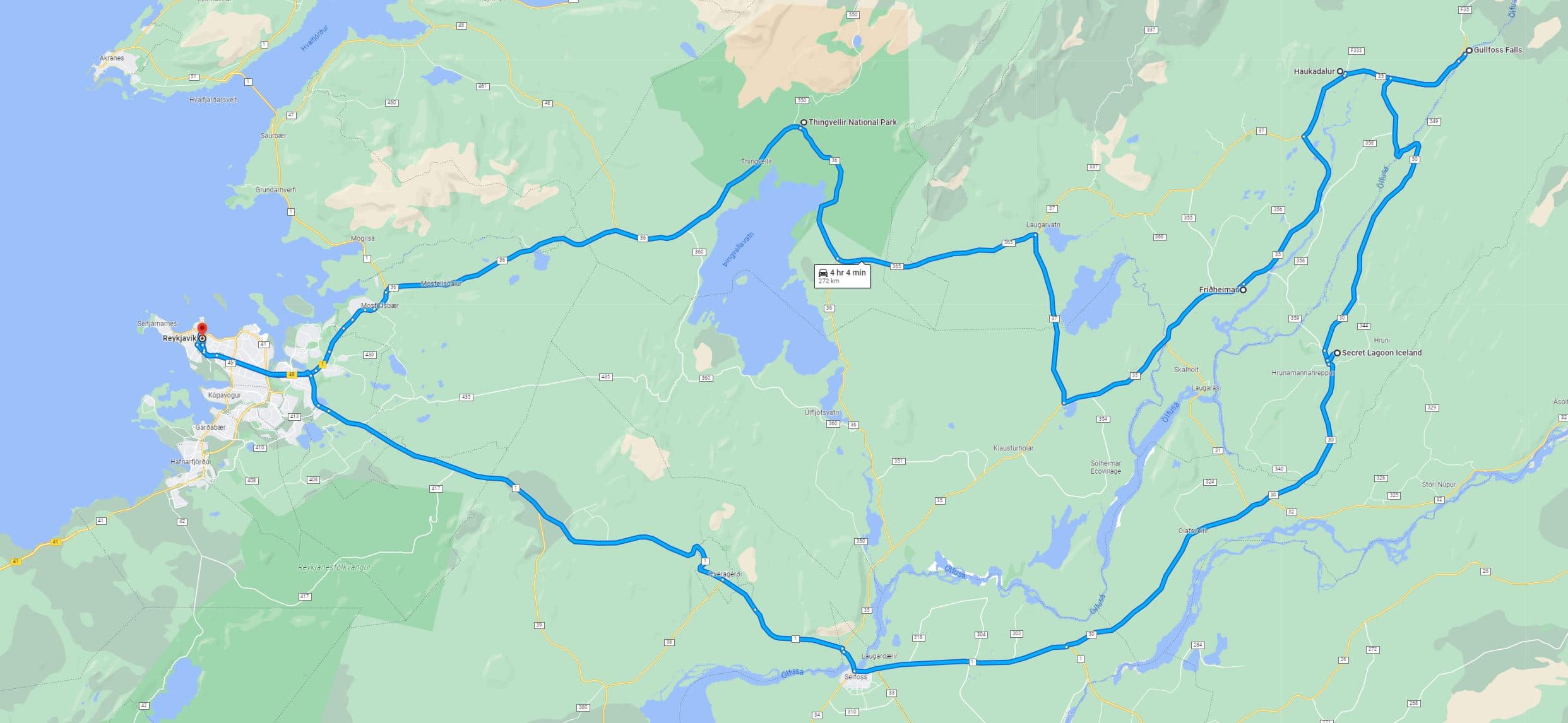
The Golden Circle is by far the most popular day trip in southern Iceland. The circular route runs for about 186 miles and starts and ends in the capital city, Reykjavik. Some of Iceland’s top scenic attractions are along this route, making it a highlight of any short or long visit to Iceland.
The Golden Circle is a great introduction to the country and all of its natural wonders. Iceland is famous for its dramatic landscape, and this mini roadtrip shows off some of its best, including gorgeous waterfalls, volcanic craters, glaciers, geothermal activity and a UNESCO World Heritage Site. Add to this the famous Icelandic ponies roaming throughout the land and you’ll quickly see just how magical Iceland really is.
This guide will take you through all the basics of self-driving the Golden Circle with some additional tips and stops along the way. Of course, you can take a guided tour of the Golden Circle, but driving it yourself gives you more freedom, and the added bonus stops are worth their weight in gold.
With the ease of the Golden Circle being a direct circular route from Reykjavik, it’s a straightforward way to explore the wonders of Iceland, even if you’re only staying a short while.
How long does it take to drive the Circle Circle?
An average tour of the Golden Circle should take about 6-8 hours, but if you were to do it without stopping it would end up somewhere between 3-4 hours.
I’ve added a few extras to the usual itinerary to make it an even more exciting adventure. Depending on the weather and tourism levels, I would factor in a full day for this trip, between 8-10 hours. You’ll want plenty of time to take in the unique and breathtaking scenery; the worst thing you could do is feel rushed.
When can I visit the Golden Circle?
Golden Circle route
This guide is for a self-drive tour any time of the year. Yes, you can even drive the Golden Circle in the winter and you don’t need a 4×4 to do it. However, I would highly recommend 4×4 in the wintertime if you are heading off the main route.
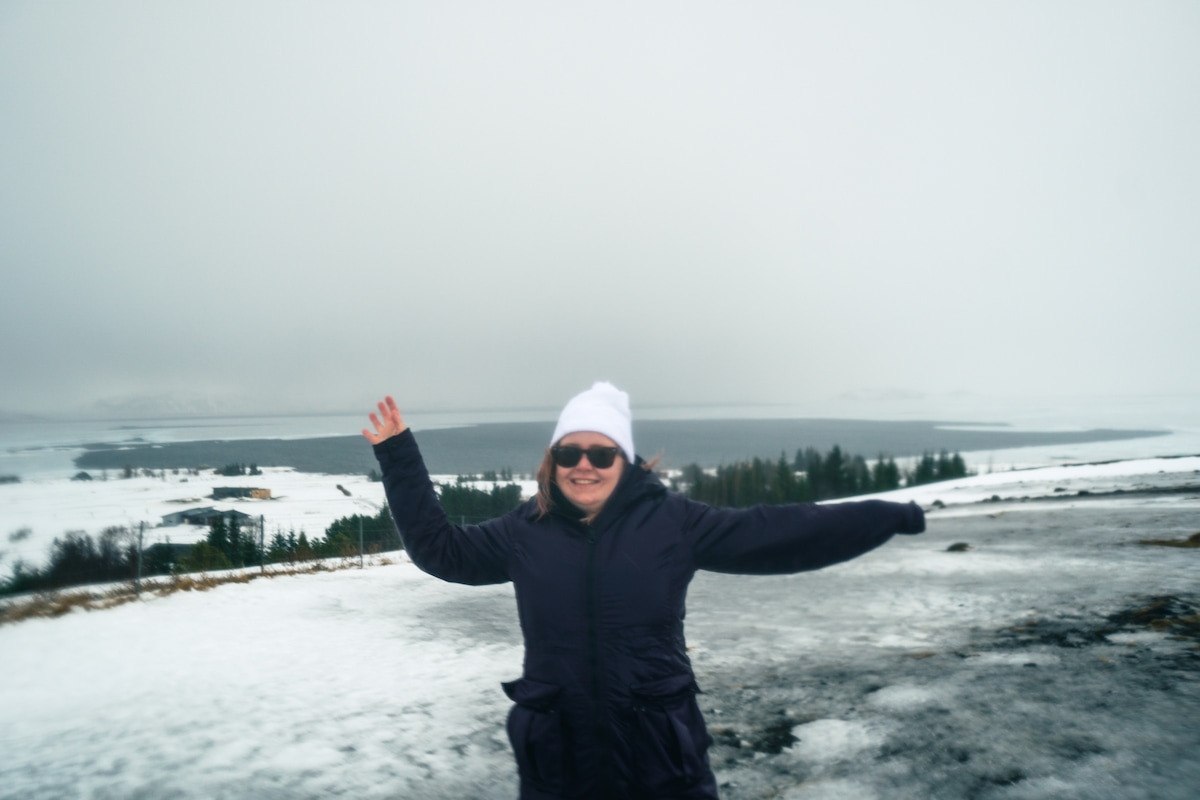
One of the scariest moments we had on the trip was visiting waterfall þórufoss, as a person that has never driven in snow nor in a snowstorm, it was challenging enough in 4×4. Going back on the main road we slid on the ice, my friends yelling brace! We were all good but I couldn’t have managed that in a smaller car.
The paved roads are well-maintained and the convenience of this route to the city is what makes it so popular. There’s still a lot of tourism in the winter for those chasing after the Northern Lights, but it won’t be as busy as the summer months.
If you’re visiting in the summer, you’ll have unlimited daylight at your disposal, meaning you can start later in the day and still have enough time for everything. In the winter, the daylight hours are very limited, so you never want to miss a chance to get out the door before sunrise.
The great thing about driving the Golden Circle yourself is that you’re more likely to avoid crowds and enjoy more privacy along the way.
Keep in mind that most Golden Circle tours leave in the morning from Reykjavik between 8-10am, with afternoon departures around noon and 2pm and most of them return to the city by 8pm. If you can, work your schedule around this to avoid the tour buses as much as possible.
Why is it called the Golden Circle?
The Golden Circle gets its name from one if its main attractions, Gullfoss – which translates from Icelandic to Golden Waterfall – along the roughly circular route. It is also sometimes called the Golden Triangle, due to the three main attractions. There’s a story that says Vigdís Finnbogadóttir, the president of Iceland from 1980-1996, was the first person to use the expression ‘Golden Circle’ and it just sort of stuck.
In the north of Iceland, you’ll also find another popular circular driving route called the Diamond Circle. In the summer, many people will use the Golden Circle as a starting point for driving the full Ring Road around Iceland and up to the Diamond Circle.
What are the highlights of the Golden Circle?
The Golden Circle has three major attractions you’ll want to visit; Thingvellir National Park, Haukadalur Geothermal Field and Gullfoss. But you’re not limited to just these three! The area around the Golden Circle has many other attractions that can make your day even more enjoyable, like soaking in the geothermal hot springs.
Next I’m going to guide you through each stop along the way in the order you might visit them.
Thingvellir
Thingvellir National Park in Iceland
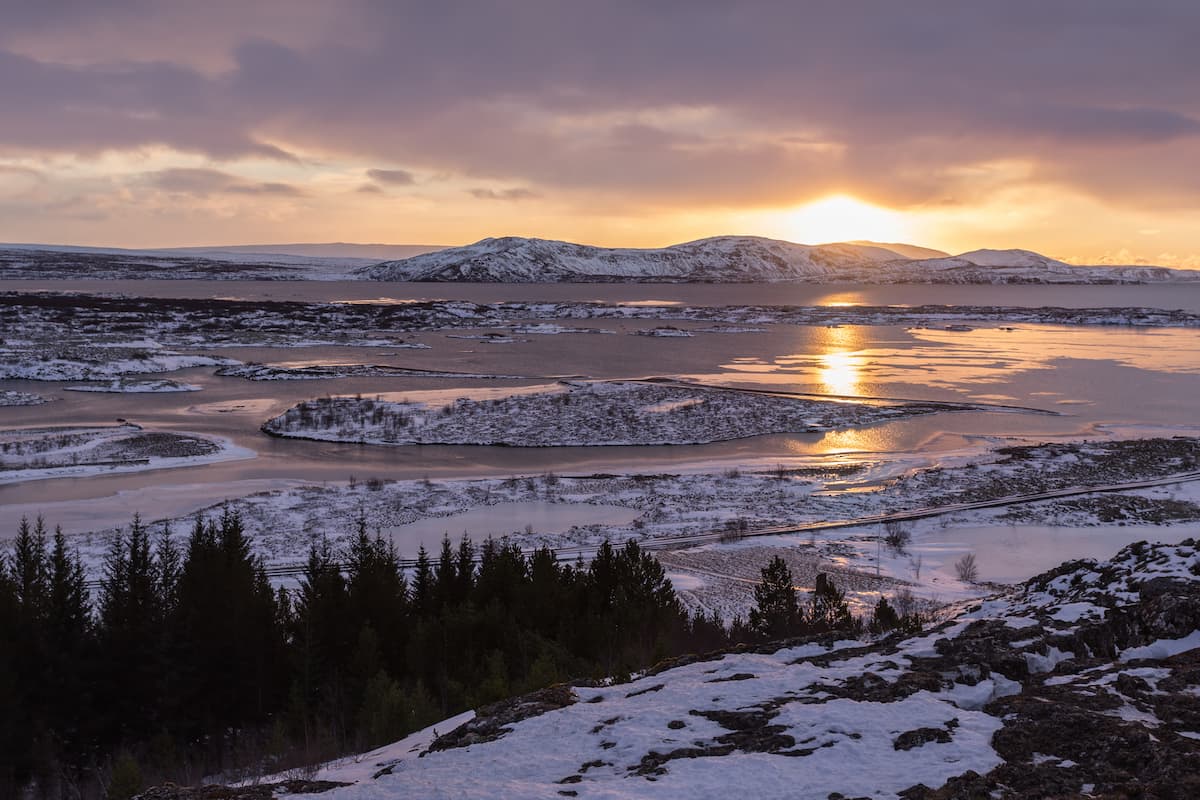
Your first stop along the Golden Circle, driving in a clockwise direction, is the National Park Þingvellir, spelt Thingvellir in English. This was Iceland’s first national park and is now a UNESCO World Heritage Site. It’s an important stop from a cultural and geological perspective.
Around fifty years after Iceland was first settled, Thingvellir became the location for Iceland’s first parliament, known as Althing, in 930 AD and continued there until 1798. Thingvellir was chosen as the parliament’s meeting location because of how easily reachable it was from all the different regions of Iceland in the summer months.
It was this location where laws were passed, judicial hearings took place and it’s where the foundation for Iceland’s cultural roots were formed. So from a cultural standpoint alone, Thingvellir is an important stop.
But then you have the fact that Iceland sits right on the middle of two continental plates, the Eurasian Plate and the North American Plate. Thingvellir just so happens to be found in the rift valley of these two plates, that are slowly drifting apart from each other.
This means that part of your experience in Thingvellir National Park is that you can see and walk in the cracks that have opened up in the earth. There are even opportunities for a truly unique experience of snorkeling and diving in these fissures.
Bad weather conditions in Thingvellir National Park in Iceland
Silfra at Thingvellir
Snorkeling and diving in Blue crystal clear glacial water in Silfra Thingvellir national park Iceland
Usually when you think of Iceland, you think of cold, so scuba diving doesn’t necessarily come to mind when you’re considering a trip to the Arctic. However, within Thingvellir National Park, you’ll find the home of one of the top ten scuba sites in the world.
Silfra provides a unique scuba diving and snorkeling experience unlike anywhere else. No matter what time of year you visit, you can actually plunge into the clearest water on earth, with wet suits of course.
The water that reaches the fissure has taken 30 to 100 years to get there, filtering through lava rock along the way. This is what provides visibility for up to 100 metres. If you’re up for it, book ahead of time to experience underwater tunnels, terrain, and caverns that you won’t find anywhere else in the world.
If scuba diving isn’t your thing, then there’s a ten minute walk from the parking lot that will also take you to a lovely waterfall called Oxararfoss. The walking paths through Thingvellir are free, however there is a small parking charge to be paid by credit or debit card. Plan on spending 30-90 minutes at the park, depending on the weather conditions.
Game of Thrones fans will be excited to know that a number of scenes from the show were filmed in the national park, as well as other locations around Iceland.
Friðheimar Tomato Farm
Tomatoes growing at Friðheimar Tomato Farm
After leaving the Thingvellir National Park, the next major highlight of the Golden Circle is about an hour’s drive. Before you reach that, though, you’ll probably want to stop for a hearty lunch! And for that I can’t recommend Friðheimar enough. This is a unique highlight to your day you don’t want to miss.
Friðheimar is a tomato farm and restaurant located in the area of the Golden Circle that’s growing increasingly popular so book a table! They’re able to grow tomatoes all year round, despite Iceland’s long, dark winters, with artificial lighting in the greenhouses.
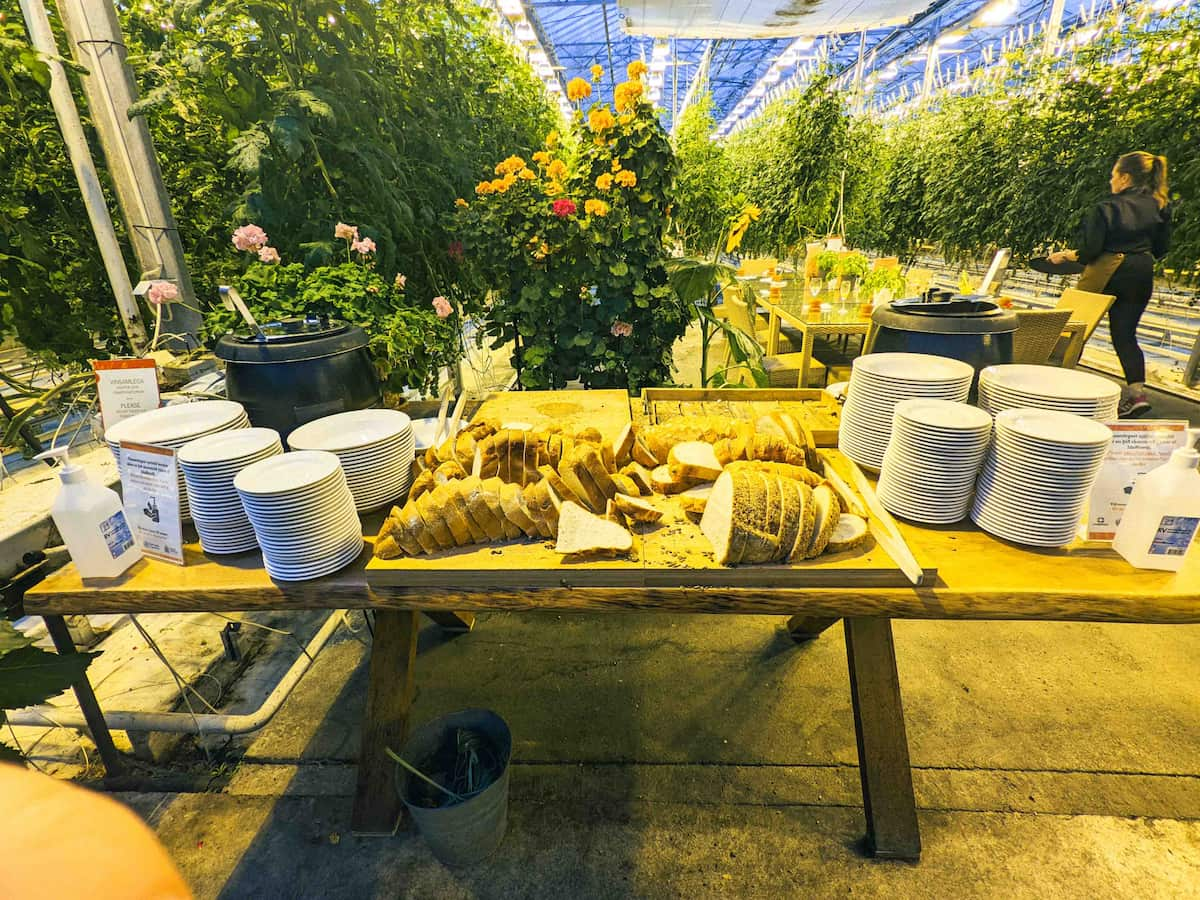
From the moment you walk into this geothermal tomato farm, everything looks and smells of tomatoes. It’s a great choice for vegetarians and vegans in Iceland and the food is extraordinary. The one and only Friðheimar Tomato Soup is served on a buffet with sour cream, home baked bread, cucumber salsa, butter and fresh herbs. You won’t believe how fresh everything tastes.
Money-saving tip: the soup is unlimited and you can eat as much as you like!
Soup station at Friðheimar Tomato Farm
Don’t hesitate to treat yourself to a Bloody Mary, which they obviously specialize in with all the tomatoes. It was the best Bloody Mary I’ve had in my life, in a uniquely gorgeous setting of tomato vines. Alternatively, they make their own beer flavoured with tomatoes.
Greenhouse visits are also available all year round for pre-booked groups and you can even take away delicious food souvenirs such as tomato jam, cucumber salsa and tomato drinks. And if you want to visit the Icelandic ponies, pre-book a visit to the horse stables.
You will not regret this enriching, wholesome stop at Friðheimar!
Haukadalur Geothermal Field
Haukadalur Geothermal Field
Jump back into the car for the much shorter journey from Friðheimar to the next major sightseeing destination: Haukadalur Geothermal Field, also referred to as the Geysir Geothermal Area.
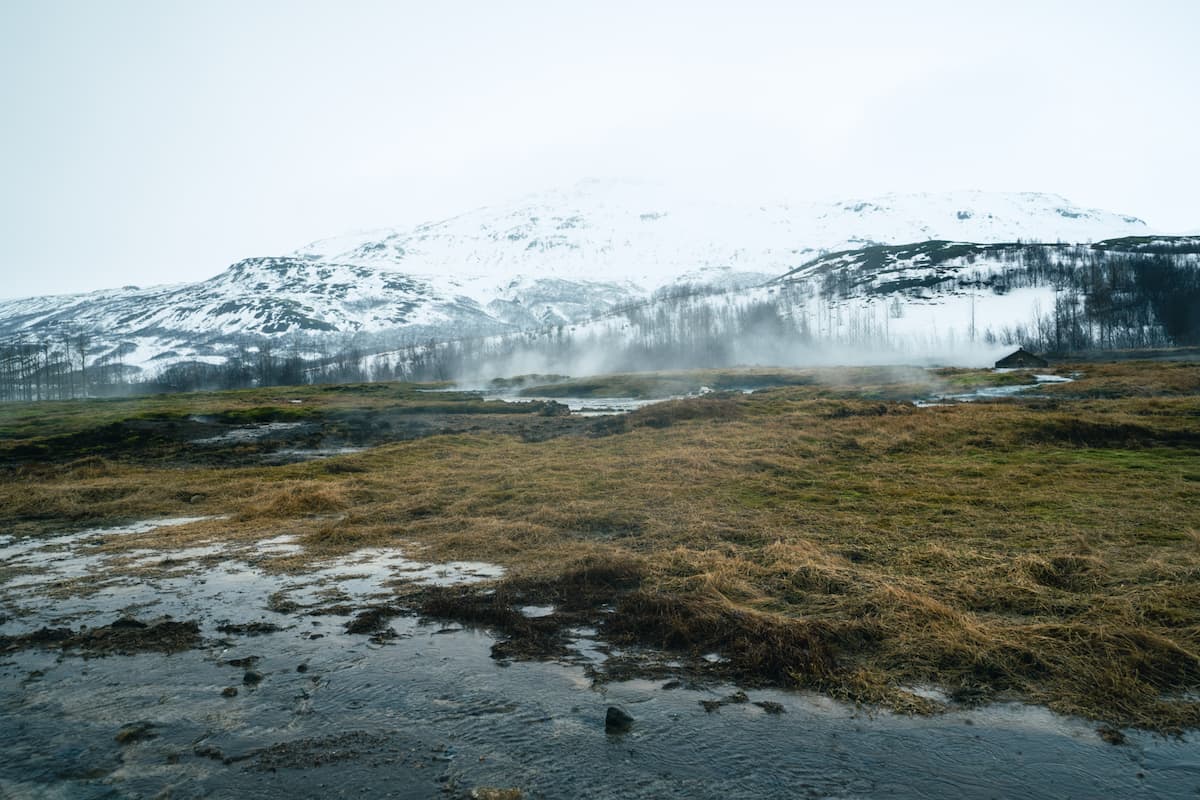
The major geothermal wonders of this area are Iceland’s famous geysers, Strokkur and Geysir. In addition to these you’ll explore mud pots, hot springs and fumaroles (steam rising, essentially).
Geysir is believed to have been erupting for at least 10,000 years, but is fairly dormant in modern times. If you’re lucky enough to see the spectacular eruption, you’ll witness boiling water and steam reaching over 400 feet in the air. But if you don’t get to see Geysir, never fear, Strokkur will save the day!
Strokkur is just 50 metres from Geysir and usually erupts every five to ten minutes, so this is what you’re really there to see. The eruption is smaller than Geysir, averaging around 50ft in the air, but it’s still an impressive sight to behold.
Visiting Haukadalur Geothermal Field is another free stop along your way and there’s free parking on site too! Next to the car park, there’s a large gift shop and plenty of toilet facilities so I recommend taking advantage of the bathroom break and food opportunity as well.
Because Strokkur spouts often, you’ll have ample opportunity for a photo, just make sure and stick to the marked paths for safety. I found this stop to be the most crowded, with lots of tour buses so I spent the least amount of time here.
Gullfoss Waterfall
Gullfoss Waterfall
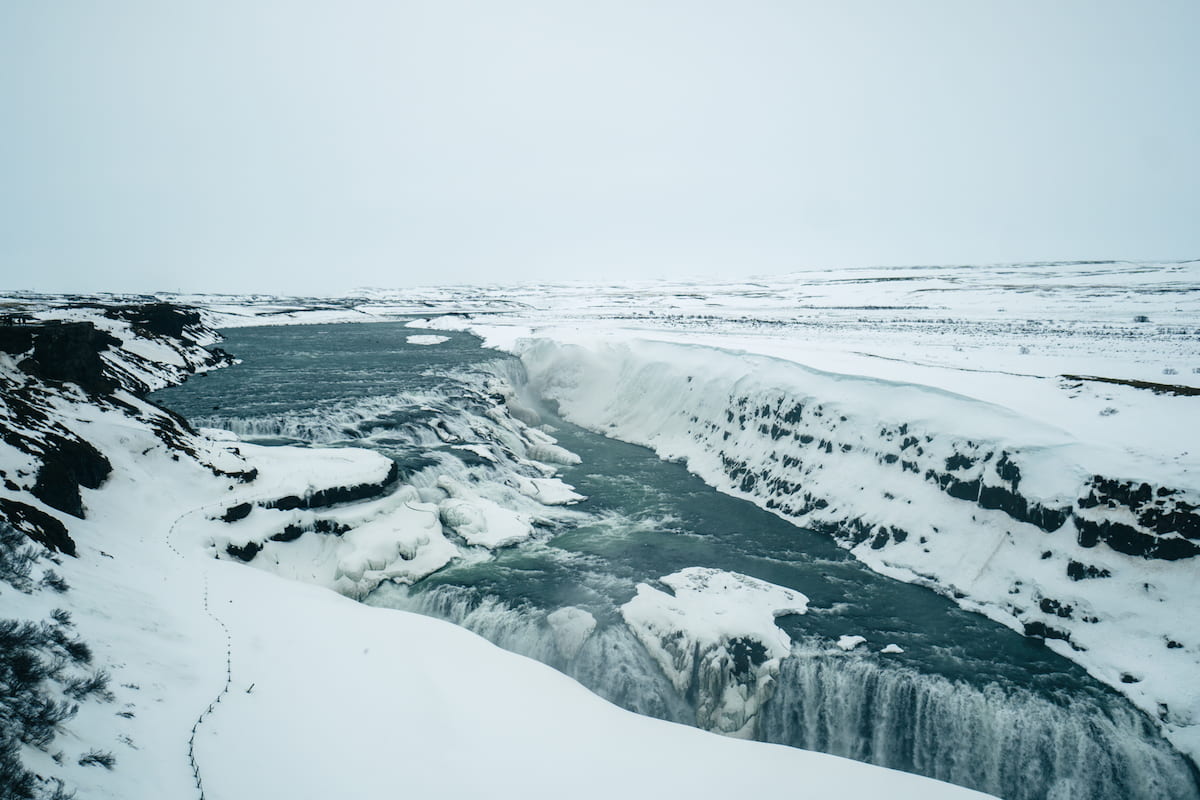
Gullfoss waterfall is the last of the three major highlights of the Golden Circle. Gullfoss means ‘golden falls’ and is where the Golden Circle name comes from. Gullfoss is a favourite waterfall in Iceland and is only a ten minute drive from the geysers.
Gullfoss is on the Hvítá River, with two main car parks, offering different views of the falls. With views at lower and higher elevations, there are steps that links the two and both viewpoints are definitely worth seeing.
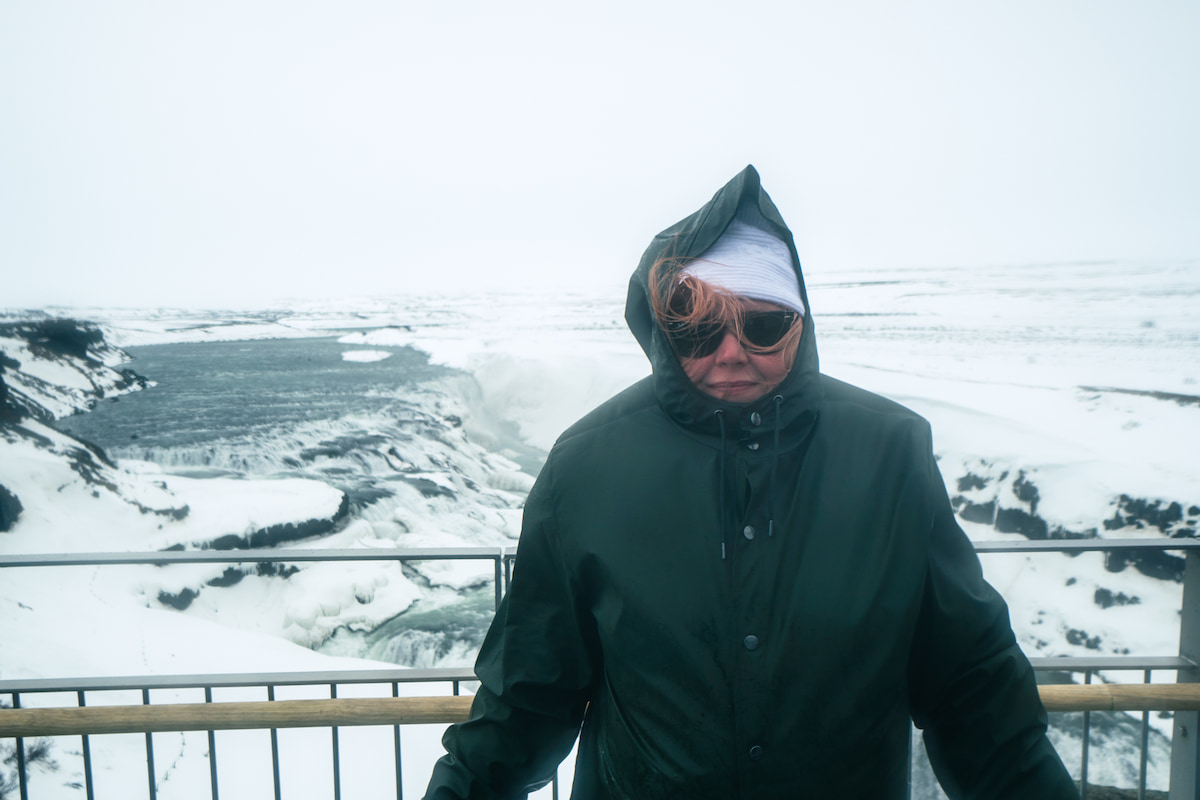
It’s also possible to walk along the edge of the river above the falls, but this will depend on weather conditions and time of year you’re visiting. This area is very windy and can be extremely cold in the winter months so you might not spend as much time as you think you will.
Blown away at Gullfoss Waterfall
The water originates in glacier Langjökull flowing down to the sea as glacial river Hvítá. The falls then cascade down across two levels. The first is around 36 feet in height and the second is around 70 feet in height, so it’s not just one tall, straight waterfall. In the summer, about 4900 cubic feet of water pass over the falls each second.
In the summer there’s a good chance of seeing a rainbow in the spray of the waterfall if you visit in the afternoon and in the winter you’ll have a beautiful snow covered landscape.
It’s free to visit and park at the falls, and you’ll also find a visitor centre, shop and café on site.
What else is there to see around the Golden Circle area?
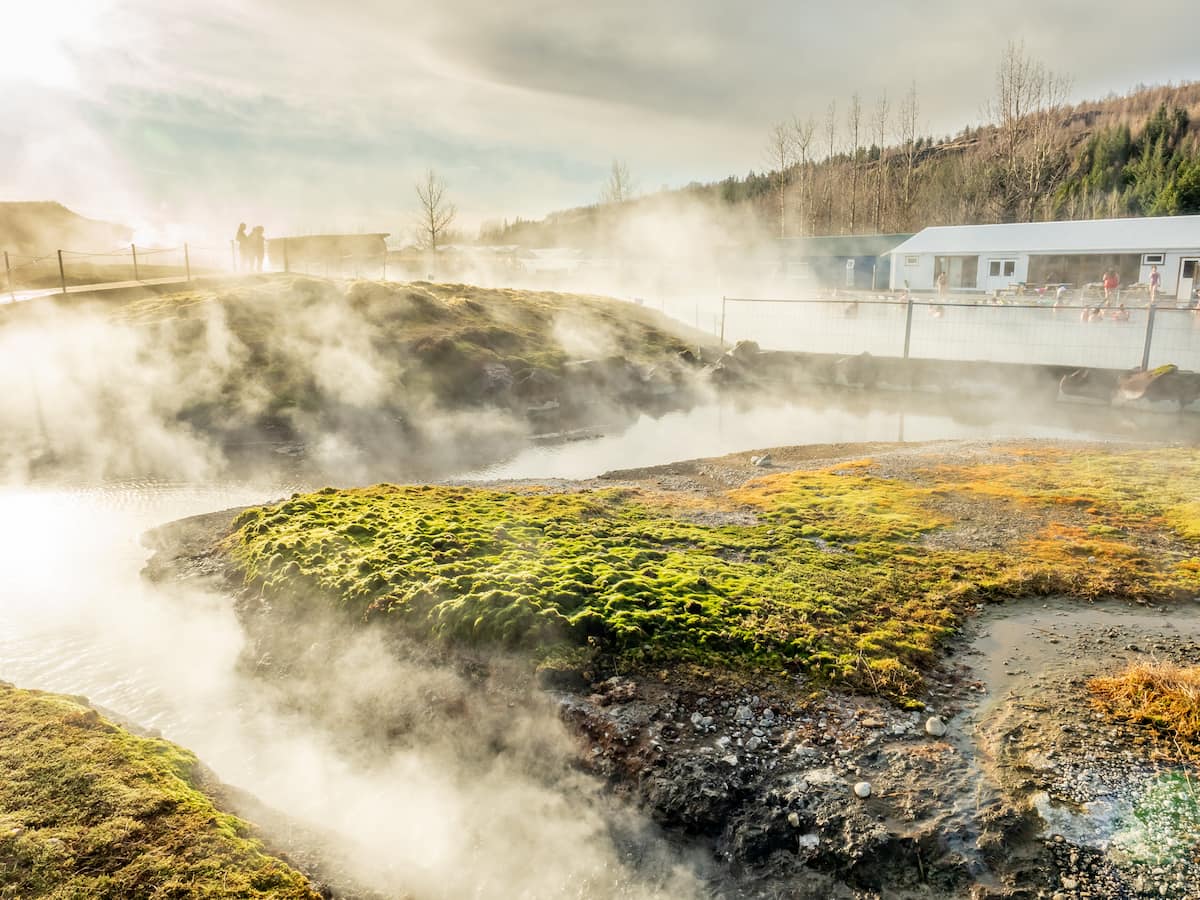
Secret Lagoon Hot Spring
Geothermal of hot spring pool in Iceland
Is there a better way to unwind after a long day than in a hot spring? And although the secret is out on this fantastic spot, you’ll be amongst locals.
If you’ve followed this guide on a visit outside of the long days in summer, you’ll be happy to know that you should be arriving at the Secret Lagoon for sunset (if you time it well!) – and there’s nothing better than watching the sun set over the horizon while lounging in a hot geothermal pool.
The Secret Lagoon, known locally as Gamla Laugin, is one of the oldest natural pools in Iceland. It was made at Hverahólmi, a geothermal area in the town of Flúðir in 1891, and is a special place with rich natural resources of warm water that comes from the hot springs.
The Secret Lagoon will be a different experience for you if you’ve already visited the Blue Lagoon, as they keep the vibe simple and natural, with a more local feel. You’ll definitely find less tourists at this location, despite being just off the Golden Circle.
The water in this geothermal pool gets very hot so you’ll have to be careful. This is because there’s actually three active geysers which spout every few minutes, showing off for the guests. Their names are Vaðmálahver, Básahver, or Litli Geysir and they provide 100% of the water supply in the lagoon.
The warm, clean water is rich in sulphur, stays at 38-40 Celsius all year round and only takes 24 hours to complete a cycle of water replacement. You’ll be able to watch the boiling water in the little pools surrounding the main pool and it only adds to the magical ambience.
There is an entrance fee that includes access to the change rooms, lockers and showers. Make sure and have your swimsuit and travel towel, but if for some reason you forget yours, both are available for hire for an extra charge.
Please note that it’s required in Iceland to shower fully naked prior to entry to any of the swimming pools and there are not private cubicles. This is good to keep and mind and be prepared if you find this uncomfortable.
Should I drive back to Reykjavik at the end of the day?
If you’ve stayed at the Secret Lagoon past sunset (in the winter), you’ll now want to head back to the capital, where you started from. It’s an easy hour and a half drive, but it will be dark, so you’ll want to drive slow and be careful, especially since you’ll be so relaxed from the hot springs. There won’t be any stops along the way, so this will be a straight shot.
If you’re following this route in the summer, you’ll have more daylight hours to stop along the way home if there’s any special spots that pique your interest. A notable stop is Kerið Crater, a volcanic caldera on the way back to Reykjavik.
Just remember to never pull off on the side of the road suddenly. The roads in Iceland usually only have one lane in each direction with no shoulder, so it can be dangerous to stop without leaving space.
Be sure not to confuse the Golden Circle with the Ring Road, which is an 828-mile drive around the entire island of Iceland that can take up to a week to complete. If you’re visiting in the summer, and you want to continue along the Ring Road instead of returning to Reykjavik via the Golden Circle, that’s another option for you at the end of the day.
Thingvellir National Park has camping options or if you want to stay in a hotel, make sure and research this ahead of time and book in advance. Iceland isn’t really the best place for spur of the moment plans.
I hope you’ve enjoyed learning about the Golden Circle and are ready for your trip! The Golden Circle is a bucket list item for many people and you won’t regret the time you took to visit all the attractions on the magical island of Iceland!
For the ultimate fairytale weekend away, look no further than Bruges! This picture-perfect city is the romantic weekend getaway you’ve been dreaming of, whether you’re travelling solo or with someone else in tow. You’re in for a sweet couple of days with leisurely strolls through chocolate-filled streets, a climb up a twisting tower, and afternoons spent skipping across the canals. And to make your visit even sweeter, I’ve created a guide to help you navigate your journey through Bruges.
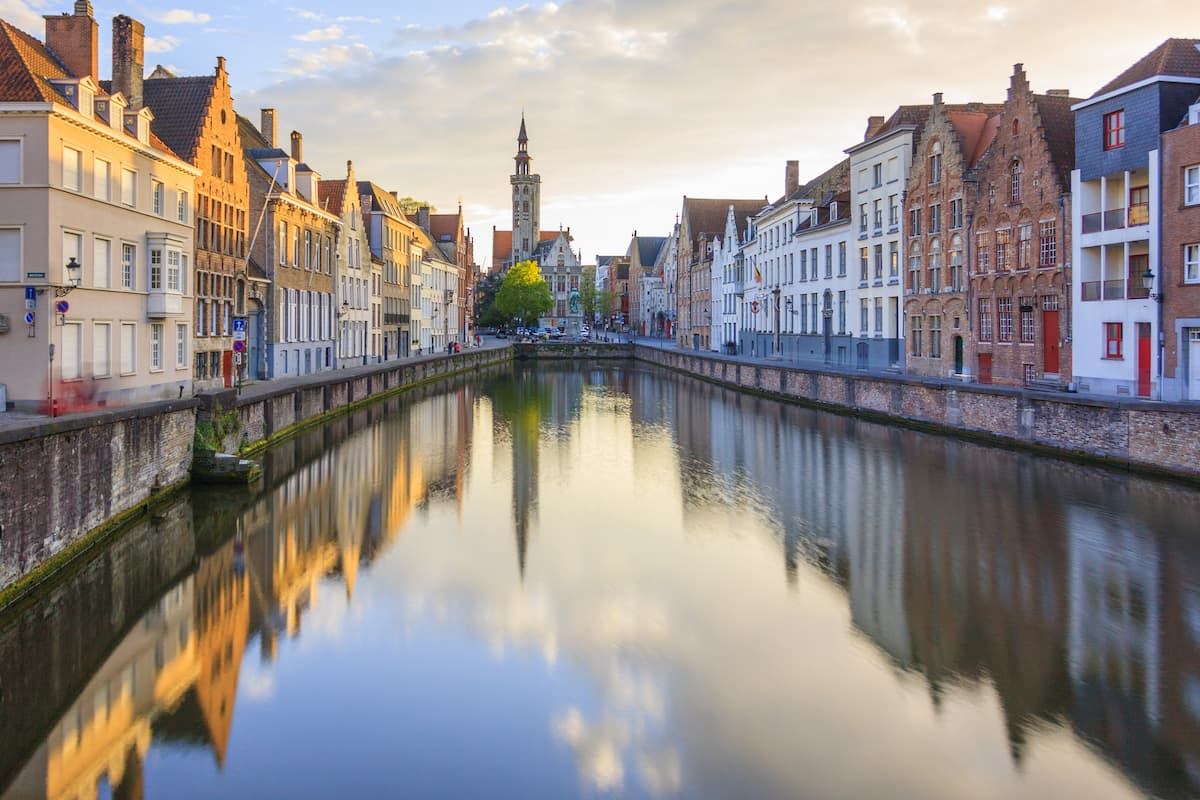
Oh, Bruges, how I love thee. I’m pretty sure my eyes still glaze over when I think back to my days in this swoon-worthy city, with the most perfect cobblestoned streets and pristine canals, complete with horse-drawn carriages replacing cars in the town square. The Venice of the North really couldn’t get more charming.
Being just under a 2-hour train ride from the capital city of Brussels, arriving in Bruges on a Friday afternoon or evening is highly doable, and it’s a great way to get settled in and start exploring the city. Once you see just how magical it really is, you won’t want to stay cozied up in your hotel for long.
This Medieval town can be whatever you want it to be, but slow is definitely the way to go. There’s plenty to do in Bruges and it’s nice and compact, making it super manageable by foot and easy to get around. And I’m going to show you an itinerary (with the addition of some hidden gems) that might feel jam-packed on paper, but once you’re there, you’ll see how close everything is and you can pick and choose which activities suit your personal preferences.
Friday Evening
Belfry Tower
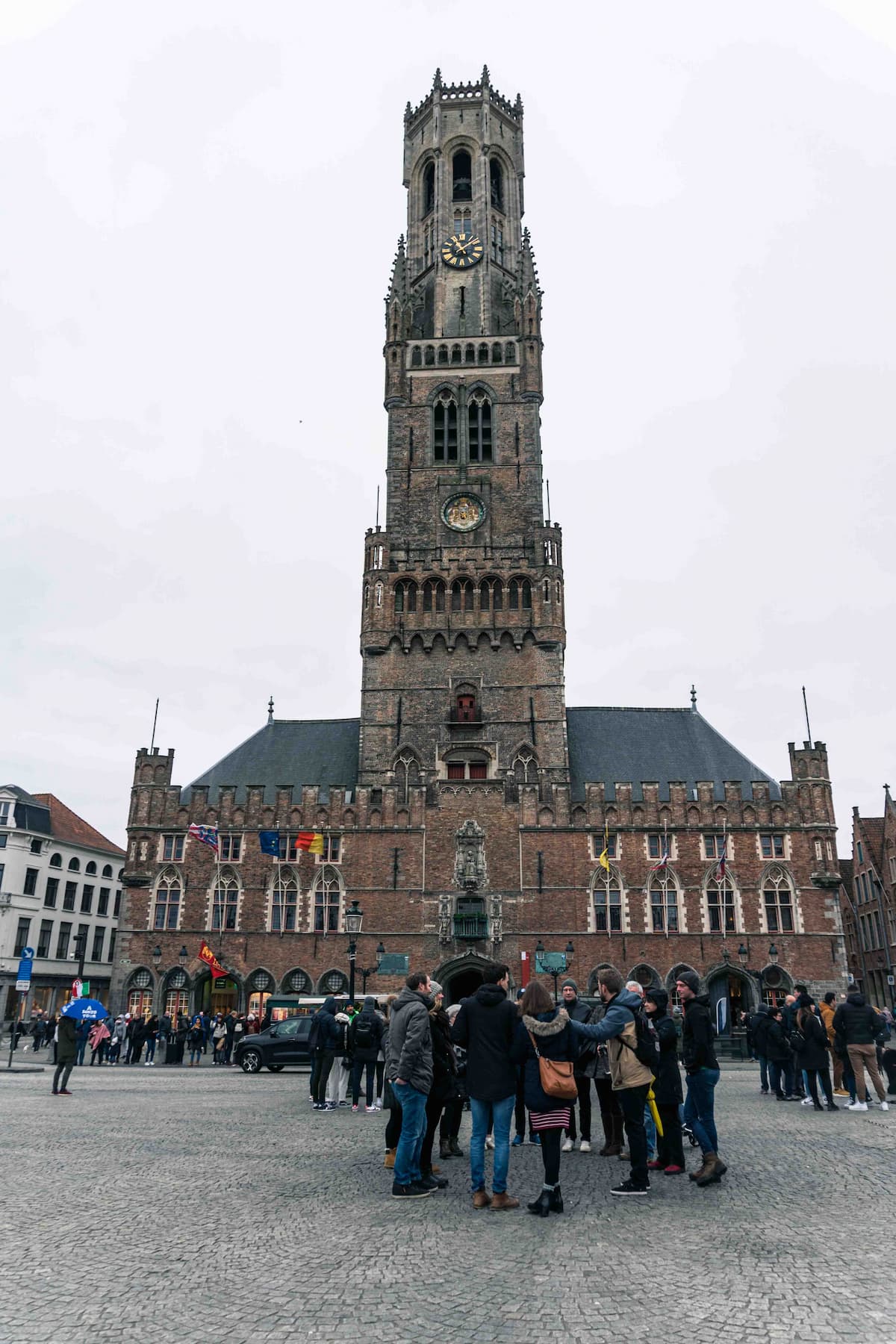
Belfry Tower offers excellent views over Bruges.
If you arrive before 6pm, I suggest heading to the Belfry Tower in the market square, straight away. It’s a great first stop on your adventure because towers always give you the best views of a city, and the Belfry is no exception. Awarded UNESCO World Heritage Site status, in times past it served as an observation tower and also protected against thieves and neighbouring enemies.
Right in the heart of Bruges, this medieval bell tower overlooks the central Markt and will give you an overview of where you’ll be exploring throughout the weekend. Yes, you’ll have to climb 366 steps in order to get this bird’s eye view, but after your train ride, it’ll do you some good. You can even have a look at the old funds and charters of the place if you fancy a little more history.
Hidden Gem: Arcade Behind the Belfry
One of the hidden gems in this area is actually right behind the bell tower. There’s a particularly interesting painted arcade that can be found on Oude Brug Road that you should definitely check out. This covered walkway is perfect for snapping some unique photos or even to shelter from the weather.
Saturday
Markt: the Market Square
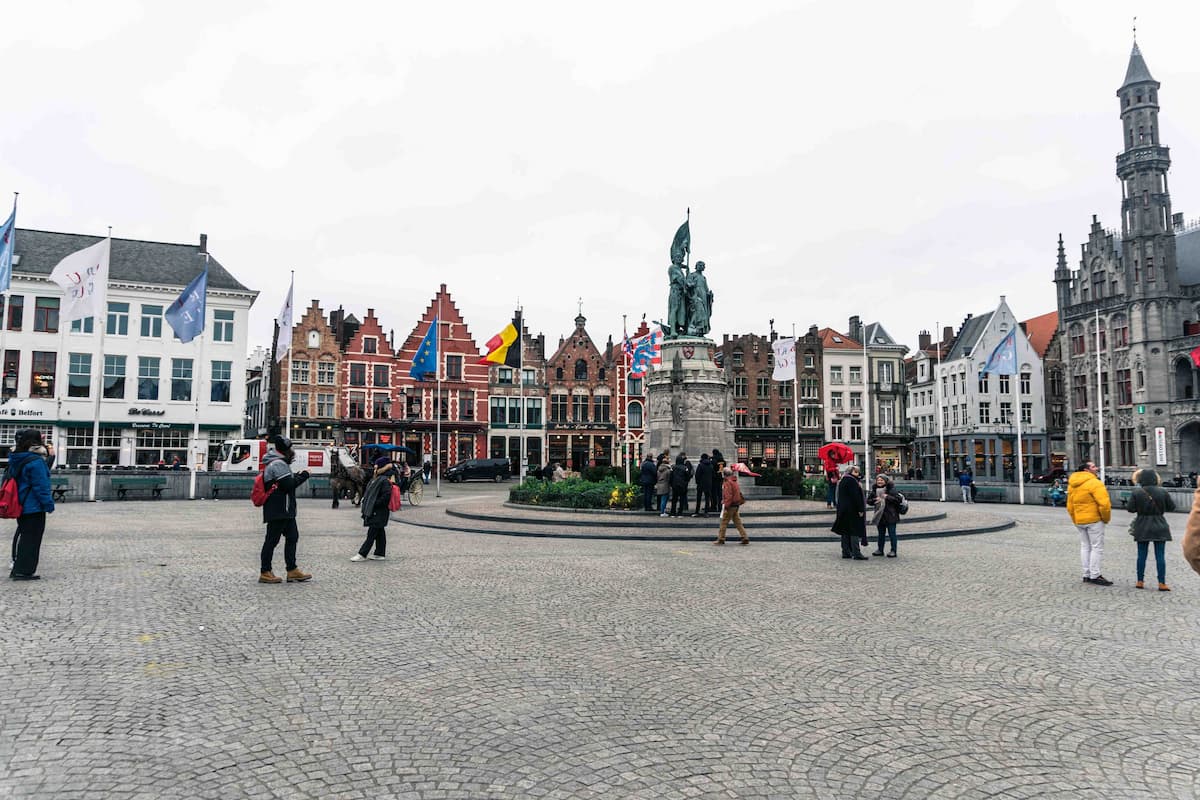
Markt Bruges
After a restful night of sleep and a delightful breakfast, make your way back to the Markt you glimpsed last night. Those gingerbread-style houses that Bruges is so famous for? You’ll find them here. You may have also noticed by now that the market square in Bruges is for pedestrians only. You won’t find any cars in this part of town, only a few horse-drawn carriages; perfect for a leisurely wander.
Surrounded by beautiful shops, traditional cafes and brilliant architecture, the Markt has a wonderful ambience. You might even recognize some of these scenes from pretty postcards. Take some time and explore the streets and shops, enjoying the laid-back vibes and spotting the colourful brick houses of Bruges. On Wednesday mornings, a food and flower market pops up in the square. In November and December, you’ll find Christmas festivities are centred here.
Hidden Gem: Medi Markt
There is very little that could be considered ‘hidden’ in the central square of Bruges, but just in the shadows of the Belfry Tower, the pharmacy – Medi Markt – is about as close as you can get. The shop itself is an ordinary pharmacy, but the façade, next to the impressive Neogothic Provinciaal Hof building, is one of the more memorable and beautiful to gaze upon in the square.
House Bouchoute
Next, turn your gaze to the oldest house on the square. On the front, just beneath the roof, is an undeniably large compass that was installed in 1682, used as a handy tool for 17th-century merchants needing to know the direction of the wind. Yep, you read that right. Where most compasses show the magnetic North, this one depicts the direction of the wind. It’s very cool.
The Old Chocolate House
For the best hot chocolate of your life, take a break from admiring architecture and stop at the Old Chocolate House. It’s so good that unfortunately it’s no secret! You might have to queue a short while if it’s busy.
Once sat upstairs inside this cosy little shop, you will be able to choose from a variety of the finest Belgian chocolate for your drink. Your mug of milk – more like a bowl, really – will arrive, and you can spoon as much or as little chocolate drops as you’d like into it for a taste of pure decadent indulgence.
Sint-Janshospitaal
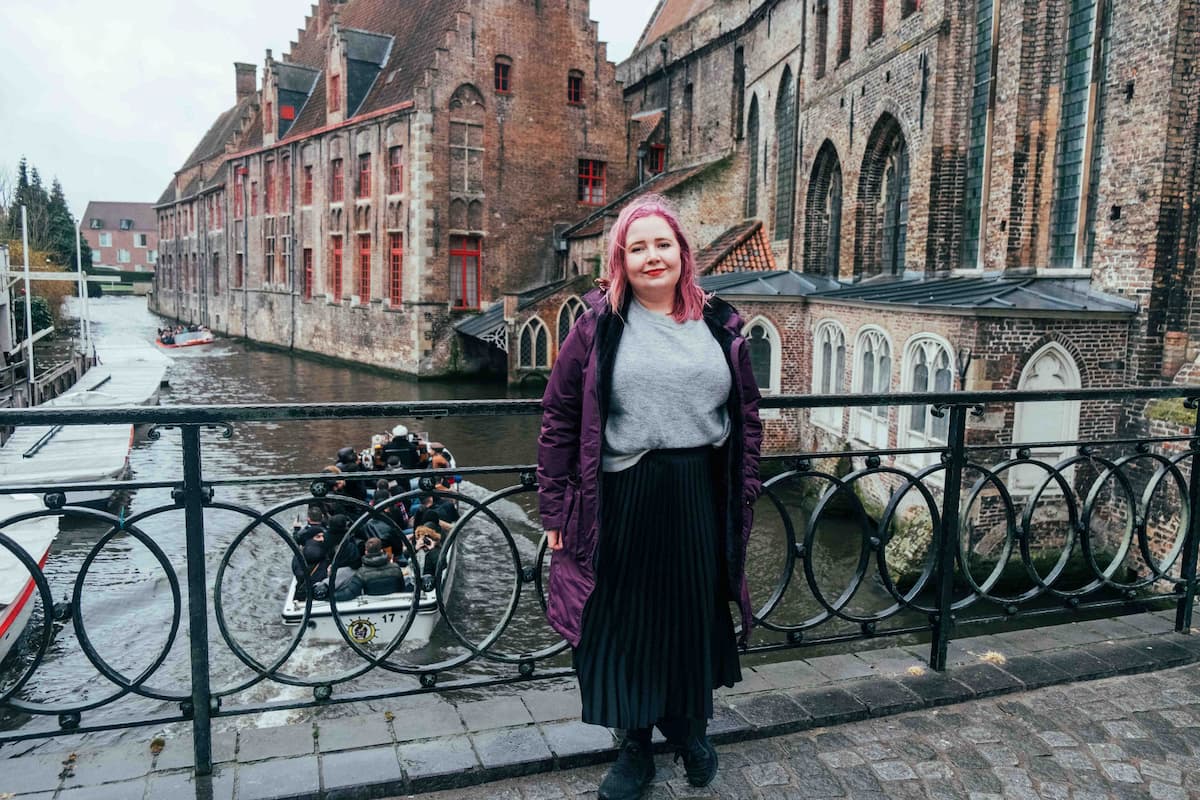
The canal with Sint-Janshospitaal
Also in the city centre is the Sint-Janshospitaal, which was in operation between the 12th-19th centuries. It’s home to some of the oldest surviving hospital buildings in Europe. You can explore inside for a fee, and see old furniture, sculptures, silverware and medical instruments. And if you do, make sure and check out the old dormitory, custodian’s room, pharmacy and Diksmuide attic. Or, you can just wander around the exterior, admiring the apothecary garden and secret little courtyards.
Church of Our Lady
Church of our lady in the background
The spire of this church completes the skyline of Bruges, alongside the Belfry. Being 115.5 metres tall, it’s the second highest brick tower in the world! The church itself is full of artistic treasures, including tombs, mosaics, and paintings like Michelangelo’s Madonna and Child.
The main church part is free to enter, with the museum charging a small, but completely worth it, fee. Other exceptional artworks and woodcarvings include the Pieter Poubus’ Last Supper, the Adoration of the Shepherd, andGerard David’s Transfiguration.
Groeninge Museum
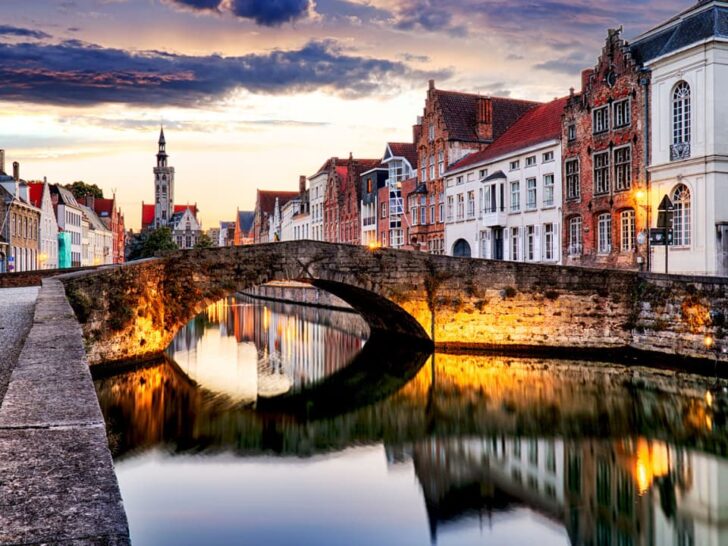
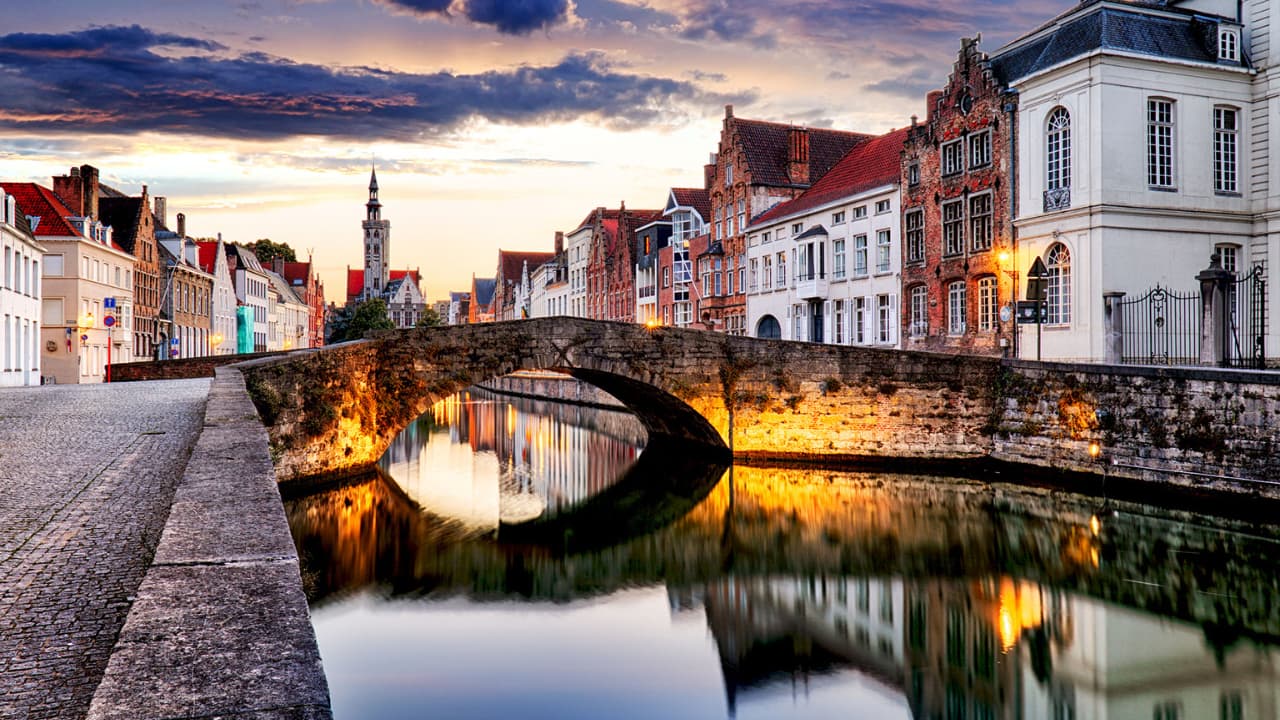
If you’re up for some European art, the Groeninge Museum should be next on your list. The short walk between the church and the museum is just as beautiful, as you’ll find yourself crossing the scenic Boniface Bridge: a piece of art in its own right.
This famous art museum is known for Belgian plastic arts, of all things, alongside neoclassical paintings from the 18th and 19th centuries, by Jan Van Eyck and Hugo Van Der Goes. Or you can even see masterpieces from the Renaissance and Baroque periods. I’m telling you, whatever your art tastes are, you’ll find it in this museum!
Rozenhoedkaai
Just a 3-minute walk from the Groeninge Museum is the most photographed spot in all of Bruges, Rozenhoedkaai. And you’ll quickly see why. I dare you to not take a hundred photos.
This enchanting, historic part of Bruges is set along the lovely canals that once served as a popular location for mooring boats. You’ll see the iconic stunning buildings that look like castles in the background framed by willow trees gently swaying in the breeze, creating a picturesque scene you won’t be able to get enough of.
Among the timeless scenery, you’ll also find quaint cafes, bars, and restaurants just beside the canal. You might want to stop for a drink at this point or just relax by the water and take it all in before heading to your next spot.
Hidden Gem: Torture Museum
Looking for the dark and macabre behind Bruges’ quaint serenity? This intense trip down Europe’s malevolent memory lane should do the trick. Right in the heart of Bruges, the Torture Museum once served as the city’s oldest prison in the Middle ages, and the old cellar has been transformed into this historical museum.
Walk through and retrace the history of the one of the darkest times in humanity. Wax statues with authentic torture instruments show what mankind has been able to do to each other, how much we’ve evolved and where the pitfalls still are in the legal system. If you want to do something a little strange and off the beaten path, this is it.
Belgian Waffles
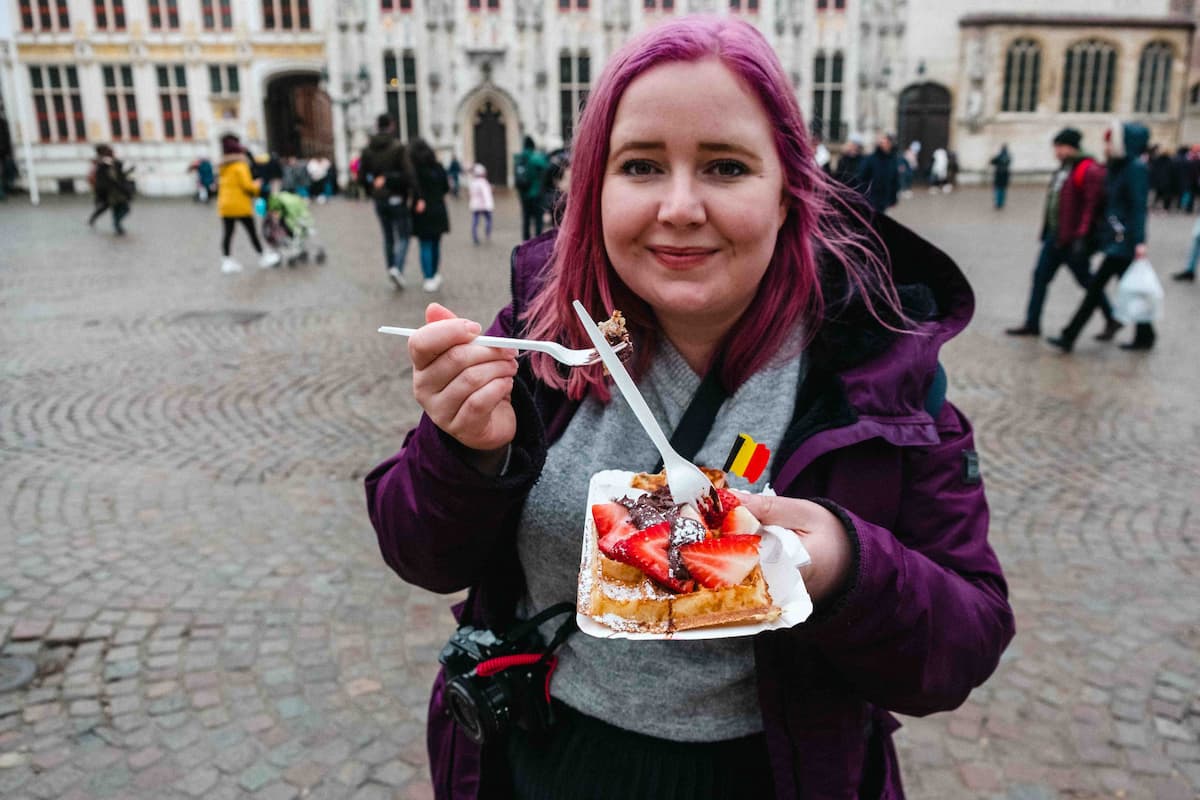
Kat eating waffles in front of Provincial Court
For something a little lighter, you simply cannot visit Bruges with having tasted the traditional Belgian waffles once, or twice. There’s no shortage of cafes where you can try these sumptuous waffles!
Recommendations:
Lizzie’s Wafels. You seriously won’t be able to get enough of these waffles! Fresh, light and crispy, with generous portions and plenty of toppings you can choose from, such as chocolate cream. Add the hot chocolate to your order and you’re golden.
The waffle truck in the Provincial Court Square.
Shopping and Chocolate Tasting
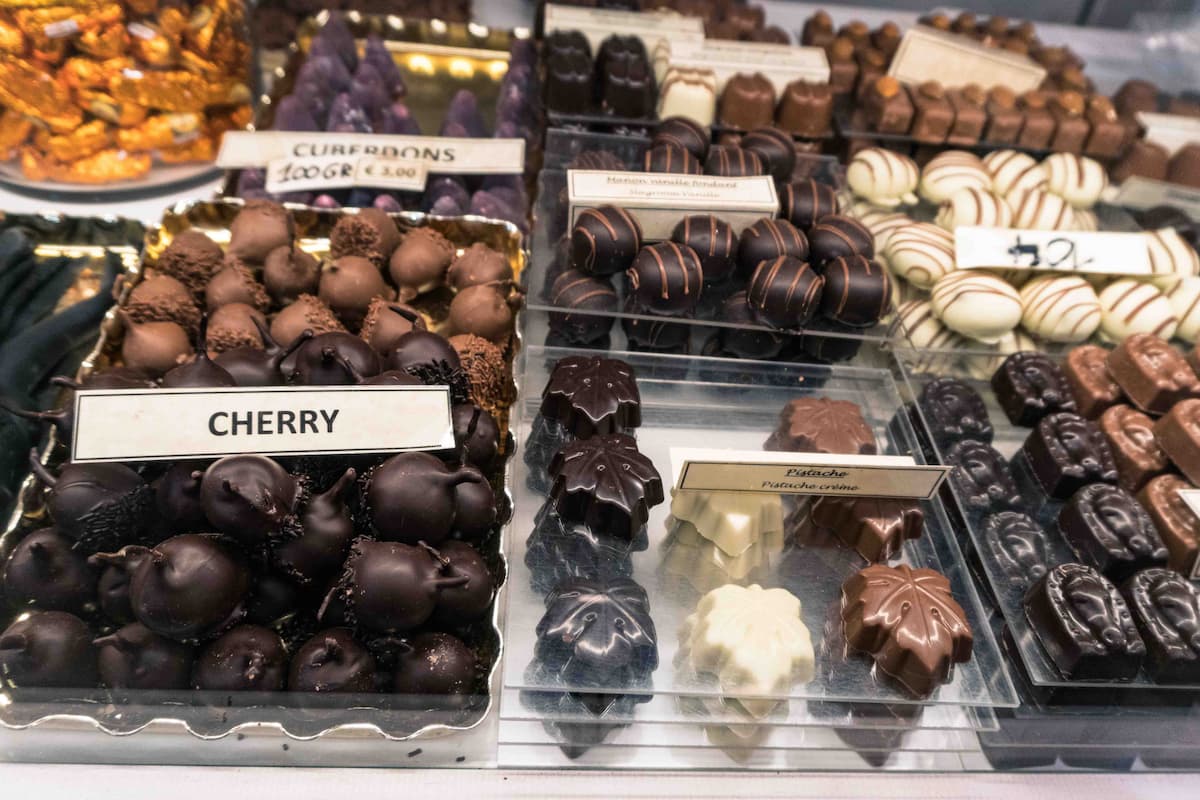
Chocolate Tasting in Bruges is a must!
After walking past all the cute shops in Bruges, you might be keen to get in a little shopping by now. Feel free to spend your afternoon weaving in and out of the speciality shops that feel deliberately placed, scattered about the city. From jewellery to Bruges’ famous lace or city souvenirs, I have no doubt you’ll find something special to take home with you.
And let’s not forget the chocolate! The streets of Bruges are lined with chocolate shops and I’ll be surprised if you haven’t tried any by now. At Depla Chocolatier, pick up some truffles, chocolate covered fruit, or dark chocolate rice cakes. And stop here for one of the best cups of cappuccinos while you’re at.
Chocolatier Dumon is another excellent choice – and while the truffles are delicious, I would recommend trying a plain bar of milk chocolate. It’s the best way to see the difference between your average chocolate bar and the finest chocolate in Belgium!
Of if you fancy trying some chocolate on the more unusual side, The Chocolate Line does amazing handmade chocolates with interesting flavour combinations, like Miss Piggy (bacon and quinoa), Green Tokyo (wasabi) and Havana (tobacco leaves).
Hidden Gem: Kantcentrum
Did you know that Bruges is actually famous for their lace? You can hear the whole story of Bruges lace at the Lace Centre and Museum.
It’s a little further away from the centre, but Bruges is so small that it’s still easily reachable if the museum piques your interest. Located in the renovated old lace school of the Sisters of the Immaculate Conception, you can hear testimonies from international lace experts that explain various types of lace and their geographical origin, as well as multimedia installations, with a focus on lace education in Bruges. And why not take some home with you?
Canal Boat Tour
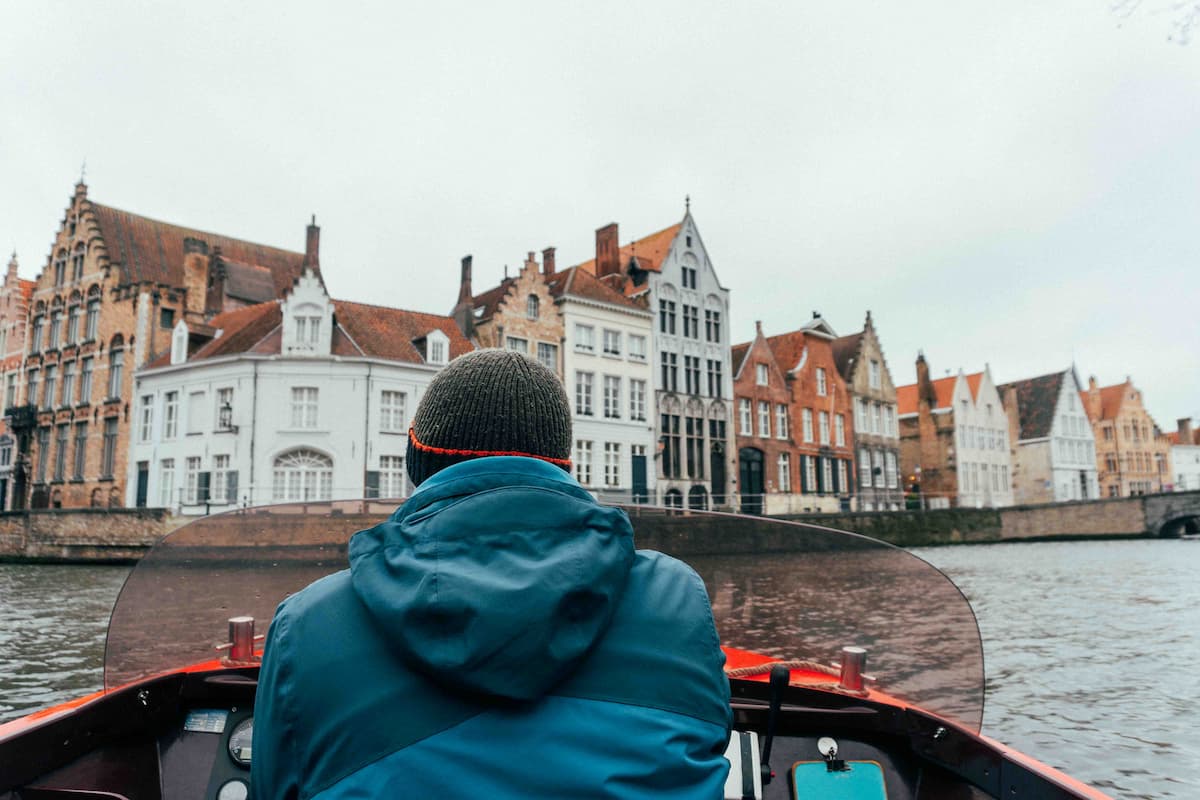
Take a canal boat tour in Bruges.
Ah, a Bruge canal boat tour. This is a great way to wind down your first full day in Bruges. After exploring the city and its magical delights, feel free to put your feet up and explore the city from a different view.
The canal tours are super relaxing and are a great way to snap some photos from different angles. Most tours set off near the Rozenhoedkaai. You might consider pre-booking your tickets in the morning for a canal tour as lines get long real quick on the weekends, especially if the weather is nice.
Don’t forget you’re in Belgium, where they have some of the best beer in the world. Check out popular bars, Le Trappiste and Poatersgat. For dinner why not try one of Bruges’ Belgium stews, such as Elderberry Soup, Waterzooi, or Curried Mussel.
Sunday
You definitely want to start the day with a good brunch and I recommend going to That’s Toast, where they serve breakfast all day long. From granola and orange juice to Tiramisu French toast (drool) and mimosas, you can’t go wrong.
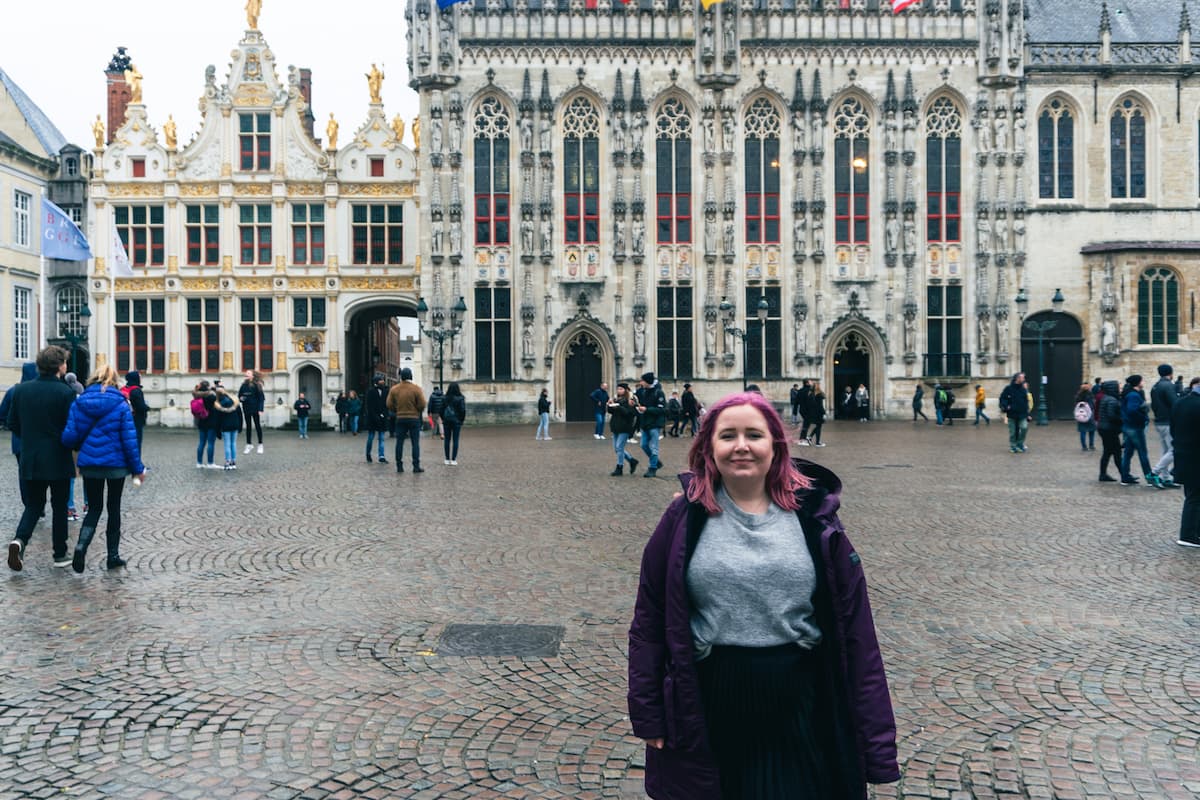
Burg Square
They say that the Market Square is the heart of Bruges, but Burg Square is the soul. I’d have to agree wholeheartedly. This is the city’s centre of power, reflected in the Gothic and Neoclassical architecture.
Stadhuis (City Hall)
Stadhuis (City Hall)
Within Brug Square is City Hall (1376-1421), one of the oldest in the Low Countries and it’s from here Bruges has been governed for more than 600 years. You absolutely do not want to miss the Gothic Hall, with its seriously impressive vault and 20th century murals. This place is a masterpiece in and of itself.
Basilica of Holy Blood
Next to the City Hall is the Basilica of Holy Blood, a Roman Catholic church built in the 12th century. This ancient church holds Bruges’ most cherished relic, an ornate vial filled with a little piece of fabric, believed to have been stained with the blood of Jesus. Each day it’s brought out from the upper chapel for the waves of tourists to admire. The chapel itself is the only one of its kind in West Flanders, being of Romanesque character.
Historium Bruges
Our next stop is the Historium. Prepare to step back in time! This is an imaginative way to discover Bruge through the medieval Golden age, with a short virtual experience. And it’s also a great place to snap some panoramic views of Market Square. If you wanted to, you could definitely spend a couple of hours here.
Hidden Gem: Gallery Xpo Salvador Dali
If you’re a Salvador Dali fan, then our next museum will be right up your alley. The Gallery Xpo has a fantastic collection of famous statues and graphics from Dali himself, set amongst a dramatic pink and gold backdrop. You might find long queues here, proving it’s not quite that hidden and definitely worth the wait. And splurge on the audio guide for sure!
Choco Story
For all the chocoholics out there, you don’t want to miss out on the Choco Story, for a chance to walk through the history of chocolate, see actual Belgian chocolate being made and sample some, of course. Here you’ll discover all the benefits of chocolate (as if we needed more reasons to eat it) and even the history of the infamous cocoa beans. Make sure and leave yourself a good hour or two for this decadent experience.
Hidden Gem: Lumina Domestica
Within the same building as the Choco Story, is the Lumina Domestica museum, or Lamp Museum. They even share the same ticket office. Convenient, eh? Don’t underestimate this hidden gem. Here you’ll find a whopping 6000 antiques and lamps, along with the history of the first light…fire, and progressing through the ages with all sorts of light-related inventions.
Bruges Beer Experience
If you’re somehow sick of chocolate at this stage, you could skip Choco Story and try out one of Belgium’s other biggest exports for style.
The Bruges Beer Experience gives visitors the chance to learn all about the history of beer and the intricacy of the brewing process. Best of all, you get the chance to try some samples of local beer at the end of the tour!
De Halve Maan
Kat drinking beer at De Halve Maan
Still sober? Your next stop might change that. You’ll be stepping into De Halve Maan, the only remaining brewery in Bruges! That’s right, since 1865, they’ve been making the best Belgian beers in Bruges, now in its sixth generation of the family business.
If you’re a hardcore fan, or even if you’re not, there’s a 45-minute tour exploring the three-kilometre underground pipe. During the tour, you’ll learn the trade secrets of beer making and get to try the local beer, Brugse Zot.
Minnewaterpark
After you’ve relaxed with a pint, head to Minnewaterpark, for some peaceful time away from the crowds. Known to the locals as “The Lake of Love” because according to legend, if you walk over the lake with your loved one, you’ll experience eternal love. Complete with beautiful swans, it might not come as a surprise to learn it’s the most-visited romantic spot in Bruges.
Almshouses
Now this is some interesting Bruges history. Almshouses are small whitewashed houses that date back to the 14th century. Wealthy citizens and guilds formed little complexes, where single women and older adults could stay, but in return they had to pray for the rich, in special chapels near the houses. Nothing like the old-school Pay for Pray!
But there are actually a total of 46 preserved church complexes that serve as shops and historic buildings now, with the Almshouse de Meulenaere being a popular one. It’s hard to tell the houses apart, but you’ll spot some with plants lining the doorways or with splashes of colour. And on all of them, you’ll see the founders’ names.
Windmills of Bruges
Bonne chieremolen windmil from Bruges
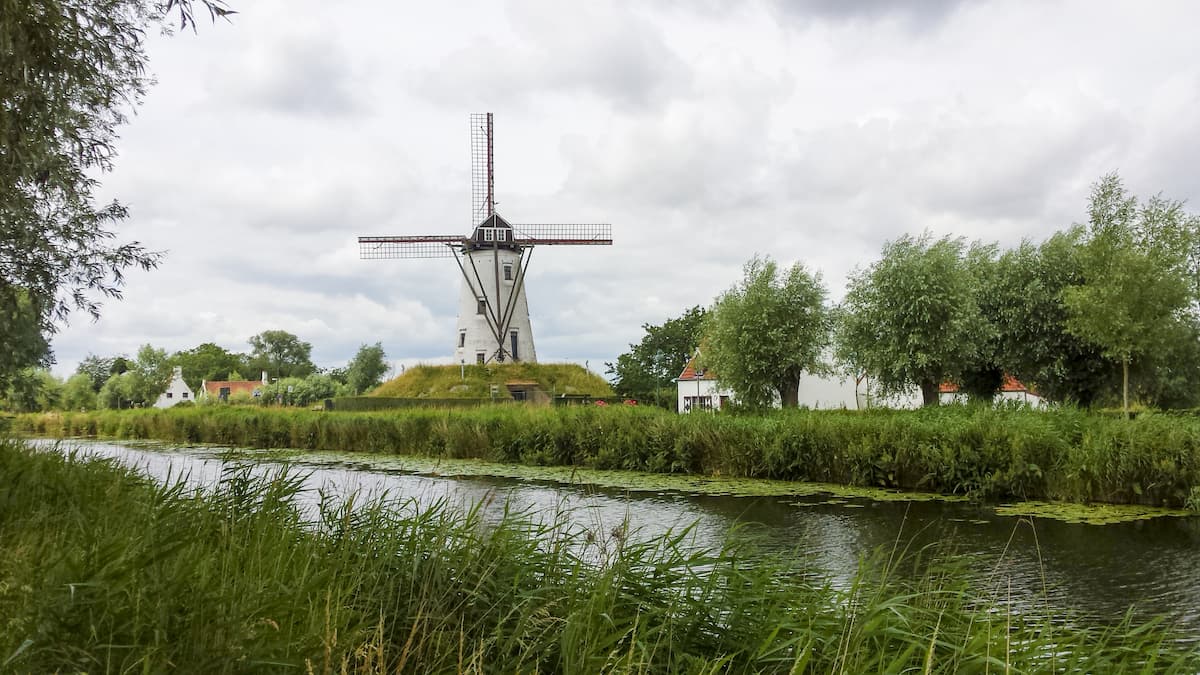
Let us not forget the ramparts of Bruges, a six-kilometre park surrounding the old town. The ramparts are where you’ll find the four remaining windmills of of the original 23 in Bruges, as well as four very cool medieval town gates. Taking a lovely stroll along the ramparts and canals, while visiting the windmills is one of the best ways to get a feel for the town’s rich history.
Koeleweimill
Koeleweimill, aka Coelewey mill, was once used for corn and was originally located in Meulebeke. Originally built in 1765 as a wooden mill on a closed brick base, it was reconstructed on its current site by the city of Bruges after it broke down in 1980.
Nieuwe Papegaai This mill is fun to see for its distinctive parrot on the roof, for which the windmill is named. It was originally built in 1790 as an oil mill called Hoge Seinemolen and moved to its current location in 1970 with a new name to boot.
Sint-Janshuismill This is the oldest mill in Bruges, built in 1770 and the only one still in its original position. It’s also the only windmill with a museum for you to check out and I recommend you do so. Built as a wooden mill on four brick dices, this historic piece of architecture is still used today for grinding flour!
Bonne Chiere A far younger mill is Staakmolen, or Bonne Chiere, built in 1844 and rebuilt in 1911 at its current location after a storm accident. This mill is built in the same style as Sint-Janshuismill, wooden with brick dices. Strangely enough, this mill was never actually used for grinding grain. It’s a show mill, only existing as decoration.
Tip: If you’re bicycle confident, you can also rent a bike cycle around the rampants in a very short period of time.
Beguinage Convent
Back in the city square, head to the most silent spot there is; the Beguinage Convent. Called the “Princely Beguinage of the Vineyard,” this UNESCO world heritage site was once the home of the beguines, founded in 1245. The beguines were emancipated women who led a pious and celibate life, and today the beguinage is home to the nuns of the Order of St Benedict, as well as several other Bruges women who have decided to remain unmarried. If you happen to pass by at noon, you’ll have the chance to hear the beautiful sounds of the nuns chanting each day.
Diamant Museum
Now on to some sparkling adventures at the Diamant Museum. Would you believe that Bruges was the first city of diamonds in the world?! Bruges archives confirm that the city’s diamond trading and polishing began in the 14th century, and in the museum, which opened in 1999, you’ll learn all kinds of interesting facts about diamonds. You’ll even see how they cut and polish these gems through cutting demonstrations, and you can pick up a diamond souvenir in the gift shop.
Hidden Gem: Concertgebouw Circuit
Visiting the Bruges Concert Hall is one of the most underrated things to do in the city. But if you’re a fan of music and design, you’ll want to head over to this strangely modern building that has a famous acoustics and contemporary art collection. And I must say, you’ll get some of the most beautiful views of the entire city here as well.
Where to Stay in Bruges
There are six main areas for you to stay in Bruges and they’re – as should be expected in Bruges – all quaint, historic and picturesque. Here’s a list of the places to consider when booking your accommodations:
The City Centre – to be right in the middle of all the action.
Ezelstraat Quarter – best for those on a budget in northwest Bruges.
Sint-Gillis Quarter – a quiet, though popular and slightly pricier area.
Magdalena Quarter – quiet, serene and made for families.
Sint-Anna Quarter – your off-the-beaten path location, where local residents live.
Railway Station Sint-Michiels – not as popular and a little further out, but only a 10-min walk from Grote Markt.
Well, that wraps up our weekend in beautiful Bruges! This uniquely picturesque place will leave you utterly speechless and I’ve no doubt you’ll want to visit again. With this weekend itinerary you’ll definitely cover all the best things to see and do in the city, making your time away absolutely perfect. Whether you’re looking for a romantic getaway or just something more low-key, the fairytale charm of Bruges is where you want to be!
If you’re heading back to Brussels and your weekend in Bruges, why not spend an extra night exploringthe capital city? Check out my post on weekend trips to Brussels and Bruges.
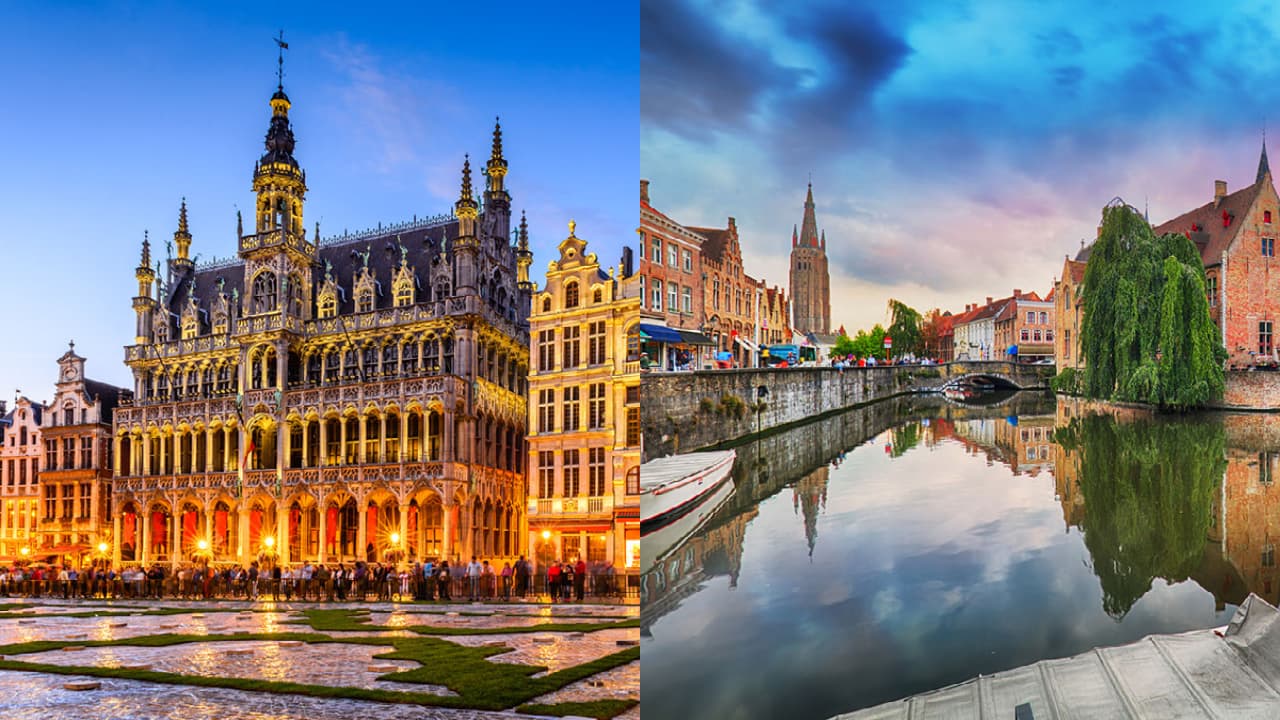
You have a weekend getaway coming up and you know you’re headed to Belgium, but you can’t decide which iconic city to choose from: Brussels or Bruges? I hear you. Both cities are worth a visit for their distinctly different charms, but for those short on time, this guide is here to help you decide.
You’ll find that the majority of visitors to Belgium are headed one of two ways: Bruges, or Brussels. While not exactly far from one another, those on tight schedules will often only find time for one of these two fabulous cities. The good news is that both Brussels and Bruges are perfect for a 2 or 3-day break. But which city is the better choice for you?
Brussels is a large cosmopolitan capital city with over a million residents, whereas Bruges is a more intimate, medieval, fairytale-like town.
Brussels has a mix of cultures, diverse architecture, and many food and nightlife options. Bruges has a more relaxing atmosphere, where you can casually stroll along the picturesque canals and cobblestoned streets.
But there’s a lot more to think about and learn about these two Belgium cities before making your decision. Here are highlights of both Brussels and Bruges to help you decide!
Brussels and Bruges: History and Overview
I’ll be honest, most travellers end up choosing Bruges over Brussels because its small, dreamlike, historic charm just seems to lure them in. Literally known as the jewel of Belgian tourism, it is hard to resist. However, Bruges can, somewhat like the canals of Venice to which it is so often compared, get awfully busy, so keep that in mind if you’re travelling in peak season.
While Bruges is a quaint medieval town that seems almost frozen in time, with Brussels, you get what you’d expect; a vibrant, bustling city with a range of cultural activities to keep your senses engaged. Like any big city, you should keep on your toes – though any unsavoury areas are well out of typical touristic zones – but with its interesting mix of French and Flemish cultures, Brussels has its own charm.
Both cities are very walkable and can be visited on foot in a full day or two. Even though Brussels is a large city, its centre is compact and easily explored. Bruges is unique in that travellers can take in the sights through canal boat rides, bicycles, or even horse-drawn carriage rides.
Brussels has a large community of expat workers, including white collars from the Belgian government, European Union, and NATO, giving the city a special international vibe. But it does lack the antique charm of Bruges.
Brussels
Grand place in Brussels
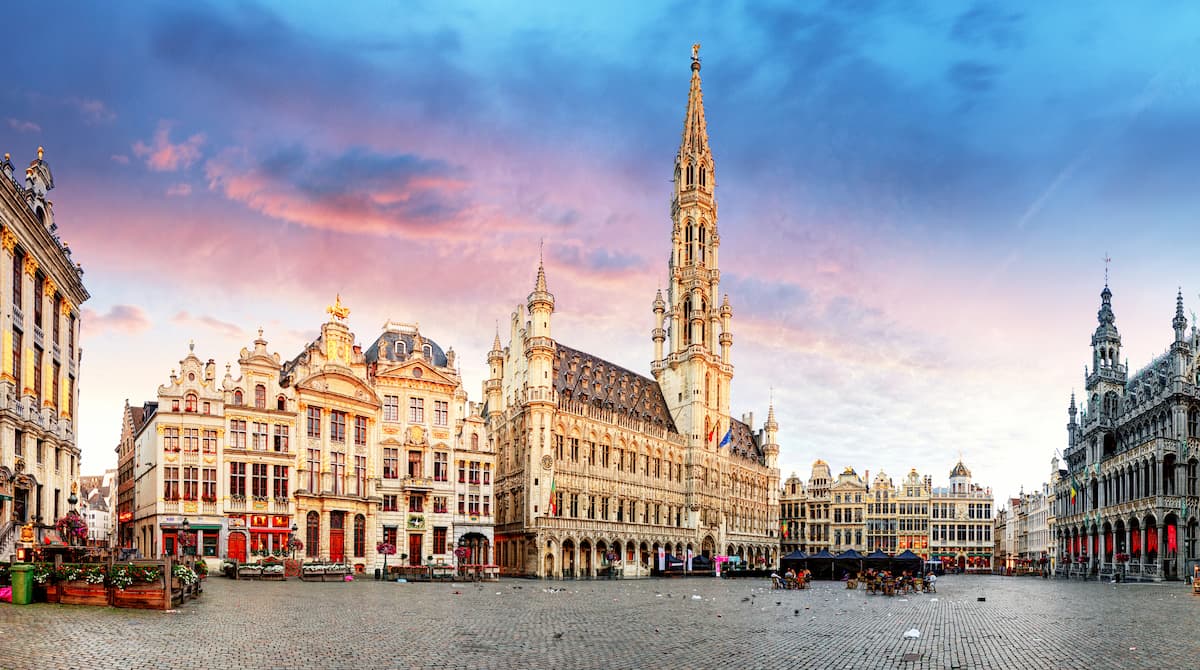
Brussels was founded in 979 AD and is the capital city of Belgium, with the largest metropolitan area in the country. The 1400-1600s brought great wealth to the city and is visible in the beautiful, diverse architecture spread throughout.
The city’s main square, called the Grand Place, is said to be one of the most beautiful squares in all of Europe.
Brussels is also the headquarters to the European Union. 70% of the population are from other countries, making for a large immigrant population. Though Belgium is largely home to a mixture of French and Flemish (Dutch) speakers, the majority of residents in Brussels speak French.
Bruges
The canal with Sint-Janshospitaal
At the time of writing, Bruges has close to 120,000 residents, making it the 6th largest city in Belgium. With many canals and over 80 bridges, Bruges is often referred to as the “Venice of the North,” similar to Amsterdam.
Thankfully, the city suffered very little damage from either world war, and its waterways helped Bruges gain wealth throughout the centuries. Unlike Brussels, Bruges didn’t have to contend with a French army burning down the city in the 17th century! It’s declining importance after the 16th century helped ensure it became one of the best-preserved medieval towns in Europe.
A wonderfully romantic city, made for boat rides and low-lit evening wanders. Bruges’ beautiful web of streets is unlike any place in the world, and while it may not be a match for someone looking for excitement, it’s a city sure to take your breath away.
Bruges is known for its lace, chocolate shops, and Belgian beers, even boasting an underground beer pipeline!
Sightseeing and Culture
Brussels
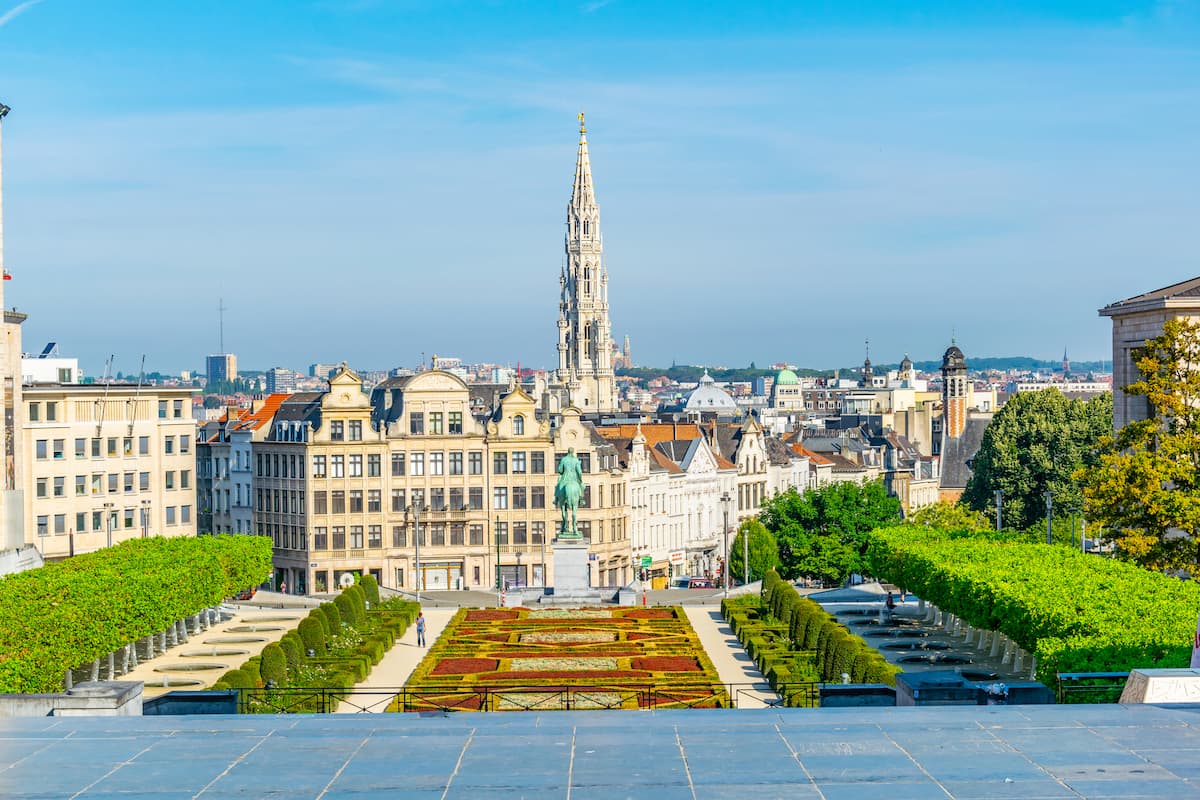
Mont des Arts park in Brussels
The Grand Place in Brussels is the city’s main square and without a doubt the first attraction you’ll want to see.
Brussels City Hall is the oldest building in Grand Place, completed in 1420, is a known masterpiece of Gothic architecture.
The Royal Saint-Hubert Galleries are a trio of gorgeous glass-covered shopping arcades filled with up-market boutiques and elegant coffee shops.
Look around the Palace of Justice and then just outside, take a glass elevator to the Marolles district, where you find a unique atmosphere with small stores and a nice little Sunday market.
You’ll recognize the Manneken Pis, a famous fountain sculpture designed in 1388. It’s one of the most beloved symbols of Brussels, and originally served as the means by which many Bruxellois received water.
And you’re sure to not miss the 102-metre tallAtomium, an historic landmark and international symbol, made for the 1958 World Expo.
Parc du Cinquantenaire is a major park in Brussels, where the monumental triple arch known as Arc du Cinquantenaire is located.
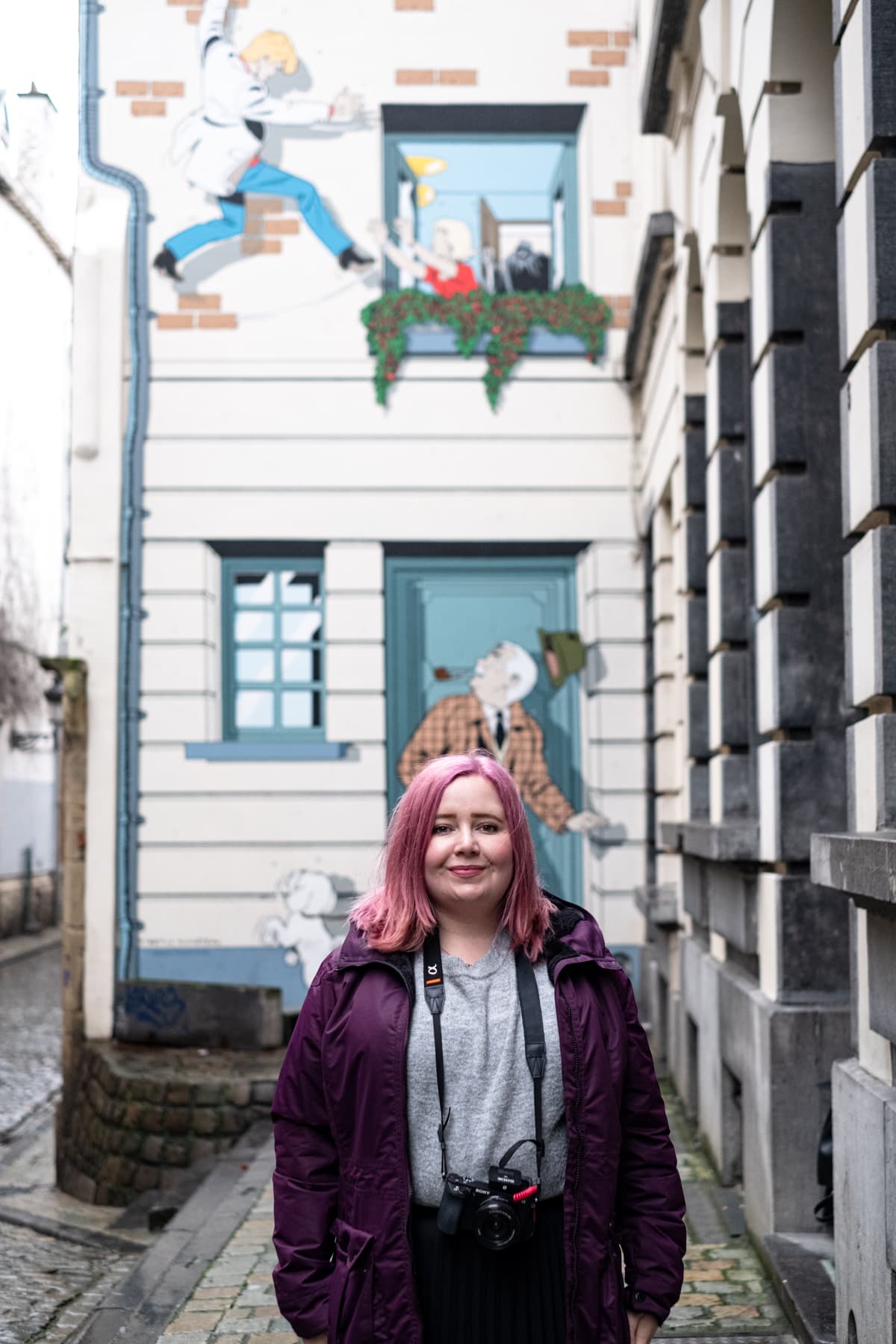
Like London, Brussels is also known for it many unique art murals around the city. Brussels was influential in the early days of the Art Nouveau movement; there are buildings scattered all over which can be visited, along with private buildings, via a tour offered by ARAU.
Bruges
Markt Bruges
Market Square is the main square in Bruges, surrounded by some of the city’s most iconic buildings.
The Belfry Tower was founded in 1240 as a wooden tower on a stone building, and is the most famous and tallest part of Market square.
Bruges City Hall has Gothic architecture and was completed in 1421, being one of the oldest in the Low Countries.
Church of Our Lady Brugesis an impressive Catholic cathedral with a museum that boasts paintings, reliquaries, tombs and mosaics, and a Michelangelo Madonna and Child.
The Rozenhoedkaai, or Quay of the Rosary, is one of the most photographed and beautiful sights throughout the city of Bruges, with its canals and classic buildings.
The 12th-century Roman Catholic Basilica of the Holy Blood is stunning inside and out.
The Beguinage convent is a very special UNESCO site, where you can hear the nuns chanting at noon each day.
There are also several medieval city gates and windmills for you to visit.
Other popular attractions include the Lace Centre and the Chocolate Museum.
Take a canal boat tour in Bruges.
With Bruges being a much smaller city, the sights are that much closer to each other and hard to miss. Every street is picturesque, with beautiful buildings and charming character.
Being surrounded on three sides by canals, it’s easy to walk around the town, from the centre square to the Belfry Tower, across the bridges and canals along the Minnewater Lake, and back to the historic buildings of Bruges.
Transportation and Getting Around
Brussels
Most of Brussels can be explored by foot, with the city centre having many of the attractions you’ll want to visit. Other landmarks like the Atomium or National Basilica will require public transportation. Still, you can buy a 24-hour public transport pass for 7.50 Euros or use the contactless system for single tickets.
Depending on what you’re going to be doing, it might make more sense to purchase The Brussels Card, which allows you to use public transportation as well as granting entry into the 39 museums in the city.
Or, you can catch a hop-on, hop-off tourist bus. This is a good way to see the city, and it’s located right across the street from the central train station.
Bruges
Bruges was made for walking. It’s not a very large city and a lot of the city centre doesn’t even allow cars, which makes it even more pedestrian-friendly. They do have a handy network of buses though, that can take you around the outskirts of the city, but really, it’s all totally walkable. It’s definitely doable to get by without using public transport at all, except when and if you’re arriving and leaving by train.
Two more unique and enchanting ways to see Bruges though, are by boat and horse-drawn carriage. They go hand-in-hand with the enchanting town. And last but not least, a bike ride is another sweet way to travel.
Food and Nightlife
Brussels
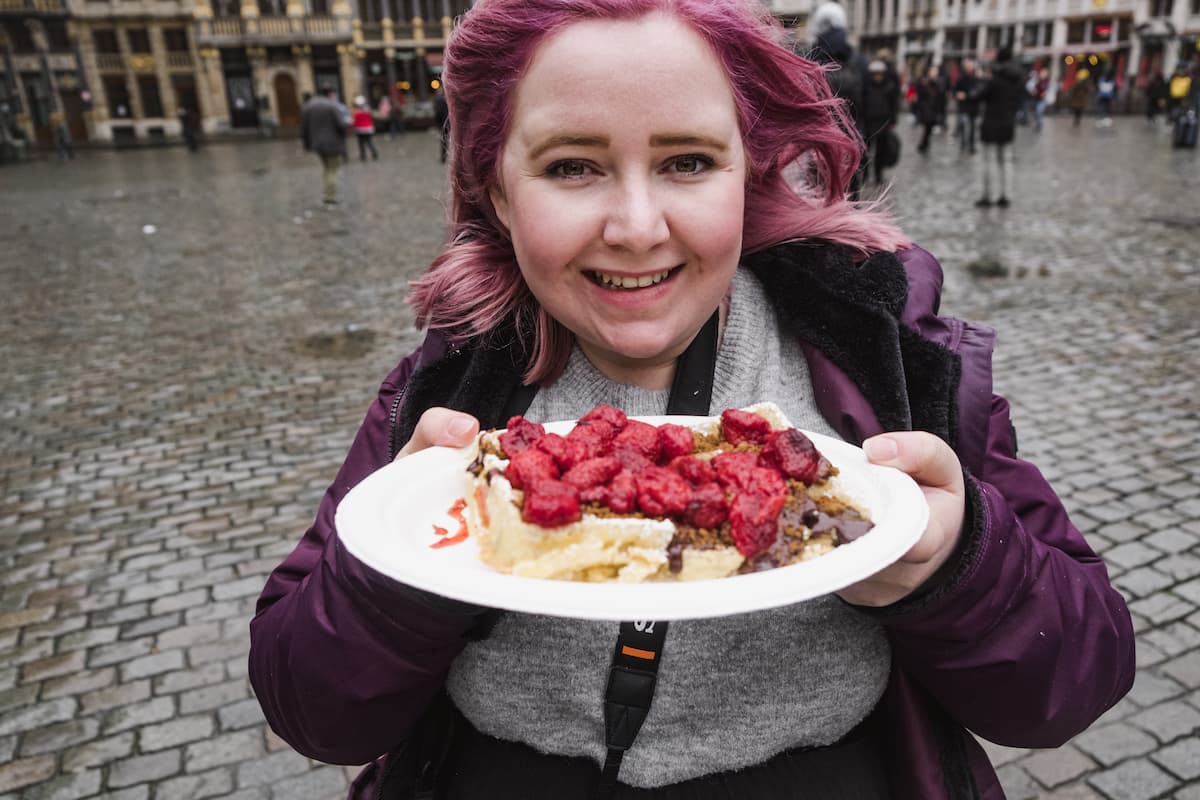
Eating Belgium Waffles
Frites are by far the best street food in Brussels. Belgians loves their frites and you will too after you’ve tasted them!
Of course, you can’t go to Belgium without finding Belgian waffle shops strewn throughout the capital. And there’s no better place to try them once, or twice.
Beer is also big in Belgium and they have a rivalry with Germany for which country has the best beer. You might be surprised to learn that Belgium is home to the world’s largest brewer, AB InBev, and has 224 breweries in the country.
Premium Belgian chocolates are very well-known throughout the world, and Brussels has over 500 different chocolatiers spread throughout the city. Do you realize what this means? That for every 2,000 people, there’s a chocolatier. Belgians know their chocolate. Even the popular Godiva chocolate was started in Brussels.
And you must try mussels in Brussels! “moules-frites” is a Belgian and Brussels specialty.
If you’re looking for a good night out, Brussels definitely beats Bruges. It’s not as crazy as some other European countries, but can hold its own. The city centre has a plethora of bars, with many of them having deals such as 1 Euro pints. If you’re looking to dance the night away, check out You Night Club and Fuse, two of the biggest and most popular clubs in the city.
Bruges
Kat drink Brugse Zot at their brewery in Bruges
Bruges offers some one-of-a-kind dishes, such as popular Belgium stews. Be adventurous and try the Elderberry Soup, Waterzooi, Curried Mussel and Butternut Squash Soup, and Presoep.
You’ll also find the cobblestoned streets lined with chocolate shops, such as the reputable Chocolatier Dumon, said to make the best chocolate. You can even visit the Chocolate Museum.
The town is also famous for the incredibly creamy and soft Passendalecheese, named after the village it originates from.
Don’t leave without tasting some of the sweets while you’re in the area, especially the Brugsch swaentje, which stands for Bruges swans, an important symbol of Bruges.
You’ll want to make early reservations in Bruges, especially for lunch, due to the large number of tourists that come in for the day. The evening gets very quiet though after the daytrippers leave, so you won’t find the nightlife that Brussels offers. But that doesn’t mean they don’t have a nightlife!
Don’t forget you’re in Belgium, where they have some of the best beer in the world, so you’ll still find bars scattered throughout the city centre for bar hopping. Popular bars, Le Trappiste and Poatersgat, stay open until 1am or later on Sundays.
There’s even a nightclub called De Coulissen Brugge for something a little more wild, and if cocktails are more your thing, the Garden of De Republiek Café is a good choice.
Brussels or Bruges?
Do you want to visit a large, bustling capital city, or a quaint medieval town, complete with cobblestoned streets and picturesque canals. If it’s the former, Brussels. For the latter, it’s Bruges. As you can see, you’re winning either way!
If you’re not bothered either way, I’ll be honest and say Bruges is the more unique of the two. There are several fantastic metropolitan cities in Europe that can compete – and often surpass – what Brussels has to offer. Cute, exceptionally-preserved medieval cities with beautiful canals and delicious chocolate? Not quite so common.
Why Not Do Both?
And then there’s always the option to visit both cities. It’s not uncommon for travellers to do day-trips from one city to the other. Brussels and Bruges are only 60 miles apart, and about one hour by train, so their close proximity does make this a viable option. You’ll even find discounted round-trip fare on the weekends.
I hope this guide has helped you decide which Belgium city is right for you! Belgium is a beautiful and really special country to visit and will leaving you wanting more. You can always visit them both if you’re still undecided!
A mention of England’s favourite National Park, the Lake District, should bring to mind rolling hills, sweeping valleys and remote countryside. There are almost 600,000 wild acres to explore within the borders of the Lake District, which are perfect for long rambling hikes and getting lost in the wilderness.
Of course, it’s an unfortunate fact that none of these things typically coincide with being public transport friendly. But the Lake District is more accessible than you might think.
While the most hidden corners and further afield locations may be out of the picture, you can still enjoy a full and satisfying itinerary in this National Park. With our guide to the best Lake District itinerary without a car, you will not only leave feeling like you have seen the best of the region, but like you could visit again and again and never feel that you have missed out.
Discover one of the UK’s most beautiful regions without ever needing to get behind the wheel.
Begin Your Trip at Windermere
Where better to start than the Lake District’s most iconic lake? Windermere is both the largest and most famous lake in the eponymous Lake District. As a virtue of those traits, it is also the best connected.
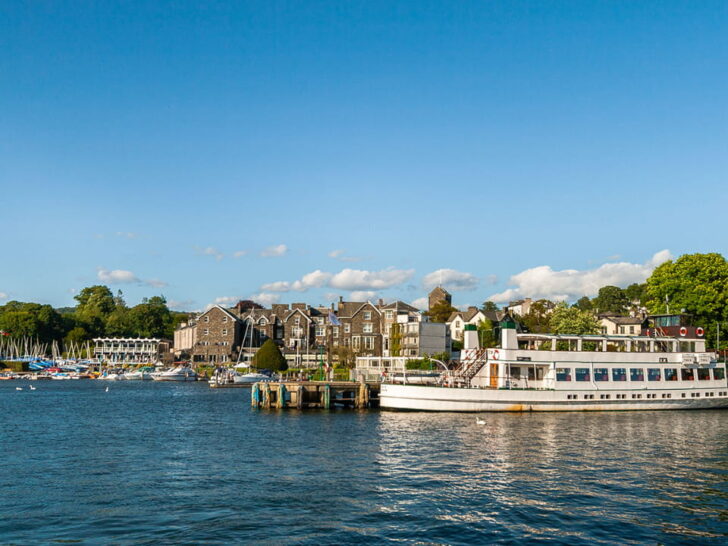
Staying in Bowness-on-Windermere puts you in the centre of all the action, right on the edge of the lake in a busy town filled with shops and places to eat. It’s connected to most areas in the Lake District by bus or ferry, and works as a great base for car-free visitors hoping to explore the region.
You can easily reach Bowness-on-Windermere by bus after catching the train into Windermere station. Once there, it’s time to start exploring the Lake District’s busiest town. With thousands of tourists flooding through Bowness-on-Windermere every week, you get the immediate sense that the town caters to a transient, affluent crowd. This isn’t a bad thing for visitors at all, as unique shops are able to flourish with the extra income provided by tourism.
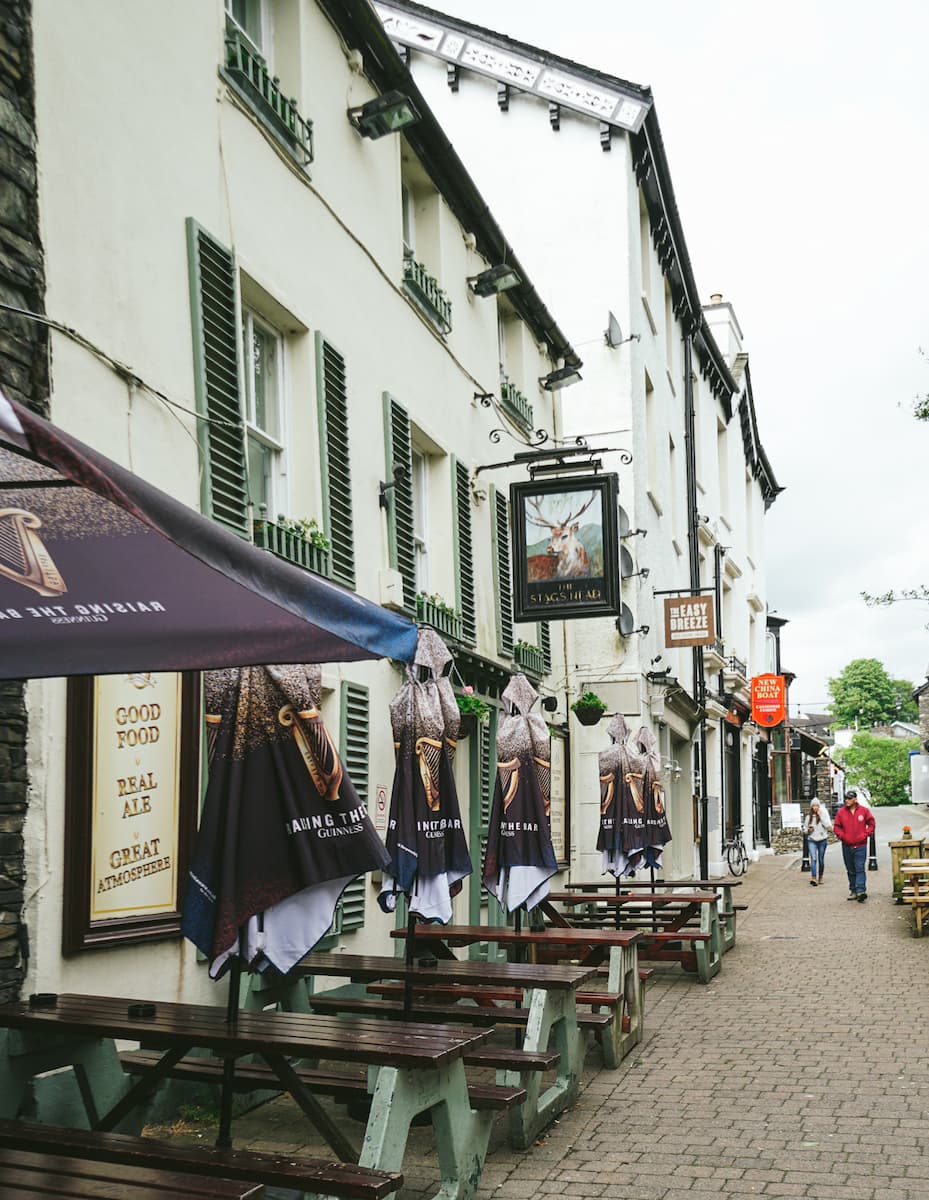
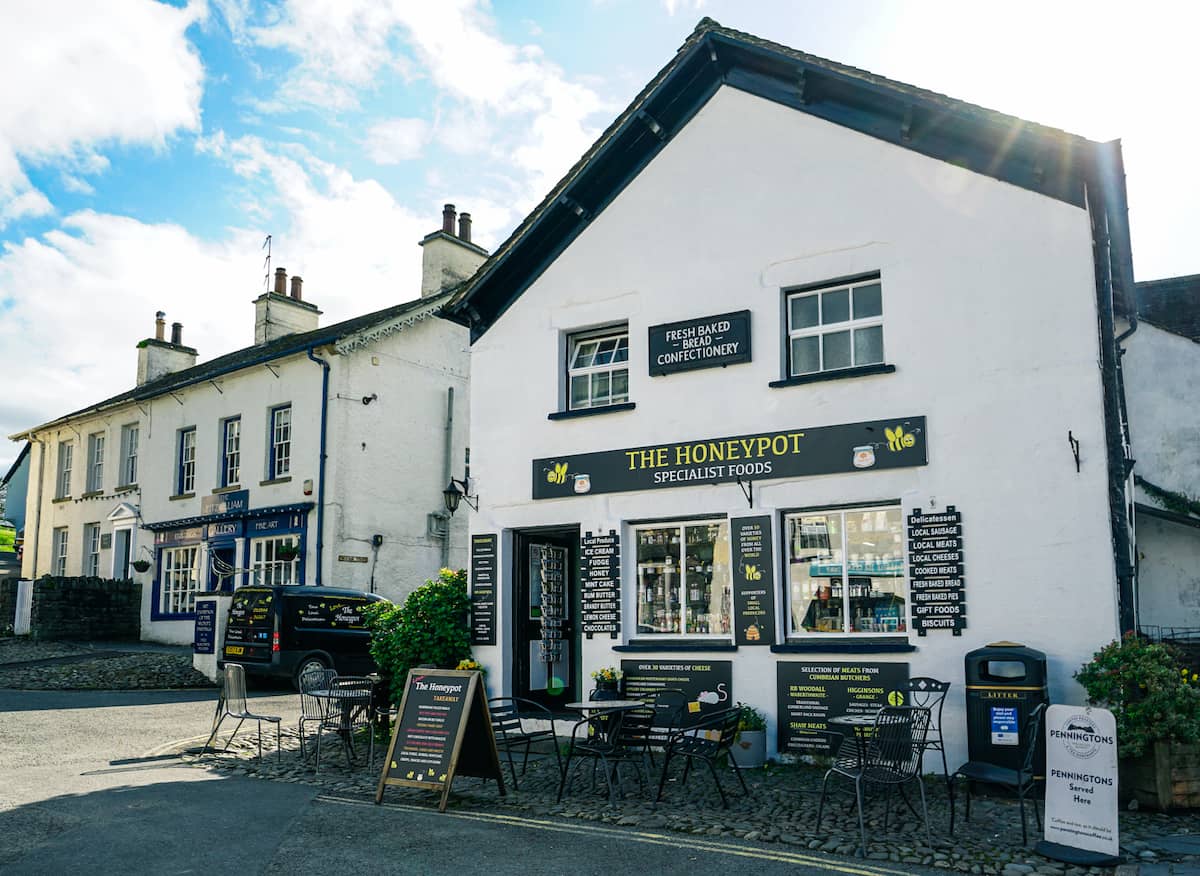
There are gift shops, unsurprisingly, but you will also find independent clothing boutiques, a fudge pantry, galleries, pottery shops and the like in this town. Cafes, pubs and restaurants are also thriving – Graze is a favourite of mine – which is perfect for visitors. Hikes and boating are the obvious activities of choice, but there are some rainy day alternatives in Bowness: Blackwell – The Arts & Crafts house, the Old Laundry Theatre, and, most famously…
Journey Into The World of Beatrix Potter
World of Beatrix Potter – Peter Rabbit
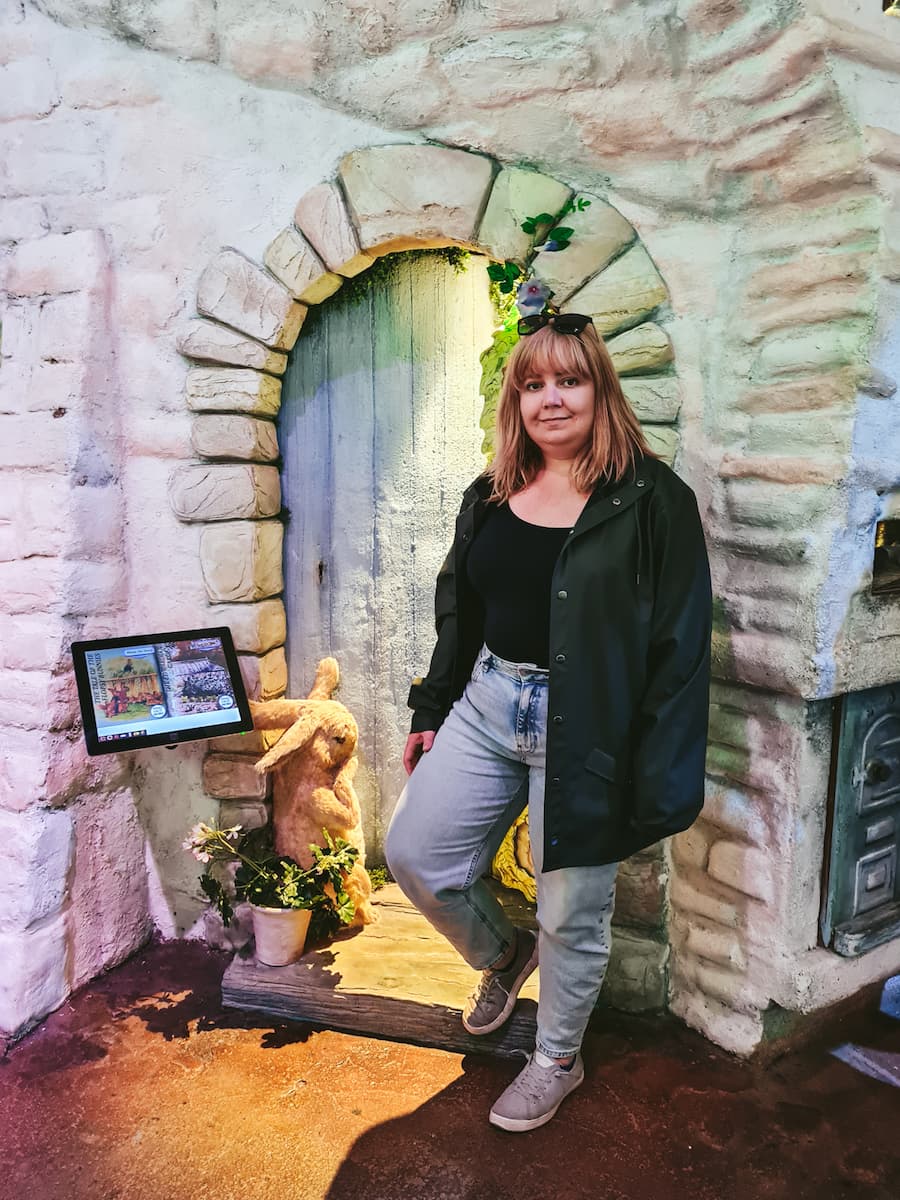
Meet Peter Rabbit, Mrs Tiggy-Winkle, Jemima Puddle-Duck and more in the enchanting ‘World of Beatrix Potter’ attraction in Bowness-on-Windermere.
Beatrix Potter spent much of her life living on Hill Top Farm in Near Sawrey, a village not far from Windermere on the west side of the lake. She adored the Lake District, and made hugely important efforts to protect the landscape; you will often find real-life locations from the region appearing in her books. The Tower Bank Arms, a gorgeous little pub in Near Sawrey, is one such example – it is featured in The Tale of Jemima Puddle-Duck.
At The World of Beatrix Potter, you can see her beloved characters and illustrations come to life. Wander through the charming tales of Peter Rabbit and the UK’s other favourite childhood stories in a series of interactive exhibits. You will step into Mrs. Tiggy-Winkle’s kitchen, and smell the fresh laundry hanging there, explore Jemima Puddle-Duck’s woodland glade, and hide from Mr. McGregor in the Peter Rabbit Garden. It’s an adventure for all the family; kids and grown-ups alike. Besides the tales and characters, you also get a chance to learn a bit more about Beatrix Potter herself – there’s an exhibit detailing her life, with a particular focus on her affection for the Lake District.
World of Beatrix Potter
The World of Beatrix Potter can be found in Bowness-on-Windermere, which means it can be easily reached by public transport, even if you’re not staying conveniently in the town. If you want to visit Hill Top, the farm where Beatrix Potter lived and set many of her stories, you can catch a bus from Bowness.
Embark On a Boat Trip On Windermere Lake
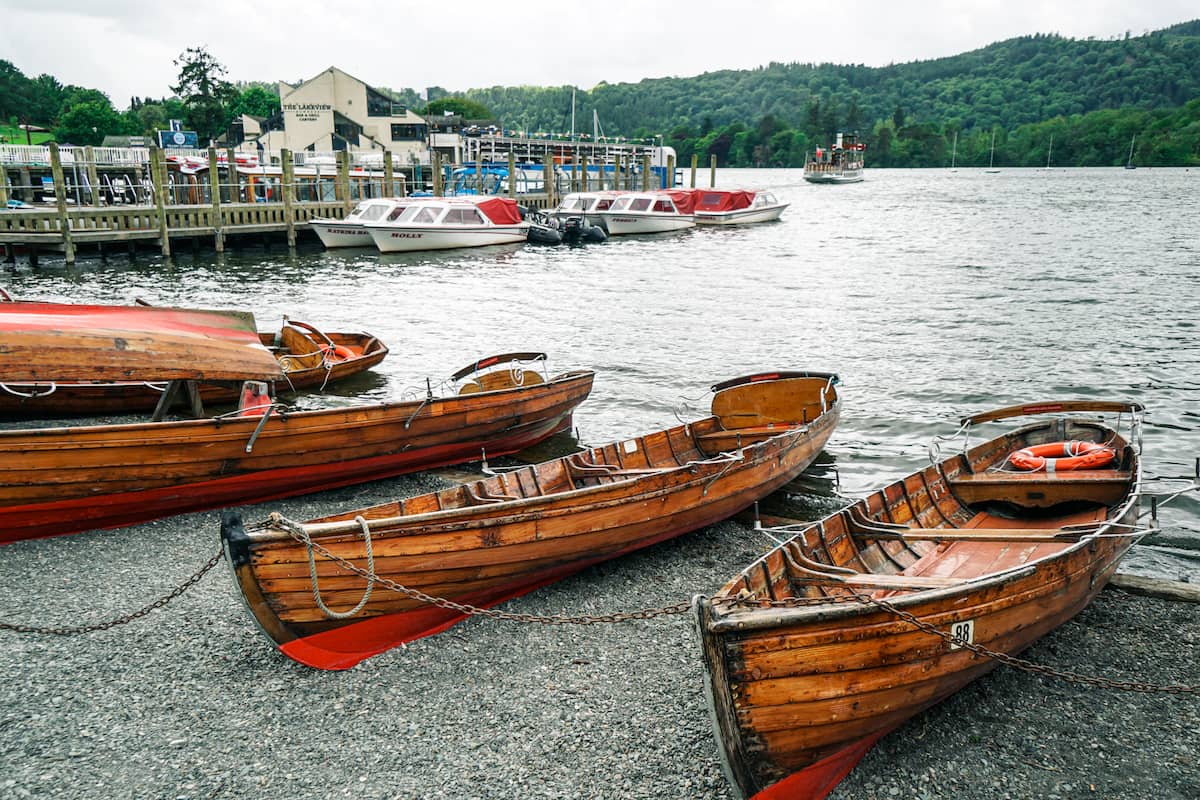
Boat Trip On Windermere
It’s just one of those unmissable experiences: when visiting the Lake District, you really need to see it from the water. Drifting away from the shore, cruising gently across a lake immersed in some of England’s most gorgeous scenery is a relaxing adventure that appeals to all ages.
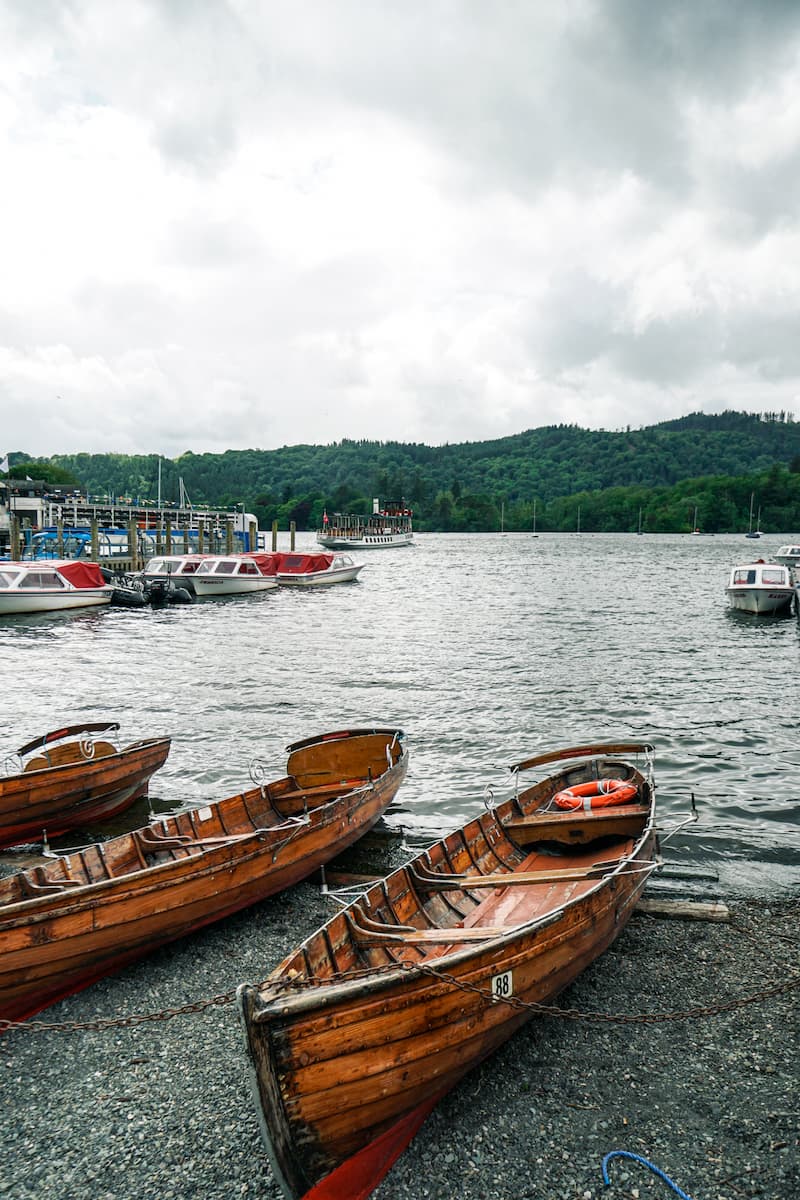
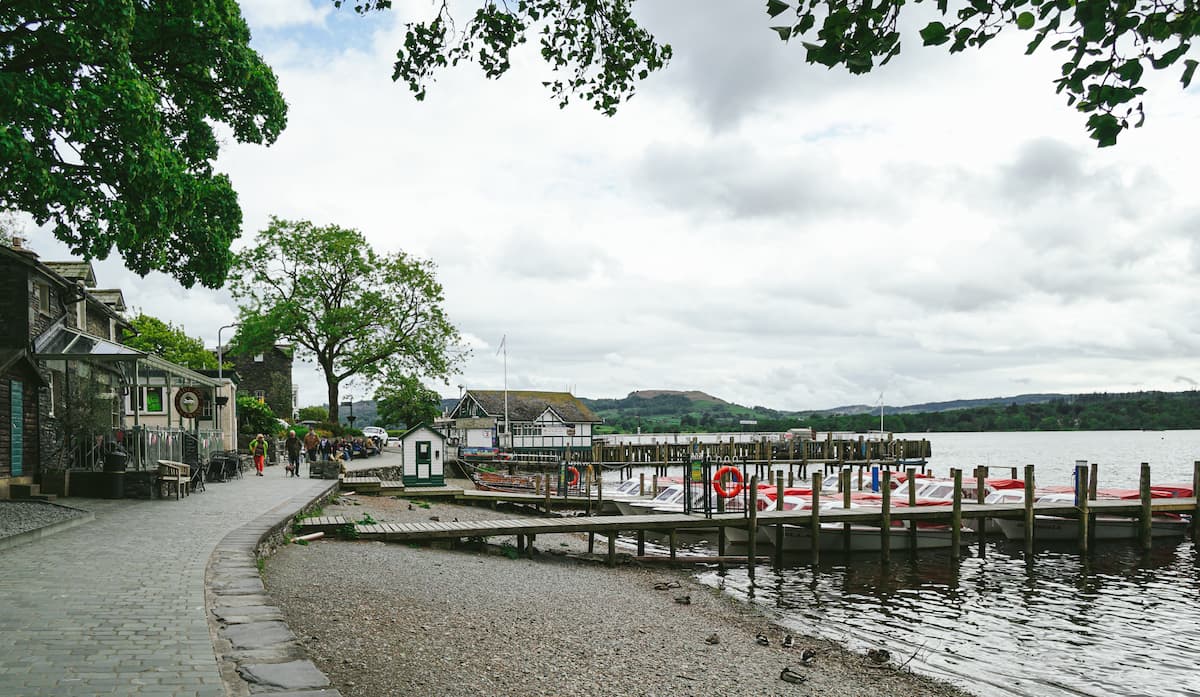
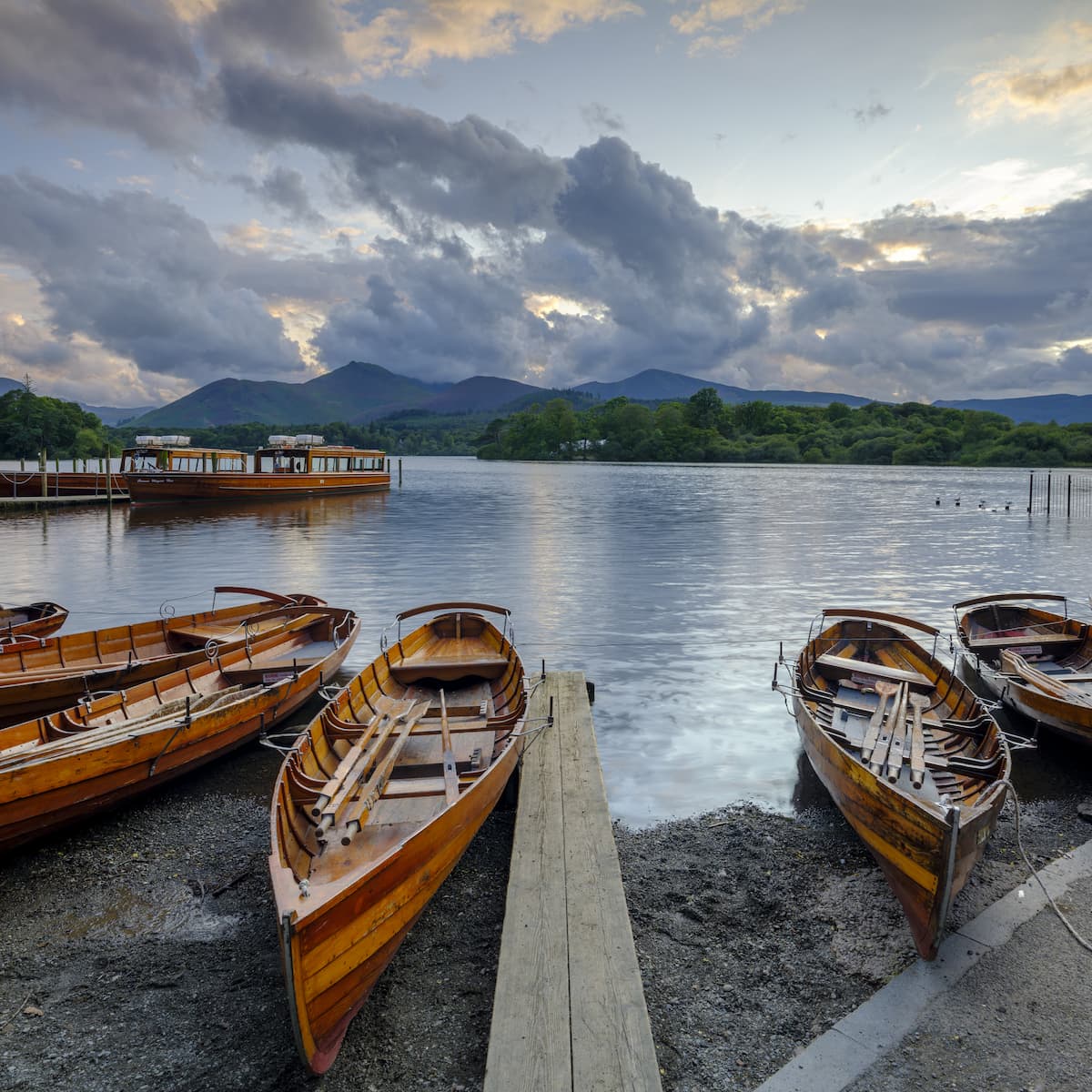
Windermere is the largest naturally formed lake in England, and stretches for 10.5 miles (or 18 kilometres). Exploring Windemere on the water can be done in a myriad of ways; there are ferry routes to Ambleside from Bowness-on-Windermere and vice-versa, but you can easily hire a boat and chart your own course. If you want to spend longer sailing around Windermere, choosing to hire a boat or embarking on a private tour are better options than the ferry.
If you want to try something a little more adventurous, you can canoe, kayak or paddleboard your way out into the lake. While jet skis and power boats are not outright banned, the speed limit of 10 nautical miles per hour – unfortunately, lakes have speed limits too – takes all the fun out of using them!
Visit Hawkshead
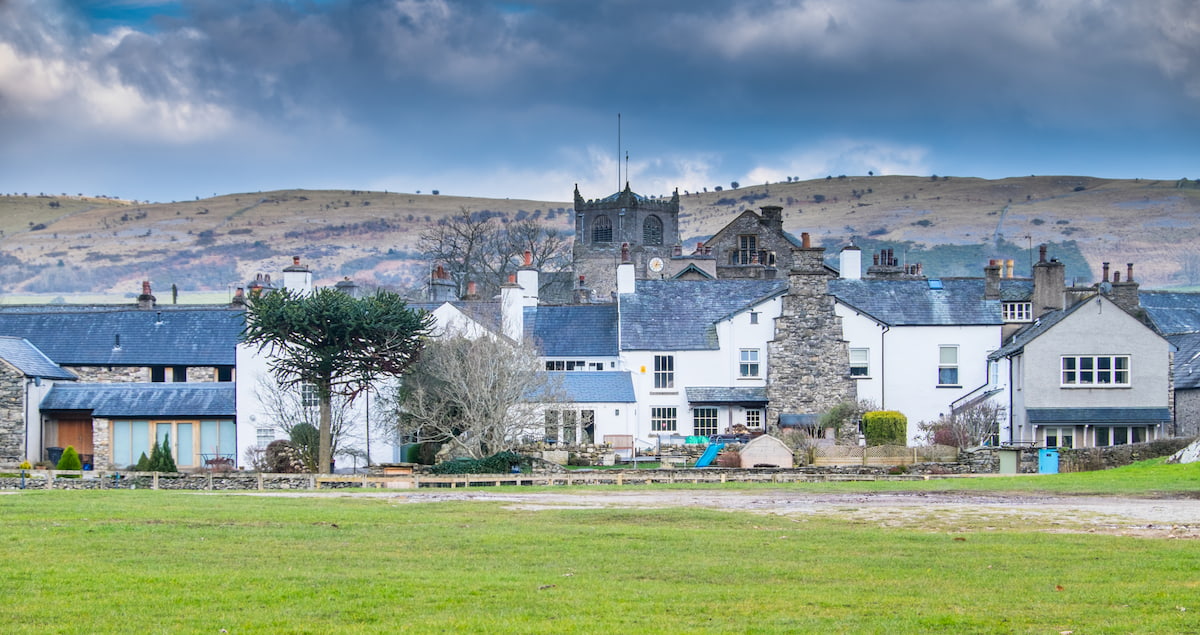
Hawkshead is the poster village for the Lake District
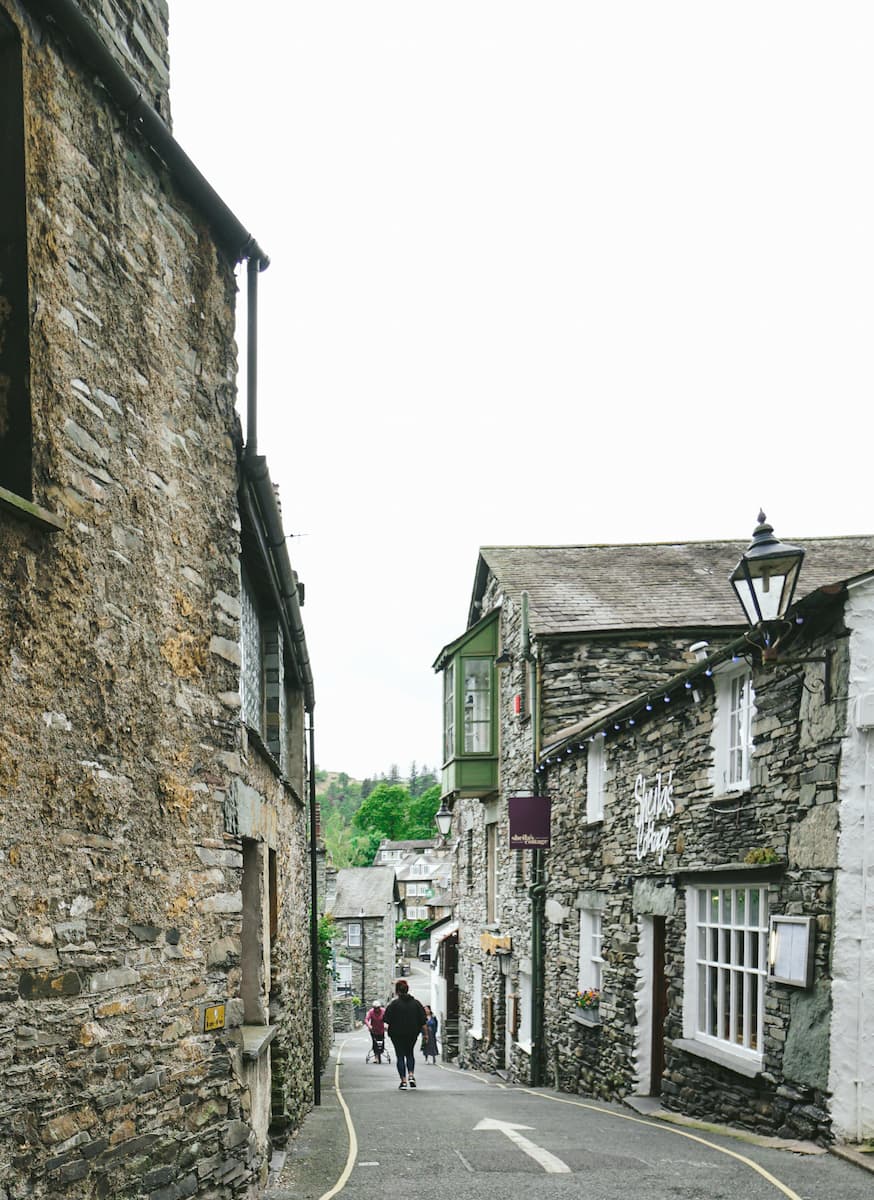
Tall chimney stacks and medieval inns and the slate and stone cottages typical of this corner of Cumbria make for a village typically plastered on postcards. Hawkshead offers the kind of rural idyll you might have expected to find in the Lake District; country pubs, a 12th century church and miles upon miles of rolling green hills just outside its borders.
The village is situated in beautiful countryside, and is an excellent starting point for a number of forays into the surrounding wilderness; Grizedale Forest and the 2 mile trail to Tarn Hows are particular highlights.
As for those who would prefer to stay within the borders of Hawkshead itself, there are a smattering of small independent shops to browse – which range from specialist food shops and delicatessens, to jewellers and boutiques; there’s even a chocolate factory! After walking around for a while, you can put your feet up in cute cafes like Ginny’s Teapot, or one of the fantastic pubs and restaurants in the village.
If you’re still hoping for more Beatrix Potter-related material after your experience in Bowness-on-Windermere, you’re in luck. The National Trust’s Beatrix Potter Gallery displays the original artwork of the author, displaying her famous character illustrations inside a 17th century house. Other things to do in Hawkshead include Hawkshead Grammar School Museum and a trip over to the Hawkshead Brewery.
Extend your Trip West of Windermere By Stopping in Coniston
Coniston is a charming village just under 4 miles west of Hawkshead, and can be reached from there by bus, bike or on foot. The villages are similar – as you might expect, being so close together – but the big difference is that Coniston sits on the banks of Coniston Water, and has an affinity for water sports as a result.
You can hire rowboats or kayaks and venture out into this small lake for an afternoon of adventure after spending a leisurely morning in Hawkshead. While the village is lovely, Coniston is really put on the tourist trail because of the landscape all around the village. You will find Coniston to be a hub of adventure and outdoor sports; hiking is the undeniable favourite, with the towering shadow of the Old Man of Coniston a popular conquest among hikers, while other trails, like Tarn Hows and the walk around Coniston Water itself, are also worth the trip.
Coniston isn’t essential viewing in the Lake District, but if you find yourself in Hawkshead looking for a little adventure, or fancy the challenge of the Old Man of Coniston, it is well-worth a visit. Ardent hikers may even want to skip Hawkshead altogether and focus on Coniston; it provides convenient access to some great trails – something not always easy to come by without a car.
Catch the Bus or Cycle to Wordsworth’s Grasmere
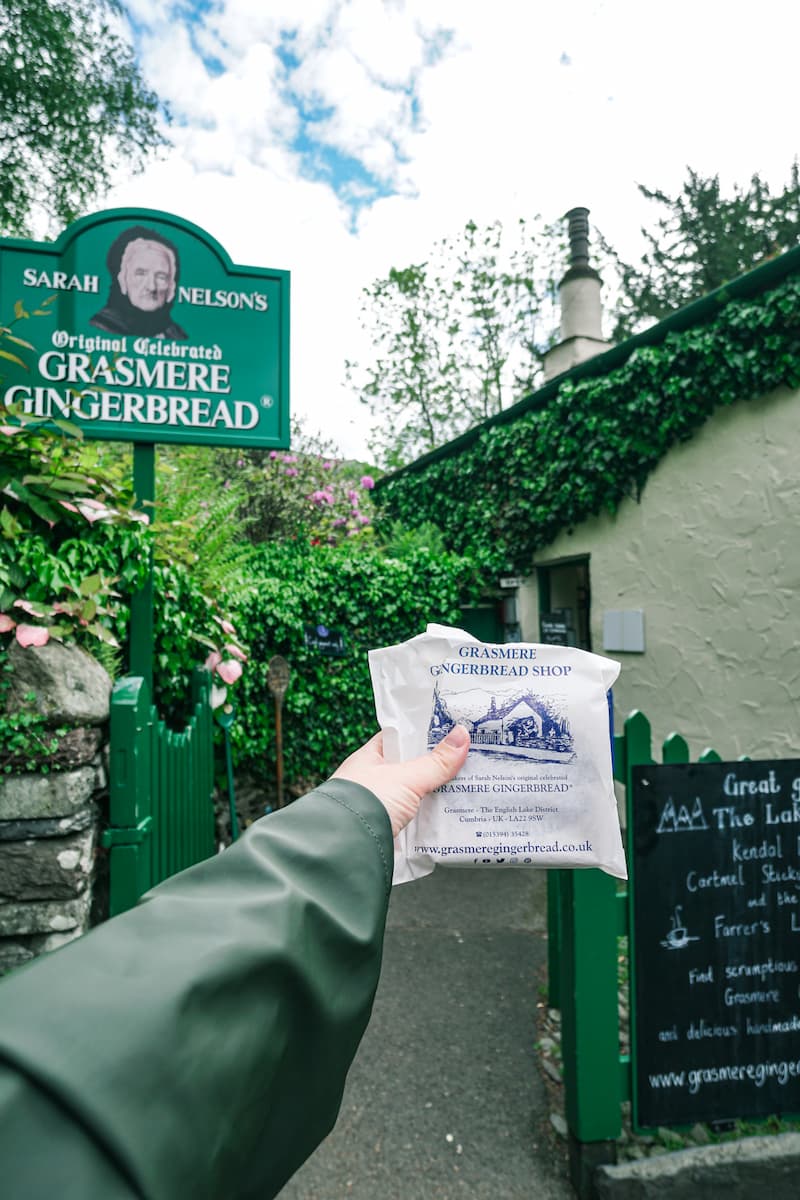
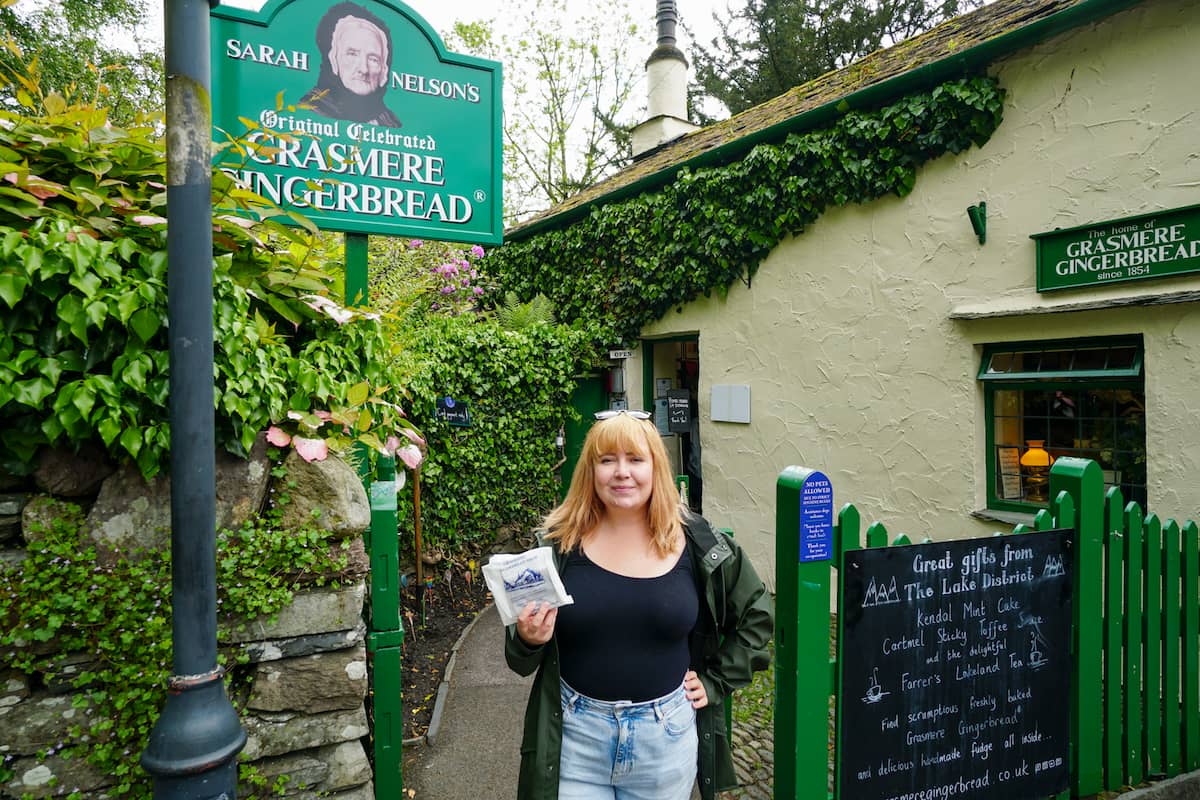
The famous Grasmere Gingerbread
Grasmere is a beautiful little village in the Rydal and Ambleside Valley, best known for its connections to Romantic poet William Wordsworth. It is easily reached by bus from Bowness-on-Windermere.
Wordsworth would quite literally wax poetic about the joys of living in Grasmere and the Lake District, writing odes to the region’s beauty while deriding the dirty nature of the city. His opinion of the peace and serenity found in the Lake District is one shared by countless others, who flock to the area hoping to experience a glimpse of that same wonder. Grasmere is as perfect a representative for the ideal of the Lake District as you could possibly imagine – which is why it is also one of its most visited.
Every angle and vista of the village offers a postcard-worthy view; Grasmere’s quaint cottages and winding streets are endlessly charming, and Grasmere lake is small, but beautiful. While in Grasmere, besides from simply taking it all in, you can explore its many cafes and boutiques, enter a 13th century church, and wander over an ancient stone bridge. An unmissable stop is the iconic Grasmere Gingerbread shop, where you will find a unique type of gingerbread – invented in 1854 – that can only be bought in England.
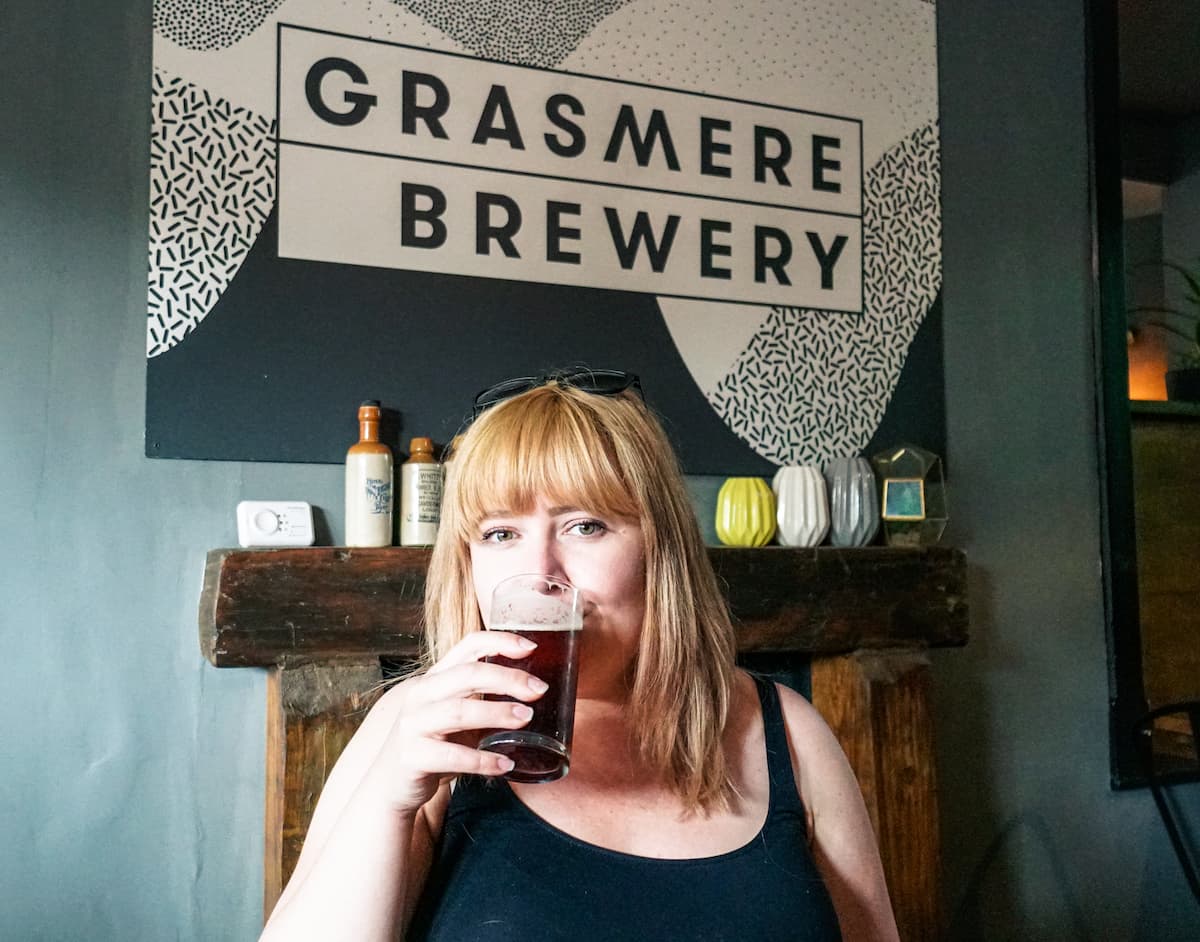
Try Grasmere Brewery
When in Wordsworth’s beloved Grasmere, you have to visit Dove Cottage, where he and his family once lived. The home has since been converted into a museum and tearoom, where you can learn more about the poet’s life and works, while experiencing the same setting that Wordsworth found so inspiring. The cottage is tucked away in the winding pathways of the village, but is only a few minutes from the gorgeous views of natural landscapes that were Wordsworth’s muse. Walks from Grasmere will treat you to sweeping views of Grasmere lake and the surrounding mountains.
Amble on to Ambleside
Lake views by Ambleside
Ambleside sits at the top of Windermere, and historically marked the head of the lake. It is one of the most popular towns in the Lake District – its easy to reach location combined with its obvious charm guarantee it a place on many people’s Lake District bucket lists.
There’s a certain sense of whimsy to Ambleside, which has marks of a pervasive, lighthearted eccentricity dotted around the town. The one most familiar to visitors, and the most delightfully ridiculous, is the Bridge House. A minute stone bridge crosses over Stock Beck, and in the 17th century, Georgian architects, in all their finite wisdom, saw this as the perfect place to build a house. It may be an odd location for a home, but it has worked well as a tourist attraction; the precariously balanced cottage draws in thousands of bemused visitors and eager photographers every year.
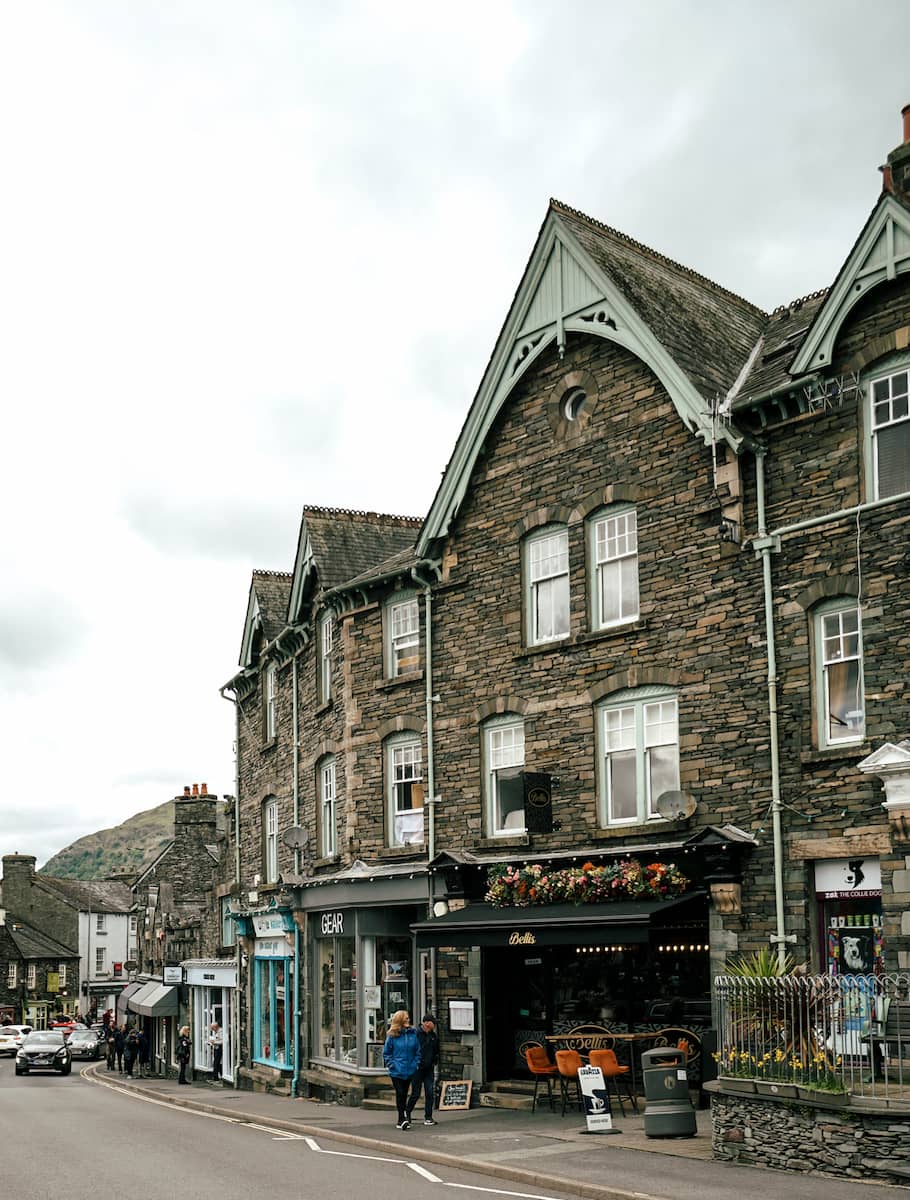
Side streets of Ambleside
Ambleside has plenty of other attractions, both in and outside of the town. You can potter around the shops, cafes, museums and galleries in Ambleside, or head out into the countryside. Wray Castle, a Victorian neo-Gothic mansion now belonging to the National Trust, is a 10 minute drive, or an hour long walk from Ambleside.
As you will often find in towns and villages in the Lake District, natural beauty is never too far away. Ignoring the lovely views over Windermere, Ambleside has wonderful walks leading into woodland, up mountains and alongside the banks of a river; Stock Ghyll Waterfall is only a 10 minute walk away from the town.
If after all that, you still have some time in the day to spare, you can enjoy another trip on to the lake. Boat hires and ferries are almost as plentiful in Ambleside as they are in Bowness-on-Windermere!
Wander Around Keswick
Keswick is the largest town in the Lake District, but shares the same charm and quaint atmosphere as the smallest villages. There are streets of sweet little chocolate shops and independent boutiques that fit seamlessly into the character of the town.
Many of the shops and cafes in Keswick are family businesses that have been in the town for decades; they add to an overall atmosphere of rural authenticity that keeps Keswick from falling prey to the cloning of high streets so common in mid-size UK towns. You could easily whittle away a few hours shopping in Keswick, and you won’t struggle for places to eat or things to do either.
Some of the Lake District’s more eccentric attractions are located in Keswick. The Cars of the Stars museum may no longer be there, but Keswick still holds its own with unique things to do; you can head to the Derwent Pencil Museum to learn all about the history of the pencil, or experience optical illusions and mind-boggling artwork in Puzzling Place. You can journey back 5000 years at the Castlerigg Stone Circle: this atmospheric stone monument is believed to have been built in roughly 3000BC, making it even older than Stonehenge.
Keswick also gives you another chance to see the water. It’s not called the Lake District for nothing! The beautiful Derwentwater is surrounded by fells and woodland, and offers visitors the chance to hire a rowboat and slowly drift out into the lake, or take a dip – you can swim, but it’s not for the faint hearted; lakes in this part of the country are notoriously cold!
Explore Ullswater
River Brathay passing from Elterwater
Ullswater is one of the easiest locations in the Lake District to reach without a car. Penrith station is connected to national rail networks, has transportation links to London via train or coach, and is connected to the rest of the Lake District by bus.
Ullswater is the second largest lake in the national park, and has a more rugged, remote feel than Windermere. Stunning mountainous scenery, dramatic waterfalls, jutting rockfaces and dense woodland make Ullswater a hiker’s paradise. Aira Force waterfall is one of the most impressive in Cumbria, walks among the fells are breathtaking, and a loop of the lake itself is an epic 20 mile hike. It’s not quaint villages that make Ullswater so appealing, it’s unquestionably the scenery: some of the finest views and landscapes in all of the Lake District can be found here, making it a worthwhile stop for anyone that loves to spend time out in the great outdoors.
Want to Avoid the Hassle? Join a Tour Instead.
If you want a car-free trip without the stress of finding your own way, you can join one of several tours available that explore the Lake District.
Tours range from single-day excursions to multi-day adventures; some have meeting points within the park, like this Ten Lakes Full-Day Tour, others will begin from a separate location altogether, like the 3-Day Small Group Tour from Manchester. These tours will take you to the majority of the Lake District’s most unmissable sights, and save you the stress of finding your own way there.
While you lose some freedom in choosing your own itinerary, joining a tour around the Lake District is a convenient way to get around without a car. It’s certainly not for everyone, but for those that want an entirely stress-free holiday that requires next to no planning, joining a tour will help you avoid the hassle.
Frequently Asked Questions
Can You Go to the Lake District Without a Car?
Not everyone in the UK can drive, and even less own a car. It can seem that the countryside is off limits to people who use public transport. While the Lake District is undeniably more difficult to reach without a car, it is far from impossible.
As this article details, most of the Lake District can be reached by bus – and there are train links into the park for those travelling from further afield. Once in the park trains quickly disappear, but buses are reliable, and ferries offer alternative travel options. If you’re physically fit, cycling is another fantastic way to move around the Lake District.
How Do You Get Around the Lake District Without a Car?
You can catch the train into Oxenholme Lake District, then venture into the national park from there by bus. Certain areas, like Ambleside and Bowness-on-Windermere, have ferries running between them.
While coaches and trains are the way into the Lake District, once you are inside, you will mostly be relying on the bus network. Buses connect all the major places and attractions in the park, and are usually reliable and inexpensive.
As long as you’re physically fit – and somewhat enjoy cycling – you could also hire bikes to explore the local scenery; there are hundreds of great cycle routes running throughout the national park.
Where to Stay in the Lake District Without a Car?
It is hard to argue against Bowness-on-Windermere as the best place to stay in the Lake District without a car. It’s the unofficial centre of the Lake District, as it’s the most popular place on the banks of Windermere. By staying in Bowness, you will be perfectly located to explore the rest of the region. It has excellent public transport links, with a train station close by and frequent buses to all the major tourist spots in the Lake District. It’s also a great town for restaurants, places to stay and things to do – being the most popular town has a few perks!
Though Bowness-on-Windermere is fantastic for public transport, it can be very busy, which some people may find offputting. If you want a quieter escape, any of the towns or villages mentioned throughout this article will work. Staying somewhere like Hawkshead would make accessing the rest of the Lake District slightly more tedious, but would give the peaceful countryside escape many are looking for.
The Lake District Without a Car
Exploring the Lake District without a car is far easier than you may have thought. If you base yourself in Ambleside or Bowness-on-Windermere, the rest of the park is virtually at your fingertips. Buses or cycling are the best methods of getting around, and you will find very few places are off limits to you.
You can enjoy the breathtaking scenery, quaint and quirky towns and villages, and the generally calming escape of the Lake District without a car. As this itinerary hopefully highlights, you can experience an expansive, varied holiday in Cumbria while only using public transport, and find enough to explore for return visits.
“The loveliest spot that man hath found” is the apt description William Wordsworth used to describe the village of Grasmere, his home and frequent source of inspiration.
You will find the Lake District is an area eternally linked with the Romantic poets. They lamented the distance forming between humanity and nature, and saw places like the Lake District as a reprieve from increasing industrial tendencies. Today, visitors flock to Cumbria with a similar mindset; to relax, take a break and reconnect with nature.
This is, perhaps, the UK’s most serene corner: with rounded mountain tops swooping down into the titular lakes and waterways, verdant green hills peppered with livestock, and villages filled with chocolate-box cottages that capture a simpler time. England’s largest national park offers a dramatic but tranquil landscape – which is perfect for escaping the city.
Your trip should include a visit to as many of the prettiest towns and villages in the Lake District you can fit in – which is why I have compiled here the best the park has to offer:
Keswick
Windermere may be the most famous part of the Lake District, but I feel that Keswick is the region’s unofficial capital. It is the main town within the national park’s borders, with the most to keep you occupied, while also being wonderfully picturesque.
Keswick has a long history, which only started being recorded in the Middle Ages, but is believed to extend all the way back to prehistoric times. The Castelrigg Stone Monument is an impressive stone circle dated back to around 3000BC, which suggests that the area of Keswick may have been occupied for millenia.
While there is plenty to see for history buffs, there are a number of sillier activities to enjoy in Keswick. You can go to Puzzling Place for optical illusions and mind-boggling artwork, learn about the history of the pencil at the Derwent Pencil Museum, or try something more active at the Kong Adventure climbing wall. There is enough to keep you occupied for any rainy days.
When the weather is good, however, you will want to go out and explore the stunning scenery that Keswick is immersed in. Derwentwater and the surrounding fells, forests and crags provide some of the best hikes and most unmissable views in all of the Lake District.
Keswick is a charming ancient market town with an enchanting array of independent shops, including Friars, a chocolate shop established in 1927, and cosy cafes and pubs. The town is particularly lovely at Christmas, when the peaks are capped with snow and the historic streets are adorned with twinkling lights.
Grasmere
Grasmere at the famous gingerbread house
This is the aforementioned “loveliest spot that man hath found”; Wordsworth’s home is a sentimental little village nestled in the fells right in the centre of the Lake District.
You won’t have to look far to see the inspiration behind Wordsworth’s famous poetry here.
You can visit Dove Cottage, where he and his family once lived – which has since been converted into a museum and tearoom – and see the views Wordsworth would have enjoyed centuries ago; in the grand scheme of things, they have changed very little. The cottage is tucked away in the winding pathways of the village, but walk for just a few minutes and you will find sweeping panoramas of the gorgeous Grasmere lake and surrounding mountains.
There are so many fantastic walks and scenic points you can reach from Grasmere, with Rydall Cave and the waterfall walkways particular highlights. Grasmere itself is a collection of stone cottages and winding streets, accompanied by a pretty stone bridge and 13th century church.
Thanks to its connections to Wordsworth and lovely scenery, Grasmere is a popular village, with many gift and trinket shops. Most famous is the delicious offerings at the Grasmere Gingerbread shop, a type of gingerbread invented in 1854 that can only be bought in England.
Hawkshead
Hawkshead is the poster village for the Lake District
Hawkshead is the poster village for the Lake District: it has a history stretching thousands of years into the past, cobbled streets and stone cottages with limitless charm, and the lovely scenery the park is so famous for.
If you’re hoping to find an exceptionally pretty village, you won’t be disappointed by Hawkshead. It is often cited as the prettiest of all the villages in the Lake District. It used to be a village centred on the wool industry in medieval times, but became a market village during the 16th century. Today, it is mostly driven by tourism: the many shops, cafes, restaurants and pubs are supported by the waves of visitors that flock to the village.
You can quickly see the appeal – the cosy inns and rustic old cottages have a lot of character, and are matched by the narrow cobbled streets that can only be the result of centuries of history. Wonky timber frames and slanting medieval houses are the norm in Hawkshead, and house tearooms, boutiques and high-quality gastropubs in the modern day.
From Hawkshead you can begin some fantastic forays into the countryside. One of the most popular is the 2 mile trail to Tarn Hows, which has lovely views and is fairly easy-going.
Bowness-on-Windermere
Windermere – The iconic lake
Think of the Lake District and Windermere is usually the first point of reference. The iconic lake is the largest in England, stretching 10.5 miles in length, and is backed by mountains and lush greenery.
The central hub of Windemere is the town Bowness-on-Windemere, which sits close to the mid point of the lake. Its a pretty town filled with the kind of shops and boutiques that are tailor-made to attract tourists. Inbetween all the gift shops selling trinkets and postcards there are some genuine fantastic independent shops and classic pubs that are well-worth a visit.
Bowness-on-Windermere is the favoured launch point used to explore Lake Windermere; there are a handful of different boat hire providers and a ferry service that can be used to journey around the lake. After all, the best way to see Windemere is on the water!
You can’t stop in Bowness-on-Windemere and not visit the most charming attraction in Cumbria. The World of Beatrix Potter is a dream attraction for families, as the sweet characters of Beatrix Potter’s books are brought to life in wonderful displays and exhibits. Peter Rabbit, Mrs Tiggy-winkle and Jemima Puddle-Duck are just a few of the characters you can expect to see in the interactive exhibits. Beatrix Potter lived in the Lake District for much of her life, in a farm on the western side of Lake Windermere. Her passion for conserving the natural beauty of the area was vital in preserving the scenery we enjoy today.
Kendal
Kendal River Scene
Kendal sits just outside the borders of the Lake District national park, so isn’t technically in the Lake District, but as it is only nine miles south of Windermere it might as well be.
Compared to the towns and villages inside the park, Kendal is quite large. There is quite a bit to see – for a rural town in Cumbria – but not all of it is as picturesque as you might have hoped. As a larger town, relatively speaking, there is more room for nicer and not-so-picturesque parts. But the parts of Kendal that are pretty are truly lovely, and earn it a place on this list.
You can wander down winding medieval streets, visit the ruins of a 13th century castle and see the pretty riverside area that follows the fast-flowing River Kent through the town. Travel a few minutes south of Kendal by car and you will find Levens Hall, the Elizabethan manor house with the oldest topiary gardens in the world.
Kendal’s most famous export is unquestionably the Kendal mint cake – when in town, you simply have to try this blast of peppermint sweetness. It is often used by people who enjoy endurance sports for a quick burst of energy. There are a number of shops that sell Kendal Mint Cake in town, but Romney’s and Quiggin’s have the most history behind them. If you visit in March, you could run into the Kendal Food Festival, which celebrates food from around the world, with a particular focus on Cumbria.
Cartmel
Cartmel Village
A willow tree and stone bridge hang over the gently-flowing River Eea in Cartmel, another of the Lake District’s (or just south of the Lake District, in this case) pretty but minute villages.
Cartmel is very quaint and cute, with the typical look of stone cottages and historic homes commonly found in the more picturesque settlements of the region.
The highlight here is the 12th-century Cartmel Priory, an astonishingly large church hidden in this unassuming piece of countryside. It is a beautiful and fascinating piece of architecture with a long history: it was founded by the Normans, saw gunfire during the English Civil War, and came close to destruction during the reign of Tudor king Henry VIII. Cartmel Priory only survived the fate of so many other monasteries during Henry VIII’s dissolution because the villagers protested – they had no other place of worship, so the church was allowed to remain.
Besides the priory, Cartmel has another surprise tucked away in its streets: L’Enclume, the first restaurant in the north of England to earn three Michelin stars. This fine dining experience is the flagship restaurant of Simon Rogan. The focus on hyper-local, seasonal produce makes this a truly Cumbrian dining experience, elevated to an exceptional level.
A lovely village square, rustic pubs and a handful of shops roundout the offerings of this charming village.
Caldbeck
Picturesque cottages in the village of Caldbeck
Up in the northern fells of the Lake District lies Caldbeck, a simple, traditional village named for the river, ‘Cold Beck’, on which it stands.
This village’s smattering of colourful houses and quaint cottages make the perfect base for exploring the rugged mountain ranges of the northern fells. It is in a very remote area surrounded by beautiful wild countryside, with waterfalls, rivers and mountains almost commonplace. Hiking and cycling into the trails running from Caldbeck is a popular pastime for adventurers staying here – the cosy village is perfect for an escape into nature.
Caldbeck is most famous for the 12th century St Kentigern’s Church. Though it is less about the church itself, and more who is buried there! John Peel, a famous huntsman, and Mary Robinson, the Maid of Buttemere were both buried in the church yard.
Ravenglass
Muncaster Castle, Ravenglass
Where other towns and villages in the Lake District may sit alongside a lake or be hidden away in the fells, Ravenglass is located on the coast.
It is the only coastal village in the national park, and has a slightly different feel to it due to this. Ravenglass is not, in my opinion, as pretty as the quaint villages nestled in the valleys and fells further inland. But unlike those places, it can boast sea views, a beach and a wonderful steam railway.
One of Ravenglass’ star attractions is the steam-powered Ravenglass and Eskdale Railway, which passes through some of the most outstanding scenery in England, which includes its highest mountain. The journey ends at Dalegarth station, which is close to Boot, another pretty village worth visiting if you get the chance.
Ambleside
Ambleside
Ambleside makes an excellent alternative to Bowness-on-Windermere for those who would like to explore the lake. It is as pretty as the latter town, but isn’t quite so busy.
The town has the typical look of rural settlements in the Lake District: cobbled streets and stone cottages follow a winding river down towards the lake. Ambleside has plenty of attractions that make it unique, however. Not least the Bridge House, an example of whimsical ridiculousness from the 17th century, when a tiny house was built on top of a small stone bridge.
There is also the ruins of a 2nd century Roman fort close to the shore of Lake Windermere, an art gallery, shops, restaurants and a pub. An easy walk to do from Ambleside is the one to Stock Ghyll Force – it only takes 15 minutes to reach this 70 foot waterfall from the centre of Ambleside.
Seatoller
Seatoller Borrowdale Valley
Seatoller is a tiny settlement in the centre of the Lake District which is unquestionably put on the map because of its use as a starting point for scaling Scafell Pike, the highest mountain in England.
Besides this famous hike and the other excellent walks in the area, there is little to see or do in Seatoller. But it is pretty, with a lovely stone bridge crossing the River Derwent and a street lined with historic cottages.
Elterwater
River Brathay passing from Elterwater
Elterwater village is, I think, even smaller than Seatoller. It has a few shops and a historic inn, and is suitably pretty, but is not an action-packed, sightseeing tourism magnet.
Its place in the Great Langdale valley and proximity to Elter Water, for which the village is named, make this one of the prettiest villages in the Lake District. The cottages of Elterwater spring out of the hillside, are hidden amongst lush trees and have a breathtaking backdrop of rugged mountains. This sublime view is even lovelier in the autumn, when the valley turns into a waterfall of oranges, reds and yellows.
Though small, Elterwater is not completely bereft of life. There are a couple of inns, a few places to eat and drink and the odd shop to keep you busy during your visit.
Where Should I Stay?
Some of these lovely towns and villages may be places you would like to visit during your holiday, but not choose as a place to stay. It depends on personal taste almost entirely, and the part of the Lake District you want to be closest to.
If you want to focus on Windermere, Bowness-on-Windermere may be ideal for you, while Keswick is well-placed to explore the northern corners of the park. For a small, off the beaten track rural experience, staying in a small village like Elterwater or Cartmel may be preferable. It depends on what you enjoy in a holiday, but any of the places listed here would be suitable.
Prettiest Towns and Villages in the Lake District
As you can see, you won’t be hard pressed to find pretty towns and villages in the lake district. Which is the prettiest is subjective, but not many would argue against Hawkshead or perhaps Grasmere as strong contenders.
You would struggle to pack all of these places to visit into one trip, but it is worth selecting a few that stand out to you most and going from there. You can always come back and visit the others another time!
The Lake District is a fantastic place to visit, whether you are travelling solo or in a group, or visiting in the depths of winter at the height of summer. It is an excellent national park, with gorgeous scenery and pretty villages, that can be enjoyed by all manner of travellers year-round.
The days of “terrible British food” are long gone, as London has stepped up its culinary game in the last few decades, earning it countless Michelin stars and putting it in contention with the other foodie capitals of the world. But many old-fashioned classics can still hold their own, and it’s vital you try them on a trip to London.
While finding just about any international cuisine your heart desires in the capital is possible, you can’t visit England without trying the local tried and true recipes that go back centuries. Family traditions are strong in the UK and recipes are still passed down through the generations, keeping them authentically British.
This list breaks down not only the top dishes either my friends or I personally think you should try (as a vegetarian, I’ve not tried the meat versions of these) but also some of the best places to sit down and enjoy them at. This makes it easy for you to plan meals while visiting London, no matter how long your trip is. Prepare for your mouth to start watering!
1. Fish and Chips
The famous Poppies fish and chips in London.
Nobody does the old classic fish and chips like England, and considering they originated here, a trip to London is not complete without them. The first fish and chip shop was actually recorded in 1860, followed by Mr Lees, who opened a shop in the North of England in 1863. By the middle of the 19th century, the dish’s popularity had spread to London and South East England. And now they’re everywhere!
If you want to sound like a local, refer to fish and chip shops as “chippy.”
Poppies
Poppies was opened in 1952 by owner Pat “Pop” Newland, and serves up some of the best fish and chips London has to offer, complete with jellied eels and homemade mushy peas. Originally starting in East London, Poppies now has several locations throughout the city, each with a cool collection of 1950s memorabilia filling the walls.
Rock and Sole Plaice
Just minutes from Covent Garden, Rock and Sole Plaice is an honest contender for the best fish and chips in London as well. They use a 145-year-old fish recipe, and have all the traditional trimmings, including pickled eggs, mushy peas and gherkins. You can bask in the sunshine in their outdoor seating area if the weather’s nice.
2. Pie and Mash
Pie and mash originated in the Docks of London around the 1800s and has always been considered a traditional working-class food. It was the original “fast food” and consisted of eels from the River Thames, which made the perfect filling for pies, as they were also cheap. They were served with a liquor sauce, which was a gravy made from the eel stock.
Our pies today are quite different than the original pies. They typically consist of minced beef, mashed potato and are served with a new twist on liquor sauce made from parsley, or, as is more common, gravy. Nowadays you’ll even find chicken, lamb and vegetarian pies.
Goddard’s Pie and Mash
Goddard’s Pie and Mash was established in 1890 and is as traditional as it gets. Being one of the oldest pie and mash shops in London, it’s conveniently located in the heart of Greenwich. Choose from a selection of meat and vegetarian pies and homemade fruit pies with custard!
You won’t find any servers here: grab a tray and order at the counter amidst the hustle and bustle. If it looks overly crowded, don’t worry, the line goes quickly and there’s plenty of seating at the back and upstairs.
M Manze
If you want to try a traditional pie, head to M Manze. The first M Manze Eel and Pie Shop opened in 1902, and by 1930 there were a total of 14 shops bearing the name. Today, you’ll find a simple menu at the two current locations, M Manze and L Manze. With wooden benches and narrow marble-topped tables, you’ll feel like you’re in the original restaurants.
Offering pie, mash, liquor and eels at a super affordable price, you’ll quickly understand why there’s a long line at the door.
3. Chicken Tikka Masala
Did you know fish and chips are not the national dish of the UK? But you know what is? Chicken tikka masala. Yep, this humble example of British-Indian cuisine has been the national dish of the UK since 2001. But really it shouldn’t come as a shock since England has been home to one million Indians since the late 19th century. The dish originated in the UK, and is believed to have been invented by a Bangladeshi chef in Glasgow.
Chicken tikka masala consists of roasted marinated chicken chunks in a spiced creamy curry sauce, making it orange in colour and hard to miss. Brick Lane is famous for their curry, but you can find this famous dish at any store and many restaurants around the city.
Punjab
Punjab opened in London back in 1946 and moved to its current location in Covent Garden shortly after in 1951, making it the oldest North Indian restaurant in the UK. The area may have changed over the years, but Punjab is still owned and operated by the same family, now in its fourth generation!
You’ll find history steeped in the walls of the restaurant with framed receipts, family portraits, historic Punjabi figures and diners of the cuisine over the years.
4. Sunday Roast
Sunday roast in London
The great British Sunday roast is at the heart of most Brits’ weekly routine. It’s a tradition where a family comes together and gathers around the dining table, usually in the afternoon, and go on to eat themselves into a roast dinner-induced food coma.
Usually consisting of a variety of meats, like turkey, chicken, beef, pork and lamb, with potatoes, veggies and Yorkshire pudding as trimmings, a Sunday roast is not for the faint of heart; it’s essentially a mini Christmas dinner! You’ll find all of this doused in gravy on overflowing plates. But Sunday roast isn’t just for cooking at home! You can find the best of the best at restaurants around London.
The Latchmere
A Sunday roast at The Latchmere is well worth getting out of bed for. With giant-sized Yorkshire puddings and extra gravy, you might have to roll home. You’ll get the best of both worlds here with one half pub and one half formal dining, so take your pick.
The Gun
Journeying east to The Gun is worth it, without a doubt. The Gun’s Sunday roasts, along with their wine selection, are the perfect pairing. The Yorkshire puddings are absolutely delicious to boot.
5. Afternoon Tea
Christmas Afternoon Tea
Afternoon tea was actually introduced by Anna, the seventh Duchess of Bedford, in 1840, and remains a long-standing British tradition. You definitely want to set aside a couple of hours one afternoon to indulge in this time-honoured delicacy, because here’s the catch; it’s not just tea! Nope, afternoon tea consists of delicate finger sandwiches, scones with jam and cream, and a selection of pastries or cakes. Not only that, but often the tea is swapped for alcohol, with champagne the preferred beverage.
You can find “tea rooms” all across Britain and London, of course.
Harrods
Serving afternoon tea since 1896, Harrods Tea Rooms are now open on the ground floor of the iconic, luxurious department store. They boast an extensive selection of globally-sourced teas, from Earl Grey to Hawaiian Black and Superior Sencha. You’re sure to have a traditional posh afternoon tea experience at Harrods.
The Goring
The Goring has been serving up afternoon tea even longer than Harrods; since 1840, and they sure know how to do it. With opulent decor, you’ll melt into the backdrop as you spend the afternoon indulging in freshly baked scones, sampling your way through all the teas, and dipping into finger sandwiches and sweet cakes.
6. Full English Breakfast
Vegetarian English Breakfast
The ‘Full English’ as it’s commonly referred to, is a feast of eggs, sausage, bacon, mushrooms, tomatoes, black pudding, baked beans, hash browns and toast. Phew. This mighty meal is an experience in and of itself, and is a tasty staple for Brits. You can see why it’s a famed hangover remedy!
Regency Cafe
The Regency Cafe is often referred to as one of the best breakfast spots in London, and has been serving up the full English breakfast since 1946. It’s a no-frills kind of place, having retained its post-war charm with red-checkered curtains and Formica tables. The famed retro look has attracted filmmakers and it’s been featured in movies like “Layer Cake,” “Brighton Rock,” and “Pride,” as well as several TV shows.
Duck and Waffle
For an upmarket twist on the full English breakfast, check out Duck & Waffle’s. This 40th-floor, 24-hour restaurant has spectacular brunch views across the city, from the famous Gherkin to the River Thames. Serving up breakfast from 6am, the full English includes Lincolnshire sausages, dry-cured bacon, eggs, tomato, mushroom, hash browns and a delicious cheddar and buttermilk scone.
7. Scotch Eggs
You might think scotch eggs originated in Scotland from the name, but London’s own Fortnum and Mason claims to have invented the scotch egg in 1738. What are they, you ask? It’s essentially a hard boiled egg wrapped in sausage meat, breaded and deep fried.
Fortnum and Mason
Since they do claim to have invented them, what better place to try a scotch egg? After you’ve wandered through the plush red-carpeted tea and cake temple, savouring one of Fortnum’s lovely scotch eggs is quintessential British experience.
8. Cornish Pasty
If you’ve ever visited Cornwall in the west of England, then you’ve most likely enjoyed a Cornish pasty. These golden flaky pastries are crimped in a ‘D’ shape and filled with various mixes of meat, swede, potato and onion. They can be eaten hot or cold and have delighted locals and visitors for hundreds of years. But if you aren’t making the trek to Cornwall, never fear, for there are plenty of options in London to pick up a pasty.
Keep in mind though that Cornish pasties are a Protected Geographical Indication (PGI). This means they have a protected status, like mānuka honey. According to the guidelines, only pasties prepared in Cornwall and to the very specific traditional standards can actually be named Cornish pasties. And you’ll know it because they’ll have a stamp of authenticity to prove it. It’s all very proper.
Regency Cafe
The Regency Cafe makes our list again for the Cornish pasty! Found on Regency Street in Westminster, it’s consistently ranked among London’s most popular eating establishments. You’ll find the pasties here as delicious as any found along the shores in Cornwall. Choose between a classic or vegetarian option, with your choice of sides.
Warrens Bakery
This Bakery has long claimed to be Cornwall’s oldest Cornish pasty maker, established in 1860. Warrens started as a family owned business and is now the largest bakery chain in the South West of England. And lucky for us, they have a shop in London too! They offer the traditional beef pasty, peppered steak, or vegetarian options, including the interesting cheese and marmite flavour. You’ll get consistently good quality and prices with these guys.
9. Salt Beef Beigel
Beigels (Bagels for Americans) have been a popular London treat since the Jewish immigrants from Poland starting baking them in the 19th century. The beigels are actually boiled in water and then baked at high temperatures and are best served with salt beef, which is like corned beef, but sliced thicker.
Brick Lane Beigel Bake
Beigal Bake is a 24/7 bagel shop that is a completely affordable indulgence. The line is always long, but it moves fast for the hungry visitors waiting on their epic portions of salt beef, smoked salmon, cream cheese and pretty much any other topping imaginable. Or just treat yourself to some heavenly beigel bites. Whatever you choose, you can’t lose at Beigal Bake!
10. Cider
No, it’s not a food, but I felt I should thrown in one of the most popular drinks you’ll find all over London, in the pubs and the shops. Cider is made from fermented apples and with more than 45% of the apples grown in the UK being used for making Cider, it’s safe to say this is a favourite alcoholic drink and something you must try in London.
The Green Man
The Green Man boasts a hefty cider selection, where you’ll find up to ten on draft, and at least twice as many by the bottle. They even have their own ‘Green Man Special’ cider.
Hawkes Cidery and Taproom
London’s first urban cidery happens to be on the Bermondsey Beer Mile. You can visit the taproom for samples of the in-house creation, Urban Orchard, or any other fruity bottled offerings.
So, what do you think? Have you tried any of these brilliantly British foods yet? While there’s so much to choose from in London, I personally think these ten are what you seriously need to consider indulging in on your next trip to the capital!
Yorkshire is the largest county in England; it inspires thoughts of natural beauty, quaint villages, and, most frequently, Yorkshire Tea.
Couples are often drawn to Yorkshire for the romance of the countryside, its charming towns and villages, and the rugged coast.
In a county as large as Yorkshire – home to not one, but two of the UK’s most beautiful national parks – there are hundreds of things to do for couples. These are some of the best.
Explore a Gorgeous Yorkshire Town, Village or City
York
Kat standing in front of York Cathedral
Yorkshire’s most beautiful city is overflowing with ‘things to do’ for couples.
You could spend an afternoon in one of the city’s fantastic museums, potentially facing off with Viking animatronics in JORVIK or embarking on the classically romantic art of chocolate tasting in York’s Chocolate Story: two very different dates, but equally fun.
There’s the imposing York Minster, miles of ancient City Walls or the crumbling ruins in the Museum Gardens to explore for lovers of history and architecture. But just wandering around the city, with all its meandering medieval snickleways and crooked buildings, has a romantic feel. You can’t miss the famous Shambles, but going early enough will help you avoid the crowds, allowing you some alone time to stroll down one of England’s prettiest streets.
Another lovely feature of York is the River Ouse. You can buy tickets for a romantic dinner cruise along the river here.
York deserves an article of its own – which is why I wrote one on how to spend a whole day there. You can check it out here.
Robin Hood’s Bay
Tucked away on the North Yorkshire coastline is a quaint fishing village that is almost ridiculously picturesque.
Beautiful stone cottages tumbling down to the seafront on streets of winding cobblestones: this is about as close to postcard-perfect as you can get.
Walk hand-in-hand down one of the most photogenic lanes in England; by Sunny Place, a steep cobbled path lined with stone cottages and lanterns curves up around the hillside. The lower village is a lovely place to explore, as the houses all seem charmingly stacked up on top of one another.
At dusk, settle down on the beach, eat some fish and chips, and watch the sunset together.
Whitby
Whitby Abbey Yorkshire
It doesn’t take a long time in Whitby to realise why Bram Stoker felt so inspired by the setting. Crashing waves against eroding cliffs, a stark silhouette of the Abbey ruins against a moody sky, and the desolate surroundings of ominous moorland: it is hard to imagine a more fitting setting for Dracula.
You can explore the famous 7th century ruins of Whitby Abbey and follow in the footsteps of Dracula; in the novel he fled to the ruins and graveyard after escaping a ship wreck. The Dracula Experience is a kooky and fun way to experience the story. It is only £4 to enter, and you are led through scenes of the novel by live actors, complete with special effects – whatever you feel about Dracula, this place is good for a laugh.
The rest of Whitby is also worth exploring. You can climb the famous 199 steps to help work off the inevitable fish and chips you will eat for dinner.
Harrogate
Yorkshire’s premier spa town is the perfect place to set aside your worries and let yourself be pampered. Visiting a spa together can be a lovely way to spend some time just relaxing in one another’s company.
The Turkish Baths are arguably the best in town.
To complete your day of decadent self-indulgence, you must experience the one thing, besides spas, that Harrogate excels in: afternoon tea.
There are a number of refined, luxurious hotels that provide their own afternoon tea offerings, but the most famous in Harrogate is indisputably at Betty’s Tea Room. This is the original location for the respected brand that has expanded all over the country, and has been serving customers since 1919. You should book ahead for a table – there are normally queues winding outside the door.
Haworth
Haworth village in the Worth Valley
Another quaint village, this time in West Yorkshire, Haworth is most notable for its connection to the Brontë sisters. Escape to the countryside with a trip to Haworth; this is one of those rural villages that feels stuck in time.
The cobbled Main Street is filled with sweet little independent shops and boutiques, all housed in stone cottages. Although Haworth is pretty in its own right, the village draws in thousands of visitors because of its literary connections. You can visit the Brontë Parsonage Museum for some fascinating insight into the lives of the sisters.
The unbridled passion of Wuthering Heights came from Emily Brontë’s experience of the Yorkshire moors. You can walk together along that same moorland, and get a sense of what the author may have felt standing in the same spot centuries ago.
Staithes
Staithes in Yorkshire
Only 10 miles up the coast from Whitby is Staithes, a lovely little fishing village. The tiny collection of 18th century cottages and Staithes’ scenic harbour is nestled between the Cowbar and Penny Nab cliffs.
A visit to Staithes is an escape from modern life. The traditional fishing village feels practically untouched by the 21st century; a frozen frame of a simpler lifestyle. There are dozens of cliffside walks leading off from the picturesque village, making it easy to spend a whole day in the area.
Romantic Things to Do in Yorkshire
Dramatic waterfalls, brooding moors, stately homes and scenic canals: Yorkshire is filled with romantic places to visit. Aside from the usual fancy restaurants and bars, these are some of the most romantic things to do in Yorkshire.
Ride the North Yorkshire Moors Railway
North Yorkshire Moors Railway
Opt for the dining experience in a Pullman Dining Carriage for a romantic meal on a classic historic steam train.
Enjoy a luxurious four-course meal as you traverse the wild landscapes of North Yorkshire. The views from the train are spectacular, and the vintage ambience in the carriage warm and welcoming. For an extra special experience, reserve a Private Coupe and have the carriage all to yourselves.
For a slightly cheaper experience, hop on one of the trains as regular passengers. You can still enjoy the old-timey experience of riding a steam train, and can choose to visit Whitby, Goathland or Pickering, depending on the line you choose. All the trains run along scenic routes; the sections moving through the moors are unforgettable.
The most inexpensive tickets are for the Moors Explorer, which takes you to the Hogsmeade filming location of Goathland. They are £30.75 per adult – you can book through their website.
Visit Studley Royal Park
Fountains Abbey in Studley Park
Spend a day together wandering the gorgeous grounds of Studley Royal Park. Ancient ruins of Fountains Abbey, a beautifully landscaped garden, a deer park and a Jacobean manor house can all be found on the grounds.
A visit to the park is a chance to get back in touch with nature and each other. The surroundings are so peaceful and serene that the atmosphere immediately relaxes you, and any worries float away. The Georgian Water Garden is particularly lovely in this regard, as the gentle waterways, still lakes and Classical features all promote a sense of tranquillity.
As you walk around the sprawling grounds, you are likely to spot some deer; Red Deer, Fallow Deer and Sika Deer all live within the park.
Bring a picnic with you for a romantic date – whether you are close to the Benedictine ruins or the water garden, the scenery surrounding you will be beautiful.
Explore the Ingleton Waterfalls Trail
Ingleton Waterfalls Trail
Yorkshire has a thousand romantic walks to try – not least in the North York Moors National Park – but there’s something about waterfalls and the Yorkshire Dales that is hard to resist.
The Ingleton Waterfalls Trail leads you to some of the most impressive waterfalls in Yorkshire. It is 7km of lovely scenery that takes you through ancient woodland, up spectacular gorges and chasing a series of incredible waterfalls together; Thornton Force is the most impressive.
The £8 entry fee is steep, but the trail is well maintained and has facilities like toilets. The route is circular and easy for most fitness levels.
Only 15 minutes away by car is the famous Ribblehead Viaduct. Time it right and you can sit and watch the unforgettable sight of a steam train passing by together.
Boating at Hebden Bridge
Hebden Bridge in the South Pennine region of West Yorkshire
Is there anything more romantic than a simple boat ride through the beautiful countryside? It gives you a chance to spend some quality time alone together and laugh about any mishaps that happen along the way.
Hebden Bridge in West Yorkshire is a lovely old mill town nestled in the stunning Calder Valley. It’s a town with an old-world feel, surrounded by an absolute abundance of greenery; it’s the classic English countryside.
The Rochdale canal that runs through the town adds to the picturesque image it emanates.
Traditional narrowboats run up and down the canal – you can hire a boat for a single day, and travel to either Todmorden or Sowerby Bridge and back again. Take lunch with you on the boat, moor up at Sowerby Bridge and head into the woodland for a romantic picnic before your return journey.
See Bridgerton Come to Life at Castle Howard
Castle Howard is a stately home in North Yorkshire
Explore the beautiful stately home of Castle Howard, owned by the Carlisle branch of one of England’s oldest noble families. The palatial building is only 24km north of York and is a gorgeous example of Baroque and Palladian architecture.
Learn all about the not-so-romantic relationship between one of the family’s most unfortunate members, Catherine Howard, and Henry VIII; she was executed while still only a teenager.
The Howard family were deeply involved in court politics at the time, often to their detriment. Anne Boleyn, the most famous wife beheaded by Henry VIII, was also a member of the family through her mother: Thomas Howard, 2nd Duke of Norfolk was the grandfather of both women. You can learn all about the family’s history when visiting the castle, though it was built long after this time period, only 300 years ago.
Ignoring the decidedly unromantic family history, Castle Howard is a genuinely romantic place to visit as a couple. The castle grounds are magnificent, with an 18th century walled garden, a Great Lake and ornate fountains found all over the estate. The interior of the castle is as opulent as its exterior; marble hallways, furniture embossed with gold and elaborate décor everywhere you look.
The romance of Castle Howard has been noticed by filmmakers.
Netflix phenomenon Bridgerton used the castle façade, entrance hall and grounds as a filming location – it’s the home of Simon and Daphne after their marriage.
Things to Do For Adventurous Couples
For the thrill-seeker couples out there, canal boats and steam trains may seem a little tame. These are some of the best things to do for people hoping for adventure in Yorkshire.
Go on an Adventure in the Yorkshire Dales
If you’re looking for an outdoor adventure to try as a pair, look no further than the Yorkshire Dales. The landscape of rugged crags, dramatic waterfalls and sweeping valleys lends itself well to the more daredevil activities you might want to try.
Besides the activities you might already have expected, like kayaking, climbing, or mountain biking, the Yorkshire Dales offers some adventures that can be hard to come by in the UK.
Canyoning. Canyoning involves following a river – usually including a series of waterfalls – downstream, by jumping from heights into the water below, sliding down rock chutes and abseiling past waterfalls. In Ingleton, Lost Earth Adventures offers this exhilarating experience on Beezley Falls.
Caving. Couples that cave together, stay together. One of the longest cave systems in the world runs under the Yorkshire Dales. It makes sense, then, that this is one of the best places in Europe to try caving. It’s not the claustrophobic nightmare you might be thinking of: think underground rivers, huge caverns and thousands of stalactites instead.
Via Ferrata. If you want the views and adrenaline associated with climbing, but don’t necessarily have the experience, Via Ferrata is a fantastic alternative. You follow a path of metal rungs and ladders to traverse difficult terrain, all while safely attached to a permanently fixed wire. The only Via Ferrata in Yorkshire is at How Stean Gorge.
Paragliding. Watch your significant other fly across the sky in one of the most incredible experiences for thrill-seekers available in the UK: paragliding. Get an astonishing birds-eye view over the Yorkshire Dales in a shared experience you will never forget. Active Edge offer paragliding experiences in the area.
Follow A Spectacular Mountain Bike Trail
Pen-y-ghent, North Yorkshire
Yorkshire has plenty of choices when it comes to mountain bike trails, but it really comes down to your skill and fitness level.
For an easier trail, try the 18km route from Ravenscar to Whitby. This is a spectacular bike ride, with views over the moors and the cliffs. As Ravenscar fades into the background, you will move through scenes of endless natural beauty, passing by Robin Hood’s Bay and finishing in Whitby.
Curbar Edge is great for riders of an intermediate skill level with good fitness. The 26km looped trail takes you past stunning views over the Derwent Valley. There are some shorter, easier routes in the same area, however.
Some of the more difficult trails, with draining ascents and tricky technical sections, include routes at Pen-Y-Ghent, Nidderdale and Threshfield Moor.
Hiking and Climbing at Brimham Rocks
Brimham Rocks, Yorkshire Dales
Brimham Rocks are so unique that they seem almost bizarre. But as oddly shaped as many of the rocks are, their formation was completely natural; the ice age and years of wind, water and sand whipping away at the limestone helped leave behind the unusual Brimham Rocks we see today.
This site of precariously balanced rocks hovering over cliff edges has been a popular tourist attraction since Victorian times, and is now both a Site of Special Scientific Interest and Geological Conservation Review, and an Area of Outstanding Natural Beauty. You can hike around the 400 acres site in just over an hour to see the area’s biggest attractions.
Couples should look out for Lover’s Leap, a rock formation with a legend of forbidden love behind it. According to folklore, two star-crossed lovers couldn’t bear to be apart so jumped from the ledge, only to miraculously fall gently to the ground. Their families, seeing this dedication, conceded and allowed the pair to marry.
Particularly adventurous couples will see little excitement in the hike around Brimham Rocks. But they may see an appeal in climbing them. You can try both bouldering and rope climbing at the site. Find out more on the National Trust website.
Unique Things to Do
Try something a little different for your romantic day out in Yorkshire.
The Deep
Hull has a bit of a reputation in the UK, where it has been somewhat affectionately assigned the nickname ‘Hell’ by a substantial chunk of the population. The reputation is a little unearned in my opinion, as the city has more to offer than you might expect. A pretty Old Town, lovely harbour, and, most importantly, a world-class aquarium in ‘The Deep’.
The Deep is a fantastic date idea, and is one of the largest and most impressive aquariums in the UK. Learn about and see the creatures of the deep in person – sharks, stingrays, sea turtles and Gentoo penguins can all be found in the aquarium.
The award-winning Deep is home to over 3500 species of fish, is a pioneer in research for marine conservation, and offers both an enjoyable and educational day out. A trip to an aquarium of this quality can be fun for people of all ages, but is a surprisingly fun date activity; especially if you happen to love penguins.
Flamingo Land
Slightly rundown, bizarrely named and a whole lot of fun? Small British theme parks are a unique experience of somewhat outdated theming, whacky mascots and wholesome fun. Flamingo Land is great for couples that don’t take themselves too seriously, and can enjoy the park for what it is.
You won’t find rides of the calibre of Disneyland or even Alton Towers here, but there are plenty of enjoyable roller-coasters and smaller rides to try out. Besides the theme park, Flamingo Land is also home to an award-winning zoo.
Black rhinos, Sumatran tigers and African lions are just a few of the selection of animals cared for in the park. Flamingo Land is actively invested in wildlife conservation, conducting research projects worldwide and working with a network of other zoos in order to provide the best care for the animals.
The Forbidden Corner
Hidden away in the heart of the Yorkshire Dales, this unique labyrinth maze began as a wealthy estate owner’s private folly. It was opened to the public by popular demand, almost closed for issues with planning permission, then rescued by the same public.
The garden is located in the Tupgill Park Estate, and features a series of tunnels, puzzle rooms, tricky dead-ends and gigantic statues. As you lose yourselves in the maze, you will stumble across a glass pyramid, a temple of the underworld and some surprising water features as you journey through the garden.
Ostensibly for children, but enjoyable for all ages, The Forbidden Corner is a unique date idea you’re sure to remember for years to come.
Wensleydale Creamery
Wensleydale Creamery
Follow in the steps of Wallace and Gromit and enjoy a taste of the iconic Wensleydale cheese. Cheese fanatic couples should go straight to the source and head to the Wensleydale Creamery in Hawes.
You can watch the cheese being made by experts in the Demonstration Room, learn more about the history of both the cheese and the creamery in the visitor centre, and try a variety of cheeses during their interactive Yorkshire Wensleydale Cheese Experience. This is a bit outside of the box when it comes to couple activities, but any cheese – or Wallace and Gromit – fans are sure to have a great time.
Yorkshire For Couples
Yorkshire consists of not one, but four different counties. An area as huge as this inevitably has plenty of choice for things to do. Couples can pick from all manner of activities – if your idea of romance is a visit to Flamingo Land, abseiling down a waterfall, or a picnic in the park, Yorkshire has something for you.
London is a massive metropolis and diverse home to over eight million people. While the multi-cultural population gives you the upper-hand of blending more smoothly than other countries, it’s still easy to spot the inexperienced tourists in a crowd of locals. This is your guide to ways you can avoid looking like a tourist in London altogether.
One of the best things about London is that you can sit down to dinner and find yourself among five different people from five different countries. It’s really common to hear multiple languages spoken throughout the day and you’re likely to meet people from a range of backgrounds.
Unfortunately, because of this, some classic British traits are dying out with the influence of other cultures, particularly American films and music. But that doesn’t mean there aren’t a few things worth bearing in mind when you’re visiting the capital to keep you from sticking out like a sore thumb.
Obvious tourists run the risk of getting sucked into tourist traps and are easier targets for getting mugged. Although London is a fairly safe city, it’s definitely worth brushing up on some of these universal rules that will have you experiencing London in an authentically British way. Here’s how to avoid looking like a tourist, while getting the most out of your stay!
1. Dress Like a Local
Despite what you might read elsewhere, it doesn’t require too much effort to look like a local in London. You’ll find a wide range of clothing and it’s not always as posh as what London is actually known for.
Ever since I moved to London, I hung up my heels and fancy clothing. Whilst there are occasions to dress up, most of the time Londoners’ wardrobe style is casual. It’s even made its way into the West End theatre scene at times.
But let’s face it; Londoners have a way of making casual look not so casual, somehow. I do still feel they dress a little “smarter” than other places of the world, and you’ll still see people working in the City of London donning suits, but you don’t necessarily need to go out and buy a whole new wardrobe for hanging out in London, other than a nice rain jacket (preferably black in colour).
People of all walks of life live in London, and the range of styles on show is rich and diverse; wear what you’re comfortable in, but if you really don’t want to look like a tourist, maybe forgo the fanny pack (bum bag) and baseball caps!
Plus, you’ll be doing heaps of walking, so make sure you have some sturdy and comfortable walking shoes. Nice trainers aren’t uncommon and neither are backpacks.
Yep, you’ll need all the essentials on a day out in London, so take a classy backpack (not a typical travel backpack), and you’ll fit right in. Even canvas bags are common for shopping and groceries.
2. Avoid Chain Restaurants
Vegan Katsu Ramen at Hakata Ramen in Bermondsey
More than just a way to avoid looking like a tourist, this is a general life tip. London has some of the best restaurants in the world, and you can try food from a hundred different countries all in one city – why would you want to eat food you could have at home?
While Londoners may eat at a chain restaurant in a pinch, most would opt for the endless choice of local and independent restaurants right on their doorstep; the old stereotype of the Brits having poor food is more than outdated, so don’t be afraid to dabble in the local cuisine.
The classics like fish and chips and the full English breakfast are still standard, but the London food scene encompasses so much more these days. Confining yourself to just one type of food, or the unwillingness to explore, would for sure have you standing out in the crowd, where you want to blend.
3. Brush Up on British Expressions
Note some British expressions before you head to London, as this will save you a lot of embarrassment and confusion.
The one that always catches me out is ‘Are you alright?’. I took it as if I looked unwell or needed help, ha! It’s simply a greeting. To avoid awkwardness, just say – great thanks, you.
If you’re used to saying ‘candy,’ refer to it as ‘sweets.’ Also ‘French fries’ are ‘chips’ in England and ‘elevators’ are ‘lifts.’
There are heaps of other expressions that it wouldn’t hurt to learn ahead of time that will have you speaking like a local!
4. Learn Proper Pronunciation
Along the same line is pronunciation. It can take some time to learn how to properly pronounce all the street names, city and village names in England. If you think you know how something sounds, it’s probably not right.
When I first heard Southwark being announced on the tube, I had no idea where this place was and quickly learned it was pronounced suh·thuhk.
Check your phone for how to say these words properly, or you’ll for sure be spotted as a tourist!
5. Mind Your Manners
Queue for breakfast at Sunday, London
Modern Brits aren’t like the old-fashioned stereotypes portrayed in the movies anymore, but a degree of politeness is still a bit of a national character trait. Good manners are widespread in the UK, so a ‘please’ and ‘thank you,’ or even ‘cheers,’ are appreciated in everyday interactions.
Queueing is also a very British thing to do and Londoners have a lot more tolerance for it than many other countries. So, practice your patience when you see the orderly queues forming for entry into the museums or buying goods in a shop.
‘Jumping queue’ in considered very impolite and a traditional sense of fair play is enforced among Londoners. If you’re unsure, just ask – we will quickly advise you if there is a queue to join.
Outside of pubs, being loud and boisterous is also frowned upon. Keeping your voice down in public is encouraged, particularly on public transport! Most people on the Tube are on their way to work or going about their day in peace, and don’t want to be disturbed.
Lastly, it’s impolite to stare and point your finger, which is a common tourist trait.
6. Mind Your Personal Space
Keeping in tune with etiquette is also minding your personal space. If you’re not accustomed to public transportation, there’s a lot of etiquette to familiarize yourself with. Be conscious of those around you, especially at peak times, as the buses and trains will get quite busy.
While you’re sitting down, don’t stretch out your legs or arms in a way that might get in someone else’s way. If you have to stand, make sure and hold onto a handrail so you don’t fall over onto anyone! If you want to look like a true local on transport, put your headphones on and avidly avoid eye contact with anyone at all.
7. Use Local Table Manners
If you’re not from Europe, you might not be accustomed to how Brits eat their food, and this is one sure fire way to make you stick out like a sore thumb. The proper way if you’re right-handed is to eat with your fork in your left hand and your knife in your right hand. Then cut each bite individually, not all at once, while you rest your arms midway between your wrist and elbow. Elbows should always stay off the table!
8. Steep Tea Like a Local
Kat drinking tea at the Mad Hatters Tea Party at Sandersons
Tea is usually one of the first things one thinks of when it comes to England, and there’s never a wrong time for a “cuppa” in London. So learning how to make a proper cup of tea in any occasion will have you blending in with the locals.
Here’s a Quick Tea Tutorial
First, you’re going to boil the kettle and as soon as the water bubbles, pour it into a cup where a tea bag is waiting. You don’t want to let the water cool down too much as this will ruin the flavour, and the tea won’t steep as well. Wait a while to remove the bag. Keep in mind, you don’t want to over stew your tea, but it’s even worse to serve a weak tea. Practice makes perfect.
Now, a cup of tea without milk in England is just unheard of, and you’ll want to add the milk after it’s brewed. How much you add is a personal preference, so when in doubt add a dash; less is better than more! Lastly, if you like yours with sugar, add your desired amount.
And most importantly, when it comes to making the perfect cuppa, you simply cannot get away with making yourself one without asking every single other person within the vicinity if they would also fancy a cup. Don’t forget to ask if they take sugar and how much, and never ever use the same spoon for someone that isn’t taking sugar.
Follow these instructions and you’ll be serving afternoon tea in no time!
9. Get Off the Beaten Path
Crystal Palace park has the best statues in London! Famous natural sculptor Benjamin Waterhouse Hawkins designed these dinosaurs and revealed them to the public in 1854.
Sightseeing does not have to be limited to famous attractions! Although it’s fun to throw of a few of those in too, getting off the beaten path is the best way to immerse yourself in the local culture. For instance, Londoners would seldom be seen visiting places like Buckingham Palace or Tower Bridge.
Take a quick stroll through the popular tourist areas like Piccadilly Circus and Leicester Square, but for the ‘local experience’, you can spend the majority of your time wandering through some lesser-known areas of London. This is easier said than done, depending on the length of your stay, so a couple of trips to the city might be in order.
If you’re willing to forego the crowds and would rather venture into some of the more quiet and charming neighbourhoods, try Dulwich Village – if you don’t mind venturing further from the centre – or the elegant and affluent Kensington, just to name a few.
10. Know Which Bridge is Which
Tower bridge with London Bridge in the background
One of the most common mistakes tourists make in London is confusing the two bridges, Tower Bridge and London Bridge. You would think by the name that London Bridge is the big, attractive, exciting one that everyone photographs, but it’s not. That one is actually Tower Bridge; named for the Tower of London which sits close by. London Bridge is the one next to the iconic Tower Bridge that’s honestly not much to look at. Now you know!
11. Don’t Wear Your Camera Around Your Neck
I think we can all agree that the easiest way to spot a tourist is when you see someone with a camera hanging around their neck. Get yourself a camera bag that doubles as a stylish backpack or cross-body bag and pull out the camera as needed. I know it might be hard because you’re bound to want to take pictures of literally everything and get swept up in the charm of London, but take some time to feel like a local and enjoy the moment as well.
Also be respectful when taking photographs. The super cute houses you’re photographing are where people actually live. Don’t be rude or take too much time in one place, looking like a stalker. And don’t get in the way of others or act annoyed with people passing by. You’re in a busy city!
12. Don’t Take the Heathrow Express
The tube is the easiest and cheapest way to travel from Heathrow to London.
If you’re flying into London Heathrow, there’s a 20-minute Heathrow Express train that will cost you a good £25 to get to central London. If you want to avoid looking like a tourist, don’t take this train; the price is extortionate! Take a ride on the Piccadilly tube line (46 minutes to Piccadilly Circus) and pay just £3.10 with an Oyster or contactless card.
13. Don’t Buy Paper Tickets for the Tube
Purchasing a physical paper ticket is a rookie mistake in London, and often the most expensive way to use public transport. In the past, the advice would always be to purchase an Oyster Card or use a contactless card (including Apple and Google Pay) for travelling around London.
This is still a great option, particularly if you’re staying long-term or will face extra fees for using your card abroad, but contactless payments are easier and don’t require paying an initial £7 fee. It works in the same way: simply tap your payment card as you enter and leave a station and you’re all set.
If you want to get an Oyster Card, you can pick one up at the airport on your way in and even return it and get any leftover funds back at the end of your trip. Oyster cards are easy to ‘top up’ at most stations and are cheaper than one-way or day tickets for the tube, and they also work on the buses.
If you want to avidly avoid looking like a tourist, make sure you have your card – Oyster or otherwise – handy so you can tap it as you enter and leave the stations. Nothing is worse than holding up the lines by having to fiddle around in your purse or wallet looking for it.
14. Don’t Overuse the Tube
Bus in driving in Oxford St London
While the tube is the quickest way to get around in London – and it’s definitely something you want to familiarise yourself with – it’s not actually necessary all the time. Studying the tube lines a bit before you arrive will have you seeing that it’s quite easy to walk between a majority of the main attractions in central London, and it’s a lot cheaper that way as well. You never need to take the tube just one stop away.
If you get tired of walking, you can also hop on an iconic double decker bus. This is a classic Londoner move. Just don’t use a tourist bus! That should go without saying.
Local Bus Routes for the Best Sightseeing
Bus Route 11 – Fulham Broadway to Liverpool Street will take you by King’s Road in Chelsea, Belgravia, then the famous sights like Westminster Cathedral, Westminster Abbey, Big Ben and the Houses of Parliament.
Bus Route 24 – Pimlico to Hampstead Heath, like route 11 you will pass by Westminster Cathedral, Westminster Abbey, Downing Street and Trafalgar Square.
Bus Route 453 – I suggest catching it from Marylebone stations and hopping off once you’ve seen the sights on your list. The bus passes by Westminster, Whitehall, Regent Street, Oxford Street and Regent Park.
15. Escalator Etiquette
Don’t ever stand on the left side of the escalator. The left side is for people walking up or down. Stick to the right side if you’re standing still, and keep your belongings and limbs at your sides.
Speaking of escalators, don’t get to the top and then stop! You’ll soon discover that people are seriously hustling through the tube stations to make their connections, and stopping at the top of the escalator will for sure get you some glares and possible comments. If you need to get your bearings, step aside and wait by the wall to read the signs or check your phone. It’s much safer for everyone.
So there you have it! These are some excellent ways to avoid looking like a tourist in London. Don’t get too hung up on looking like a local; if you want to see the famous sights, then do it! Londoners would do the same if they were visiting New York.
Yes, you’ll probably still have your moments, but overall, you’re now equipped with how to blend into the local city scene smoothly and have the best memories to take home with you!