Moving to the UK
Australians love to move abroad. It’s in our blood. As people would say, we are bloody everywhere and the UK is one of those places that we flock to. It’s no surprise given:
- It’s next door to Europe.
- We get easy movement between our countries, Canada included.
- No language to learn.
Smooth on paper.
Moving fourteen thousand kilometres across the sea is one of those things that toughens you up. I have the learning experiences to prove it.
I’m a career girlie. I built my whole life around the nine to five and I moved over in 2013 with seven years’ experience and a CV I was proud of.
Then I landed in London and literally tried to wing the rest. I didn’t know how to open a bank account. Finding a place to live was another wing-it job, because I hadn’t done any of the research. That didn’t turn out as well as I thought it would, but I survived. Then someone took eight thousand dollars out of my account, which wasn’t my doing, but it didn’t stop the tears either.
Here’s the checklist and the adulting I’d do to help you move over:
- a brief intro to your visa options
- what it costs before you’ve earned a pound here
- the Australian admin to sort before you fly
I’m still cleaning mine up thirteen years later. My Medicare I was still sorting out when I was back home earlier this year.

Covers | Ancestry, Youth Mobility, Skilled Worker and Partner: who each one’s for, what it costs and the catch. |
Have up front | The visa fee for your route, the health surcharge for the whole visa, up to five weeks’ deposit plus the first month and three to four months of living costs. |
Do first | Your Australian admin, before you fly. |
Works for | You, if you’re moving over solo with a suitcase and want the visas, the money and the admin in one place before you book anything. |
Fact check · 6 and 7 September 2026
I’m not an immigration adviser. This is one Australian’s move in 2013 with today’s rules and prices next to it, checked at gov.uk, the Australian government sites and every other source linked on this page on 6 and 7 September 2026. The rules and the fees change. The basics of moving haven’t. Read the guide for your route on the day you apply, or speak to an immigration adviser. Use this to make your own call.
Disclosure
Some links on this page are affiliate links. If you click one and buy something, I earn a commission at no extra cost to you. It never changes what I recommend.
Which route you’re on
Your visa decides how much you need to save and how long it’ll be before you can move. This might be the point where you realise you need another year of saving before you go. Add up the visa and the surcharge below, then the first few months in London on top. If that’s not in the bank yet, the Ancestry visa might not be the one for you right now. You might be lucky and have a job that relocates you, or you start on Youth Mobility and build up the funds for the rest from here.
So here are the cliff notes on the four visas I’ve watched Australians move here on: who can apply, what it costs, what you get and the catch points that catch people out. The exact requirements are on gov.uk and that’s where to check yours.
Route | Who it’s for | What it costs | What you get | The catch |
|---|---|---|---|---|
A grandparent born in the UK | £726, plus the health surcharge at £1,035 a year, so about £5,175 up front over five years | Five years, then you can apply to settle | The surcharge is about seven times the visa fee | |
Aged 18 to 35 | £340, plus the surcharge at £776 a year. You also have to show £2,530 in savings | Up to two years, plus a one-year extension for Australians | It doesn’t lead to settlement, so the clock runs out | |
A UK job offer paying at least £41,700 a year | £819 for up to three years or £1,618 for more, plus the surcharge at £1,035 a year. You also have to show £1,270 in savings | Up to five years, then you may be able to settle | You need the employer before you need the visa | |
A British or settled partner and a combined income of £29,000 a year | £2,064 from outside the UK or £1,407 from inside, plus the surcharge at £1,035 a year | Two years nine months, then an extension, then settlement after five years | The old £18,600 floor only applies if you first applied before 11 April 2024 |
Right of abode, Global Talent and Innovator Founder exist too and they depend on your circumstances more than anything I can generalise about, so go straight to gov.uk for those. Investor and Start-up are closed to new applicants. If you’re not sure where you land, start with gov.uk’s check if you need a UK visa tool.
The Australians I know who came over on Youth Mobility went one of three ways when it ran out: home, sponsored by an employer or a British partner. The extra year for Australians makes it a better visa than the two years I watched people run out of, because two years is barely enough to work out whether you want to stay.
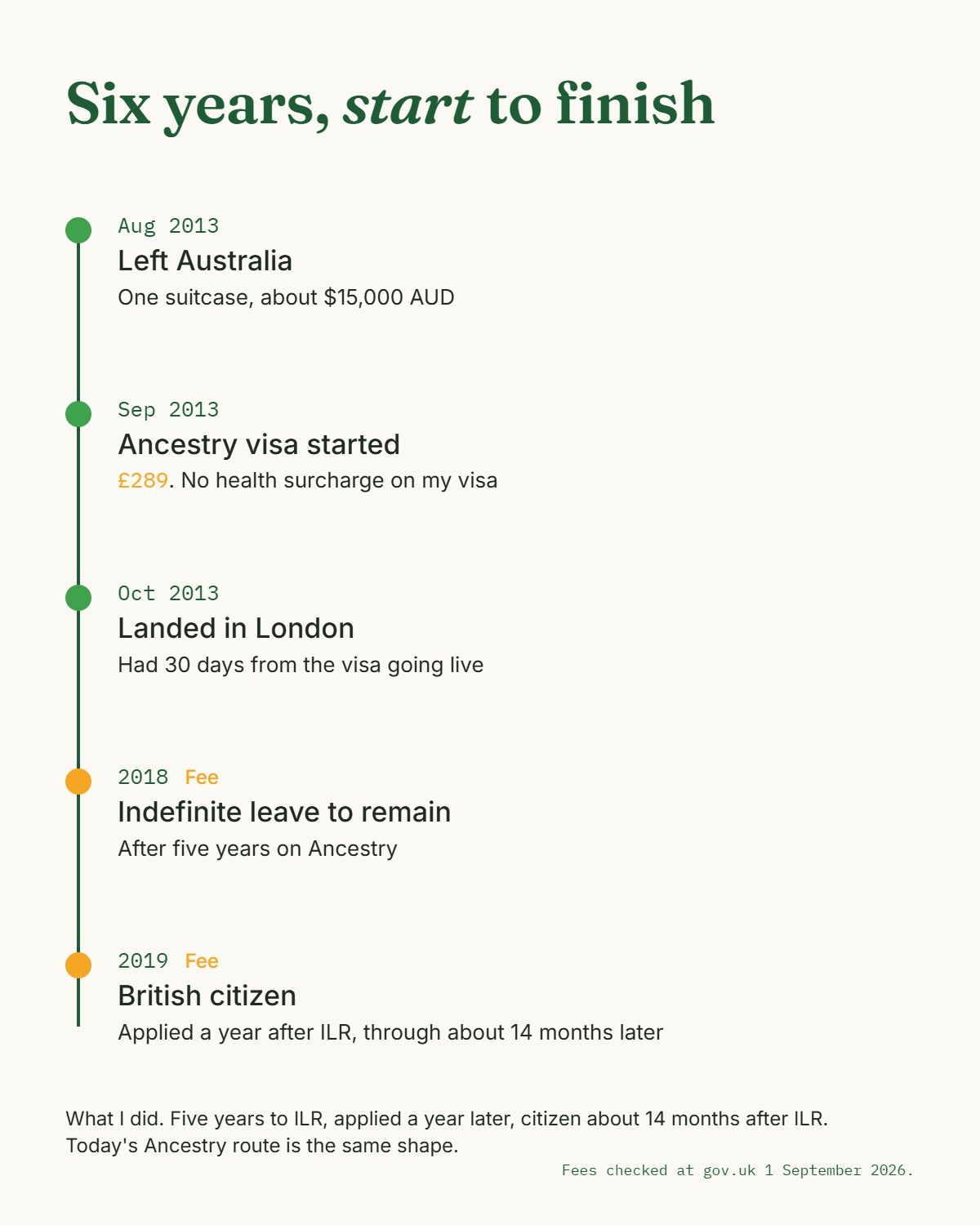
Mine was Ancestry. I went travelling for three months first, landed in October 2013 and here I am, indefinite leave to remain and a British passport later. Different routes suit different lives. This one suited mine.
Worth it
The Ancestry visa, if you’ve got the grandparent. Five years, then you can settle, then a passport. Spenny now, but it’s the route that ends somewhere.
Worth it
Youth Mobility, if you haven’t. Two years plus one is enough to know whether you want to stay. The Australians I know who stayed switched to a job or a partner visa before it ran out.
What the visa costs, all in
Whichever visa you’re on, the fee on the gov.uk page is not the cost. The Immigration Health Surcharge comes on top and you pay it up front for the whole length of the visa: £1,035 a year, or £776 a year on Youth Mobility or a student visa.
What that looks like for your visa:
- Youth Mobility, two years: £1,552 of surcharge on top of the £340 fee.
- Skilled Worker, three years: £3,105 on top of the £819 fee.
- Ancestry, five years: £5,175 on top of the £726 fee.
The rounding works against you too. More than six months but under a year is charged as a full year.
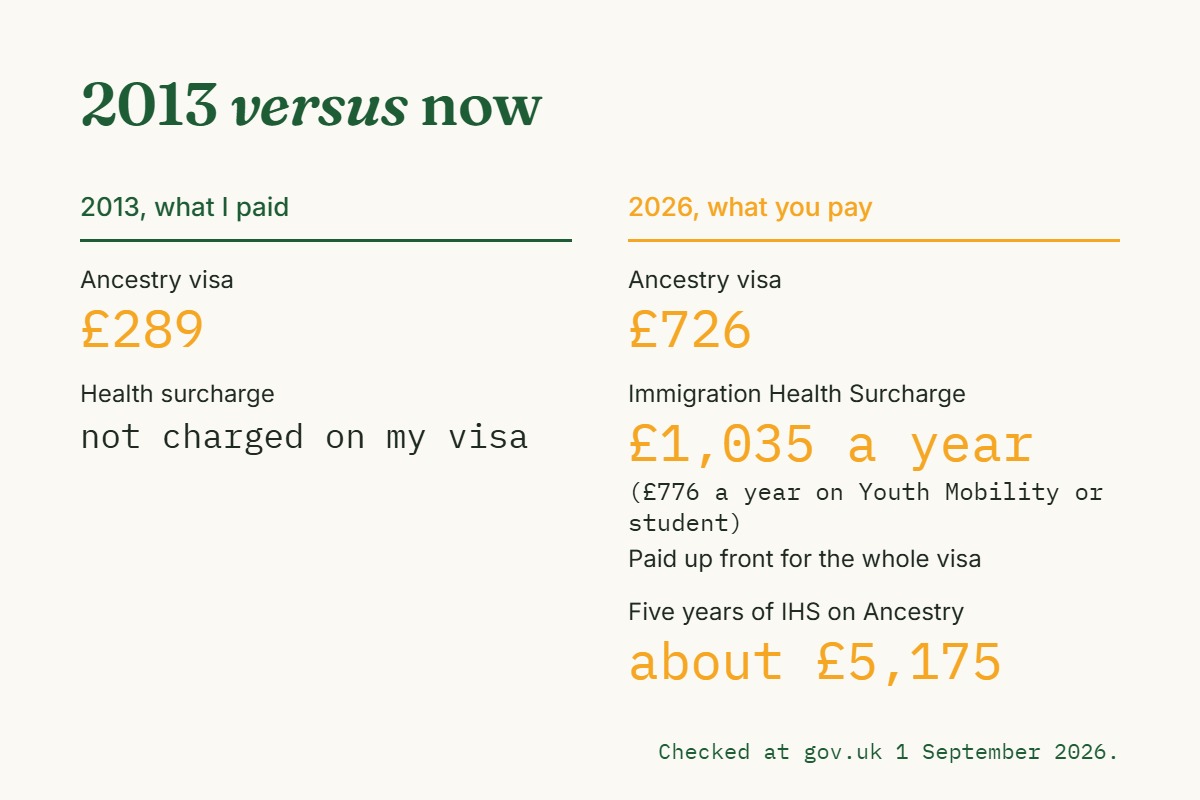
My visa in 2013 cost AUD 459, about £289 at the time and no surcharge, because it didn’t apply to the Ancestry visa then. It does now, so it’s a spenny visa these days. For an Australian the visa plus five years of surcharge is roughly ten thousand Australian dollars before you’ve bought a flight, give or take the exchange rate.
It prices a lot of people out and it’s a much higher entry point than I had. I didn’t need savings to get in. The savings I did have went on travelling first. I was very fortunate.
What to have in the bank before you land
The question I get asked most is how much to bring and I won’t give one number, because it depends on where you end up living and how long the job takes. What I can give you is the things to forecast and how to work each one out, with my own figures in it. Every rent here is London, from my own tenancies in southwest London and Shoreditch. Prices are different elsewhere in the UK.
Forecast these before you fly:
- rent, plus the deposit and first month you pay before you’ve slept there
- bills, if they’re not in the rent
- living, so food, transport and a bit of going out
- the gap before your first payday
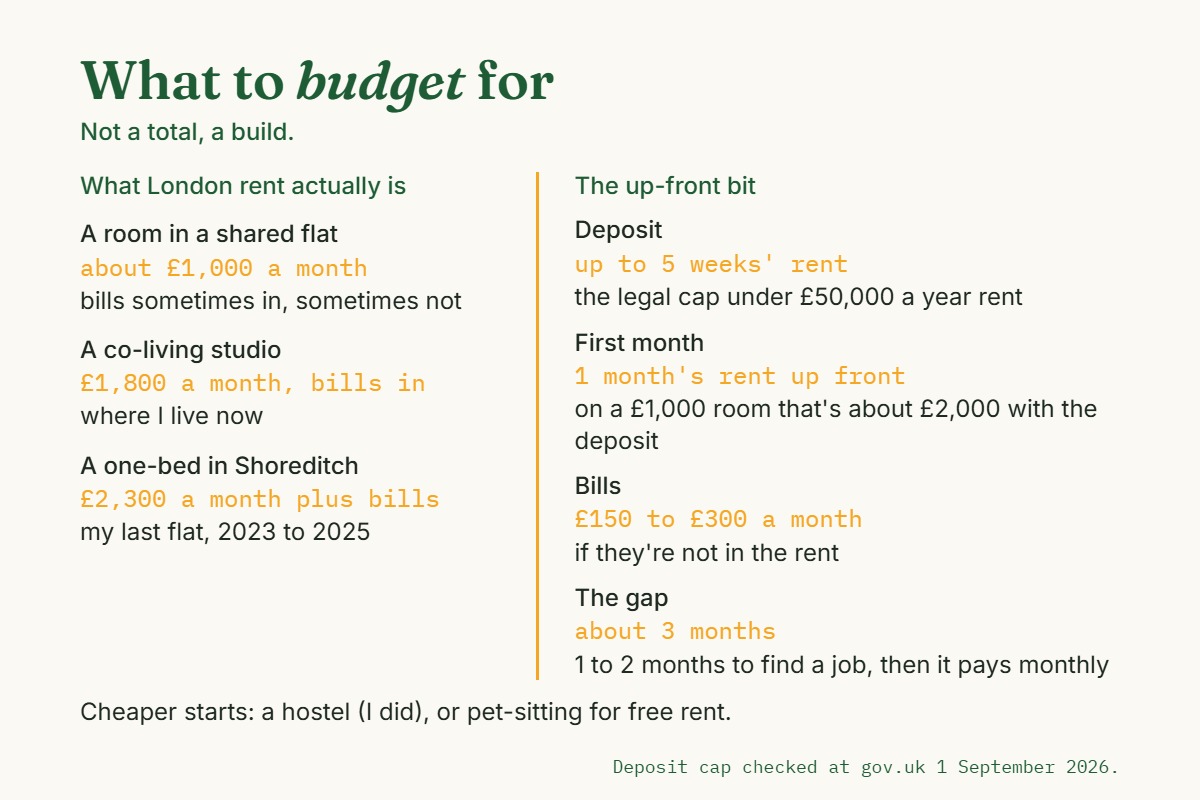
Rent. The average room in inner London is £979 a month on SpareRoom’s figures for the second quarter of 2026 and the southwest London average is £1,039. Call it £1,000 a month for a room to do the maths with.
Deposit and first month. The deposit is capped at five weeks’ rent where the annual rent is under £50,000. Most places ask for the first month at the same time. On a £1,000 room that’s about £1,150 deposit plus £1,000 rent, so roughly £2,150 before you’ve bought a pillow.
Bills. Where they’re on top, allow £150 to £300 a month depending on whether you’re sharing. Co-living buildings fold them in, mine does, which is part of why they cost more.
What they’ll ask you for. Any rental will want the same things: proof of your right to work, bank statements showing you can pay and sometimes an employment contract. It depends on the agency or the landlord. Renting a room in a shared house can be easier, because the other housemates already carry the tenancy. A lodger agreement, where you rent from someone who owns and lives in the place, runs on its own rules.
The old way round having no UK payslips was to offer months of rent up front. That door shut on 1 May 2026. A landlord in England now can’t take more than a month’s rent before you move in, so the bank statements are what carry you.
The gap. Give yourself two to three months to find a job. Then remember UK pay is monthly, so your first payday can be a month after you start. I was used to fortnightly pay in Australia and this caught me out. Realistically you’re covering three to four months of everything from savings, with pay landing around month four or five. Mine ran out. My dad sent me money for Christmas that first year and it went straight on the credit cards and the rent.
The worked example, on a £1,000 room with bills on top:
- deposit, about £1,150
- first month’s rent, £1,000
- three more months’ rent before payday, £3,000
- four months of bills, £600 to £1,200
- four months of food, transport and living, your number, because mine from 2013 won’t hold
That’s about £5,750 to £6,350 on rent and bills alone before you’ve eaten. Put your own living number on top and that’s your minimum.
How to bring it down. A hostel at the start is a real option. Mine was Saint James Backpackers in Earl’s Court, a bed in an eight-bed dorm, £110 for four nights in October 2013, so £27.50 a night. I stayed in hostels from October until the end of January 2014 while I sorted a job and a room. Ask around the hostel too, in case someone’s renting out a room. The pet-sitting websites are the other one, free rent while you find your feet, but you need to build up a portfolio of sits first, so it’s not a day-one option.
Worth it
A hostel for the first stretch. £27.50 a night in 2013 and it bought me three months to find a job and a room without burning through the savings.
What I pay now, for scale. A co-living studio in southwest London at £1,883 a month with bills included, think university halls for working professionals. Before that, a one-bed in Shoreditch from 2023 to 2025 at £2,300 a month with bills on top. Yes that’s an expensive area, but I haven’t seen many one-beds much under that anywhere I’d want to live. The co-living place wanted the same as any flat before they’d rent to me: bank statements, right to work and previous tenancy references.
Moving the money. Sort the transfer before the money moves. In 2013 the banks took a cut I never saw coming and I lost real money to it before I worked out there was a better way. Wise is what I use now for moving money between here and Australia. There are other transfer companies out there, but this one is the most hassle-free for me and I like it.
I didn’t keep receipts for the move itself, because it was 2013 and I wasn’t running a website out of my own move. So this is “about”, not itemised to the penny. I’d rather tell you that than dress a guess up as a figure.
I flew with one suitcase, no shipping, no excess baggage and took roughly $15,000 AUD, most of which went in the first four months while I had no income here. I’m not going to translate that into what it “would be now”, because that’s a guess wearing a number’s clothes.
Before you get on the plane
This is the section I’d want someone to read before they book the flight, because it’s the part I got most wrong and I’m still tidying up thirteen years later.
One thing to keep in mind: I came over on a five-year visa, so a lot of what I did, I did because five years is a long time to not live somewhere. If you’re coming for a year to three, on Youth Mobility say, you might make different choices.
Two hard deadlines first, then everything else.
If you’ve got a HECS debt (the Higher Education Loan Program, or HELP, as it’s called now), or any other study loan, leaving doesn’t pause it. Once you’ll be out of Australia for 183 days or more in any 12 months, the Australian Taxation Office (ATO) wants an overseas travel notification within seven days of you leaving.
Then every year, by 31 October, you report your worldwide income to them if it’s over a quarter of the repayment threshold, which is $16,750 AUD for the 2025 to 2026 year. Once it’s over the threshold itself, $67,000 AUD that year, you keep repaying, in pounds converted back to dollars. I don’t have a HECS debt, so this one never applied to me. If you do, it’s a deadline with a penalty on the end of it.
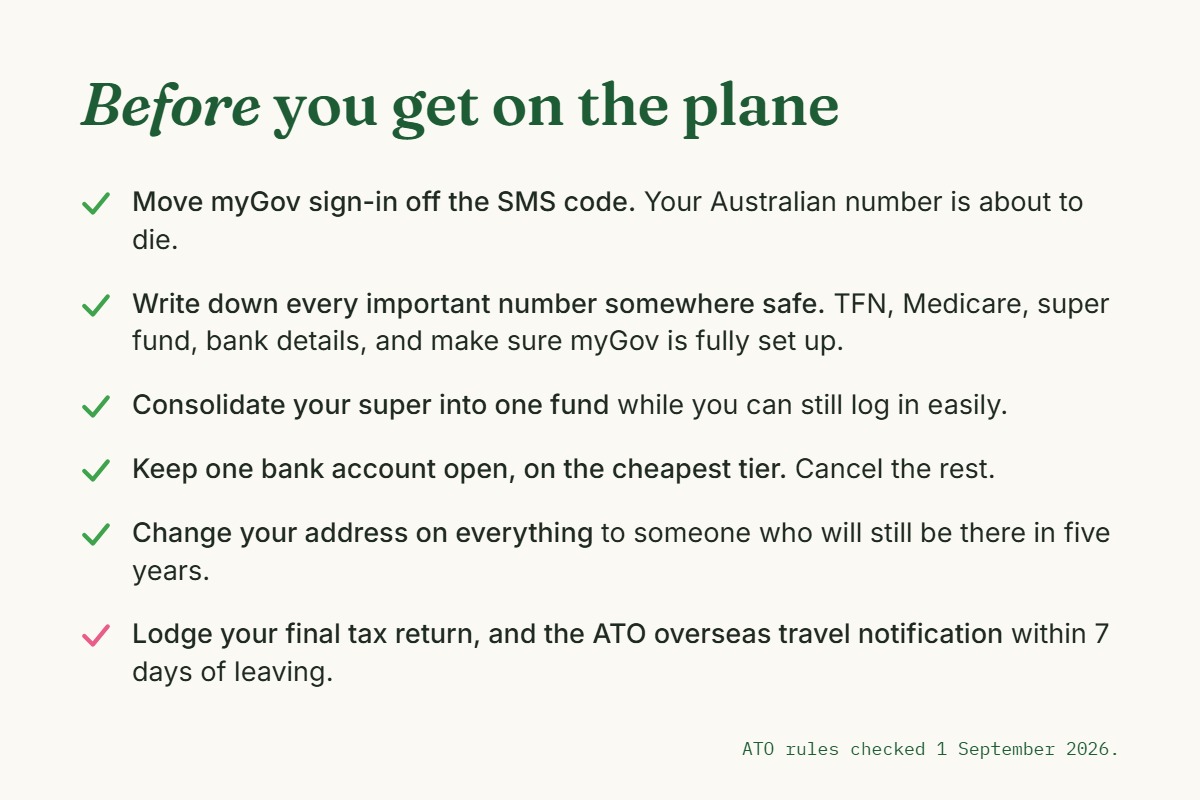
Write it all down and scan it. Your tax file number, your Medicare number, your super details, your bank logins. Scan every critical document and send the copies to someone at home. I sent mine to my mum. Even a copy makes the conversation easier when something like a passport goes missing.
Change your address on everything to someone reliable. The day they move house, or the address quietly goes stale, you lose the thread on all of it. The government consolidated my old super funds while I was mid-move and it was only luck that my family still got my mail so I saw it happen.
Set up myGov and link the ATO and Medicare before you leave, because linking asks for identity documents that are far easier to have to hand in Australia than from a hostel in London. Then move your sign-in off the SMS code to a passkey or an authenticator app, while your Australian number still works.
I didn’t. I left mine on SMS to a number I’d already cancelled, so I put the codes through mum’s phone. Then she changed number and I was locked out. Then my sister’s phone, then she switched providers and I was locked out again. Every time I had to prove who I was all over again to get back in. It took embarrassingly long to fix.
Consolidate your super while you’re in there, if that’s your call. The ATO lets you do it through myGov, under Australian Taxation Office, Super, Manage, Transfer super. This one’s a personal choice and not financial advice. I just wanted my small ones, about $1,500 AUD each, in my big fund and not getting eaten by fees. The government’s clean-up scheme did most of mine for me and I did the last one years later when mum posted me the letter. Don’t run it the way I did.
Close off your tax year before you go. I didn’t lodge a final return before I left and ended up sorting it out a couple of years later, from here, which is the harder way round.
Cancel what you don’t need and know what you’re keeping. I kept one Australian bank account open so I wouldn’t lose my history and I’ve paid about $5 AUD a month for it ever since, which is the fee on my account type. Other account types charge differently or not at all, so look at your options rather than paying for the privilege like I do. Everything else, the credit cards, the extra accounts, I closed.
Bring the things you can’t get here. You can buy a lot of Australian food in London (a shop like Sanza, for example), but for the niche stuff, pack it or organise a care package for when you land. Mine is Cherry Ripes. A friend of mine swears by one particular sanitary product and brings a supply every trip home.

Worth it
Sorting your Australian admin before you fly. myGov, super, the tax year. The cheapest thing on this page and the one I got most wrong.
Not worth it
Leaving your myGov sign-in on an Australian SMS number. Three lock-outs, three phones, three rounds of proving who I am.
Your first weeks here
The loop that ate my first weeks: I needed a UK address to open a bank account and I needed a bank account to get a place to live. Round and round, from a hostel bunk in Earl’s Court. It’s the thing to solve before you land. Here’s the order I’d do it in now.
1. Money before you land. Set up Wise before you fly. You can get the card sent to your Australian address, so you land with a way to pay for things that isn’t your Australian bank.
It’s the best way I’ve found to do the transfers. I don’t have other Australian accounts to compare it with and I know friends who use other things, but it’s been the best for me. It’s the upgrade on what I had in 2013.
Affiliate
Set up Wise before you fly. The card comes to your Australian address, so you land with a way to pay that isn’t your Australian bank.
2. The address and bank account loop. I went through a relocation company called BritBound, who got me set up with Lloyds and sorted my National Insurance number, all of it by post, I never went in for an appointment. I’ve stayed with that Lloyds account since.
I went looking for BritBound while writing this and I think they may have shut down, so take that as what got me sorted in 2013, not a recommendation. An HSBC overseas account, opened before you leave, is worth looking into as an option. I didn’t know it was a thing at the time.

3. Right to work and the National Insurance number. You don’t have to wait for your National Insurance number before you start working, you just need to prove your right to work. Your visa is that proof. Mine came through before I started, so I never had an emergency tax code.
Worth it
Wise, set up before you land. The card comes to your Australian address and you arrive with a way to pay that isn’t your Australian bank.
What catches Australians out
Six things that catch you after you land, none of them on the visa form. Most of them caught me.
1. Your tax code. Out of twelve years of UK payslips, about eight have been fine and four haven’t, or not quite. Being self-employed for a stretch changed it and I get a bonus every year, which throws the tax office’s maths out every single time, so I always end up paying HM Revenue and Customs (HMRC) some back, out of a later payslip or as a lump sum.
Anything unusual, a bonus, a second income, a bit of freelance, will change your tax code and it’s on you to check it’s running right rather than assume the payslip is.
2. Swapping your licence and the manual catch. Australia is a designated country, so swapping your licence needs no test, just the paperwork and the Driver and Vehicle Licensing Agency (DVLA) fee of £43. You can drive on your Australian licence for 12 months after becoming resident and you have up to five years to make the exchange as long as the Australian licence hasn’t expired.
The trap: you can get a manual licence, but your Australian licence needs to have it on there, or you provide proof you can drive a manual. Otherwise you’re issued with an automatic. Mine, on a manual Western Australian licence, went through fine and so did my sister’s on her automatic one. A friend of ours had to go back to VicRoads for a letter confirming her manual entitlement before hers would go through. If there’s any doubt about what your licence shows, sort that proof out before you apply.
I’m not going to recommend a car insurer, because I’ve bought one policy in thirteen years and that’s not enough to have an opinion.
Not worth it
Buying a car early. I’ve owned one for two months in thirteen years. Everything else has been a rental.
3. Qualifications that don’t transfer. Degrees don’t always carry across one to one. For most jobs it’s fine, but anything regulated, pharmacy, healthcare, allied health, has its own pathway: registering with the UK regulator (the General Pharmaceutical Council for pharmacy, say) or a bridging qualification before you can practise. Check where yours stands with UK ENIC, the official body that compares international qualifications against UK ones, before you land.
A friend of mine, qualified as a pharmacist in New Zealand, couldn’t work as a pharmacist here on that qualification. She was only here on a two-year visa, so there was no point doing the bridging work and she worked as a pharmacist’s assistant instead. Right call for two years. If you’re coming for longer, factor the conversion in first.
4. The Medicare clock. You can be out of Australia for five years without losing Medicare. Past that you re-enrol from scratch when you go back, with a current passport and two documents dated within the last six months proving you live in Australia again, a lease, proof of a job, a bank account. If you’ve been away more than 12 months you may need to re-enrol anyway.
I rang Medicare last time I was back and they told me the five-year part but not the twelve-month wrinkle, so the written rule is the one to follow. Five years is where it stops being a phone call and starts being paperwork.
5. Voting from overseas. Voting isn’t compulsory while you’re overseas, but if you skip an election without telling the Australian Electoral Commission (AEC) you’re away, they write to you and can take you off the roll.
If you plan to be back within six years, register as an overseas elector and tick general postal voter, so the ballot papers come to you on their own. Otherwise it’s a postal vote or the embassy, high commission or consulate, which open for the two weeks before polling day.
6. The Australian cards that keep charging you. The 28 Degrees Mastercard I moved over with in 2013, back when it had no fees at all, has changed hands since and now carries an $8 AUD monthly fee after the first year. Add my $5 AUD a month bank account and that’s money leaving every month for nothing. Check every Australian card and account in your wallet for a fee before you fly. Close or switch the ones that charge you for existing.
Not worth it
Keeping Australian cards and accounts you don’t check. Mine have quietly charged me for thirteen years.
Where I’m at now
Thirteen years on, I’ve gone from an Ancestry visa to indefinite leave to remain to British citizenship and I’ve helped a fair few Aussies land since. Both of those steps have their own pages if you’re on the same road.
And I’m still mopping up the Australian admin I didn’t do before I left. So take the before-you-fly section from someone who learned it the slow way.
FAQ
How much does it cost to move to England from Australia?
Budget four things: the visa fee for your route, the Immigration Health Surcharge for the whole visa (£1,035 a year, or £776 on Youth Mobility or a student visa), a deposit of up to five weeks’ rent plus a month up front and enough to cover two to three months without a payday. I can’t give you one number that holds, because prices have moved a long way since 2013 and I don’t have receipts to back an updated figure.
How much savings do I need moving to London specifically?
Enough for three to four months of everything before your first monthly payday. Real rents: the inner London room average is £979 a month (SpareRoom, Q2 2026), my co-living studio in southwest London is £1,883 with bills in, my last one-bed in Shoreditch was £2,300 plus bills. Add up to five weeks’ deposit, the first month and bills of £150 to £300 if they’re on top. A hostel at the start brings it down. Pet-sitting does too, once you’ve built up a portfolio.
Does the Youth Mobility visa lead to settlement?
No. It runs up to two years with a one-year extension for Australians and there’s no route from it to indefinite leave to remain. The Youth Mobility page has the rules. The Australians I know who stayed did it by switching to a sponsored job or a partner visa before it ran out.
What order should I do things in?
Visa first, because it decides everything else. Then your Australian admin, before you fly: myGov linked, super consolidated, tax year closed, the ATO travel notification lodged if you’ve got a HECS debt. Then money you can spend from day one. Then the address and bank account loop, which is easier with the first three done.
What’s different for someone moving from New Zealand?
Most of the UK side is the same. The qualifications trap is the one that bit my own friend, who’s a New Zealand pharmacist, so check that before you assume your degree or registration carries across.
Worth It / Not Worth It
Worth it
Moving to the UK. Every bit of it. Europe on your doorstep, a career you can build here and the friends who follow you over. Thirteen years in and I’d do it again tomorrow.
Not worth it
Winging it. I did. It cost me sleep, money and most of my first four months.
The Pivot
Worth it
Worth it, every bit of it, though I’d do the admin in a different order if I went back. How I landed with almost nothing in the bank after three months around Europe and what my old employer did next is one for Controlled Chaos.