Discover England, Northern Ireland, Scotland and Wales with its breath-taking scenery, history and culture it is packed with appeal for travellers. It’s hard to travel more than a few miles without stumbling upon a castle, pub, stately home or historic village. Alternatively, explore one of the bustling cities like London, Glasgow, Cardiff, Edinburgh, Belfast and Manchester…
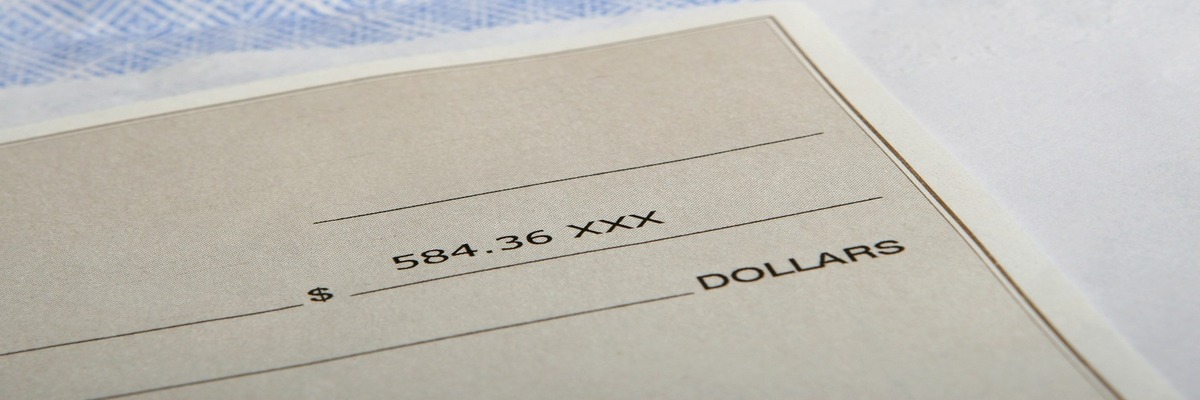
On a rare occasion, you may find yourself in the position of needing to cash a cheque.
Can you cash a foreign cheque in the UK? Yes, it can be possible to cash a foreign cheque. Some UK banks will allow you to cash the cheque depending on where the cheque comes from, what bank it is drawn on, which currency it’s in – and how long you are willing to wait.
While it is possible to cash a foreign cheque, an electronic cash transfer is the most efficient way to move funds to your account while you’re in the UK. If you’re a short-term visitor, it will be virtually impossible to make the transaction in time.
Getting Started. What will Work?
Cashing any foreign cheque in the UK isn’t easy and take a significant amount of time. If you need the funds relatively quickly, attempting to cash a cheque is not the way to go. Fortunately, access to personal funds electronically is more convenient and efficient than ever.
According to Barclays bank, if you want to cash a foreign cheque, you’ll need a local account. If you have an account in the UK, you are one step closer to getting your cheque cashed. But the cash won’t be immediately available.
Instead, at a local bank branch, you will deposit the foreign cheque into your account. Depending on the particulars of your cheque, it will be deposited into your account through either a negotiation or collection process. The transaction will be assessed a fee, depending on the amount of the cheque and/or the bank’s policy.
Whether it’s negotiation or collection
depends on:
where the cheque comes from and
what currency it’s in
If a cheque is made out from one country but is in a different currency than the country of a cheque, the cheque will be held through the collection process, which means an additional delay.
Watch out for high fees. Using banks can incur high fees and you should look into what will be most cost-efficient for you. For lower value cheques this may not be an issue but if you are looking at several thousand dollars then you could lose out on a significant amount of that money.
Here Is How Each Cheque Cashing Process Works
Negotiation
Negotiation lets a bank customer use the funds from a foreign cheque before the cheque has cleared. The amount of the cheque will be credited to your bank account after three or more working days.
The credit is only temporary – until the cheque clears. If the bank the foreign cheque is drawn on rejects the cheque, the amount is taken from your checking account.
Collection
With the cheque collection process, the bank does not credit your account until the cheque is completely cleared through the foreign bank. You will wait until the cheque has been cleared and the funds obtained from the bank before crediting your account. This takes on average about 4-7 weeks. There is also a fee.
How Long It Takes
There is no standard timeline for how long it might be until you’ll have your funds. It varies widely, based on the country and currency of the cheque.
Danske Bank reported a process similar to Barclays, also stating on their website: “We recommend that funds from abroad be sent by bank transfer rather than by cheque. Bank transfers are faster, cheaper and safer.”
The wait is generally long because the cheque needs to be physically mailed back to the foreign bank for processing. Maybe even to a specific branch. The bank the cheque is sent to will have its own process and timeline for sending funds back to the UK. Between the mailing, exchanging and processing, this method takes time.
Exchange
Rates
Sometimes it takes so long, that the exchange rate between currencies can change during the process. Whatever happens, you will be paid in the amount that was quoted on the day you presented the cheque to the UK bank. It may be favourable by the time your funds clear.
Opening a Bank Account in the UK
Traditional banks will require more information to establish an account. They generally require proof of address, that you can work in the UK so visa or passport and potentially require proof of income or a certain amount to be deposited each month into the account.
You’ll need the following pieces of information to present to your new bank:
Proof of identity
Passport, driver’s license, ID card
Visa if applicable
Proof of address
Types and number of pieces varies by bank
Providing that information can be difficult without a permanent address, although it’s getting easier with new-age banks like Monzo and Starling. You will need a UK mobile number, UK address (so you can be sent your card etc) and proof of identity. Both Monzo and Starling accept cheques GBP, however, unable to accept foreign currencies cheques.
International Bank Accounts
Some banks offer international bank
accounts, with the option of working in multiple currencies and easing both the
process and cost of funds transfer.
Major UK banks, such as Lloyds Bank, HSBC, Citi Bank and Barclays, offer international accounts. Each bank will have its own policies, procedures and standards of eligibility. Some eligibility areas include:
Proof of Identity – Your passport and driver’s license or state ID. Many banks
require two forms of ID.
Proof of Residency – You may need proof of residency in the United States, proof of an
address in the foreign country, or both.
Startup Funds – Banks often have minimum startup funds required for deposit.
A student or work visa if you
need one for the country
A university letter or proof of
school enrollment
A letter of employment or
employment contract
While international accounts can simplify the process of working with money in multiple countries, this is the kind of thing you probably want to get taken care of before you leave home.
If you plan on opening a bank account in your destination country, you can even begin the account opening process prior to arrival through the international banking centre of your home bank.
To hold a local account in a foreign currency you’ll probably need to be living or working abroad at least some of the time. It can ease your money transferring woes but at a cost. There are likely to be charges for the account itself.
Alternatives to Cashing Cheques in the UK
Cheques are nearly obsolete in your everyday life at home, you can imagine why they’d be difficult to work with overseas. There are so many options that exist to make financial transactions easy while you’re visiting another country.
Bank Transfers
Organizing a bank transfer is a much smoother transaction when abroad. While you’ll still encounter some pretty high fees and exchange rates. I don’t generally recommend using your bank to transfer money due to the fees.
If going this route, first find out how many pounds you’ll receive when all is said and done. You can then check how much your transfer service quote you against the “interbank rate” online.
The interbank rate is the rate that is used between banks when they transfer and trade money between one another. XE.com is one source for the interbank rate.
Agencies that can transfer your money:
Wise – this is what I use for my business and personal accounts to send money from USD, AUD etc to my UK bank accounts.
High street/major UK banks – generally the highest fees
Services such as Western Union or PayPal
In short, there is no easy overseas, cross-border cheque clearing system. Your foreign cheque must be physically mailed back to where it came from, processed there and then the funds must be exchanged and entered into your account in the UK.
If you have the account and the time, you’ll still encounter significant financial penalties, in the form of high fees, for engaging in this process.
Advice for Consumers Receiving Payment Abroad
There are a variety of methods for making
payments abroad. From electronic transfers to currency brokers. The UK’s Pay Your Way website offers advice and
information to help you understand your options and choose the one that best
suits your needs.
If you have a choice in how you are being paid from home while you’re in the UK, request an automated payment directly to an account you can access in the UK.
There are certain pieces of information the sender will have to know, such as your International Bank Account Number (IBAN) and your Bank Identifier Code (BAC). These international identifiers ease the transition of funds directly into your account in the UK.
Speak to your bank before you leave home. This is the best way to ensure you know how to handle and receive any payments while you are in the UK. Figuring these things out before you’re overseas can save you a lot of time and headache.
Travelling can take a toll on your phone’s
battery life, you want to be capturing all those London moments and navigating
the city. The last thing you want on your trip is not to be able to capture something!
So where can you charge your phone in London?
ChargedUp
Powermat
Aircharge
Charging at your accommodation
John Lewis Charging Station in Oxford Circus
Use any public charging outlet available (with your charger &
adapter)
There are plenty of phone charging options
in London, even some newer London buses are adapted with USB ports! I’ve never
had an issue finding a place to charge my phone when I am out and about. All
the cafes, restaurants and tourists’ areas will have options. I always travel
with a power bank just in case I run into issues for whatever reasons.
Your Options for Charging Your Phone
in London
1.
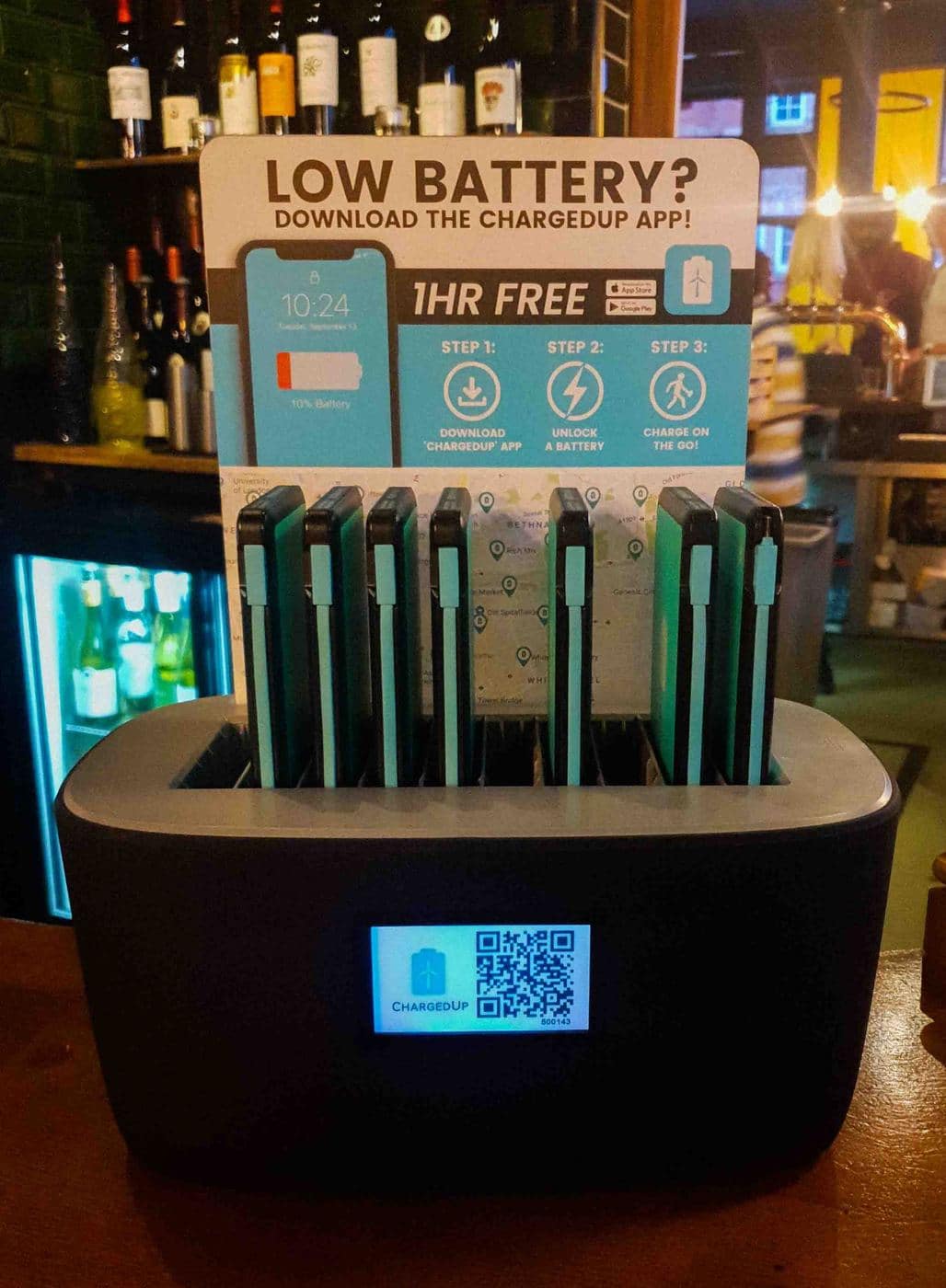
ChargedUp
ChargedUp Station at a pub in London.
It is becoming more convenient to get charging equipment in London. ChargedUp is a business that places vending machines in places like:
Restaurants
Shops
Bars
Hotels
And more
The only disadvantage with ChargedUp is that they only have an IOS app to find charging points. Brands like DoubleTree by Hilton, wework, Stonegate Pub Company, Selfridges & Co, Pergola, M&S, Laine’s, Brewdog, and Boxpark are partnered with ChargeUp so you will likely find them in one of their venues.
Simply pay the
fee to rent the charging pieces you need for the duration of your stay. When
you finish using them, simply return them to any ChargedUp vending machine.
This is a great help for those that want to avoid packing too many items.
2.
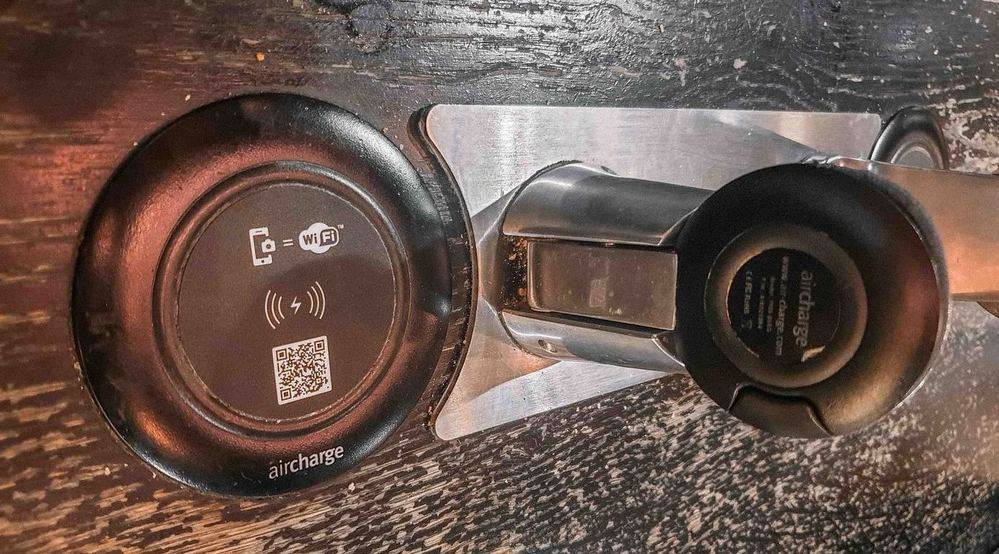
Aircharge
You will find these Aircharge stations (or versions of) in all the brands I mention below.
Aircharge has
paired up with brands like McDonald’s, Starbucks, YO! Sushi, Costa Coffee and
Vapiano to provide customers with Qi wireless charging stations. McDonald’s is the
largest provider to date with more than 400 UK stores offering these facilities.
The easiest way of finding the closest charging station is by using Aircharge app. Using your location, it will guide you to the closest station.
You do need to
have a newer phone for Aircharge to work. If your phone is on the list below,
then it will work with Qi wireless technology:
LG: G7 ThinQ, V30, G6 (US version only), G4 (optional), G3 (optional) (Plus more devices)
Nokia: 9 PureView, 8 Sirocco
Huawei: P30 Pro, Mate 20 Pro,
Microsoft Lumia: 1520, 1020, 930, 929, 928, 920
Google: Pixel 3 XL, Pixel 3,
Nexus: Nexus 6, Nexus 5
For the phones that aren’t compatible will need to get adapter to use Aircharge.
3.
Powermat
Powermat is
another charging facility that can be found in stores around central London.
Places like; All Bar One, LEON, Heathrow Airport and German Doner Kebab are
offering Powermat charging stations. As they are using wireless charging technology
your phone will need to have these capabilities.
To use Powermat,
simply place your phone on the Powermat spot and it will start charging your
phone.
Oxford Circus is
a connection point between Regent Street and Piccadilly. The term “circus” can
be confusing if you are not from England. It literally means circle in this case,
translated from Latin. There are many
shops present in the circle around this street junction.
John Lewis is a
well-known department store in London and has a Chargebox station inside the
store. The best part of the ChargeBox is that the first 30 minutes are free!
You can find a
ChargeBox in the John Lewis store located in Oxford Circus. These are small
lockers with charging plugs in them. You can simply put your phone in the locker
and use the provided key to keep everything safe.
If you don’t want to wander too far away from your phone, you should explore the cheese room on the lower ground floor. Honestly, it is a cheese lover heaven! But back to phones…
After 30 minutes
it will disconnect your phone and if you want more charge you will have to
reconnect it again.
Where to find
them:
On level 5 at Place to Eat entrance
Place to Eat – Right.
Ground floor next to Customer Collections.
5.
Charging
at Your Accommodation
Charging your phone at your accommodation it is the easiest way. If you’re like me it’s just habit to charge your phone when you’re asleep. If I find I end up glued to my screen before leaving I will give the phone a quick top-up before heading out the door. That extra 15 minutes can help!
Hotels/Hostels
USB ports are
becoming a popular way of charging your phone instead of having the old school
plugs. You should bring an adapter and the plug just in case your hotel hasn’t
caught up with the latest trend. In most cases when I am travelling in the UK,
I find that I don’t need my plug, but you can occasionally get caught out.
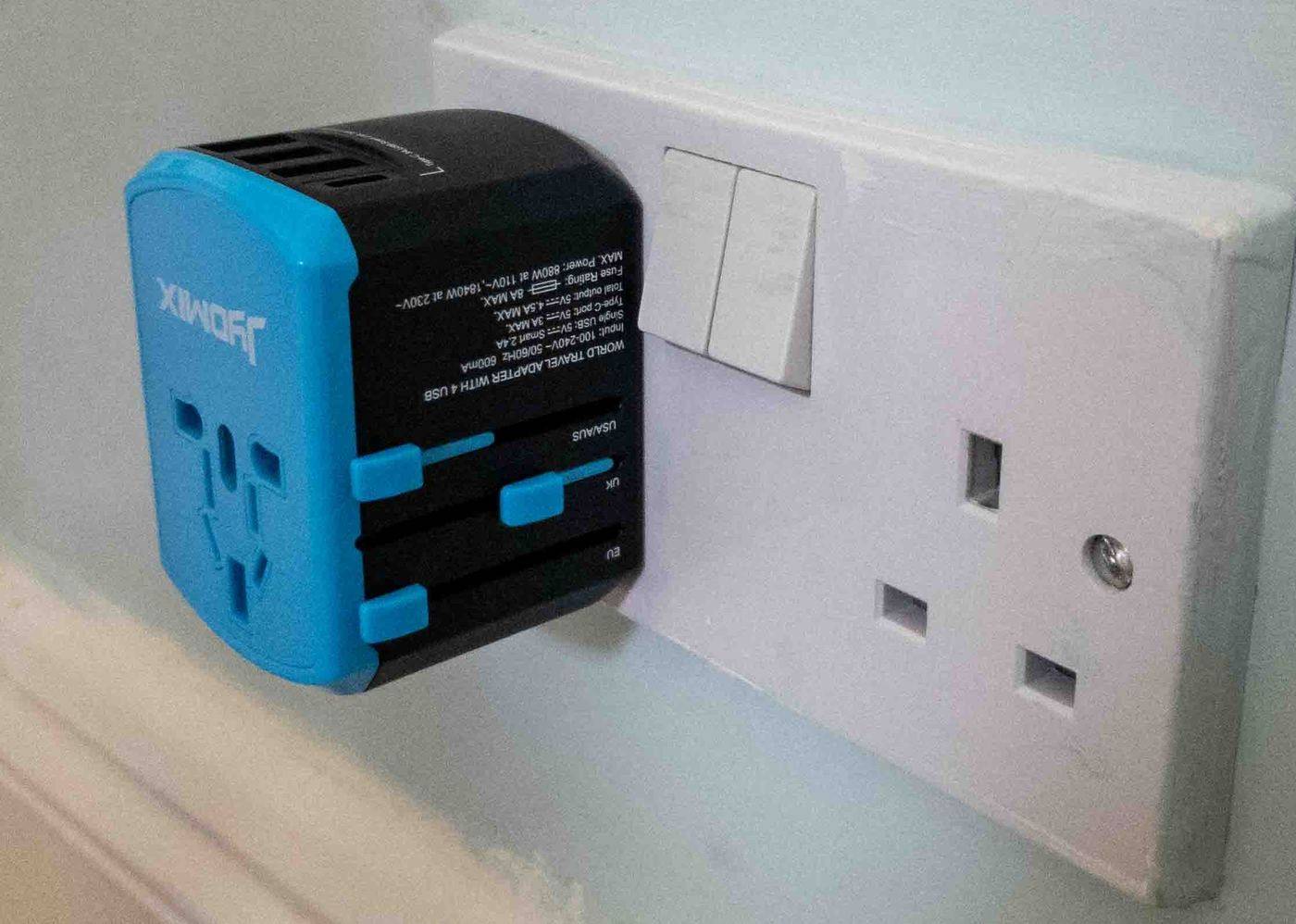
Adapters are necessary because the plugs in the UK have three prongs. Depending on where you are travelling from, your plugs may be completely different. Be sure to get enough adapters to allow everyone in your group to charge as needed.
Airbnb
Staying in an Airbnb it is unlikely you
will have USB so if you need a power convert then I suggest getting one before
travelling.
6.
Use
Any Public Charging Outlet Available (With Your Charger & Adapter)
Charging your phone while you are shopping for coffee or food is a great way to top up your phone. After all, we must rest our feet sometime after all that sightseeing!
Cafes, Coffee Shops and Restaurants
There are generally power points and free internet in cafes, coffee shops and restaurants. If you can’t see the powerpoint straight away, just ask the staff and they will be able to let you know the best seats to get that top-up.
National Rail
On some of the National Rail trains, there will be power points available, especially the long-distance trains like Edinburg to London. Having a power adapter and charging equipment means you can easily take advantage. However, you won’t find these on the Underground, unfortunately.
Other Public Transport / Stations
I have found some London stations popping up with charging facilities like Shoreditch High Street station. Just through the gates, on the left-hand side, you will find charging facilities that come with the different plug adapters to meet all your charging needs.
On some newer London buses, I have also discovered USB ports to charge your phone. The route I have seen it the most on is the 521 from London Bridge to Waterloo.
It’s not a guaranteed
way to charge your phone though.
Do You Need Plug Adapters in
London?
My favourite travel adapter, save you bringing all the bulky plugs!
London plugs have three prongs. If you are
coming from elsewhere in the UK, you may not need an adapter. Europe includes
many countries outside of the UK, and outlets can vary.
If you are coming from the United States, you need an adapter for London. Most of Europe has two-pronged plugs; however, the prongs are shaped differently than U.S. prongs. Ireland and the UK are the exceptions (with 3 pronged).
No matter where you are travelling from, you will likely need an adapter if you are traveling in the UK.
Adapters are inexpensive and I recommend getting one for worldwide use. This enables you to use your adapter for all of your travels and doesn’t lock you down to the UK. Here is my favourite adapter VGUARD Worldwide Travel Adapter, 4 USB Ports (Amazon).
Do You Need Power Converters in
London?
Power converters are necessary if your
devices cannot handle the higher voltage in London. The median voltage in the
UK is 230 volts. Check your devices before you go to find out what they run on.
You can ruin a phone or laptop that cannot handle the voltage difference.
Look on the plug for your phone to see what the voltage limits are. Some items, such as iPhone chargers, do fine with the voltage difference. Look on the website for your phone or computer brand to find out if the UK voltage is safe for your product.
Quality Brands
It is convenient to replace a broken
charging plug or cable with an inexpensive copy. Even in your home country,
there are warnings against this, however. You may severely limit the longevity
of your device by using off-brand charging equipment.
If you are travelling overseas, purchase plugs and cables that match the brand of your phone. This ensures that everything is of good quality. This can prevent dying cables and damaged devices.
Most phones come with a charger and cable.
People often buy cheap charging items, so they have extras in the car or around
the house. Find the original plug and cable before your trip or buy a new one.
Some companies get their products certified for use with common brands like
Apple and Samsung. Read the fine print before you purchase these.
Purchasing Charging Equipment for London
It is easy to purchase adapters for travel.
Most equipment is very affordable. Even if you need several items, you are
likely to spend very little. You can find adapters at Boots, WH Smiths,
electronics stores, and department stores.
If you do not want to pack extra items, you
can easily purchase adapters in London. This is a common item bought by
tourists, so they are easy to find. If you do not plan on using the adapters
again soon, be kind and hand them off to another tourist before you head home.
Why Outlets are Different in
London
The reason for varying outlets around the
world is simpler than you may think. There is more global travel now than when
electricity was new. Even after the invention of electricity, it was not in use
like it is today. Early uses mainly included lights and fans.
Different people were busy setting up
electricity in different parts of the world. They each simply came up with an
outlet design that met their needs. Frequency and voltage changed in the UK
after World War II. The frequency of 50 hertz matches up with the standard in
many other places.
Britain changed over to a higher voltage during the 1950s. The United States did not change at this time, as most of their homes already had large appliances running on 120 volts. It would have made things difficult for a large part of the population.
Most electronics and small appliances work
with a variety of voltages. This dual voltage ability makes it easier for
manufacturers to sell items globally. You can get an idea of whether you need a
voltage adapter by learning about voltage in different countries.
UK/ Europe- anywhere from 220
to 240 V
United States- 110/120 V
Japan- 100 V
Australia- 230 V
Brazil- 127/ 220 V (in the
process of changing, some older buildings are still 127 V)
Other Electrical Items to
Consider
Adapters can be helpful for many items, not just phones and computers. As people often travel with electric razors, hairdryers, and cameras. You should be able to use your adaptor for most items.
Before travelling make sure you check out the tag to find out if your appliances are dual voltage. This means you can use them anywhere in the world with only an adapter.
If you have older appliances or some odd brands, you may need to purchase a voltage adapter, as well. You can simplify your trip by using disposable razors purchased in London and use the hair dryers that come with your accommodation.
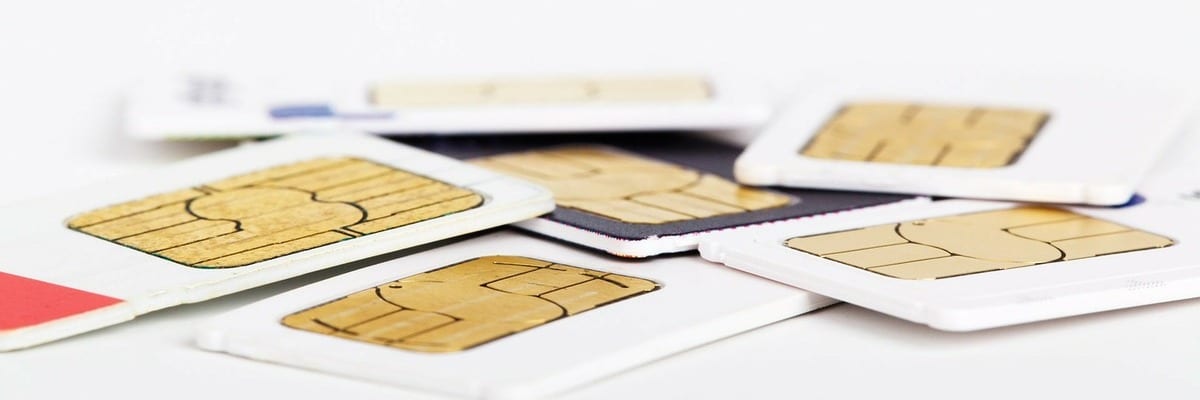
When travelling to the United Kingdom, you may consider using a local SIM card from the UK. If you have a phone with an interchangeable SIM card, then you should take advantage of a local SIM card’s benefits.
Do all phones work with UK Sim cards? Not all phones work with SIM cards from the United Kingdom. Some phones operate on a network called CDMA which will prevent you from being able to use a foreign card. If your phone operates on GSM, then you can use a UK SIM card after you have the phone unlocked.
What to know before visiting? It is important for travellers to know whether your phone is compatible with using a UK SIM card and where to find them. If you don’t have a compatible phone, it is good to know what other options are available.
There’s a lot of avenues for you to take to avoid the hassles of using your phone overseas. If you have the right phone for it, travelling the world with your mobile device can be a breeze. Once you know, you’ll be armed with a better understanding of your phone and how to travel with it.
Taking Your Mobile Phone to the United Kingdom
You can take your phone with you when you travel to the UK but using your mobile phone while you’re in the UK can be costly from roaming charges. If you don’t want any unexpected bills when you return home, then it might be wise to take advantage of a local SIM card to avoid such fees.
If your phone is compatible with a
different card, then there are SIM cards set up as a pay-as-you-go system. You can buy an initial large sum of data, voice, and text which you
plan to use the entire time, or you can add more data as you go.
If your phone comes from Canada or Australia, then your phone likely runs on GSM, but if you’re from the United States you may have a phone which runs on a different network than those internationally. Some companies out of the US, such as Verizon and Sprint, run their phones on the CDMA network which makes them unable to use a local SIM card.
CDMA and GSM
The reason certain phones don’t work with
other SIM cards is that they use a system called CDMA which stands for Code
Division Multiple Access and they don’t even use SIM cards to operate. Phones
which do communicate using SIM cards are working on a system called Global
Systems for Mobile Communication or GSM.
They are both ways to access radio channels
and both compress multiple calls into one radio wave. The reasons for using one
network or the other was a choice for providers while some companies saw faster
speeds and response times on CDMA, the others wanted the wider use by choosing
GSM.
The difference between these two is how
they communicate with each other. A CDMA phone communicates with specific coded
segments for talking. So, the receiver’s phone only takes out its portion of
the coded segments. The benefits for phones on CDMA are:
Increased immunity to
interference
High-speed internet for faster
data
GSM is a time division system, so calls
take turns on a radio wave, but the receiver only hears their time slot. There
are a lot of claims that GSM isn’t as responsive or as fast as CDMA, because
most of them still connect to older 3G networks. Having a GSM phone means:
Can be unlocked
A higher percentage of the world is running on the network
Can easily switch carriers, local or international
The Challenge of Locked Mobile Phones
Cell service providers have the ability to
lock a phone to their network when the service is shut down. When a phone is
locked, many of the features are disabled and the phone cannot use a SIM card
from another provider.
The phone is locked by having a code on it
which enables the phone only to use the provided network, but if the phone is
unlocked it can accept and use SIM cards for other networks. In 2017, Canada
passed a law banning mobile companies from locking phones.
If you find yourself to be a tech-savvy
individual, then there are videos on the internet which guide you through the
process to unlock your phone. Some companies will unlock the phones for you,
but if not, a third party out of the UK can unlock it, usually at the cost of
purchasing their SIM cards.
United Kingdom’s Wireless Service Providers
Any SIM card purchased in the United Kingdom will be considered a UK SIM card. This encompasses England, Wales, Scotland, and Northern Ireland.
There are many popular providers to choose
from:
EE Limited
Vodafone
02
Three UK
Sky Mobile
Giffgaff
Virgin Media
These have been ranked as the best working mobile networks in the UK. Each offers competitive rates and the highest quality in data and voice throughout the United Kingdom, but for precise details, you can learn more.
Using a local UK card will work in most other countries in Europe, so if you plan to take a trip to France or any nearby countries, you can take your phone with you and not worry about any additional charges. Much of the world runs on GSM, so you always have the option to use the local SIM card of wherever you’re travelling to.
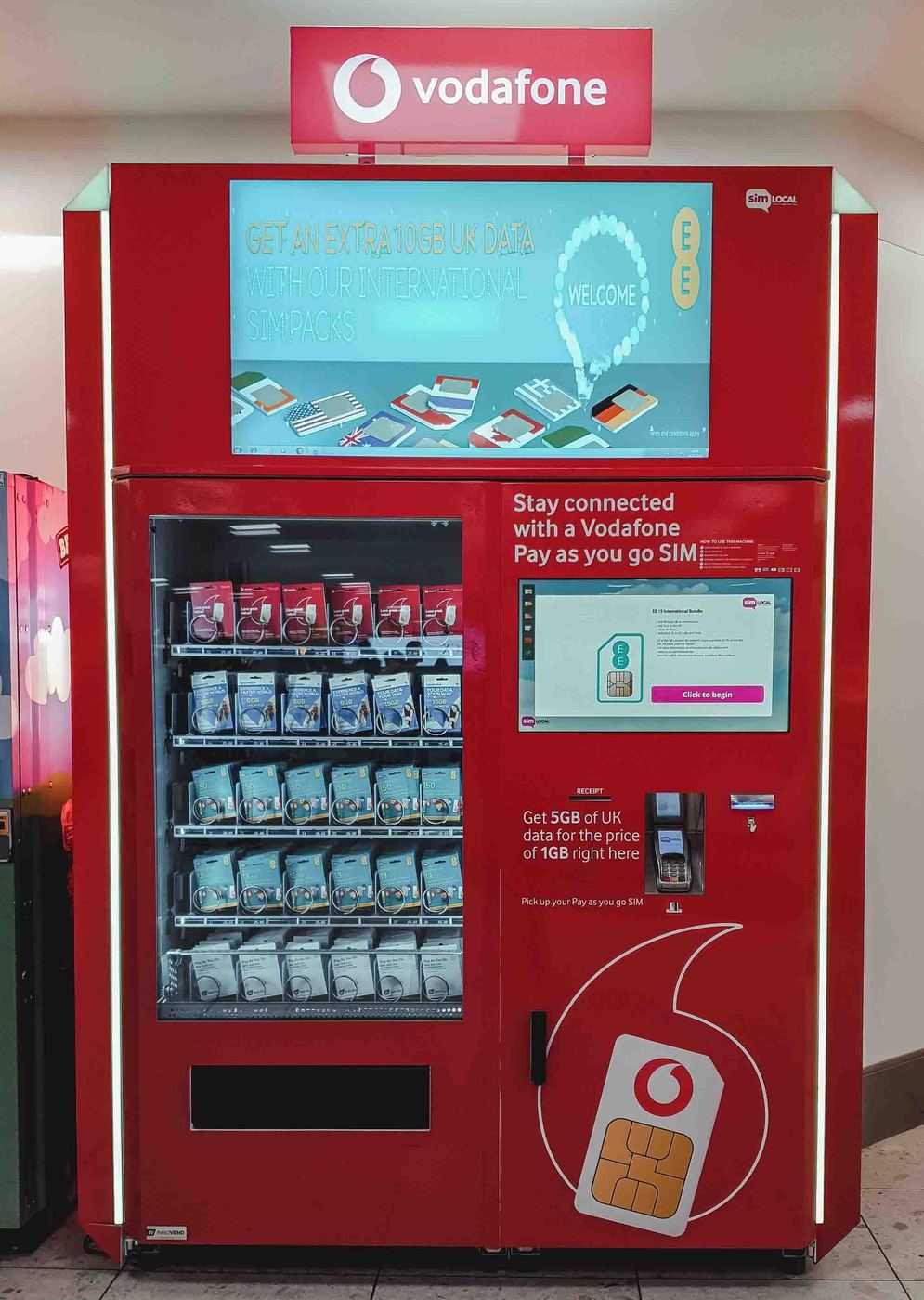
Vodafone stand in the airport
Prepaid Cards and Knowing your Usage
If you’re only visiting the UK, then you
can purchase one of the SIM cards with prepaid data and voice. It is important
to know how much data you’re going to need when you’re not planning on using a Wi-Fi
connection.
The Sim cards can be bought with as little
a 2GB and many offer unlimited data use for a certain period. Much of these
pre-paid plans offer unlimited talk and texts, but each SIM card only lasts for
an extensive amount of time such as 30 or 90 days.
If your planning on travelling outside of the cities and towns of the UK, then it is recommended to go for a high amount of data since you may need it for travel directions or information. For cities, you may not need such a high amount as there are ample times to connect with a business or hotel’s internet.
What Happens When You Take Out Your SIM Card?
It is best to take a SIM card out when the
phone is turned off to avoid any possible glitches or software malfunctions.
When your phone doesn’t have a SIM card in it:
You will not be able to make or receive any phone calls
You can’t access the internet without Wi-Fi
You can still make emergency calls
Taking your SIM card out will not damage your phone but for these reasons, it’s good to keep your card in your phone until you have another to switch out.
When Visiting
UK SIM cards can’t be purchased outside of
the country unless you purchase it online. Buying online will save you time and
allow you to have already the SIM card ready when you get to your destination.
However, if you don’t purchase online, you can find them for sale in airports,
some gas stations, and every mobile phone store.
If your phone isn’t compatible for a local SIM card, then you can rent Wi-Fi packs which create a wireless hotspot. While using local internet you can utilize apps such as WhatsApp or Skype to make any necessary international calls. Many phone shops in the UK also offer disposable phones which work similarly to the pay-as-you-go SIM cards and can be recycled after use.
If you’re planning a trip to London and you
have questions about money, you are not alone. With so many options available
you will have no trouble finding solutions on how to spend your money and
advice for paying for things in London.
One of the first questions you probably
have is, should I exchange money before I go to London? You should exchange some money before you
leave but plan to get the rest in London. When you do, remember that London and
the rest of the UK do not use the Euro. Since London is one of the world’s
financial capitals, you will be able to access your money and spend it pretty
much as you do in the U.S.
As London is a mecca for tourists, they want you to spend your money. Here are some things to know and even a few tips and tricks to have up your sleeve before you head across the pond.
Think Pounds, Not Euro
When the euro was first proposed as a
single currency for the European Union (EU), the UK Prime Minister (Tony Blair)
decided that the euro needed to pass five economic tests. The tests didn’t meet
the expected outputs so the UK opted to keep the pound (technically the “pound
sterling”) as its official currency.
Therefore, if your stay is only to London
or the rest of the UK, then you will only need the British Pound. If you are planning to travel in the rest of
Europe, then you will need Euros or those countries’ currencies.
Deciding on the amount of each to take will
require some planning. We’ll talk more
about that later. First, let’s decide
where to get your pounds sterling.
Is Exchanging Money Before Traveling a Good Idea?
You should make a decision based on
numerous factors, including:
How much time you have before leaving?
Whether my travel card will give good rates for the destination
If the destination is cash-driven
Your comfort level about how much foreign currency you want to have with you
If you have plenty of time before leaving,
then you should consider getting some pounds or find a travel card that suits
you.
The security of having some British pounds
as soon as you arrive in London is nice but make sure you always find the best
place to exchange your money. Banks will usually give you worse exchange rates
and charge additional fees.
How To Turn Your Money into Pounds?
As someone that travels constantly getting
the best rates for my money is very important! I always recommend Googling the
best travel cards or exchange places in your hometown or city before purchasing
pounds.
You have several options for getting hold
of those pounds.
Pre-paid travel card
Travel Credit Card
Money Exchange Places
Large National Banks
Your local bank or credit union
In America you can go to AAA
offices (American Automobile Association)
Post Office
Travel Card
Finding a travel card (debit or credit)
that suits your needs and the trip is important. London is slowly becoming more
card only so I would recommend travelling with at least one card. Countries
like Sweden are already leading the way with becoming card only economies.
When choosing a card bear in mind a credit
card will give you additional support when travelling and debit gives you
cheaper withdrawals (in most cases). For this reason, I like to travel with
both.
In the UK you will find the common ones
Mastercard and Visa are more widely accepted in the UK but American Express is
very easy to use in London and major stores.
Getting Money from Your Bank
If you have an account at one of the major banks, such as Bank of America, Wells Fargo, or Citibank (follow the links for more information), then the transaction will be fairly easy. You can order in person or online, but you will have to wait for several days to receive your pounds.
Smaller banks and credit unions will typically also be able to exchange currency. You might not get the best rates with a
smaller bank, but you will avoid the delivery fees that larger banks charge to
deliver the bills to you. Whether you
use a credit union or a larger bank, you will have to wait a few days to
receive the pounds.
Why We Got Some Pounds Before Traveling
Before I lived in London, I travelled to
London a few times. Each time I made sure that I went to my local money
exchange to get out a £100 before coming to the UK. I also have my 28 Degrees
Mastercard (Australian based credit card) and normal banks cards with me.
It was super easy to get the money I told
them how many British Pounds I wanted and next thing I knew I had the cash in
my hand.
I hate having to deal with airport kiosks
or currency exchange stores. This way if I need a taxi, a bottle of water or
some food I was set. It’s a little comfort blanket when travelling.
Why Getting Money While on the Way is a Bad Idea
Don’t.
Airport Kiosks will have the highest fees
and poor exchange rates, so only use them as a last resort. Even airport ATM’s will give you poor
exchange rates so walk past them as quickly as possible and head into the city
before exchanging or using an ATM (if possible).
Getting Money in London
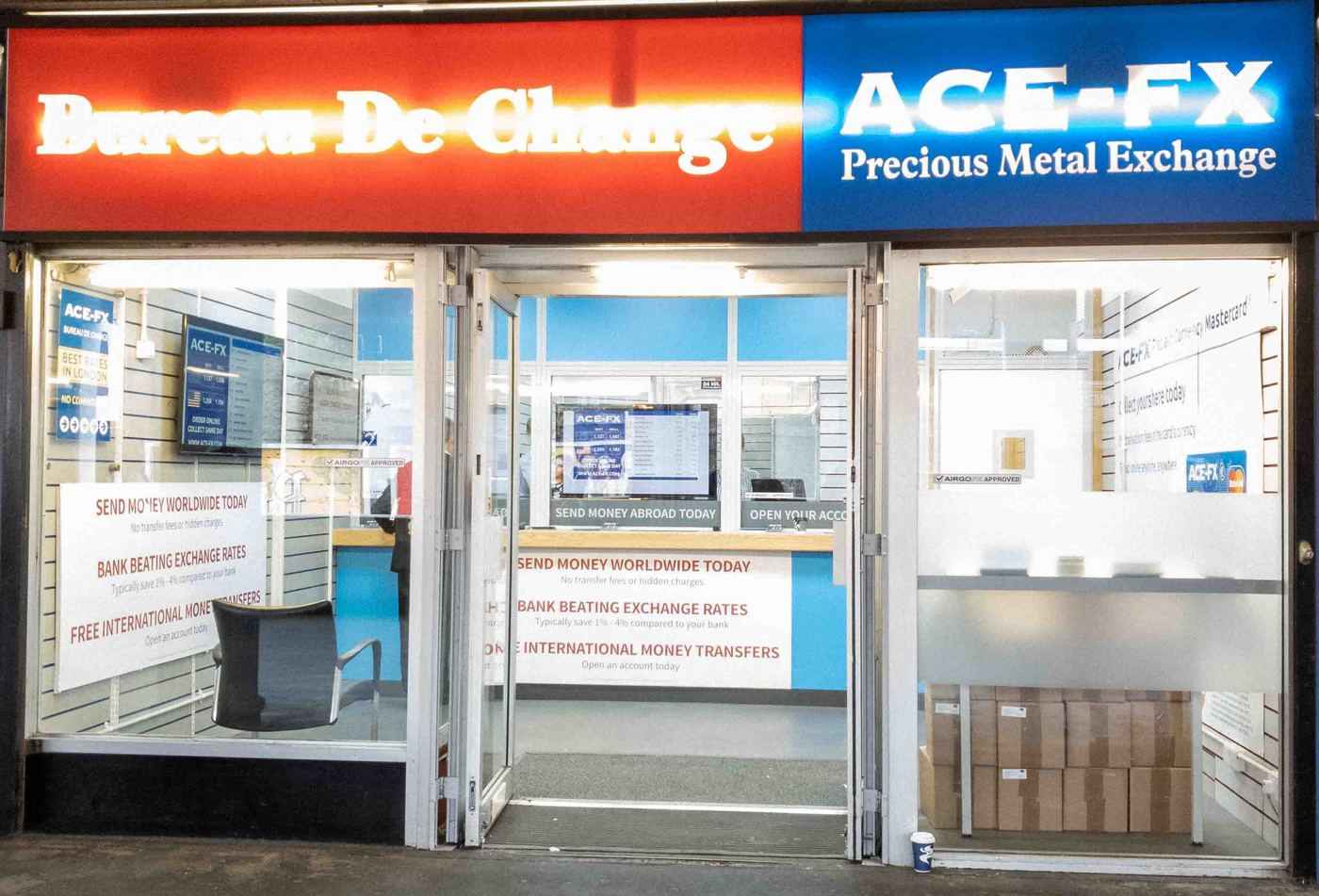
There are numerous places to exchange money in London and whenever I need of an exchange place I always tend to end up at ACE-FX (mainly because it’s on my commute). Thomas Exchange Global, Eurochange and UK Post Offices are a good place to start if you don’t have time to research before exchanging.
To see the best rate use the buyback
function of Money
Saving Experts, simply put in your home currency and how much you want to
exchange, the result will appear with the best exchange place that day.
If you are trying to find a money exchange
on the street look for the bureaux de change signs.
In tourist areas, you will often see currency exchange kiosks or storefronts. They will post their rates, which will usually look to be quite favourable. But read the fine print—there will be fees associated with the transaction. Add in those fees, and that favourable rate isn’t so favourable.
Banks are another option but generally, require you to have your passport.
Find a Cash Machines Instead
Kat getting money out of the ATM
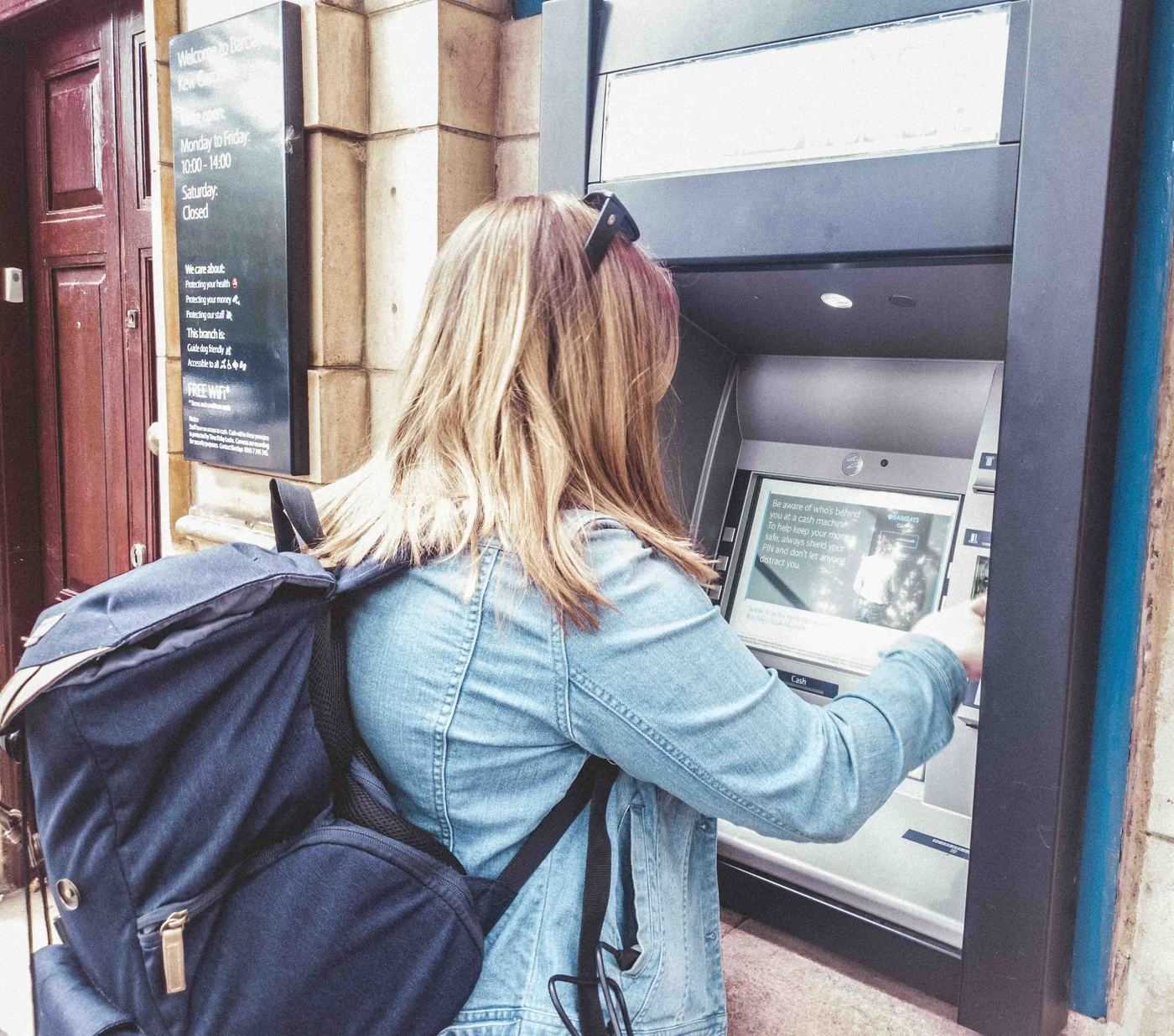
ATMs are everywhere in London. Savvy travellers walk past currency exchange vendors, banks, hotels, or the bureau de change (the French name for British exchange counters) in the post office and head for the nearest ATM. If you have the right travel card this will always be the winner option.
They will be easy to spot at airports,
banks, and other high traffic areas.
However, if you are off the beaten path (you rented a B&B on a quiet
street), Link Q provides an online service that will show you nearby ATMs. You can download the Link app or use their website to locate one near
you.
Things to Keep in Mind When Using the ATM in London
You can use your credit or debit card to
get pounds. Put your card in, enter the pin, and make a withdrawal. You will
receive your card back first and then the cash.
Do not accept the currency conversion by the ATM! This will always give you the worst exchange rate. It will give you an idea of how much you are taking out which is always a good indication to ensure you have enough money to withdraw.
Some important advice:
You may have to pay fees so double-check what fees you will be charged before you leave
Visa and Mastercard will work anywhere; American Express sometimes; and Discover won’t
Cards with Visa and Mastercard logos are ideal as they are most commonly used
If you’re worried that your bank or credit unions card won’t work, consider opening an account a different account or getting a prepaid travel card—at least for the trip
It’s a good idea to have a back-up card in case the ATM, for various reason, the ATM is hungry and eats your card, the card gets demagnetized or the card doesn’t work.
Contact your bank(s) before you leave so they have the dates and location of your travel. Even if they say you don’t need to, do it anyway, there is nothing worse than being overseas and your card is blocked.
Debit cards in most cases will have fewer fees associated to them, I say this as I did have a credit card that was specifically for travellers and provided better rates than my debit card. Generally, avoid using your credit card in an ATM, unless it’s an emergency. Cash advance fees, transaction fees, exchange fees—that’s a lot of fees. On top of that, your bank may charge higher interest rates for cash advances.
One last thing: A lot of ATMs in London
don’t always have letters on their pins, so if you have memorized Always
Scramble Your Eggs, memorize 2-7-9-3.
Using Money in London
London is moving towards paying
electronically so you want to have at least one card when travelling to the UK
but ideally two cards.
Your credit card is good for larger purchases (hotels, shops, car rental agencies) and for ordering online. I also like paying with a credit card for the protection they provide to your purchases, it’s my go-to card in London.
Your home countries cash is a good back-up. I like to have a hundred dollars for an emergency. You never know if the ATMs won’t work, all your cards get rejected, and you’ve run out of pounds. Cash is cash.
But keep the cash as a back-up and never use it at places that say they accept foreign currency. You will receive the worst exchange rates.
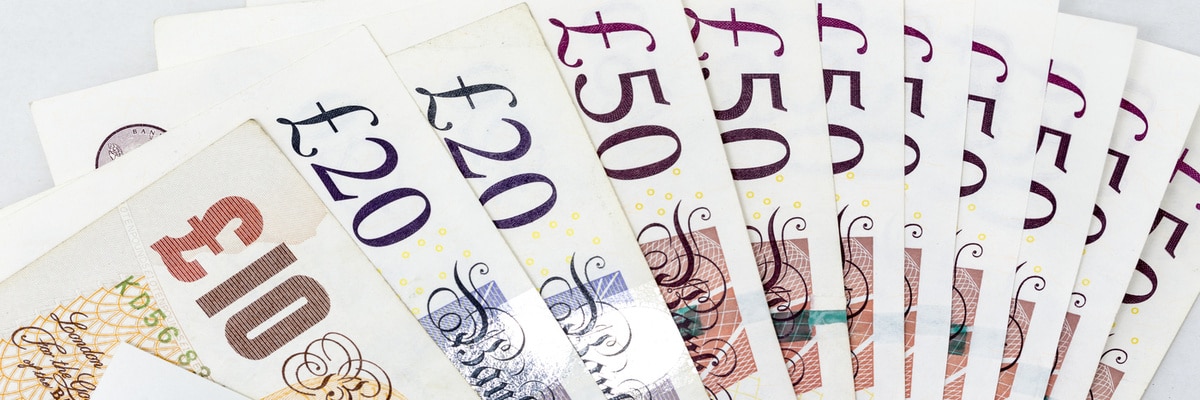
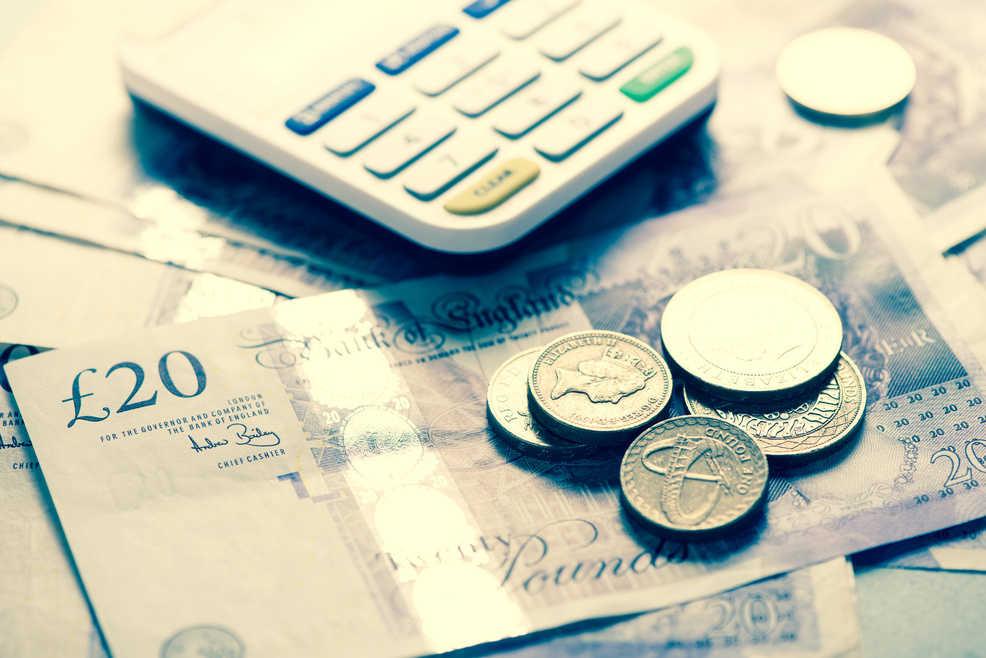
Pounds sterling.
Paying by Card
Card is widely used in the UK and in London
some places are turning card only, so it is essential that you have the ability
to pay by card.
Paying Electronically (Phone, Watches, etc.)
In London, especially, it is becoming
easier to pay for goods or services with your phones. Although they are not universally used yet,
more and merchants are accepting ApplePay or GooglePay, with ApplePay being accepted
at more locations. Both services work
with Visa or MasterCard debit or credit cards.
Having said that, you will still be paying
in pounds so having the right card is essential otherwise you will be charged
an exchange fee.
What About Those Euros?
If you have some Euros, will you be able to
spend them in London? There are two
answers: no and maybe
No. Most shops won’t accept euros. It’s not worth the hassle to them.
Maybe. Large department stores in London will take euros. Harrods, and Selfridges, for example, will. Marks and Spencer even have bureaux de change in its larger stores.
But even if you can get someone to take your euros, you should consider that it is a foreign currency transaction with hidden exchange rates
Smaller stores often have clerks not familiar with taking foreign currency, which will mean more time waiting to pay and less time for exploring
Euro coins will almost never be taken
Your chances of paying with euros outside of London is practically nil unless you’re at the airport.
If you plan to travel to Europe after
leaving London, get Euros once you arrive at your next destination (unless you
want to pay for two exchange rate fees—dollars to pounds, then pounds to
euros). If you are visiting London after a European visit, plan ahead so you
aren’t stuck with euros that you probably won’t be able to use in most of
London.
About coins: coins for larger denominations
are quite common in Europe. You won’t be
able to exchange them when you get back home (but you will be able to exchange
your pounds sterling!). Unless you want
to add them to your coin collection or have them to show off (British money is
quite fascinating), spend them on knick-knacks, exchange them for paper money,
or give them away.
Is British Similar to American Money?
In concept, yes. Pounds sterling, or pounds, are divided into
100 units, just as our dollar. The coins
will look different, but the principle is the same. Anything under a pound is called a penny, as
in 50 pence
Larger coins are more commonly used. If you’re changing is under 5 pounds, expect to receive coins. 1 pound and 2-pound coins are common
Differences in coins are not based solely on size or colour; there are also differences in shapes
There’s a 2 pence coin
You will usually hear British people say “pee” rather than pence, as in 50p (50 pee). More colloquially, a pound is known as a “quid”, a five-pound note is a “fiver” and a ten-pound note a “tenner.”
In appearance, no. Bills larger than a pound—called notes in
London—come in the same denominations you are used to. However, the notes have
many surprising differences.
Size–Not all notes are the same size
Feel–They have a smoother feel than dollars
Security features are more obvious
Colour—not all notes are the same colour
At first British notes take some getting
used to. You might decide to take some home as a souvenir. They are great
conversation starters, especially if you have gathered some friends and want to
talk about your trip.
Money in the Rest of the UK
Just to add a little more confusion to the mix—money in all of the UK is not the same. Both the Bank of Scotland and the Bank of Northern Ireland have their own versions of the pound sterling. They have the same value, but different images for the notes and different engravings on the coins. If you visited either of those places and then head to London, you may encounter some difficulties using them.
It is still a legitimate currency in the UK, but some places can be funny accepting it. To get around this just pop into a bank and they will be able to give you the English version. I tend to find that chain stores will accept the currency with no issues.
Staying Safe with Money
London is considered a safe city by most measures. With any city, there are things you need to be careful of. Here are some things to watch out for:
Pick pocketer which operate
mainly in high tourist areas and crowded trains (tubes) or buses. Be on alert
and ensure your wallet is kept in a place you’ll notice something happening. I
personally like to keep my wallet in secret pocket or in a hard to get place in
your bag, in your front trouser pocket or keep your handbag at the front of
your body.
Try to avoid walking alone at
night in places such as parks and side streets or any unfamiliar environment.
If you do have to walk, stick to busy places where is a lot of activity CCTV
and good lighting.
Of course, any
time you go into a touristy area you risk spending money on things you could
purchase elsewhere for much less.
A Pretravel Checklist
Make sure you have contacted your bank regarding travel dates and locations
Check your cards for expiration dates
Memorise your pin
Adjust your ATM withdrawal limit. You will want to exchange larger amounts if your bank charges a single withdrawal fee.
European ATMs will withdraw funds from your checking account, not your savings account
Ask about fees so you won’t be surprised later
Traveller’s checks will incur extra fees and lines at banks to cash them. Not worth your time
Determining How Much Something Costs
Wonder how much that cup of coffee costs in
American dollars? You can use a currency converter, but why would you use up
your phone data when you can use your head? Since the pound is decimalized,
knowing the currency rate and doing a little mental math will get you to a
close estimate.
Say the currency rate was 1.3 pounds for a dollar. Since the price charged is the price you pay—taxes are calculated in the amount—your 3 quid cup of coffee costs you $3.90. Of course, it was a freshly-made Americano, not something that might have been sitting around for two hours.
Final Thoughts
Hopefully you are travelling to London for pleasure, or at least you are able to add a little pleasure if it is a business trip. If you do some planning ahead, you will be able to limit the extra expenses so that you come home with fond memories, some treasures (who can resist buying something a little extra), and no surprises.
When travelling overseas one of the key questions that always pops up is about whether water is safe to drink. After all, staying hydrated is important, especially when you are travelling.
Is it safe to drink tap water in the
UK? Yes. Tap water in the UK is
rigorously and regularly tested to ensure it is safe for human
consumption. Drinking from taps is
generally considered safe. As a tourist, you need to worry less about water
safety than finding drinking water.
Why UK Tap Water is Safe to Drink
The United Kingdom has some of the most
stringent water standards. A robust testing
and monitoring program which ensures the quality of the water in the UK.
Each of the countries in the UK tests their water independently, and the results have to be published on an annual basis. These results are overwhelmingly positive. For example, in 2014 a total of 3,853,350 water quality tests were carried out. Only 32,427 (or 0.04%) of those tests showed water that did not fully comply with water quality standards, according to a report by the Drinking Water Inspector.
By law, water companies in Great Britain
are required to provide water suitable for drinking, cooking and washing. The
results of those tests are required to be made available for consumers if they
request them.
In addition, the results are published online annually. If you are interested in looking at some of the data, you can find out more about water quality at DiscoverWater.co.uk.
“Water coming from UK taps is the most stringently tested in the world,” said Prof Paul Younger, of Glasgow University.
Great Britain Compares Well Against Other Countries
The Global Data Index is another source that rates water. It lists the UK’s drinking water quality as the 13th best in the world. The index uses data from a variety of testing sources, looking for data on the following chemicals:
Nitrates
Faecal coliform
Fluoride levels
Total Dissolved Solids
Data for each water source
The data is combined and measured against
other countries to come up with a country’s ranking. Great Britain’s water quality is equal to the
United States’ and higher than France’s, Denmark, and Canada, among others.
Drinking Water’s
Sources
Some parts of Great Britain have a
reputation for having “bad” water, especially London and the area around it. Since the water is thoroughly tested, why does
London’s water get such a bad rap?
It’s because of the source of the water.
Most tap water in the southeast of England—where London is located—is groundwater,
which is water that has filtered through underground rocks, gathering minerals. Surface water, which is water from lakes,
pond, and rivers, contains far fewer minerals.
Because of the additional minerals,
groundwater has a taste that many describe as “hard.” Hard water picks up minerals,
especially calcium and magnesium, as it passes through limestone. Water that is purer does not contain those
minerals and is considered “soft.”
What About the Rest of Great Britain?
The further north one travels from London,
the softer the water becomes. The main factor behind this is the trace amounts
of minerals found in surface water. Northern England, Scotland, and, to a
lesser degree, Wales are home to numerous large freshwater lakes, and these
lakes provide much of the drinking water for those areas.
The rainfall that the UK is known for constantly
provides fresh water, which helps the surface water remain fresh instead of
stagnant.
Ensuring Drinking Water is Safe
To ensure the water is safe, water
companies use a complex filtration process. The process is:
Surface water is kept in
reservoirs to help organic matter break down
Then it is filtered to remove
floating objects
Chemicals are added to make
removing silt particles easier
Water is aerated so that gases
like carbon dioxide can be removed
Then organic compounds are
removed so the water is clear
Ozone injection comes next to
break down any pesticides present
Finally, chlorine is added to
kill any bacteria that is still remaining.
Ironically, the taste of chlorine shows up
more in the soft water. The minerals in
hard water cover up the chlorine taste better.
How the British Consume Water
Tappwater surveyed people throughout the UK to find out what they thought about their water. The results show that the further north, the lower the percentage of people who drink get their drinking water primarily from bottled water.
In England, 15% of people drink
mainly bottled water
In Scotland, the percentage is
4%
In Wales, it’s 13%
Northern Ireland has the
highest percentage of 17% choosing to drink bottled water.
The majority of residents in the UK
obviously trust their drinking water, though many purchase a water filter,
through companies such as Tappwater.
Water Advice
Clearly, British water is rigorously
tested, is judged very safe by independent sources and is provided by people
who take their responsibility to provide safe water seriously. As a tourist, however, you might still have
some questions.
Can You Drink Water from Bathroom Taps?
Yes. The water in bathrooms comes from the
same water supply as water in sinks.
Sometimes a public bathroom telling you not to drink the water. If so,
it’s probably because of an uncovered storage tank in either the basement or
attic. If you don’t see a sign and you are thirsty, drink away.
Can I Order Tap Water in Restaurants?
If you are eating out, it is acceptable to
ask for plain water—ask for taps—and they shouldn’t charge you.
What About Warm Water?
Generally, the advice is to avoid drinking
from the hot tap. The reason given is
that hot water coming from a storage tank or water heater might not be as
fresh. Hotels and other public venues are required to indicate which taps (what
the British call faucets) you shouldn’t drink from.
What If the Water is Cloudy?
Sometimes tap water looks cloudy, this isn’t
something to worry about. Air trapped in the pipework or dissolved chalk
particles are usually the cause.
Air Bubbles
If repairs or maintenance work is done by
the water company are done nearby, air can enter the water supply. A pocket of
air can also become trapped in a building’s pipework.
The concentration of thousands of air
bubbles causes the water’s milky appearance. The water will clear in a few
minutes, clearing first in the bottom of the glass. Trapped air can also water
to sputter from the tap. Let the water run for a minute or two and the problem
should “clear” up.
Chalk
Deposits
If you have cloudy water and the water
clears from the top and takes a long time, then you are drinking water with
chalk deposits. Chalk is one of the
natural minerals in groundwater, so you most likely won’t encounter chalky
water unless you are in Southeast England. The water is still safe to drink,
but it certainly won’t be appealing.
Isn’t Bottled Water Safer?
If you are thinking that bottled water will be safer, you might want to keep a few things in mind. There are fewer regulations around bottled water and testing. Bottled water is only mandated to be tested at least once a month, whereas, drinking water must be checked daily before it leaves a pumping station.
Bottled water can contain toxins due to the plastic, even with the move to BPA free bottles you can still find them laced with other chemicals. These can seep out if bottles are exposed to heat or sit around for a long time.
Best Places to Find Free Drinking Water in the UK
The best way to get free drinking water in the UK is using the Refill app or website. The biggest contributor to the scheme is Pret Manger, if you’ve been to the UK before there is no shortage of these stores.
Refill is a campaign that is attempting to
make it easier for people to refill water bottles as a way to cut down on
plastic bottle waste. They sign up businesses that will become “Refill
Stations.”
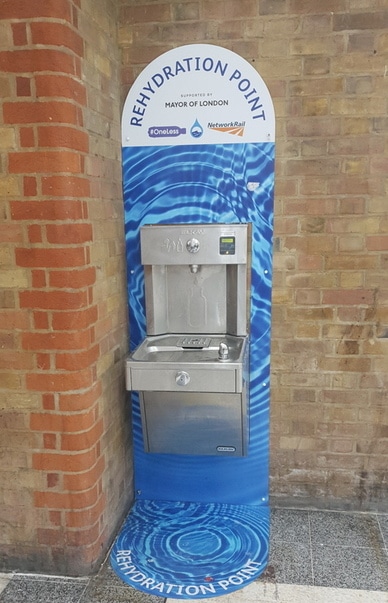
Finding water fountains in the UK is a little
difficult. There are more popping up in train stations and bigger tourists’
areas to help reduce plastic water bottles. If you use the Re-fill app then
this will let you know where the closest fountain or store that you can get
water from
Water Fountain at National Rail Station in the UK
Another great source for finding water is Find-a-Fountain. They are trying to rectify the problem by mapping water fountains throughout London. They even have a free app. Make sure you read the description before you head out to the water fountain. The app will highlight the water fountains in their database are not functioning which is super handy.
Unlike the rest of Europe, tap water is provided and you should never have to pay for water. So ask the pub, café, restaurants, bar or wherever you stop in for a drink or some food if they would kindly fill up your water bottle or check if they have a water station. I’ve never had anyone reject filling up my water bottle so just ask.
What about Water Bottles?
The cost of buying bottled water can add up quickly so unless your preference is drinking bottled water there are other options. There are plenty of free options; I recommend buying a reusable water bottler like the Super Sparrow Stainless Steel Vacuum Insulated Water Bottle (my go-to water bottle). Alternatively, as space is a premium when flying, especially overseas, a collapsible bottle is something to consider. There are many different kinds and styles available, such as this one.
Otherwise, you can buy a plastic bottle when you arrive and continue re-filling. Water bottles can be purchased anywhere.
Purchasing a Filtered Water Bottle
If you have decided that you are going to
fill up a water bottle before you leave your hotel room but are still not
convinced the water will be safe, then consider a filtered water bottle.
The LifeStraw Go Water Filter Bottle is a wonderful example that filters water while you drink it. Perfect for travelling around the UK.
These bottles work on one of two principles:
Some filter the water as you
drink it
While others filter the water
as it is going into the bottle
Both use charcoal as the primary filtering
agent.
Not All Filters Are Created Equal
Some filtered water bottles are designed to remove minerals and chemicals so that the water tastes better. Other bottles have filters that remove bacteria, viruses, and parasites. Read the label carefully. In most cases, the more a filter removes, the more expensive it becomes. You might decide that a trip to the UK doesn’t warrant the same level of filtration as a camping trip or less well-developed countries.
Filters will also need to be replaced. Most bottles list how long their filters last, but some do so by listing gallons (or litres) and others by how the number of cycles. Honestly, there doesn’t seem to be much of a difference how long they last.
Not All Bottles Are Created Equal
Water bottles are made from four different
materials, and each has its benefits and drawbacks.
Material
Benefits
Drawbacks
Aluminium
Lightweight and recyclable
Aluminium changes the taste of water Check the label to see if the manufacturer is using BPA-free plastic as a liner
Glass
No health risk associated with it Easy to keep clean Keeps water tasting fresh
Not good for sports enthusiasts Heavy
Stainless steel
Clean and durable Needs no lining to keep water tasting fresh
Typically the most expensive choice
Plastic
Usually, the least expensive Easy to find
Durability can be an issue Tendency to scratch
Bottle-less Filters
There are also several filters that are water bottle filters. These filters are designed to be used with a variety of bottles. One advantage of these is they are much smaller and lighter, which can be helpful for packing. Another is that these filters can be used with most existing water bottles. Lifestraw is one manufacturer of bottle-less filters.
Water
Bottles and Airport Security
Wondering if you can bring a bottle of water through airport security? The regulations for bringing water from the TSA website state:
Thirsty flyers—Bottled water: You can’t bring a bottle of water through the checkpoint, but you can bring an empty bottle through the checkpoint and then fill it up once you’re through security. That will even save you a few bucks.
To make my process easier through airport security, I always remove my water bottle out of my bag so the security guard can quickly verify my water bottle is empty. I have saved my bag from additional checks so many times by doing this.
Essentially,
Water is Essential
To sum it up, the UK has some of the best water and I recommend bringing a water bottle with you or keep refilling a plastic bottle. Refill will guide you to your closest free water, Pret A Mangers are always nearby or just ask when you’re sitting down for food or a drink if they’d kindly fill your bottle up.
To tip or not to tip is a difficult question, depending on where you are. Tipping is customary – even obligatory – in some parts of the world. And in others, it is downright frowned upon. With no universal standard, tipping is often a source of confusion for travellers around the world.
Is it customary to tip hairdressers and nail salons in London? The answer is mostly yes. While tipping isn’t nearly as common in the United Kingdom as it is in places like the United States, rewarding good service at a salon is generally well-received.
Learning
to tip like a local in London just requires a little research and a touch of
cultural savvy. We’ve done the work for you.
Tipping
protocol can be a virtual etiquette minefield. For instance, tipping in the
U.S. is more than customary – it’s expected. In Italy or France, it may already
be included as part of your bill. In Japan, trying to give a tip might even be
considered rude. The U.K. has its idiosyncrasies when it comes to gratuity.
To
make matters worse, the confusion surrounding tipping doesn’t just occur
because of the differing cultures of countries. There are also varying tipping cultures
between different industries within the same city.
Tipping Guide for London, by Industry
Where
Customary Tip
Cultural Notes
Salon – Hair
10-25%
Generally Expected
Salon – Nails
10%
Not expected, but not uncommon
Spa
Optional
Not expected, somewhat uncommon
Restaurants
10-15%
12.5% gratuity fee charged for large parties
Bars
Optional
Common to leave a few coins
Hotel Bill
10-5%
10-12% fee added to hotel bills
Hotel Staff
Optional
Customary to give a few points per attendee: bell person, room service, maid service
Taxis
10-15%
Common to round up to the nearest pound
Why Tipping Isn’t Always Expected
In some
countries, the reason tipping is routine boils down to this bit of economic
fact: many employers pay sub-par wages to their service and hospitality
workers. It’s built into the industry in some economies. Employers pay these
staff members a low wage, the cost of which is transferred onto the paying
customer.
Not so in the
U.K.
A VisitBritain.comarticle notes: “all staff in the U.K. must be paid at least the National Minimum Wage,” indicating that workers don’t have to rely on their tips to make a living and that employers can’t expect that tips will fill in the gaps of worker’s low wages.
This doesn’t
mean that workers don’t still rely on their tips. Service industry workers still often count on
tips as part of their regular income. And the government realizes this.
A government report on tipping states: “There are some 165,000 businesses in the hospitality, leisure and service sectors where tipping is common… employing some 1.3 million workers,” and adds that “tipping is also an important feature in industries such as hairdressing, casinos and private car hire.”
How Tips Work in a London Salon
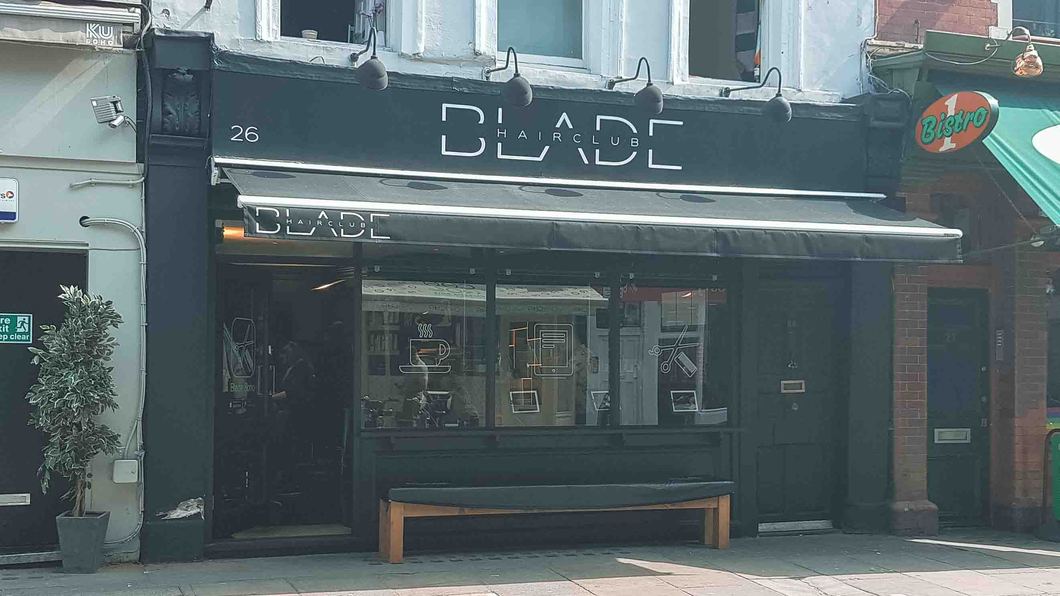
Blade in Soho – one of my favourite salon’s in London.
Tips are part of the culture in the beauty industry in London. But how they work can be as varied as the neighbourhoods of London itself.
How Tips Are Distributed
Not all tips go directly into the pocket of the nail technician or stylist. All salons are different. Some may pool the tips together in a ‘tronc’ to be divided out by a ‘tronc master’ on a certain schedule. Others may be collected by a salon owner and distributed evenly, or by some predetermined formula.
A tipping policy
might be posted right in clear view on the wall of the salon, or you may want
to ask the stylist, client service staff or salon management directly. But if
that feels awkward and you really want to know what happens to your tip, there
are other ways to find out.
The British
government thinks
all consumers have a right to know where their tip goes. They have published a voluntary
code of conduct which states, among other things, how tips should be split,
how consumers find out, and whether cash and card tips are treated differently.
Places to find
more information on the code of contact, and how stylists feel about it are:
As a general
rule, a cash tip is a preferred way to reward stellar service. Many
salon tipping policies allow staff to keep cash tips directly, but some require
electronic tips to be evenly distributed among staff. For high-performing
stylists and technicians, those who might create the lion’s share of the tips
in that pool, equal division among all players don’t serve them well.
If you don’t feel
like reading through government paperwork, the clear answer is: tip your
stylist or nail technician cash. Assume that most salon workers and owners will
appreciate it. Some salons don’t want the additional paperwork and even insist
gratuities are paid in cash. Expect such policies to be posted, if they exist.
Or ask the staff of the client service desk what is customary.
Does a Stylist or Nail Technician Have to Report Tips?
Of course. All employees in tipped positions in the U.K. are legally mandated to report tips and pay taxes on them. Here again, the British government is crystal clear on how this gets done, stating that a worker must pay Income Tax on any tips received, and, in some cases, make an additional National Insurance contribution as well.
Whether or not a tipped employee pays the additional tax depends on two
things:
Whom the tip is given to
Who decides how the tips are doled out
While
the full details of tipping and taxation are available online, this isn’t your
concern. At the end of the day, it’s the salon employees and owner who need to
worry about tax-related responsibilities. However, it may be nice to know that
the tips taxed the least are those that are paid in cash, directly to the
employee:
Who to Tip and How Much
The basic rule for tipping in salons is
this: if you are happy, it’s nice to show your gratitude with a tip.
Salons are a place of pampering and the end results are intended to make us
feel good about ourselves. And whatever process we’re there for – there is
often more than one person taking care of us in a salon.
If you would like to reward the junior
stylist who gives you a great head massage during the shampoo or the stylist
who lets you come in for a quick, free bang-trim, here’s some tipping
guidelines that can help lead the way.
Salon-Specific Jobs and How to Tip
Hair Stylist, Hair Colorist
15-20% of service
Nail Technician
10%
Corrective Hair Color
20% (even if it’s a complimentary redo)
Complimentary Bang Trim
15-20% of the cost of a haircut
Shampoo Person
Under £5
Blow Dry Person
About £5
Salon Owner
15-20%
Tips and Tricks for Tipping in Certain Situations
There may be times a salon visit doesn’t go
quite right. You may not feel like making an additional display of gratitude
and satisfaction. However, it is usually just polite to leave a tip: just as a
gesture of good faith.
Your result is a disappointment. Talk to
the manager or owner. They’ll want to know if you’re not happy and they’ll
often refund the cost of your service or deliver a complimentary re-do. Tipping
the stylist is not mandatory, of course, but it is a good idea. Especially
if you’d like to develop or maintain a relationship at the salon
The owner styles your hair. It used to be customary to skip the tip if the owner styled your hair. Owners often charged higher rates for their services and that was “payment enough.” The general belief was that an owner/stylist would be offended at the offer of a tip. Not so anymore. Whomever your stylist is, if you are happy with the results, a tip is a welcome gesture!
Planning a trip to London can be difficult with weighing up all the factors!
From deciding whether your wallet can fund the trip, best places to stay, what
London sights to see and how much time you need to explore them.
How many days do you need in London? Ideally, three to four is the most common amount of time tourist spend in London. If your budget and time allow it then you can easily be entertained for a week or more!
At the end of the day, there are no right or wrong answers! On my first trip to London, I spent 1 day and then 3 days at the end of my trip. After that, I packed my bags and moved over. I loved the city that much I thought I could make it my home.
To help you decide how long you need in London with some of the best
tips for visiting from a local, this article will help you plan your trip
to London and give you a feel for how long you should spend here.
How Many Days Do You Need to See London?
I’ve broken the decision down into 5 areas, your budget, what
you are most interested in, day trips from London, pace and distance of
activities.
1# Deciding Based on Your Budget
London is an
expensive city so if you’re on a budget it can impact the time you will be able
to spend here. Luckily there are affordable options
like hostels, London is spoilt with free museums, incredible
parks and lots of events that pop up around the city.
However, the cost of attractions and food can
kill your budget. I’ll give you a rough estimate of food, accommodation,
attractions and transport to get you started on how long you can afford to
be in London.
The minimum I would bring is £60 per day,
this will get you:
A bed in a hostel (generally at this price you’re expecting to share with 8-bed dorm) for £20
For food, meal deals, markets and cooking in the hostel for £10 to £20
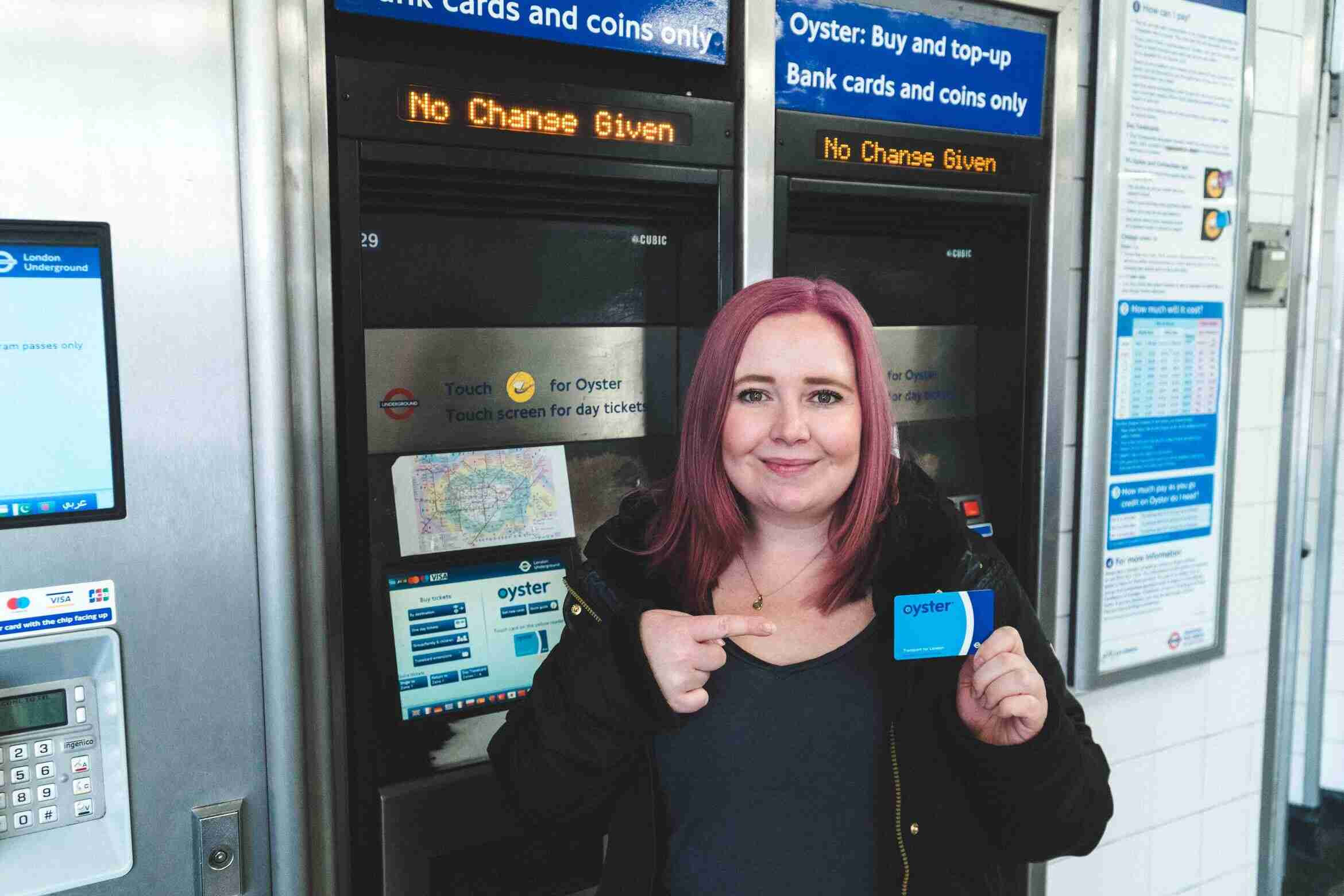
Daily Oyster (Zone 1 to 2) £9
Midrange:
A low to midrange hotel for £80 to £150
Everyday restaurants £20 to £40+
London sightseeing activities £30+
Daily Oyster (Zone 1 to 2) £9
Splurging in London:
Four-star or boutique hotel room for £200+
Dinner at London’s finest restaurants £80+ per
person
Good theatre tickets £100+
Taxi’s around £30+
Budget Saving Tips for London
Before you head to the sights and pay for entry have a look
at:
Days Out Guide
Days Out Guide is great if you’re two people travelling together or you make some friends along the way as they offer 2for1 deals on London attractions. Just make sure you buy aNational Rail ticket (Oyster and TFL tickets don’t count) and get the vouchers (either print online or get one at a National Rail station).
Visit London Oyster Card
Visit London Oyster card, you can get tourist
discounts for various sights. Go to the Visit Britain shop for more
details.
The London Pass
The London Pass is a popular choice as it has access to over 80+ London attractions. Make sure when you are planning your days you will be able to get the most out of this. When you purchase you simply choose how many days you would like, active the card within a year (i.e. your travel date) and show it at the venue.
Railcards are great for travelling around the UK, they
offer you up to 1/3 off ticket prices. You can also connect it to your
oyster card and automatically save on National Rail journeys like to Gatwick
Airport.
Check for last minute theatre tickets if you’ve not purchased in advance. There are a couple of sites to look at but the most popular is TKTS London.
2# How Long To Spend In London Based On The Things You Are Interested In
If it’s your first time in London it can be so easy to have a jammed packed itinerary, but I would only choose two to three main things a day to give you time to relax. Start by writing down all the things you want to see in London so you can plan how much time and money you will need.
London is a big city so there is no way that you will
be able to see everything in a couple of days, after all I have been living
here for 7 years and still exploring corners of this city.
A couple of questions to get you started:
Do you love museums and art? It could easily take you days to explore the museums and galleries.
Love markets? Then you should tailor your time in London to the weekends.
Want to see London’s iconic landmarks? Then you could see the outside in a day but exploring inside can add half a day per landmark.
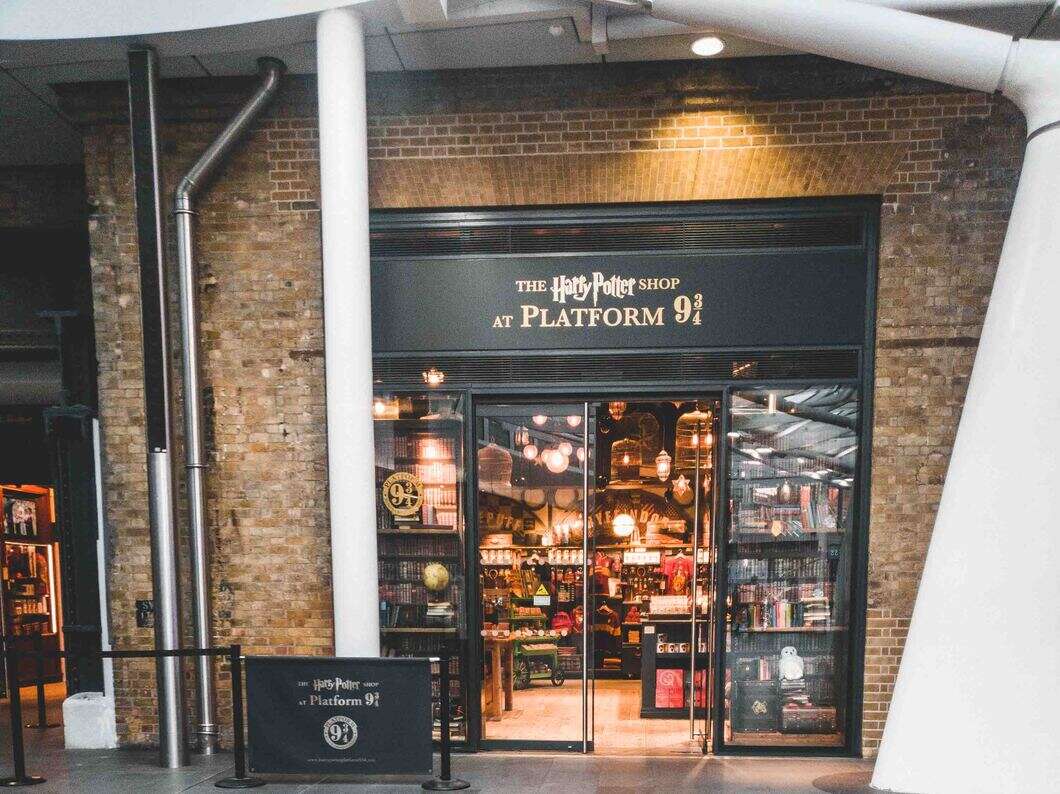
Love Harry Potter? The studio will take you a day and if you want to watch the play this runs over two nights or a whole day.
Enjoy day trips? These add days on to your itinerary.
Like Theatres? This can easily add a couple of extra nights.
As you can see the must-do list will easily affect how much time you
need. Do allow for some spontaneity as a jammed pack to-do list
means you won’t be able to discover London’s hidden gems.
Here are some London guides to get those idea’s flowing!
London has great transport options which means day trips can easily be squeezed in as they are a short train ride or bus trip away.
It’s a nice way to see more of England without moving your belongings and finding another hotel.
Here are some London day trip options:
Stonehenge Day Trip
Stonehenge and Bath are a common day trip that you can take. Bath is an
absolutely beautiful place to visit so well worth getting this added to your
day trip. You will be able to explore the Roman Baths, the Abbey and Jane
Austen Centre.
Stonehenge is a little more difficult to get to by public transport and I would recommend a tour for this one. Get Your Guide has serval tour options available like this one Stonehenge Half-Day Morning or Afternoon Tour.
Windsor
The Royal residence of the Queen and where Harry and Meghan got married.
It’s the perfect day trip by train from Paddington station.
Cambridge
Most of us have heard about Cambridge from its prestigious university colleges
and regatta on the Thames between Cambridge and Oxford. Visit the prestigious
colleges like King’s College, Trinity College and St John’s College, go punting
and visit The Eagle pub while you are in Cambridge.
Oxford
The rival to Cambridge and just as many incredible looking colleges!
Also, Lewis Carroll started Alice in Wonderland there which is my favourite
tale. J.R.R. Tolkien who wrote Lord of the Rings studied at Oxford.
Paris
St. Pancras offers frequent trains to Paris by Eurostar, when my cousin
was over, she popped over to Paris for a French cooking class for the day. A
little extravagant but totally doable!
Brussels
Belgium is probably best known for its beer, waffles, pomme frites and
chocolate. It’s a perfect day trip from St Pancras on the Eurostar. If you want
to know more about I’ve got you covered in my Brussels in a Day Trip.
The
Cotswolds
The Cotswolds is famous for the pretty houses in golden stone, ancient woodlands and wildflower meadows.
It’s a little harder to get public transport here as it’s the Cotswolds in a set of villages. Here are some tours I recommend to visit the area:
Most famous for being the birthplace of William Shakespeare, explore
where he was born and grew up.
Brighton
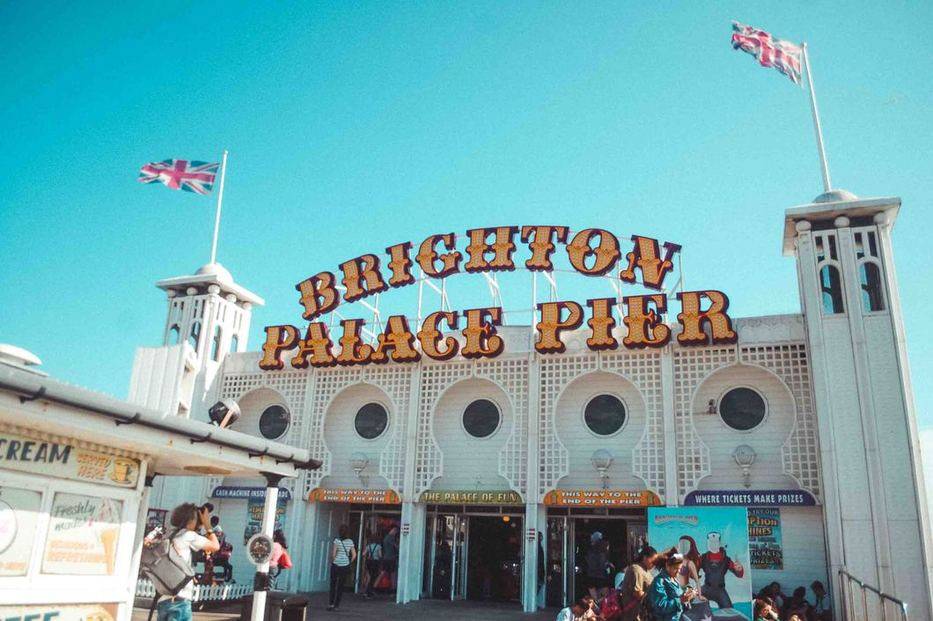
A seaside town, on a summer’s day watch all the Londoners flock to the
beach. Visit the famous Brighton Pier, pick up some doughnuts and sit on the
beach enjoying the view. Be careful of the seagulls, they are pretty confident
and have stolen my doughnuts before!
4# Deciding on How Long to Spend Based on
Your Pace
An important part of itinerary planning is your pace. London is really easy to get around by walking and has an excellent public transport network. Sometimes public transport can take longer than actually walking (check out this walking tube map)! Plus you save on transport costs.
When thinking about your pace, consider some of these questions in your
planning:
Are you someone that just likes to see the outside of an attraction or do you like to spend a lot of time exploring the attraction?
Do you like to walk slow or fast?
Like to find cute coffee shops or grab a beer?
Do you like to take public transport or prefer to walk?
An injury that might impact you?
When I travel, I love to walk as much as possible and stop for food and
drinks along the way. I walk at a medium pace and due to my knee injury, I know
I can’t walk more than 2-3 hours in a row, then after 15km, I struggle to walk.
Also, the stairs are a killer! There are only so many tall buildings,
cathedrals and monuments in a day. Knowing your strengths and weakness, all
help in what to factor in your travel planning.
5# Consider the Distance
It’s a good idea to stay somewhere within close proximity to London attractions and activities. This gives you the edge of being able to see things more easily than travelling into London every day.
London is made up of different areas which can sometimes feel like a
collection of villages. A few areas to consider staying in:
South Kensington for the museums and
close to Kensington Gardens and Hyde Park.
Soho is an area forming
part of London’s West End and has loads of bars, restaurants and very central
location.
Shoreditch is east of the
city and one of the cooler areas to stay. You will be able to discover some of
the great coffee shops, famous street art, some of the best markets.
Bermondsey & London Bridge is the
perfect place to stay if you love to discover new street-food, craft beer and
gin and close to attractions like Tate Modern, Tower Bridge and the Tower of
London.
South Bank and Waterloo are very
central to all the main site in London and a fantastic location for the
sightseeing orientated visitor.
Additionally, you want to consider the distance between the
activities you choose to do.
For example, walking from the west (say the Natural History
Museum) to the East (so Tower of London) can easily take an hour and
forty minutes. It’s a popular route for people visiting to take as you pass
by all the sights.
If you only have a limited amount of time these distances can
affect what you can fit in. Whereas taking the tube will be around 30
minutes saving you and providing an hour more to explore inside these buildings.
I recommend downloading the City Mapper app to help you decide
whether walking, tube or bus is a better option (p.s. they recommend step-free
routes as well!). When considering the distance, if it says that the route is
12 minutes on the tube but 15 minutes to walk then I would opt to walk.
More London Articles
Want to know more
about London and practical information to make the most out of your trip? Then
I have more resources to get you ready for your trip here!
Taking home something you can only buy in London means your trip keeps giving long after you’ve unpacked.
Some of it’s beautiful, some of it’s genuinely useful, and a few things are just delicious.
I’ve pulled together a list that covers every budget, from a stuffed Paddington Bear to a full Fortnum’s hamper.
Here’s a list of the top London Gifts and Souvenirs!
1. An Umbrella from the James
Smith & Sons
An Umbrella from the James Smith & Sons
England is famous for its drizzle, so it makes sense there’s a shop dedicated entirely to umbrellas. James Smith & Sons has been selling them since 1830, out of an original Victorian shop near Tottenham Court Road and Holborn tube stations.
They still use traditional methods to build these long-lasting umbrellas. My two picks:
Fortnum & Mason has played a huge part in London’s history since it opened in 1707, originally selling on Queen Anne’s half-used candle wax for a profit before turning into the grocery store, then department store, it is today.
Hampers can be large, and bringing one home depends on your luggage space and how tempted you are. Their tea hampers are always my go-to gift, but browse their latest hamper selection here for the full range.
For a special occasion you can customise one too. A friend did this for my 30th birthday and it’s still one of the best gifts I’ve had.
3. Tea Whittard and Twinings
Tea from Whittard
The English love their tea, and there’s no more classic souvenir than this. Whittard and Twinings are the brands I’d recommend.
From traditional British tea to an assortment of flavours, there’s something for everyone. Not a tea person? Whittard also does incredible hot chocolate, perfect for a cold winter night.
Their shops are scattered around London and the tea itself is lightweight and easy to pack.
4. Pick Up Some Biscuits to Go with Your Tea!
The Brits love a good biscuit with their cuppa, and you can grab the classics cheap. The best packets to pick up:
Custard Creams
Digestives
Jammie Dodgers
Jaffa Cakes
Head to any supermarket, Tesco, Sainsbury’s, Marks and Spencer or Waitrose, and you’ll find plenty of stock.
5. An Oyster Card
Chances are you’ll end up buying one anyway while you’re in London, which makes it a great souvenir, iconic to the city and genuinely useful. That said, most Londoners now just tap in with a contactless bank card or phone rather than buying a physical card. An Oyster card’s shifted from “necessity” to “nice memento” because of it. It’s a flat, non-refundable fee rather than a deposit these days, worth knowing before you buy one purely as a keepsake.
Go to the Visit Britain shop to pick up a visitor’s Oyster card before you travel, or just grab one when you land.
6. A House of Commons Notebook
At the Houses of Parliament shop you can buy branded items with the official UK Government stamp. As someone who loves a good bullet journal, this is a genuinely cool souvenir. You can buy online, but there’s a good chance you’ll walk right past while visiting Big Ben anyway.
7. A Hat from Lock & Co.
Lock & Co is the oldest hat shop in the world, and it wears that history well. It’s said Lewis Carroll based the Mad Hatter on the shop’s manager.
“You can draw water out of a water-well,” said the Hatter, “so I should think you could draw treacle out of a treacle-well, eh, stupid?”
Alice in Wonderland
Heading to Paris after London? Grab a stylish beret from Lock & Co. On a tighter budget, the canvas bag or Lock keyring makes a perfect London souvenir.
8. Potter Merchandise
Potter Merchandise at Platform 9 3/4
Head to King’s Cross Station, find Platform 9¾, and you’ll magically be swept through the barriers to the Hogwarts Express. Step into Ollivanders to choose your wand, or pick up some school uniform along the way.
Primark is another solid spot for Potter merch at a cheaper price point. And if you’ve got extra time, Warner Bros. Studio Tour London (the Making of Harry Potter) is where you’ll find every souvenir your heart desires.
9. London’s Print: Cath Kidston
Cath Kidston is a quintessentially British lifestyle brand. Their iconic prints are stocked in 16+ countries now, but buying one in London just feels more authentic. Cath Kidston does some cute luggage accessories, and my favourite pick is this luggage tag.
10. Authentic English Souvenirs – Mind the Gap, Union Flag, Big Ben or The
Buckingham Palace
The classics: anything featuring Mind the Gap, the Union Flag, Big Ben or Buckingham Palace. Central London is full of shops selling exactly this. A few ideas:
Buckingham Palace has an official gift shop with a huge range of palace-themed gifts, including a Cuddly Corgi, the breed Queen Elizabeth II famously kept for decades and remains closely associated with the Royal Family.
Mind the Gap or Transport for London
The second you arrive you’ll hear the tube announcer say “mind the gap” between the platform and train. It’s pure London, and you can pick up souvenirs featuring the phrase easily. The London Transport Museum shop is also worth a browse for transport-themed gifts.
Big Ben’s restoration wrapped up back in 2022, so the tower’s fully visible again and back to bonging on the hour, its clock faces restored to their original Victorian blue and gold. Get your iconic photo, then bring a bit of it home with this pop of colour from Embarcadero Prints.
11. Benjamin Pollock’s Toy Shop
Benjamin Pollock’s Toy Shop
Benjamin Pollock’s is a traditional British toy shop in Covent Garden. Don’t expect anything kids play with today, think retro toy theatres and shadow boxes instead.
As an Alice in Wonderland fan, I love their shadow boxes. They take a bit of assembling, but that’s half the fun.
12. Museum Merchandise
Natural History Museum Merchandise
Museum gift shops always have the predictable stuff, but also some genuinely cool finds. My favourite is the Wildlife Photographer of the Year merchandise: the photos make incredible prints, and you’ll find them at the Natural History Museum.
The British Museum and the V&A also run limited-edition pieces tied to current exhibits, worth checking whatever’s on while you’re there.
13. London Gin
London Jensen’s Gin box.
Londoners love their gin, and a bottle from a micro-distillery makes a proper souvenir. Some are right in the heart of the city, others a bit further out:
Craft Beer at Crate Brewery in Hackney Wick London
London’s craft beer scene is genuinely great. Not the easiest souvenir if your luggage’s already tight, but worth stocking up on a few bottles if you’ve got the room. Some favourites live along the Bermondsey Beer Mile, plus Gipsy Hill, Southey, Beavertown and Camden.
Want to dig deeper into the scene? Add the Bermondsey Beer Mile to your London to-do list.
15. Fabric from Liberty of London
Liberty opened its doors in 1875 and has been a London institution ever since, famous for fashion, interiors, luxury goods and its own in-house fabrics and textiles.
If you love sewing or quilting, this is heaven. Buy some of their famous fabrics for a dress, skirt, top, or a beautiful addition to a quilt.
16. Beatles Memorabilia
The Beatles weren’t from London, but one of their most iconic album covers was shot on Abbey Road in St John’s Wood. Near Baker Street Station you’ll find the London Beatles Store, selling everything from postcards to original tour programmes.
17. Vintage knick-knacks from Portobello Road
Market
Head to Portobello Road Market in Notting Hill for antique glass, cutlery and old books. Saturday’s the big day for the full market and its famous antiques stalls, Friday’s the quieter second-best option, and Sunday’s mostly closed outside of seasonal markets, so plan around that.
It’s not just a shopping trip either, it’s genuinely one of the most iconic things to do in London full stop.
18. Bulbs or Seeds
Flowers from Columbia Road Flower Market
Columbia Road Flower Market is one of my favourite weekend mColumbia Road Flower Market is one of my favourite weekend markets. Head there on a Sunday and wander through the flowers and plants, a tradition that’s been running since the 1800s.
You’re probably not taking a full plant home, so bulbs or seeds are the next best thing, and they come with a story attached. Just double-check your home country allows plant imports first; Australia, for one, will confiscate them.
Even without buying anything, Columbia Road is a gorgeous Sunday out, and consistently one of the prettiest of London’s Sunday markets.
Not scarfs but it is Arsenal Football Stadium! It’s as close as I will get to a souvenir.
A scarf from a famous team like Liverpool, Manchester United, Manchester City, Arsenal or Chelsea makes a proper gift. Visit the club shops directly, Arsenal and Chelsea are both London-based, or hit one of the souvenir shops on New Oxford Street or around Piccadilly Circus.
20. Penhaligons Perfumes & Colognes
Penhaligon’s is a British perfume house with beautiful gift sets for both men and women, ideal if you’re travelling with hand luggage only.
They’ve got boutiques across town, or shop online if you can’t get to one in person. My top picks:
Molton Brown is the fancy stuff you actually want in your stocking, a proper step up from the everyday hand wash and moisturiser you’d normally grab.
They’ve built a reputation as a luxury bath, body and beauty specialist, and you’ll find their products in five-star hotels and department stores across the country, including a boutique at Heathrow if you’re short on time before your flight.
As someone who loves travelling light, I love their refined wanderer drawstring travel pouch for hand luggage. To cut down on plastic, I keep the little bottles and refill them with other toiletries later.
22. Pimm’s No 1 Cup
Pimm’s is the drink of British summer, you’ll find it on nearly every menu. A classic Pimm’s Cup is Sprite, strawberries, orange, apple, cucumber and mint, though you’ll also find versions with champagne, prosecco or extra spirits mixed in. I prefer soda water over Sprite if you struggle with sweetness like I do.
Impress your friends back home with a bottle and whip up some summery London cocktails once you’re there.
There are other Pimm’s flavours out now, but Pimm’s No. 1 is the classic and the one I’d recommend trying first. You’ll find it at any supermarket or duty-free.
23. Paddington Bear
Kat and Paddington Bear
Paddington Bear is as iconic to London as it gets, and a perfect gift for kids. Drop by the Paddington Bear shop at Paddington Station for stuffed toys, key rings, mugs, T-shirts and the books themselves.
For a free souvenir, head to Platform 1 and pose for a selfie with the bronze Paddington statue under the clock, right near where the Brown family first found him in the books.
24. London Christmas Ornament
If you’re in London around Christmas, which is genuinely magical, stop by a market stall or department store and pick up a classic icon: Big Ben, a red phone box, the Underground roundel, or a London bus.
London runs on afternoon tea. Why not recreate it at home with a proper tea set? A few places worth checking:
Harrods, for high-quality designer teapots
John Lewis, for well-designed teapots at a more affordable price
Any of the tea shops, like Whittard’s
Museums also sell unique tea sets if you want something a bit more unexpected.
26. Arts and Crafts
I love filling my house with art and crafts, and Backyard Market in Shoreditch is where I’ve picked up some real favourites, including several pieces from UK artist Alice Tam, whose cute prints and Birds in Hats collection I’m obsessed with.
Stalls rotate, and you’re not guaranteed the same artists every visit, which is half the fun. Crafty Fox Market is another favourite of mine; they move locations regularly, worth checking their site for current dates before you go.
Map of Store Mentioned
To make shopping easier, I’ve mapped every store above with an icon to match.
This is just a selection of things you can only buy in London. Let me know in the comments what you picked up, or any other unique finds worth adding to the list. Want more? I’ve got a whole list for England too.
Hyde
Park is one of London’s biggest and most beautiful parks in the city. On a
sunny day, Londoners will flock to the park to enjoy picnics, drinks, brisk
walks, boot camps and some fresh air – but is cycling allowed in Hyde Park?
Hyde Park is friendlier to
cyclists than the other Royal Parks around. There are a number of designated
routes you can take and is ideal for an early morning wake-up ride between April and
September. Being flat it makes it an easy ride!
Getting to Hyde Park
With the park being in Central London it’s super
easy to get public transport here. I wouldn’t recommend driving to the park as
central London traffic and parking can be a nightmare.
Hyde Park Corner, Knightsbridge, Queensway and
Marble Arch are all good options to arrive by tube. Don’t forget to check the
map at the bottom of the article as it will guide you where the closest bicycle
hire is.
Where to Rent a Bicycle
Santander Bicycle Station in Hyde Park
London has a public bicycle
renting scheme, nicknamed Boris bikes and run by Santander. The bicycles are
named after Boris Johnson who was the Mayor of London and brought the bicycles
to the city. You will find cycle docking stations in the immediate vicinity of
Hyde Park.
You pay £2 when you first get the bicycle out of the docking station and then £2 every 30 minutes you rent the bicycle. You can find a breakdown of how Santander bicycles work, here.
A bicycle can be found:
North
Carriage Road near Speakers Corner – the two near here I can’t confirm what
type of bicycle hire they are. I’ve included them as they are on the Royal
Parks map.
West
Carriage Road near Serpentine Sackler Gallery
West
Carriage Road near Princess Diana Memorial Fountain
South
Carriage Road near Marble Arch Station
Queensway
Station – Notting Hill Bike Tours (they offer private hire of their bicycles).
The Royal Parks provide a map of all the cycle hire stations, or the TFL website shows all the available bicycles plus docking spots and I’ve included a map below so you can find the hire stations.
There is an app you can
download as well for Santander which will give you up-to-date information on
whether there are bicycles available or docks available to park the bikes.
I’ve searched the internet high and low and not found a place you can get child seats for babies. The closest is London Recumbents in Battersea. If you find anywhere let me know in the comments below!
Taking Your Own Bicycle to Hyde Park
Taking your bicycle on public transport can be complicated, however, if you are planning to travel on weekends and non-peak times it’s generally fine. You can find the guidelines on taking your bicycle on public transport on TFL and National Rail website.
Where to Park Your Bicycle
Hyde Park has parking spaces
for bicycles these can be found:
West
Carriage Road near Serpentine Sackler Gallery
West
Carriage Road near Princess Diana Memorial Fountain
South
Carriage Road near Will to Win Hyde Park Sport Centre
Royal parks provide a map of the spaces here or you can look on the map I’ve provided below.
Designated Cycle Routes
The Royal Parks have designated cycle routes and covers the main paths in Hyde Park. If you do want to explore a little more you will need to park your bicycle before doing so.
The basic circular route is about 2.5 miles (or 4km), if you’re cycling for exercise then this won’t take longer than 20 minutes (although you need to avoid all the people on the path). If you’re planning to take in the sights around the park then I would allow an hour.
Things to See in Hyde Park
With several cycling routes
taking you through Hyde Park there are lots of things to do and see on your
visit. Whether you prefer to keep cycling on or stop to take in some of the
attractions there are so many reasons to stay.
Signs on where to go in Hype Park
Speakers’ Corner
Starting back in the
mid-1800’s Speakers’ Corner has been a place for public speeches and debates.
The park has hosted some famous people during its time like Karl Marx, Vladimir
Lenin and George Orwell. Speaker’s corner is busy on the weekends, see if you can catch a few
speeches!
The Serpentine Galleries
The Serpentine Galleries are free to the
public and are located on either side of the Serpentine in the grounds of
Kensington Gardens. Featuring contemporary art pieces, some that have been
featured in the galleries are Man Ray, Andy Warhol, Henry Moore and Damien
Hirst. It’s quite a popular tourist attraction in the park hosting over a
million visitors a year.
Memorials, fountains and statues
In the park there are easily
20 statues you can visit, here are a few to consider:
Diana
Memorial Fountain – In memory of Princess Diana, the Memorial is
meant symbolise Diana’s quality and openness. The fountain has three
bridges where you can cross the water and go right to the heart of the
fountain.
Serenity
– Made by British sculptor Simon Gudgeon the artist was is inspired by the
Egyptian goddess of nature to create this bird bronze statue.
7
July Memorial – In honour of the victims during the 2005 London
bombing.
Holocaust
Memorial – The first memorial in Britain to remember the victims of the
Holocaust. It’s a garden of boulders surrounded by white-stemmed birch trees.
The Duke of Wellington Museum: Apsley House
The first Duke of Wellington
bought Apsley House after he was victorious at Waterloo. Now it is a museum run
by Victoria and Albert Museum, the museum hosts a magnificent collection of
paintings which include pieces like Velázquez’s “Waterseller of Seville”.
The Rose Garden
As the name alludes to, it’s
a beautiful rose garden with other seasonal flowers incorporated into the
beds.
Hyde Park doesn’t have speed
limits for cyclists so you won’t be penalised for speeding. As pedestrians have
priority within the park for safety, it’s recommended that your speed is no
more than 12mph (19kmph).
Keep to Cycle Tracks
Ensure you keep to the park
roads and cycle tracks when enjoying your ride in the park. The park staff can
fine you on the spot £60 if you don’t comply,
unless you have evidence that someone’s messed up the
cycling permitted signs (erroneously or maliciously) on the path where you were
stopped.
Are Helmets Need?
In Western Australia wearing
a helmet is mandatory when cycling so I thought UK Law would be the same,
however, they don’t require you to wear helmets. It’s a totally optional thing
to do here. If you want to wear a helmet you either have to bring your own
helmet or can rent one from the bike shop.
There is less risk when
riding in parks that a car is going to hit you but having a helmet, in general,
will provide you with more protection.
Facilities in Hyde Park
Stop for Drinks and Food in Hyde Park
Water Fountains
As someone
that loves to cut down on my plastic use and carry my water bottle around with
me everywhere, having free water available is important! There are only three
water fountains which are available in the park, which are highlighted in the
pdf map or the google map I’ve included. With the
limited fountains make sure you note these down as a stop on your ride to
refill and rehydrate.
You will find several
refreshment points if you wish to buy bottled water or other drinks.
Food
Hyde Park is a fantastic place
for a picnic if you have a chance to bring along a
picnic blanket and food. You’re also allowed to drink alcohol in the parks so
if you feel like having a beer or wine with your food that’s totally fine.
Barbecues are
not allowed to be used so unfortunately you’ll have
to skip on that sausage sizzle.
Refreshment points are
located around the park and offer quick refreshments like coffee, ice cream,
snacks and sandwiches. You can also stop by one of the cafes and grab some hot
refreshments, like:
Serpentine Bar and Kitchen
The Serpentine Bar and
Kitchen serves hot meals and snacks, freshly prepared sandwiches and salads,
cakes and drinks.
Lido Café and Bar
Lido Cafe has a large outside
dining area with views along The Serpentine. The perfect place to take a rest
from cycling and do some people watching.
Toilets
Toilet facilities can be
found in Hyde Park, some of them are free and some require you to have 20 pence
available to pay. It’s good to carry some coins around just in case.
The toilets available in the
park:
Serpentine
Bar and Kitchen
Lido
toilets
Tennis
Pavilion
Bandstand
(costs 20p)
Reservoir
(costs 20p)
Map of the toilets can be found here and some highlighted on the map below.
Map of Hyde Park with Facilities
Other Cycling Destinations in Europe
If you love a cycling holiday, then I recommend Amsterdam! If you plan to visit Amsterdam you must check out my friend’s blog. Rafal has been living in Amsterdam giving fantastic tips on the city.
A Guide to Cycling in Hyde Park (With a Handy Map). This guide is perfect for people wanting to know how to cycle in London’s Hyde Park, facilities available and things to do in Hyde Park. #hydepark #london #cyclinglondon #england #UK
With London being such a big bustling city, it is understandable to want to book ahead so you enjoy your time here. You’re probably wondering if you will get into the popular attractions like the London Eye, Tower of London, London Dungeon, St Paul’s Cathedral, London Bridge Experience and Tombs, and Westminster Abbey without a booking.
Do you really need to book ahead to enjoy London? Potentially but this is dependent on the type sights, restaurant, event and things you want to do. In this guide, I will cover how to look out for discounts before you book, what you should book in advance and what you don’t need to book.
Check Potential Discounts Before Booking
We all like to save a bit of
money when on holiday. Before you head to an attraction, restaurant or anything
in London check whether there is a discount available.
Days Out Guide
Days Out Guide is a great way to save money in London. It offers 2 for 1 price for London attractions. To be able to use the deal you need to book the vouchers online or visit a rail station for the voucher (it needs to be a physical copy) and have a National Rail ticket for each person. I’ve used 2 for 1 on the Tower of London before which save my mum and I £15 each on our entry.
The London Pass
The London Pass has a list of sights you can enter once you have paid for the pass and often with fast track entry. They cover an impressive 60+ attractions including the Tower of London, Westminster Abbey, London Bridge Experience and the Thames River Cruise. It’s key to plan out your days you have the London Pass so you can get the total benefit.
Groupon
Groupon will have quite a few deals for restaurants and cafes for the week. It’s not uncommon to see a Michelin Star restaurant offering a Groupon deal. The times are normal weekdays but if you are visiting during the week it’s such a great way to grab a deal for your holiday.
Buying Tickets Online
Booking in advance can
sometimes save you a few pounds. I mentioned in the Days Out Guide section you
can get into the Tower of London under 2 for 1 but if it is
the high season this option isn’t normally available. Instead of buying at the
door for £25 you can buy an adult ticket online for £22.70.
This is also true of train
tickets, some train companies do add discounts to their own websites. For
example, a train company may offer a discount for booking on their website
which others cannot provide the same ticket. It is more an incentive to get
people booking with the train operator they are travelling with and away from
the competition.
What You Should Book in Advance in London
Train Tickets
When to book: 12 weeks in advance before
you plan to travel.
Planning on leaving London or
taking a day trip? Booking train tickets in advance will save you a ton of
money. There are different types of tickets that you can buy:
Advance (where you can save the most money) – With the advance tickets, you need to travel at the exact time and on the train stated on the ticket.
Off Peak – cheaper tickets than any time and allow you to travel any time off-peak. There may be restrictions on routes so double check beforehand.
Anytime – this ticket gives you the ability to travel anytime and will be the most expensive ticket available.
Group tickets – if there is more of you travelling and these can be cheaper than the advance ticket.
The
tickets will be available in standard and first class. For any short trips like
Cambridge, Oxford and Brighton I would suggest not buying first class as it
doesn’t give you any added value and going with the standard. If you are
travelling to Birmingham, York, Leeds and Manchester and have the cash to
splurge on first class then it’s totally worth it. P.s. sometimes you can get
upgrades on the weekend for £10+.
Check National Rail or Trainline for the latest ticket prices. National Rail is like a Sky Scanner for the rail industry and will hand you off to the train company offering that ticket.
For trains to Paris, Brussels, Amsterdam and more European check Eurostar or Trainline for the latest ticket prices.
Watch these train travel tips to help save more money on UK Rail.
Warner Bros. Studio Tour London – The Making of Harry Potter
When to book: Two months +.
The Sorting Hat at Warner Bros. Studio Tour London
Just received your Hogwarts letter and ready to catch the Hogwarts Express from Platform 9 3/4 at King’s Cross? If only! Instead, you will be catching the muggle train to Watford. Although it still doesn’t take the magic away, after all, you will be going to Warner Bros. Studio Tour which is where most of the filming of the Harry Potter series happened.
Warner
Bros. Studio has recently changed the entryway to include the Chocolate Frog Café,
perfect for those starting early and need a coffee fix. Also, you will be able
to see the newly installed Gringotts!
Before you get started there are some important things you should know about your admission to Hogwarts! Mainly when to book your tickets!
Book 2 months in advance: For Warner Brothers Studio I would allow at least two months in advance to book tickets or earlier if you can. Getting morning slots will be harder to obtain than afternoon slots! If you want to spend a lot of time at the studio’s book as soon as you know you are coming to London to get those awesome time slots.
It’s a self-guided
tour and will take about 3.5 hours to walk around the studio and take it all
in.
An
alternative way to get tickets is to use the Golden Tours as they seem to have
tickets available when the official website does not. The downside is it costs
a little more and only gives you 3.5 hours at the studio before you must return
to London.
Pro-tip: Make sure you speak to the staff
dotted around the tour, they are experts in all things Harry Potter.
Practical Information Warner Brothers Studio
Book Tickets: To book tickets for Warner Brothers Studio go here for the official site or here for Golden Tours. Address: Studio Tour Drive, Leavesden, WD25 7LR Opening Times: Tickets are available from 9 am to 18:30 pm (Tickets are only valid for your time slot)
Shakespeare’s Globe
When to book: A few months in advance for
plays. A few days in advance or on the day for the tour.
Plays at the Globe can sell out so look at buying these in advance. Standing tickets are the more iconic way to see a play, as this what people did in the 1600s. There are 700 £5 standing tickets available for each performance in the summer theatre season, which runs from April — October.
There is also seating which is slightly more expensive.
The Globe also offers tours of the iconic theatre. These don’t need to be booked in advance so go with whatever works for you the best. The London Pass is accepted for entry to the Globe Exhibition and Theatre Tour.
When to book: A few months to a few days
in advance.
Harry Potter at the British Library
Museums and galleries in
London have some pretty cool exhibitions and can sell out pretty fast. For
example, London celebrated the 20th year of the first release of Harry Potter
and the Philosopher’s Stone. In October, the British Library launched an
exhibition showcasing ‘Harry Potter: History of Magic’.
The event was so popular with
the fans that there were no weekend dates left in the first week or so of the
event opening. The British Library had assembled a room for every lesson that
was taught in Hogwarts School of Witchcraft and Wizardry. There are classrooms
for potions, alchemy, herbology, astronomy, charms, divination, defence against
the dark arts and care of magical creatures.
It does make you wish that
magic really exists!
If Hogwarts doesn’t make you excited then look out for other types of exhibitions in London that might spark your interest. Look at booking these in advance as the popular ones sell out pretty quickly. I would highly recommend the Wildlife Photographer of the Year at the Natural History Museum which is on every year.
Theatre, Ballet and Opera
When to book: A few months in advance to
save money or a few days to on the day if you don’t mind paying the prices
available.
The Theatres, Ballet and Opera
are best booked
in advance if you are set on seeing a particular
show and at a certain price range. You can get last minute tickets
fairly easily as theatres do get frequent no-shows and sell these spots. There’s
more of a risk of being disappointed with the options available to
you and if you are with a group you may not be seated together.
I would recommend
buying in advance:
Book of Mormon
Hamilton
Harry Potter and the Cursed Child
Lion King
To grab last minute deals try lining up at the theatre for stand-by tickets and returns. You can also visit the TKTS booth in Leicester Square for cheap, last minute tickets.
Restaurants
When to book: A few months to a few days
in advance.
Kat drinking tea at the Mad Hatters Tea Party at Sandersons
London has a fantastic food
scene and with that, some restaurants can book out in advance. With casual
restaurants, I wouldn’t normally book ahead of time and some don’t allow
booking. If you have a specific restaurant you want to visit, if it takes
reservations I’d go ahead and book.
Of course, busier areas will
be harder to get tables and even harder if you are a big group of people. I
tend to book a table when I head out to Soho, Covent Garden and Shoreditch. Generally,
I will have a look a few days before or on the day.
One of my favourite places to
recommend people and take people when visiting in London is Duck and Waffle.
Normally to get a booking I need to do this 3 months in advance when the
reservations are open. I have been lucky sometimes to get a cancellation a week
before I plan on going.
A few ideas to get you
started:
Sketch – Instagram worthy pink themed 18th-century townhouse tea room turned into a restaurant and cocktail bar.
Circus – Serves Pan-Asian food with cabaret performance during courses. It’s great fun for an evening out.
Bob Bob Ricard – It’s an ionic Soho restaurant most famous for it’s “Press the bell for champagne” button.
La Bodega Negra – Mexican restaurant which disguises itself as a sex shop. It’s a bit of fun walking into the door and the food is great too.
Bars
When to book: A few months to a few days
in advance.
Cocktails at Cahoots
London has some quirky bars!
From cool cocktail bars set in the Victorian era to SpeakEasy, you will be able
to find a bar the perfect place to enjoy a drink. Lots of bars in London don’t
need bookings but there are a few I would recommend booking, otherwise, you
won’t get a table or will be left waiting for hours.
A few suggestions:
Bar Termini – Great little Italian bar location is Soho. Due to the size and the fact they take booking it can be hard to get a table so it’s wise to book ahead!
BYOC – Bring your own cocktail is a ton of fun. Everyone brings a small bottle of spirits and the bartenders make you drinks based of the spirits.
Cahoots – Blitz spirit alive with dazzling cocktails which is set in old style London Underground paraphernalia. Enjoy your drink in one of the tube cars!
Mr Fogg’s – Run by the same owners as Cahoots is based on “Around the World in 80 Days” and transport you back to the Victorian era. Enjoy adventurous cocktails like gin safaris to tipsy teas.
Buckingham Palace – Changing of the Guard, State Rooms, The Queens Gallery and Royal Mews
When to book: Allow a few days to weeks in
advance to book.
Buckingham Palace and the Changing of the Guard
Buckingham Palace is one of the most iconic sights of London and still the official residence of the home of Queen Elizabeth. It’s one of the few working Palaces left around the world and has the famous changing of the guards’ ceremony.
Changing of the Guard at Buckingham Palace is
totally free and you don’t need a booking, you can find the dates on which there is a ceremony here.
For two months (July to Sept) of the year the state rooms are opened whilst the Queen is away allowing us visitors to explore the
Palace. Whilst tickets are still available in March the tickets do start to run
out towards the summer season so I recommend booking in advance.
If you don’t visit during July and September, you
may get to see Queen Elizabeth drive by, after all it’s her actual home and workplace
(p.s. I have actually seen her drive by once).
Alternatively, The Queens Gallery and the
Royal Mews (where the Royal stables are) is open most days of the year.
Practical Information for Buckingham Palace
Due to restrictions currently only the gardens are open to vistors in April and May. The State Rooms are open on selected dates in May and June for guided tours.
Buckingham Palace State Rooms Opening Times: From 21st of May the State Rooms will be open Friday, Saturday and Sundays.
Buckingham Palace The Queen’s Gallery Opening Times: Will reopen from the 17th May. As there are different exhibitions in the gallery opening times will vary. See the latest events in the link above.
Buckingham Palace Royal Mews Opening Times: Temporary closed.
Sky Garden
When to book: 3 weeks ahead.
Bar at the Sky Garden.
On the 35th Floor of the Walkie-Talkie you will discover a tropical oasis, the Sky Garden. The tropical garden wraps around the spacious bar and outdoor terrace which gives you amazing views on London. You will get 360-degree views of London like the Gherkin, the Cheesegrater, the Shard, St Pauls and other iconic London landmarks.
It used to be one of London’s hidden gems but with anything this good it
has become super popular. Before you get started there are some important
things you should know about your visit the Sky Garden.
Book three
weeks in advance.
The Sky Garden is
slightly odd where it is a free attraction but to get a guarantee you can go
inside you to need to book in advance as a limited amount of tickets are
available. Booking opens on a weekly basis with slots up to three weeks in
advance.
When booking you will get to choose a date and time which will allow you
to enter within that hour.
Pro-tip: If you go
to the Sky Garden for breakfast or cocktails you don’t need to book in advance.
Book Tickets:Book tickets to the Sky Garden here. Address: 1 Sky Garden Walk, London, EC3M 8AF Opening Times for Sky Garden Bar & Restaurants Monday to Tuesday from 7 am to 12 am Wednesday to Friday from 7 am to 1 am Saturday from 8 am to 1 am Sunday from 8 am to 12 am Opening Times for Public Ticketed Hours Monday to Friday from 10 am to 6 pm Weekends & Bank Holidays from 11 am to 9 pm Price: Free Entry
Shard Viewing Platform
When to book: 14 days in advance to get the discounts.
The view from the viewing platform at the Shard.
It’s hard to miss the Shard in the London skyline, after
all it is the tallest building in Western Europe and in London. The viewing
platform spans over three floors, 69 through to 72 floors giving you a ton of
fantastic views for miles. The views make you feel like a giant overlooking a miniature
town complete with toy trains, cars, miniature London landmarks and a
ribbon-like river Thames.
Before you get started there are some important
things you should know about your visit the Shard.
Book
14 days in advance to get discounted tickets or read on how to get free views
at the Shard.
The Shard offers discounts based on when you book
if you book more than 14 days in advance you can get tickets for £24.00,
between 1 to 13 days £27.00 and on the day will be £32.00.
To save even further money make sure you check out Days
Out Guide 2 for 1 offer or if you have a London Pass this attraction will be
covered by this.
How
to get free views at the Shard? At the entrance near
the Shangri La hotel is the entrance to Aqua Shard, Hutong and Oblix. When you
arrive just tell the staff you would like to have a drink at the bar. There is
a quick security check and then you head to the bar on the 32nd floor, the Aqua
Shard or Oblix. The view is amazing and you get to relax with a drink.
When to book: A few days in advance or on
the day.
View of the London Eye from the river Thames.
I feel like so many cities around the world have tried to copy the London Eye but this Ferris wheel still takes the cake of being one of the best in the world (in my opinion). How can anything beat the views of the river Thames and view world-famous London buildings like the Houses of Parliament and Big Ben? Before you venture off the London Eye, there are a couple of things you should know.
You should only book the London Eye a few days in
advance or on the day.
London’s weather can be flakey and booking ahead you could risk a day
that has fog, rain or other issues with visibility, making the experience less
than ideal. Leaving the booking to closer to the day will give you a better
chance of beating London’s weather and enjoying your visit to the London Eye.
School holidays, summer and weekends will be the busiest times of year
to go to the London Eye so it can be worth booking online to skip the queue and
get the 10% discount.
Otherwise, it’s easy enough to book on the day if you would like to be flexible.
Practical Information for the London Eye
Book Tickets to the London Eye. Address: The London Eye, Riverside Building, County Hall, Westminster Bridge Road, London, SE1 7PB Opening Times: The London Eye opening times vary throughout the year, typically the attraction opens at 10:00 and closes between 18:00-20:30. For exact details please check here. Discounts: On the London Eye website you can get a 10% discount buying online or check out Days Out Guide 2 for 1 offer.
Tower of London and Tower Bridge
When to book: A few days in advance to on
the day – mainly to get the discounts.
Birds eye view of Tower of London
Mixed in with the high rises of the city of London is Tower Bridge and
Tower of London. Almost every day I get to admire the Tower of London and I
just think how lucky I am to see this incredibly beautiful bridge on my walk to
work. It’s possibly the most famous bridge in the world!
Just across the bridge is the Tower of London. The building is from 1078
and use to run as a fortress, royal palace, prison, museum and much more of the
years. So, what’s the best way to book ahead to visit two of the most famous
buildings in London?
Book a few
days in advance to on the day – mainly to get the discounts and skip the
queues.
The Tower of London itself has a number of ticket kiosks and the chance of queueing more than five to ten minutes to purchase a ticket is low. By going early in the morning you will get the benefits of fewer people – head to the jewel room first so you get a bit of peace and quiet while admiring the jewels.
Did you know that you can enter Tower Bridge? Inside you will find
exhibitions and guides who will tell you stories set during the Victorian time
and learn all about its history.
I would book ahead if you wish to score the discounts. You can pick up discount’s
tickets online or during the low season you can get 2 for 1 voucher. The
voucher means you will need to queue at the ticket kiosk.
Practical Information for the Tower of London and Tower Bridge
Tower of London
Book Tickets:Tower of London tickets are available here. Address: Tower of London, London, EC3N 4AB Opening Times: During the summer season (01 March – 31 October), the Tower of London opens between 9 am and 10 am, the last admission is at 17:00 and the buildings inside close at 17:30. During the winter season (01 November – 28 February), the Tower of London opens between 9 am and 10 am, the last admission is at 16:00 and the buildings inside close at 16:30. Discounts: Tower of London is included in the London Pass and available on the Days Out Guide 2 for 1 offer.
Tower Bridge
Book Tickets:Tower Bridge tickets are available here. Address: Tower Bridge, Tower Bridge Road, London, SE1 2UP Opening Times: 09:30 – 17:00 (last admission) Prices: There are over 15 ticket options so it’s best to check the website for the option you wish to choose. Tickets will be from £8.80+ for Adult and £3.80+ for a child. Discounts: You can save 10% on buying tickets online. Tower Bridge is included in the London Pass and available on the Days Out Guide 2 for 1 offer.
Westminster Abbey
When to book: A few days in advance to on
the day – mainly to get the discount.
Westminster Abbey
This beautiful church has been in London since 960. In 1245 it was
decided to rebuild the church into Gothic style (after all it was the fashion) and
completed in 1517. You’ve likely seen the church during Prince William and Kate’s
wedding as it’s the it place for Royal weddings and also coronations.
What’s the best way to see and book Westminster Abbey? Book a few days in advance to on the day plus I will include a tip on how to see Westminster Abbey for free.
Westminster Abbey doesn’t require booking but booking ahead means you
will get a slight discount of £2 and avoiding the ticket queue. The 2 for 1
discount and London Pass is available for the Abbey.
During the summer queues do get long here so make sure you arrive before
the opening time to skip the wait times.
Pro tips: On
Wednesday the Abbey is open until 18:00 and the tickets will be half price at
the door if you head late on Wednesday.
See Westminster Abbey for free on Sunday’s. The church is open for worship
only and means you can only go inside to pray but you won’t be able to visit
the tombs and monuments during this time.
Practical Information for Westminster Abbey
Book Tickets:Purchase Westminster Abbey tickets here. Address: 20 Deans Yard, SW1P 3PA, London Opening Times: Daily from 9:30 to 15:30 and Wednesday from 9:30 to 18:00. Discounts: You can save £2 buying tickets online and fast track the queue by using the book tickets link. Westminster Abbey is also included in the London Pass and available for Days Out Guide 2 for 1 offer.
St Paul’s Cathedral
When to book: A few days in advance to on
the day – mainly to get the discounts.
View of St Paul’s from One New Change Rooftop.
St. Paul’s Cathedral dome is a landmark of the London skyline so if you haven’t been here, yet you’ve probably caught a glimpse of it. The original cathedral was built in 604 AD but during the Great Fire of London destroyed its predecessor in 1666. Now stands the St. Paul’s Cathedral we know and love today.
You’ll be able to explore the Cathedral Floor, the Crypt and the three Dome Galleries, Whispering Gallery and make your way to the Golden Gallery to get breathtaking panoramic views over London.
What’s the best way to see and book St Paul’s Cathedral? Book a few days in advance to on the day.
St Paul’s offers a £3 discount and fast track queue if you book ahead.
Online tickets are only available to purchase the day before.
Pro tip: If you don’t have money to pay to go into St Paul’s head to One New Change Rooftop to enjoy free views of St Paul’s. During the evening there is a doorman at the elevator as there is a bar on the roof that has a dress code but just let them know you just want to go to the rooftop and not the bar.
Practical Information for St Paul’s Cathedral
Book Tickets: Purchase tickets to St Paul’s here. Address: The Chapter House, St Paul’s Churchyard, London, EC4M 8AD Opening Times: Monday to Saturday from 7:30 to 5:00 Sunday from 8:00 to 6:00 Discounts: St Paul’s offers a 15% discount and fast track queue if you book ahead. Online tickets are only available to purchase the day before. You can use Days Out Guide 2 for 1 discount (check availability as it’s not available all year round) and you can use the London Pass to enter St Paul’s.
London Bridge Experience and Tombs
When to book: A few days in advance to on the day – mainly to get the discounts.
London Bridge Experience is an immersive theatrical experience taking
you through 2,000 years of London’s history. Travel back in time with some of
England notorious characters and experience London’s darker history like the
former plague pit and London Tombs. Prepare for a few screams and jumps as the unspeakable
horrors emerge.
Before embarking on your dangerous mission at the London Bridge
Experience and Tombs there are a couple things you should know.
Book a few days in advance to on the day as it will save you cash!
London Bridge Experience and Tombs only requires one ticket that gets you into both the attractions. Tickets start from £19.95 which will give you general admission. To get a fast pass this will set you back around £44.95, although I would suggest getting general admission tickets as there isn’t normally a queue and you can save £20!
When to book: A few days in advance to on
the day – mainly to get the discounts or a show time to suit your itinerary.
Featuring 18 shows and 3 rides, the London Dungeon is a fun way to learn about London’s dark and creepy history. During the experience, you will meet so notorious characters such as Jack the Ripper and Sweeney Todd.
Here’s what you need to know before booking the London Dungeon. Book afew days in advance to on the day.
London Dungeon has set show times so if you need a certain time to suit your itinerary it’s best to book in advance. Booking on the day they will try and provide you either the closest slot or your desired slot.
Practical Information for London
Dungeon
Book Tickets: Purchase tickets to the London Dungeon here. Address: Riverside Building, County Hall, Westminster Bridge Rd, Lambeth, London SE1 7PB Prices: Prices start from £45.00 for VIP, £34.00 for fast track, £24.00 for standard and £22.50 for family. Discounts: You can save up to 30% when purchasing online, alternatively, you can use the Days Out Guide 2 for 1 voucher.
What to Book in Advance in London Map
Everything mentioned in this post is on this handy map. Save the map to your phone and you will have all the locations.