Two questions sort this. Answer them out loud and the rest of the trip plans itself.
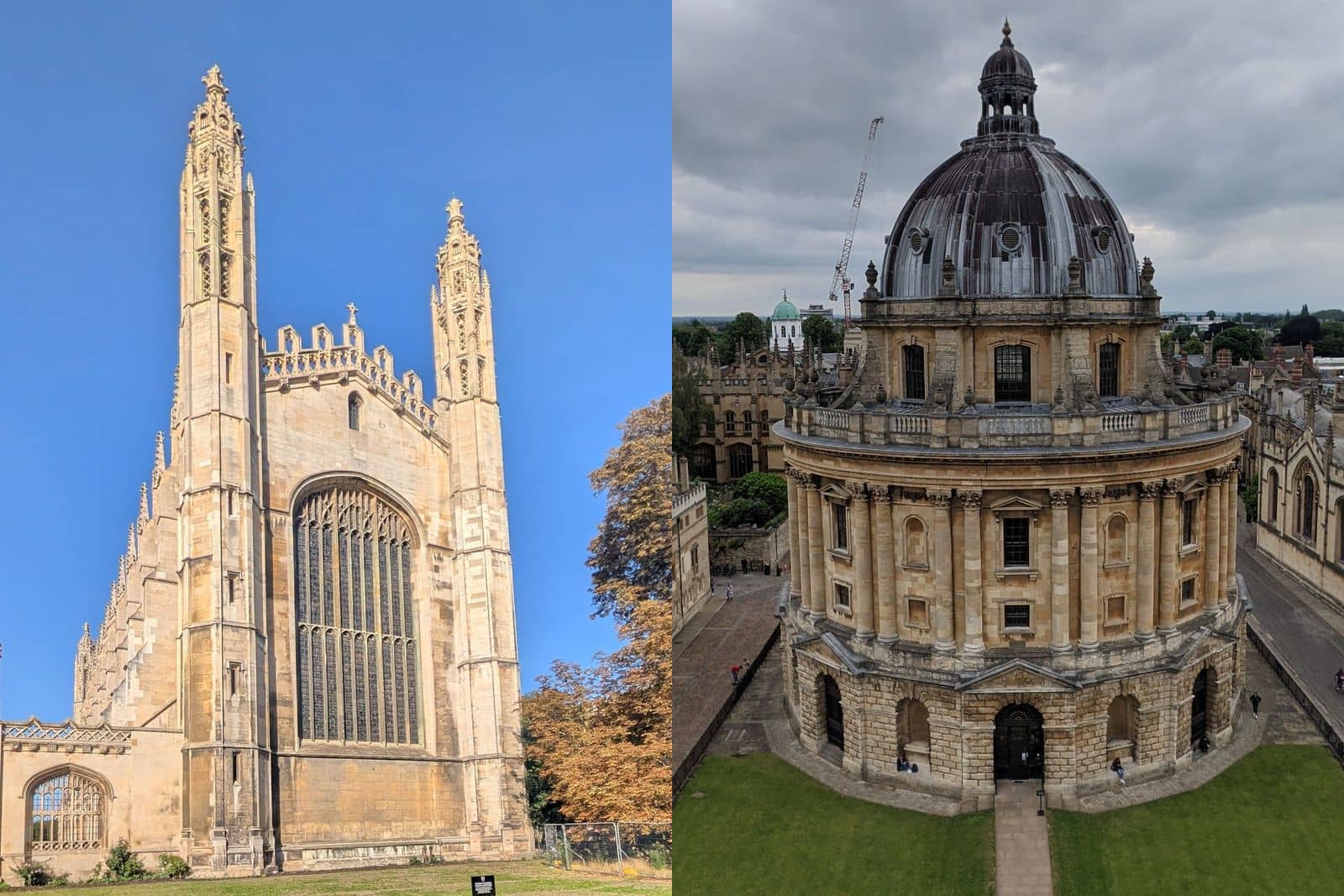
Do you want the literature side of Oxford, Tolkien and the Harry Potter staircase? Or the science side of Cambridge, where you stand in the courtyard where Newton clapped to measure the speed of sound? And have you got a day or a weekend?
Pretty streets and the sciences send you to Cambridge. Literature and two nights send you to Oxford. A day trip is Cambridge, because the whole city sits inside about an hour’s walk. Longer than that is Oxford, because it is bigger and it carries on west to Bath and Bristol. When friends are trying to toss up between the two, these are the two questions I put to them.
Your call
Cambridge
Oxford
The pull
The science. Newton, the Eagle, the colleges
The literature. Tolkien, Narnia, Alice, Harry Potter
Out of London
King’s Cross or Liverpool Street, north
Paddington, west
On the train
About an hour
About an hour
On the ground
A day, one night at most
A couple of days
On your way to
Ely and further north
Bath and Bristol
The one thing
Punting the Cam
The Bodleian
The pub
The Eagle, where DNA was announced
The Turf Tavern. The Eagle and Child reopens in 2027
On foot
Compact. Everything inside an hour’s walk
Bigger. More walking between things
Disclosure
Some of the tours below are affiliate links. If you click through and book, I earn a small commission at no extra cost to you.
Option one: Cambridge, because you can do it in a day
Catch an early train, do the lot and be home for dinner. That is the case for Cambridge. Nothing sits far from anything else, so the day holds a punt, a college, a pub and a wander without ever feeling rushed.
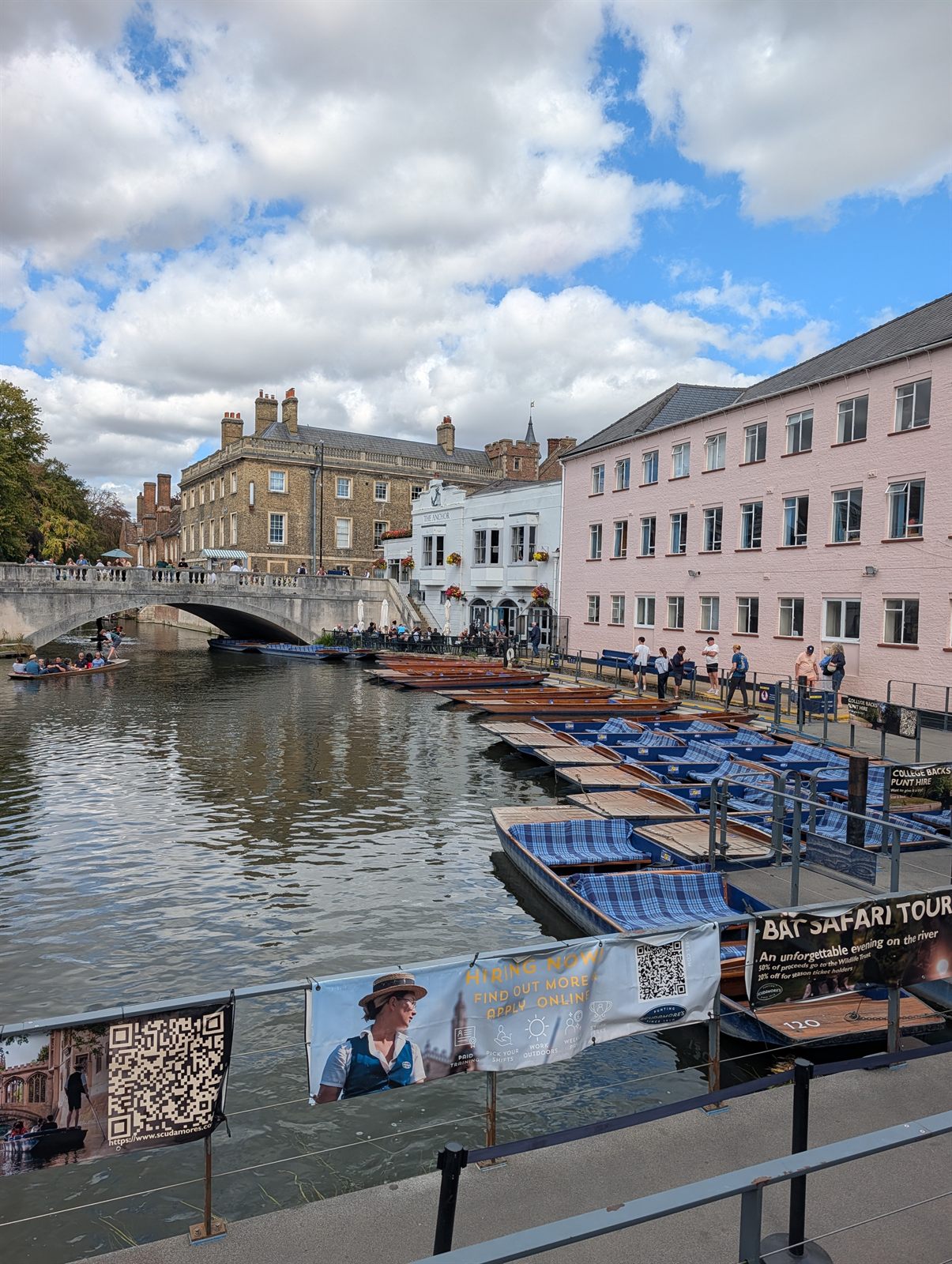
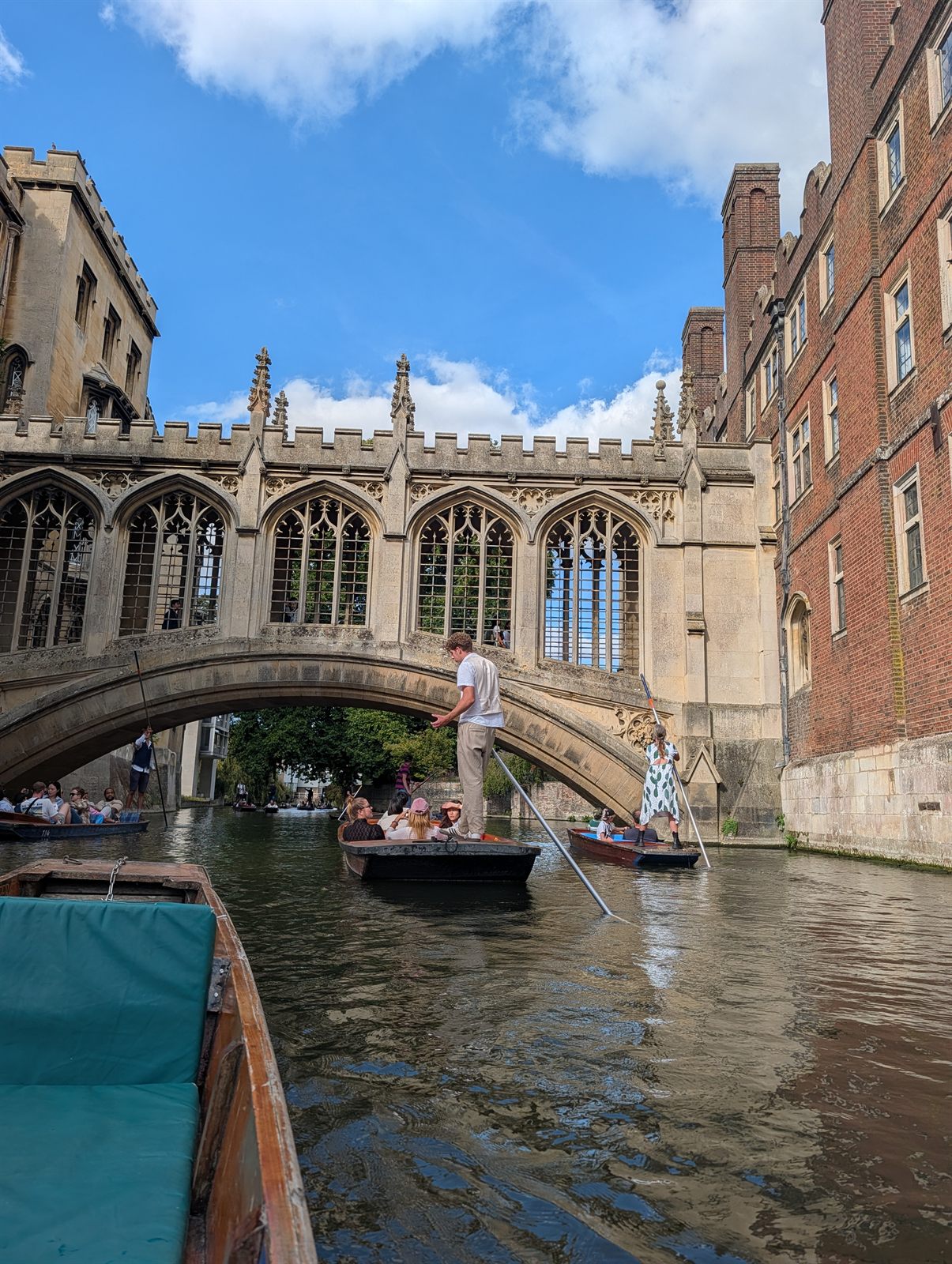
Hire a punt you steer yourselves and the day makes itself. It is a lot harder than anyone anticipates. Have a bet on who goes in first, count the crashes and run it as a drinking game if that is your group. It’s my running joke to see how many people can fall in. I’ve steered one down the Cam myself, which is where the joke comes from.
Want the day without the steering? A chauffeured punt does the work for you.
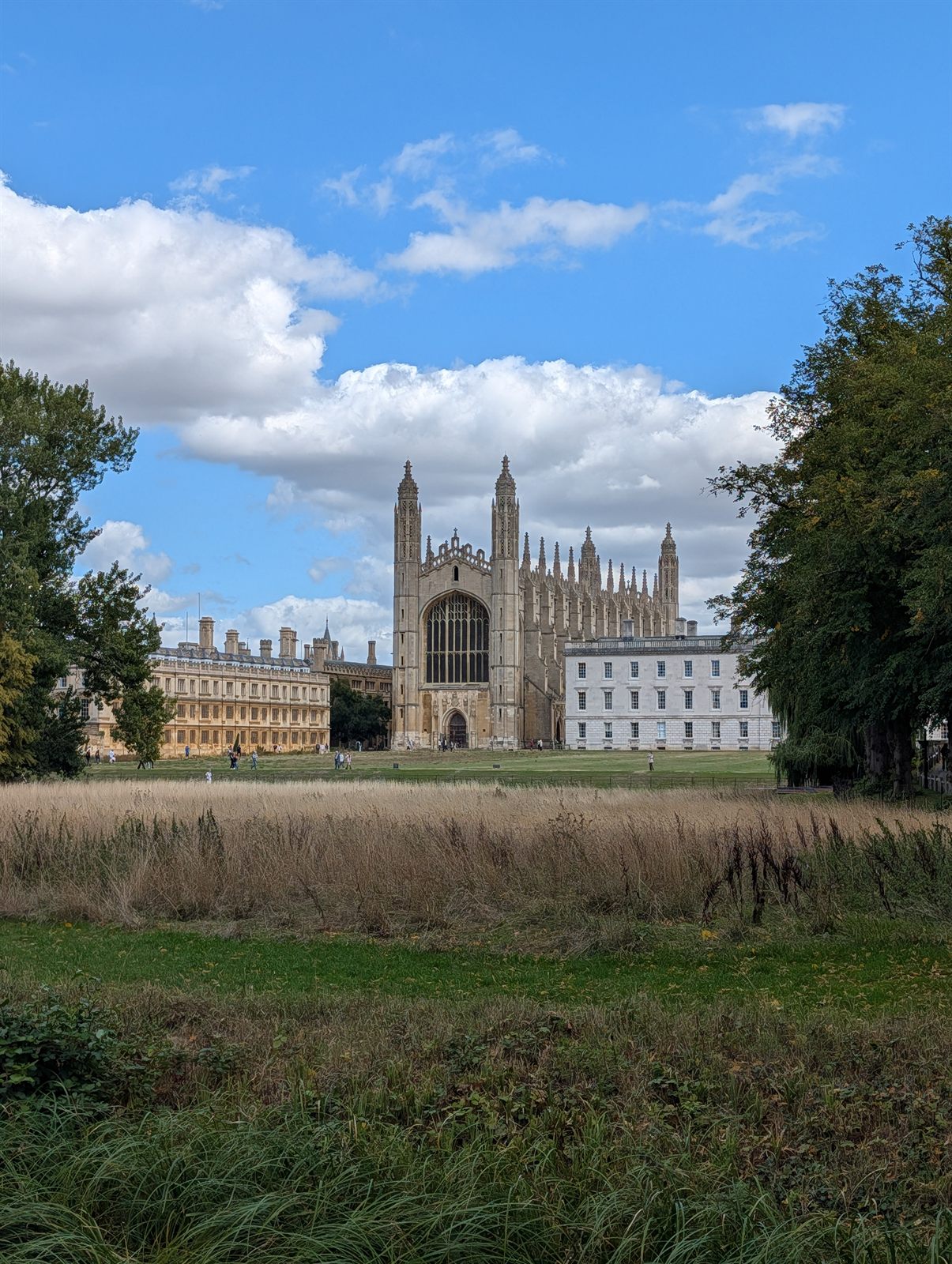
Pick one college and go inside, because there are some amazing ones to choose from. Trinity comes with a guide who walks you round. King’s is self-guided and a guide costs extra. Entry runs in two fixed slots, one morning and one afternoon, so it pins the rest of your timing. King’s is also the one that gives you the classic Backs photo.
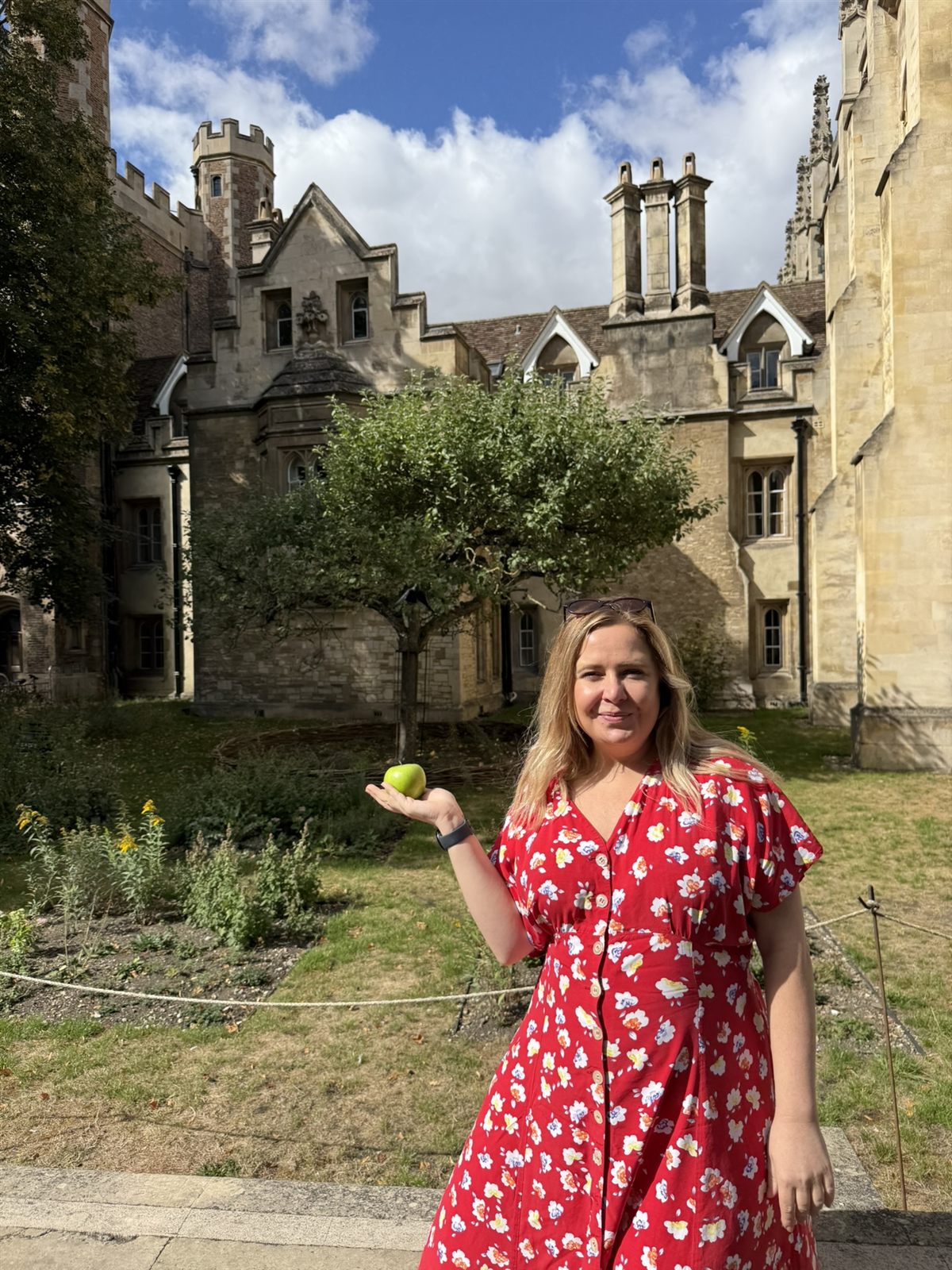
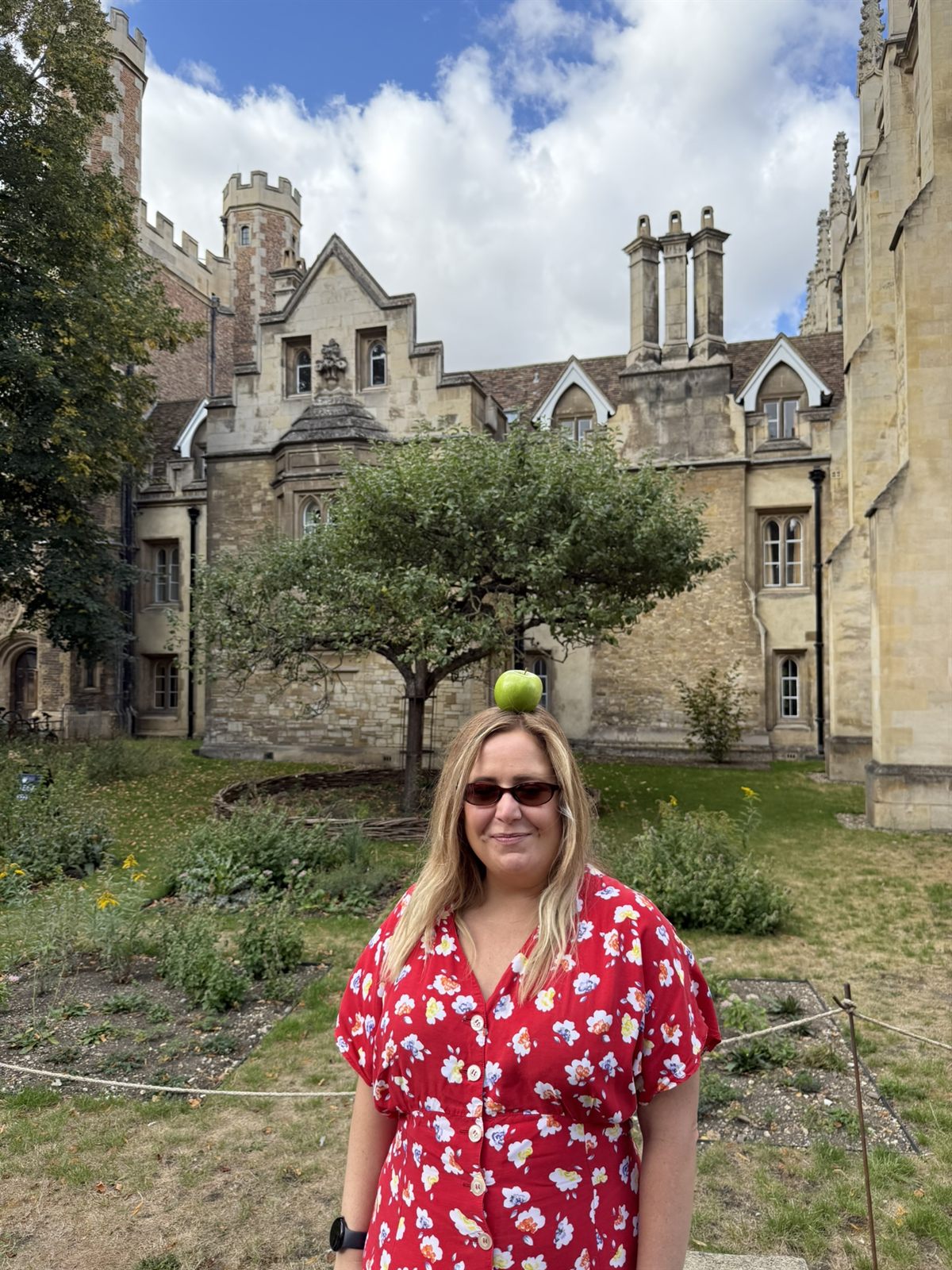
Stand in Trinity’s Great Court and you are where Newton worked out the speed of sound, clapping and timing the echo. The apple tree by the gate is a graft of the original. Hold an apple up in front of it and you have the photo. I do it every visit.
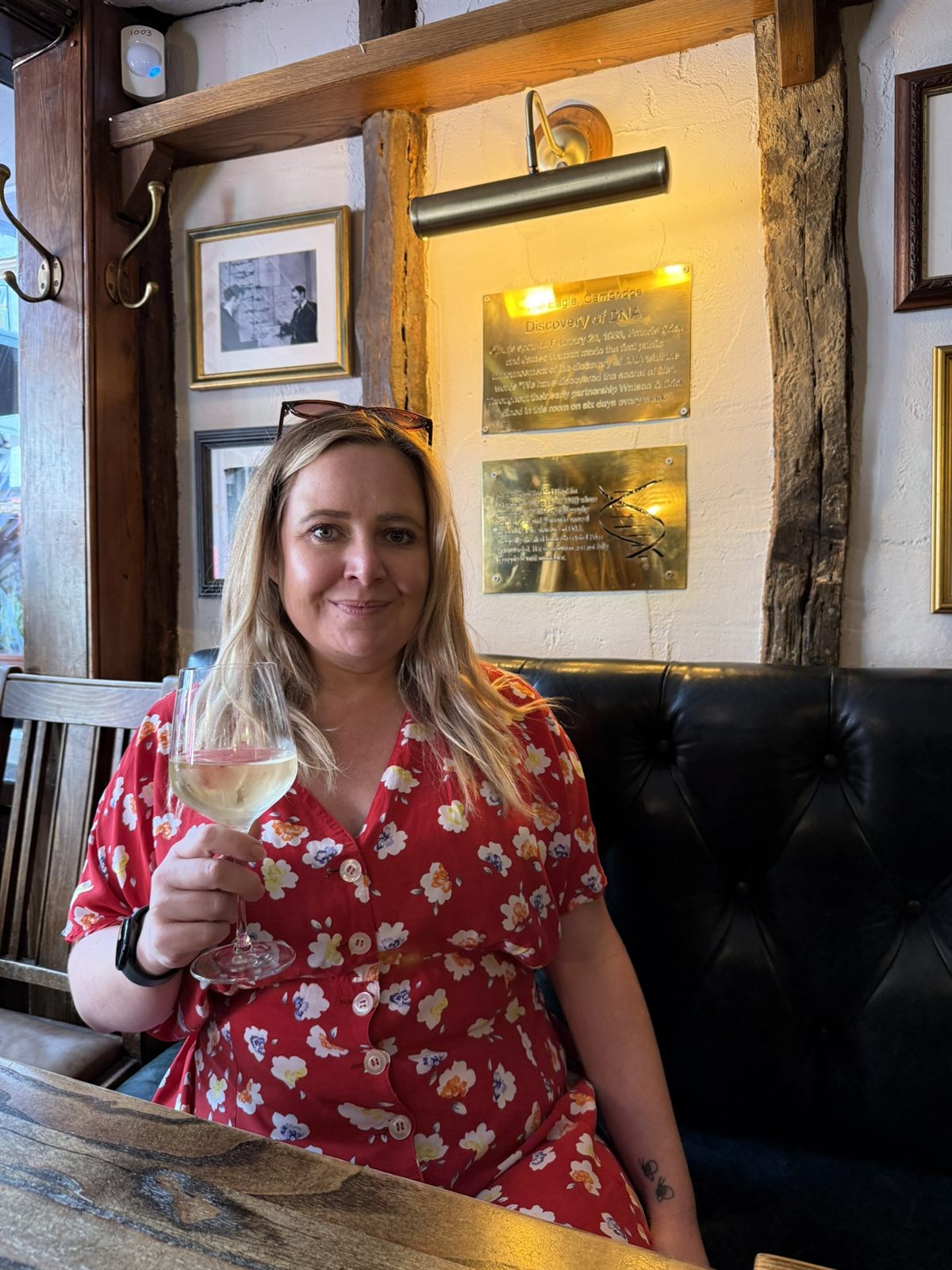
Sit in the Eagle afterwards and you are in the pub where DNA was announced. I’ve had a pint there and it still gets me.
Travelling with someone who cannot walk as far as they used to? Cambridge is the kind answer. Mum puts in the effort and does her ten to fifteen thousand steps, but she needs breaks between them. A compact city means an hour or two of doing, then a sit-down in a pub or a café.
You see more here for the time and the steps. It is nicer on the feet than Oxford is. The sciences Mum taught me when she homeschooled me are standing right there in front of her.
Worth it
Worth It: Trinity College and the punt. Those two are the day. One day in the diary is all Cambridge asks for.
Option two: Oxford, for two days and the books you grew up on
Give it two days and Oxford pays you back. It is bigger and there is more to fill the time with. For anyone obsessed with literature it is the one. You can walk the streets where Tolkien wrote and stand at the Narnia lamp post on St Mary’s Passage. The colleges where the Harry Potter scenes were filmed let you in too.
Stand at that lamp post and you are looking at the thing behind the wardrobe scene. Narnia was one of my favourite things growing up. I have a special edition of The Lion, the Witch and the Wardrobe. I always wanted to come here.
As a book lover the Bodleian belongs high on your list, so book a library slot. It is one of the libraries that collects every book, one copy of everything kept. Book dreams come true in there. Slots go on the library’s own tours page. A two-hour Harry Potter walking tour takes you in there and round the filming spots in one go.
If you want one of those classic photos on the Harry Potter staircase, bring your wand or something to wear and pretend you are a student at Hogwarts. That is the bit that brings the literature nerds out, because you can re-enact any of it.
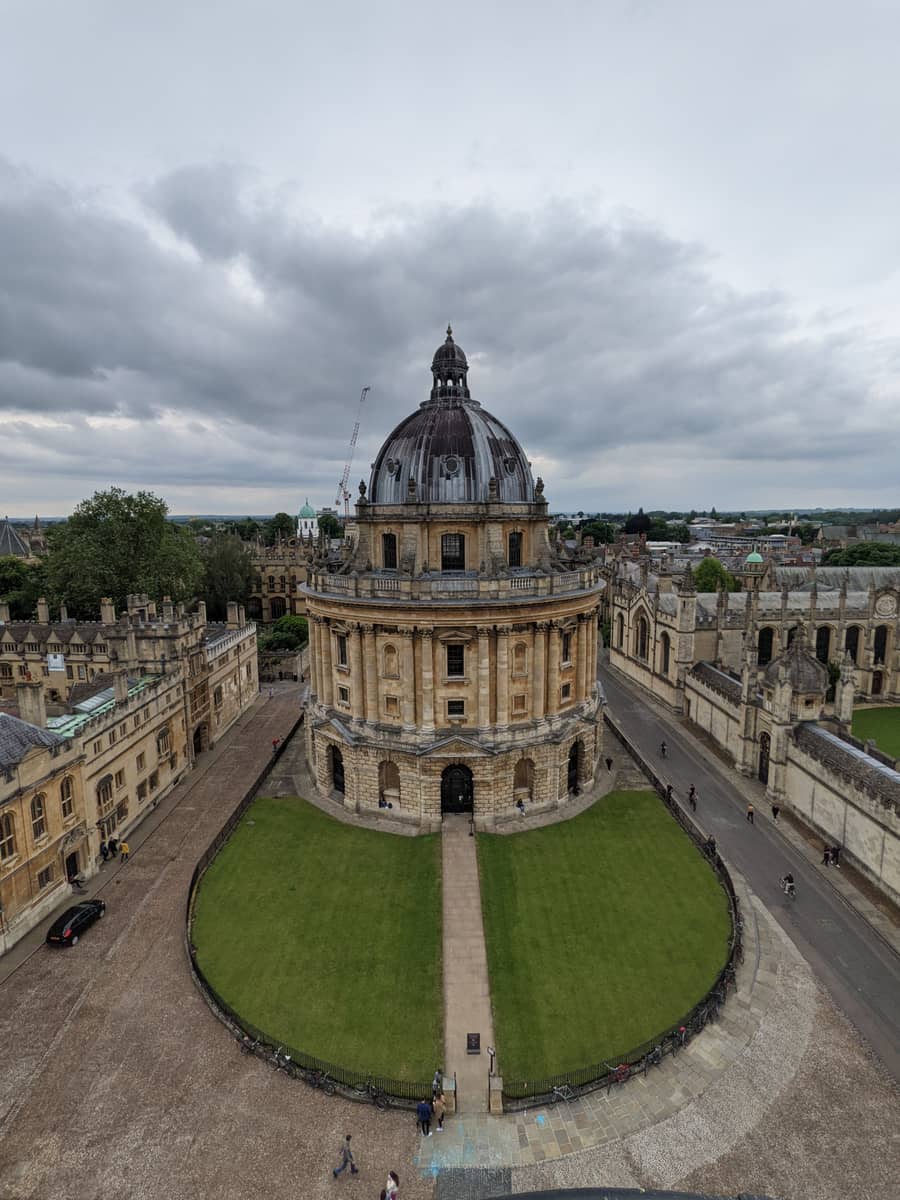
Climb St Mary’s tower for the view, 127 steps. I’ve climbed them. The Radcliffe Camera from up there is the reason to.
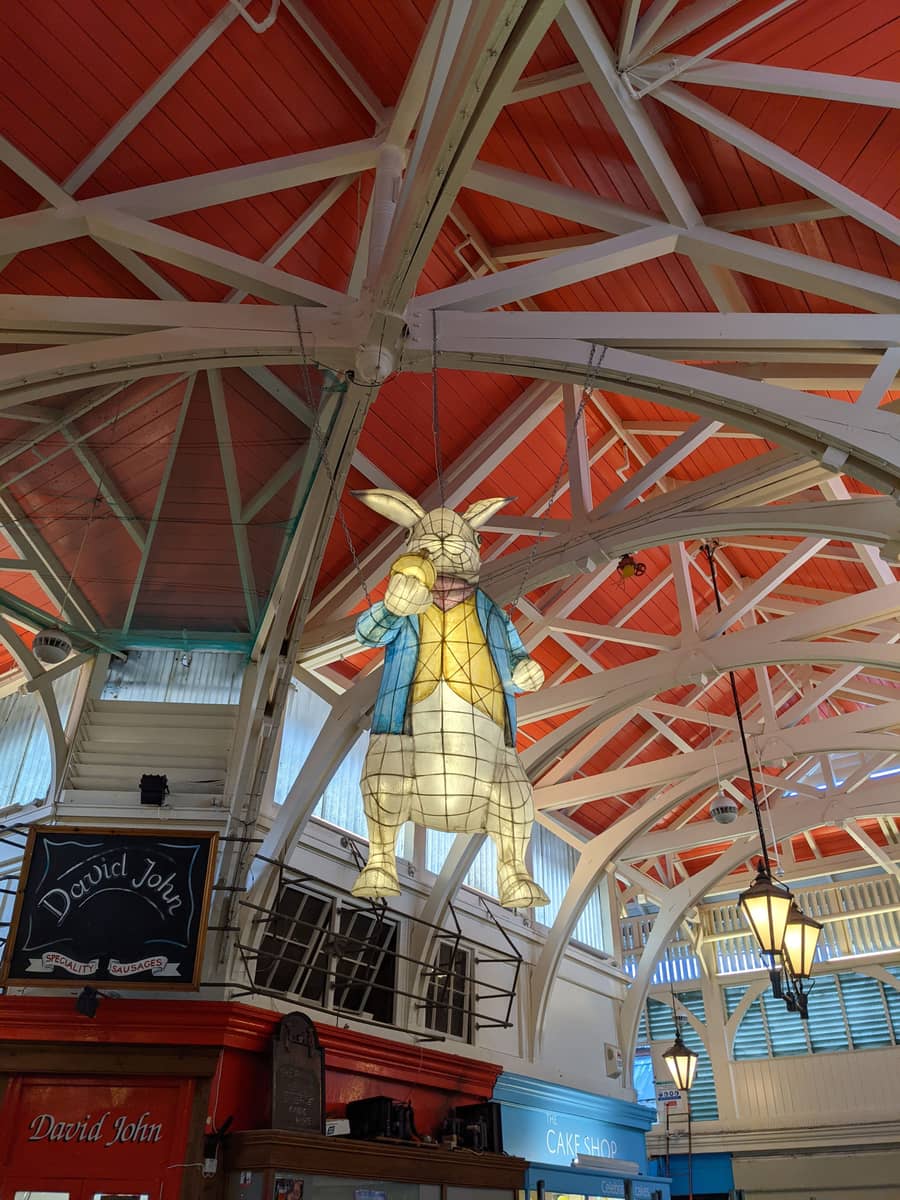
Look up in the Covered Market and the Alice in Wonderland figures hang from the roof like lanterns. It takes five minutes on the way past. The White Rabbit is the one I stopped to photograph.
Give an afternoon to something that is not a college and Oxford Castle and Prison is the one. I’ve been a couple of times and one of them was my birthday, on a ghost tour in broad daylight. The guy running it was hilarious.
Finish at the Turf Tavern, down an alley you will walk past twice before you find it. I loved the atmosphere. It is where Bob Hawke, later our Prime Minister, drank a yard of ale in eleven seconds.
Worth it
Worth It: the literature walk and a pint at the Turf.
Not worth it
Not Worth It: doing Oxford from the outside only. Mine have mostly been walking trips and the buildings are lovely from the street, but you get far more back for going inside something. Pick one college, one library, one tower. Two days gives you room to do all three.
Getting there from London
Head north out of King’s Cross or Liverpool Street for Cambridge, west out of Paddington for Oxford. Both run about an hour on the train, so choose on the two questions and not on the timetable. Allow about half an hour on foot from Cambridge station to King’s, which is the only bit that catches my friends out, every time.
Every one of these trips has a version that does not go in a guide. The ghost tour in broad daylight is one of them. That one belongs on Controlled Chaos.
Both are lovely. This is the choice I put to anyone coming to stay with me. Whichever one you say first out loud is your answer.
By Kat, who has taken visiting friends to both cities more times than the diary can account for.
Everyone has DNA. But did you know it was discovered in Cambridge? And you can sit at the table in the pub where it was announced.
Cambridge is the maths and the science. The halls of Trinity and the colleges, the pieces you learned about at school, the tree graft where Isaac Newton’s apple came from, then a drink at the Eagle where DNA was. All of it on foot, because the city is nice and compact and it’s never far to a feed.
Then the punt. You pole it yourself, it’s a lot harder than you anticipate and my running joke is to see how many people fall in. A bit of a drinking game if you’re a group.
Build the day around one anchor and let the rest go loose. Mine was the 10am Trinity tour.
This itinerary works all year. The only thing to swap in winter is the punt, for a walk along the Cam or the library. I haven’t done the library yet.
Put it on your list. It’s back on mine, because I just love walking around Cambridge, it’s so pretty. Next time another college, a picnic if the weather’s good and punting again with a few drinks on the water.
Disclosure
Some links on this page are affiliate links. They don’t change what I paid or what I’d tell you to do.
The spend
About £80 a head on the day, plus the train, from £27 return.
The booking
The college tour, reserved online, £10 at the door. Trinity Lane takes no punt bookings, so go early or expect a wait.
Wear
Shoes for a full day on your feet. A layer, whatever the forecast says.
Works for
Couples, first-timers, showing a visitor England. One anchor, the 10am tour.
Fact check · 7 September 2026
Prices are what we paid on 4 and 5 September 2026, checked against the venues on 7 September 2026. This is my weekend, not a guidebook.
The day, mapped
Do the day in this order. It’s built by effort, not by the map. The Trinity tour is the one fixed time, so everything before it fits around 10am.
Leave the punt for the afternoon. You don’t want wet hands and a rush back to a college tour. Nothing here climbs, so the thing to manage is the clock and not your legs. The wine bar goes last, because you can’t start a day in a wine bar.
Schematic, not to scale. The river runs down the left. Stop 12, home, is the station again.
A rough finish and your call. Cut anything above to catch an earlier train.
Pink ring = timed entry, book ahead. Plain green = walk up. Grey = start and finish.
Getting there and in, by 9am
Aim to be off the train by 9am. That leaves half an hour to reach the centre before the bun and the tour.
Book the train before anything else. Ours was a Greater Anglia weekend ticket, out on the Friday and back any day up to the Monday, which came in slightly cheaper because we stayed over.
For a day trip you want an off-peak. The off-peak day return is £27. There’s a more flexible off-peak above that. Pick the off-peak that suits you if you want to choose your trains on the day. Take an advance if you’re happy to be tied to one train and want it a bit cheaper.
Doing it in a day is cheaper than it sounds. It’s about an hour on the fast train.
From the station it’s about a 30-minute walk to King’s College, or £6 to £10 in an Uber. There’s a bus as well. We never took it.
You can wing the rest. Only the college tour needs booking, plus the punt in high summer.
book the train and pick off-peak if you want your options open on times.
Breakfast on the go at Fitzbillies, 9:30
Take your bun and coffee away with you, because you can’t eat inside the college. Fitzbillies on Trumpington Street, right next to King’s, is the famous one for its Chelsea bun.
Skip the Chelsea bun if currants aren’t your thing. They aren’t mine, so I had the cinnamon and cream cheese icing bun at £4.25 with a £4 coffee.
You can order online if you’re worried they’ll sell out.
Not worth it
Not Worth It: nice, not worth the hype. Great for a quick breakfast on the go. Don’t build your morning around it if there are big queues. It is lovely, don’t get me wrong.
Trinity College tour, 10:00
Reserve the slot on Trinity’s own site, then pay £10 at the door. Card is fine and under-12s are free.
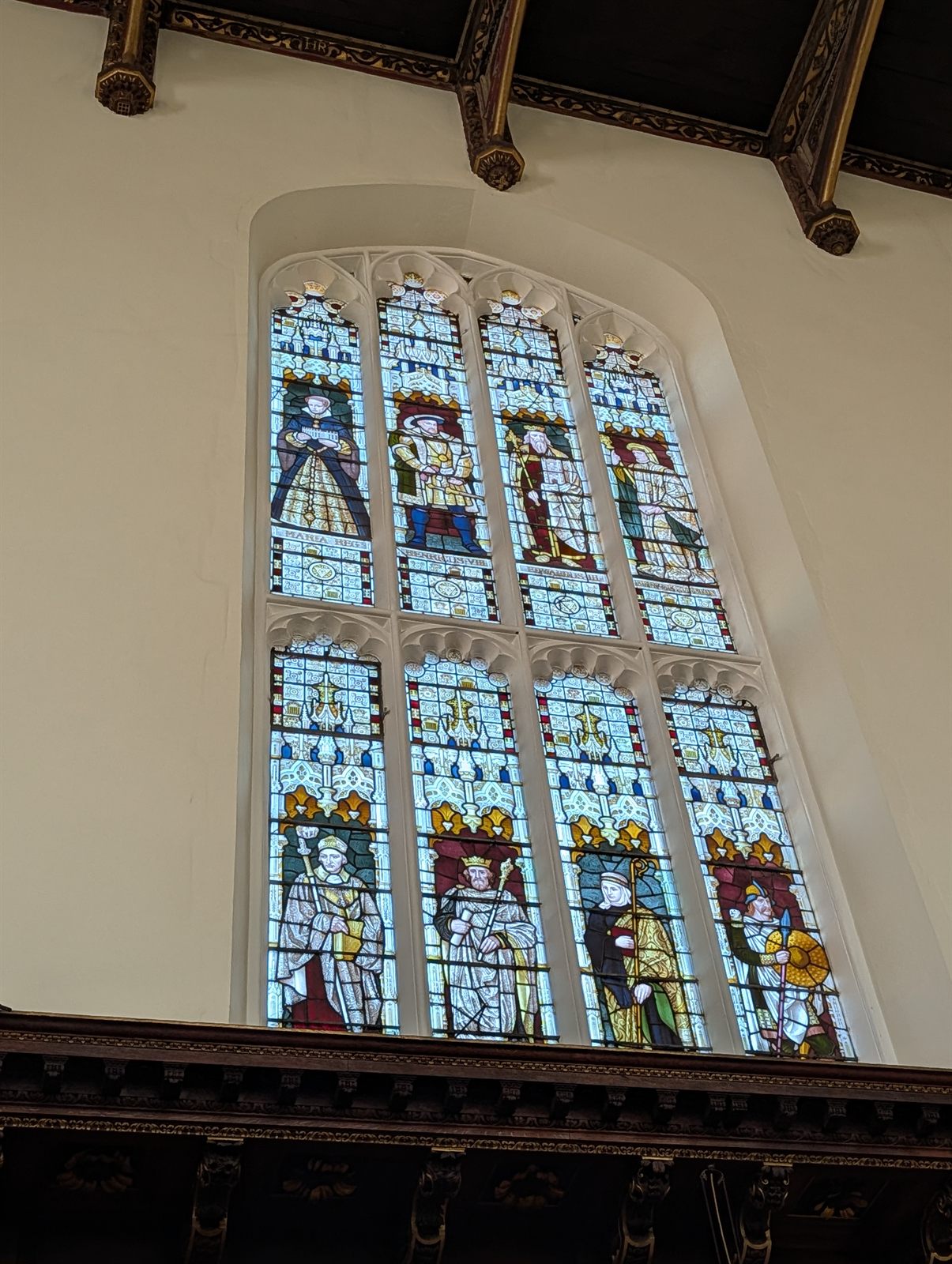
Go out of term if you get to pick your date. The college takes you into the hall instead of roping it off. That is where the Tudor stained glass is, kings and queens set into the windows above you. We got in.
Look up at the Great Gate on the way through. Henry VIII is holding a chair leg where his sceptre should be. I checked my photo and it’s still there. The story I’d always heard was students. Varsity tracked it down in 2010 to a window cleaner who found the hand empty and filled it. It never came out.
Clap once in Nevile’s Court and wait. Newton stamped his foot in the north cloister there to time the echo and work out the speed of sound. Someone on our tour did it and you could hear it come back. Do it.
Don’t plan on the Wren Library on a September Saturday. It opens Monday to Friday, 12 to 2, until its weekend season starts again on 3 October. Any weekday works.
If the Trinity slot has gone, a walking tour led by a former student covers the colleges from outside. I did one on an earlier trip. The facts overlap with the Trinity tour, so do one or the other, not both.
Take some of the guide’s patter as patter. Ours had Trinity owning the land under some Tesco stores and leasing the ground under the O2. Then the Byron story: the rules banned dogs and said nothing about bears, so he kept one. What is solid is the first female Fellow, elected in 1977. The hall was built between 1604 and 1605.
Worth it
Worth It: the Trinity tour at £10, paid at the door. Out of term they take you into the hall.
Newton’s apple tree, 11:00
Stand where the gravity story starts. Newton thought about gravity when an apple hit his head. This graft of that tree stands right next to Trinity, where he studied. His room is nearby. It is not the original tree. That one is at Woolsthorpe Manor in Lincolnshire.
Bring a green apple for the photo. The real one is a cooking apple, hard to come by unless you go to a bigger shop. A green one is the best re-enactment you get, which is the shot below.
Craft market on Trinity Street, 11:10
Give it ten minutes between the gate and the Eagle, on a Saturday, because that’s the one day it runs. It’s the place for things you can only buy in England: jewellery made from old coins from £45 up, stamps, belts and college hoodies. I didn’t buy a thing and I was tempted twice.
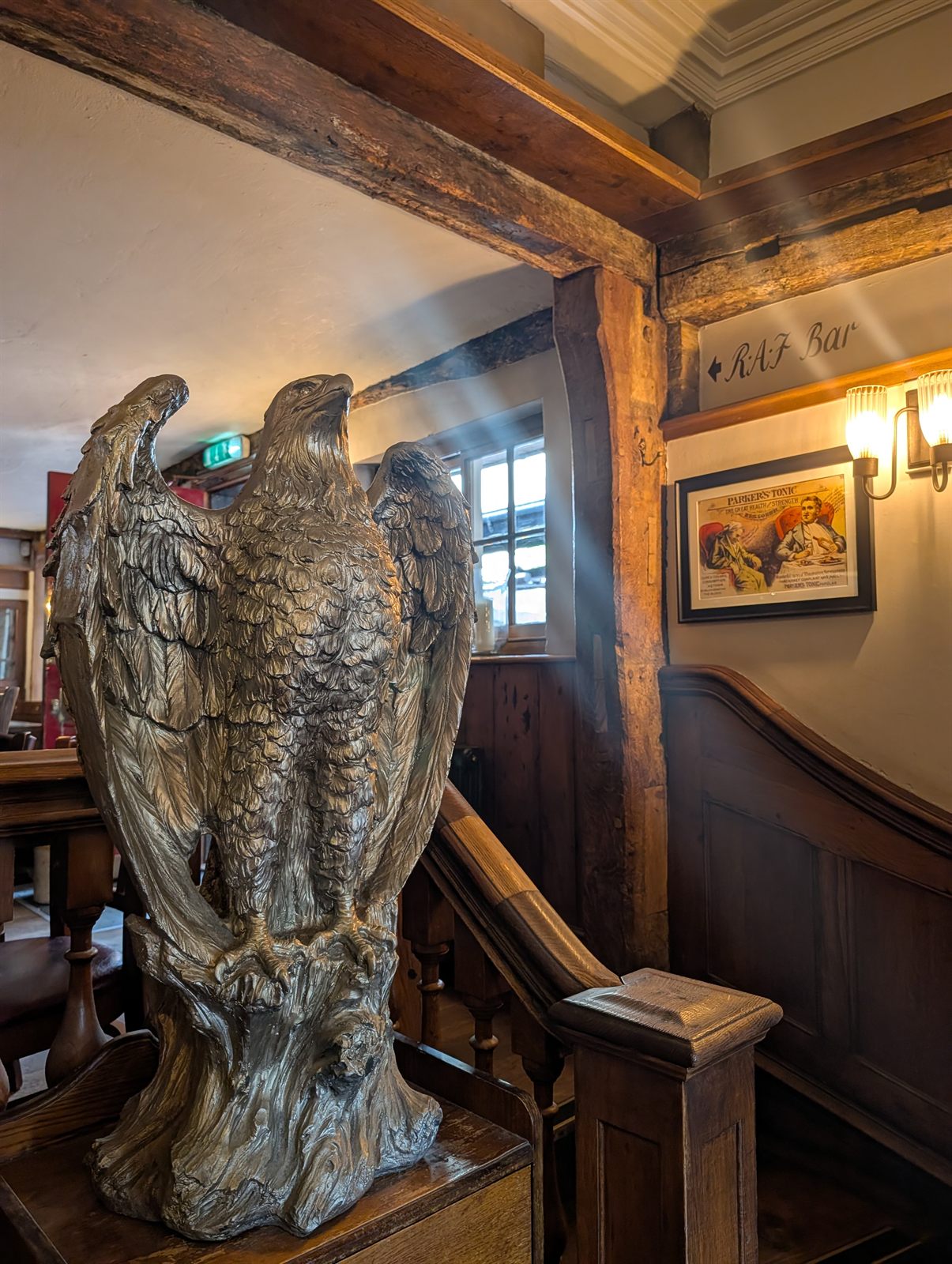
Look up on the way to the bar. The silver eagle sits on the RAF Bar staircase and the ceiling above it is covered in wartime airmen’s names, burned in by candle.
Budget around £9 a glass here. We paid £18.60 for two glasses of Chapel Down white, an English wine in the pub where DNA was announced. The Eagle doesn’t take bookings from May to the end of September. Arriving at 11:30 is what gets you the table rather than a wait at the bar.
Lunch, pick one, 12:15
Pick one of these two. Both are a minute from the Eagle.
Bread and Meat, 4 Bene’t Street, for the chips. The roast vegetable ciabatta is £12 and the poutine side is £7.50, beef gravy, not vegetarian. I ate it anyway. It was the star of the day.
Order the bowl at £19.50 if you’re hungrier, which is what I wish I’d done instead of the sandwich. Service is 12.5% on top. One plain note: the cheese curds are unpasteurised, so flag it for anyone who needs to know.
Butch Annie’s, 23 Market Street, for a burger. The Ooh La La veg burger is £11. The peppercorn saucy chips are £7.50, made with beef dripping. I ate them knowing that. Two schooners of Rex lager were £5.50 each. Two of us came to £50.06 with 12.5% service.
Go here for the independence and the concept, both of which they have put real effort into. The patty just wasn’t my preference. If you eat meat you’ll likely rate it higher than I did.
Worth it
Worth It: the poutine at Bread and Meat. Not vegetarian. I ate it anyway and I’m still dreaming about those chips. Butch Annie’s too, for the concept and the independence. My line on the burger: I’d eat it again, I just wouldn’t rave about it.
The Backs, on foot, 13:30
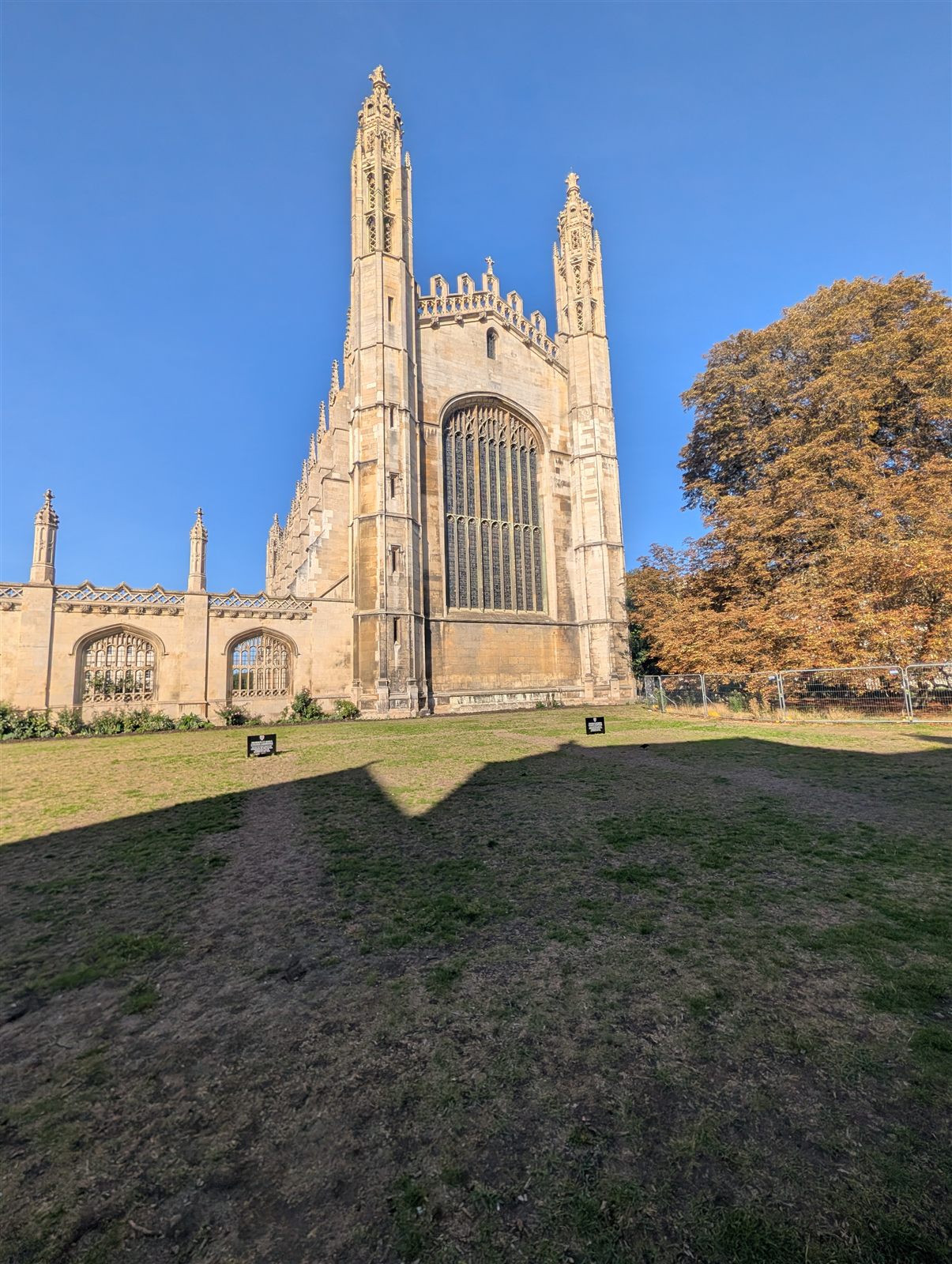
Walk the Backs after lunch and you get King’s College from the meadow, which is the actual postcard shot and better than the street view.
Don’t build the walk around the cows. A friend’s list promised us grazing from April to October. We walked Coe Fen and the Backs on the Saturday and found plenty of evidence of cows and not a single cow.
The punt, 14:30 to 16:30
Pick your version of this first. Hire a boat yourself and bet on who falls in. Or take a guided tour and get chauffeured around, which is a lovely way to do it.
Hire self-service from Trinity Lane, from Trinity College and GHL Punts. Self-hire is the one I did. The chauffeured boats go from the same dock. The table below has both, with what each one costs.
Get there before the rush. We arrived about 2:40 and waited around an hour, because we turned up just as it came in and took out all the boats. We were on the water by about 3:20 to 3:30, for the hour.
Self-hire for two is under half this. The guided tour says no drinks on board
Pimm’s from the river boat
£12.60 a pint
£25.20 for two
Comes to more than the boat did
Mill Lane (Scudamore’s) guided tours
£78 up to three, £144 up to six
worse value at two
The tours do go past the famous colleges. It’s the self-hire from Mill Lane that runs the other way
The Prezzo end of the river
the cheapest, according to a friend who lives in Cambridge
not checked
We never made it up that way, so that’s his word, not mine
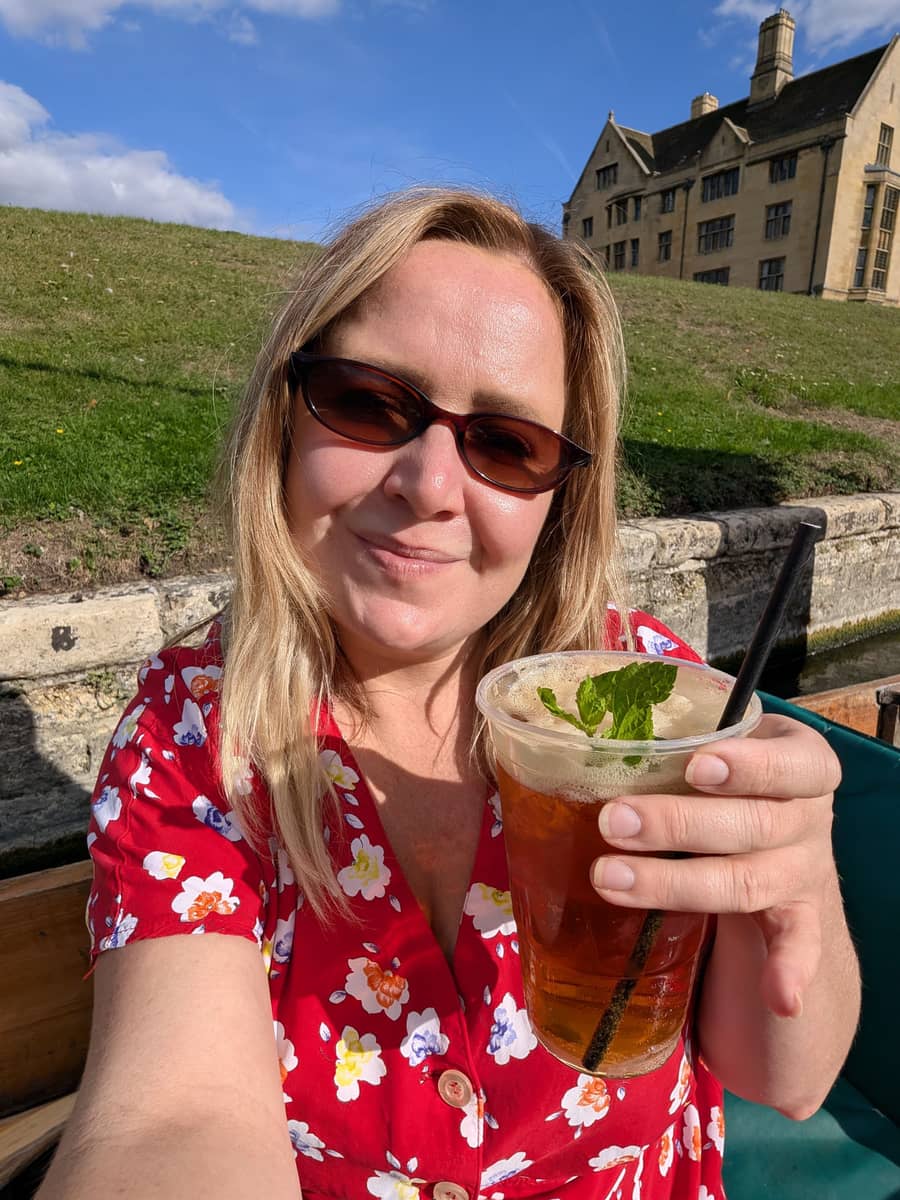
Carry your own drinks on board, because you can when you self-hire. Wine, anything. The guided tours say no drinks. I wish we had, because when a boat selling Pimm’s came alongside we bought two pints at £25.20. Lovely. Also £12.60 a pint.
In peak summer, budget that queue in or book at a dock that does take bookings. Accept you may not get the Trinity Lane price.
They show you how to pole it, then you go whichever way you fancy. We punted ourselves, one on the pole, one on the photos. It’s a lot harder than you anticipate, so count your crashes and make a drinking game of it. The Bridge of Sighs at St John’s is the one you’ll want from the water.
Worth it
Worth It: self-hire at Trinity Lane. Half what it costs to be punted. The boat is yours for the whole hour.
Not worth it
Not Worth It: self-hire from Mill Lane if the Backs are the point. Those boats run the other way. Their guided tours don’t.
Jack’s Gelato and Market Square, 16:30
Cool off with something cold and walk it through Market Square. Jack’s Gelato on Bene’t Street does a cup for £4.90, which is what I had.
Go for the iced tea instead if you’d rather. The Bubble Bliss stall on Market Square does one for £4, cheap against London prices. I had that too.
See what the square is doing while you’re there. We got Morris dancers on the Saturday, which was luck and not a plan.
King’s College and the wine bar window, 17:00
Get your postcard shot outside the Chapel first. Tickets are about £18 on a weekend to go round on your own. Or a guided tour of King’s walks you through it, the way the Trinity one does. Book ahead either way, because the early-bird price on the college’s own ticket closes every Sunday night for the week ahead.
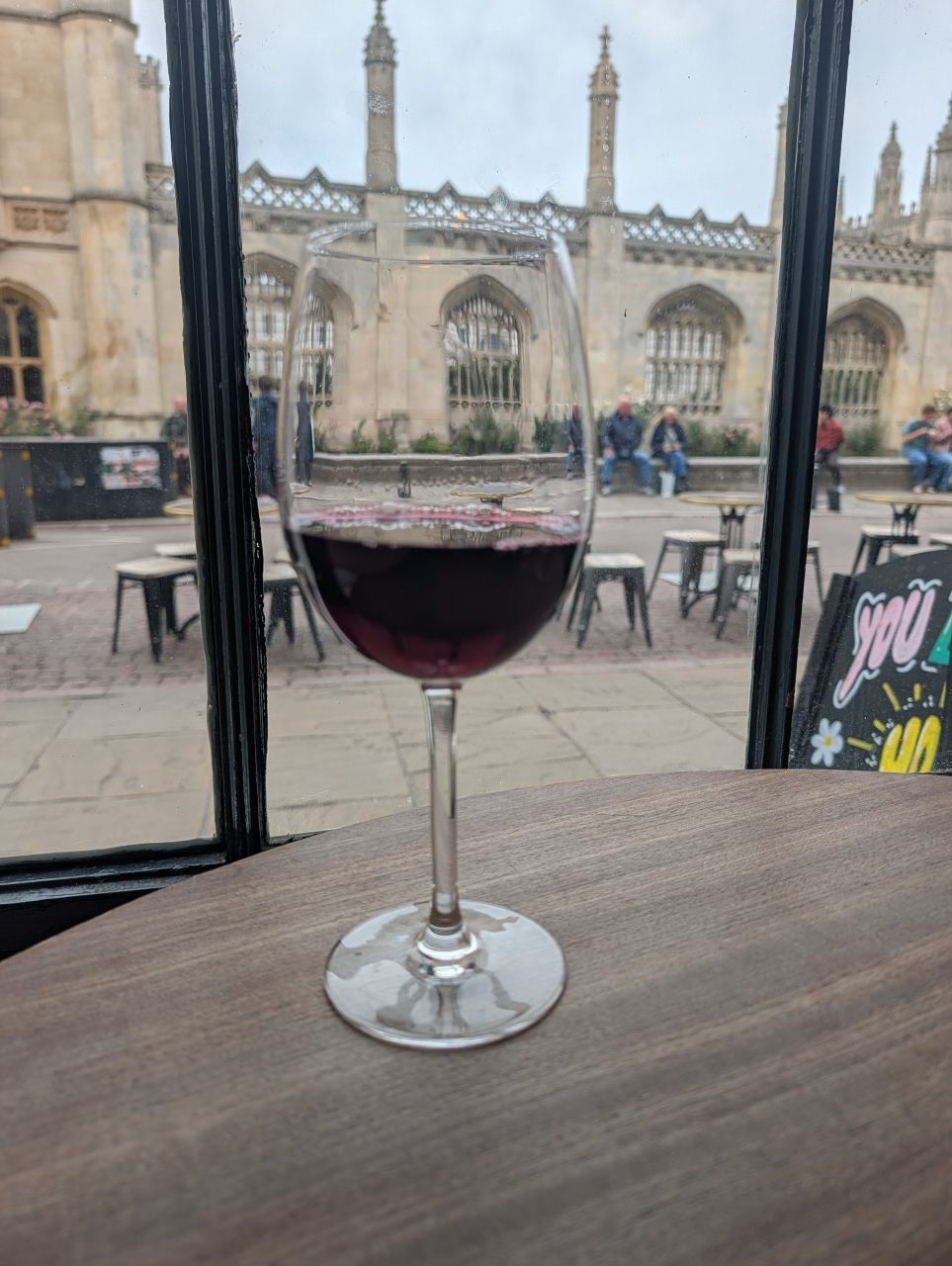
Finish at Cambridge Wine Merchants on King’s Parade, the way we did both days. Take the window seat if it’s free, or a table outside if you’re lucky. It sits on the main walkway down to King’s, so it’s proper people-watching with the Chapel in view the whole time.
Order the mystery glass, 175ml. We had the red on Friday at £12 and the white on Saturday at £10. Every bottle on the list has its own label with the winemaker and the region on it, which is exactly my kind of thing. If you’re travelling with wine-club people, bring them here.
Sit until your train if you want to. They’re open to 9pm on a Friday and Saturday. They also pour an English one, Flint Vineyard Bacchus from Norfolk at £10 a glass. Ours was the 6pm home.
Worth it
Worth It: the window seat at the wine bar opposite King’s. A mystery glass and an hour of people-watching.
If you stay the night
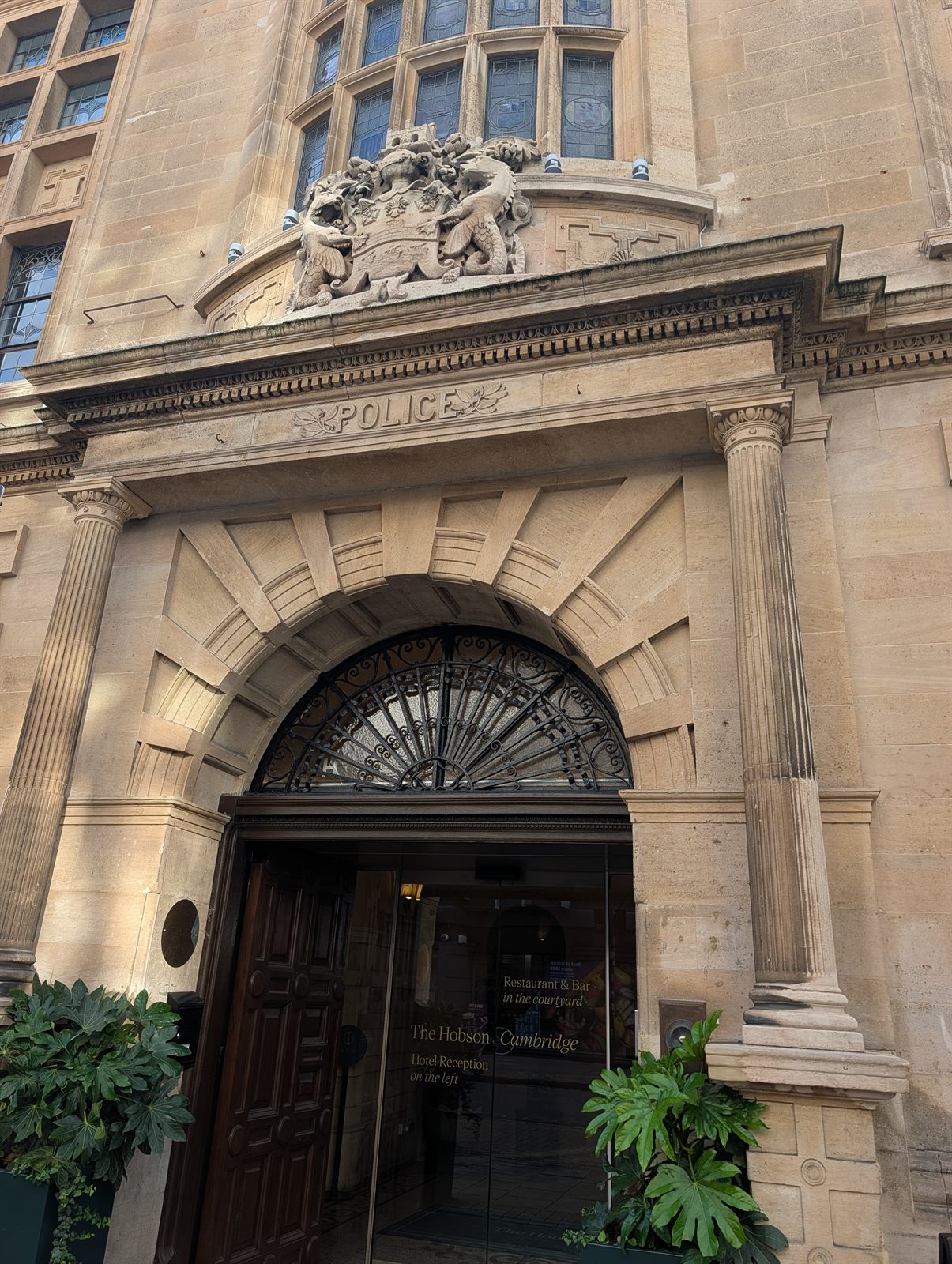
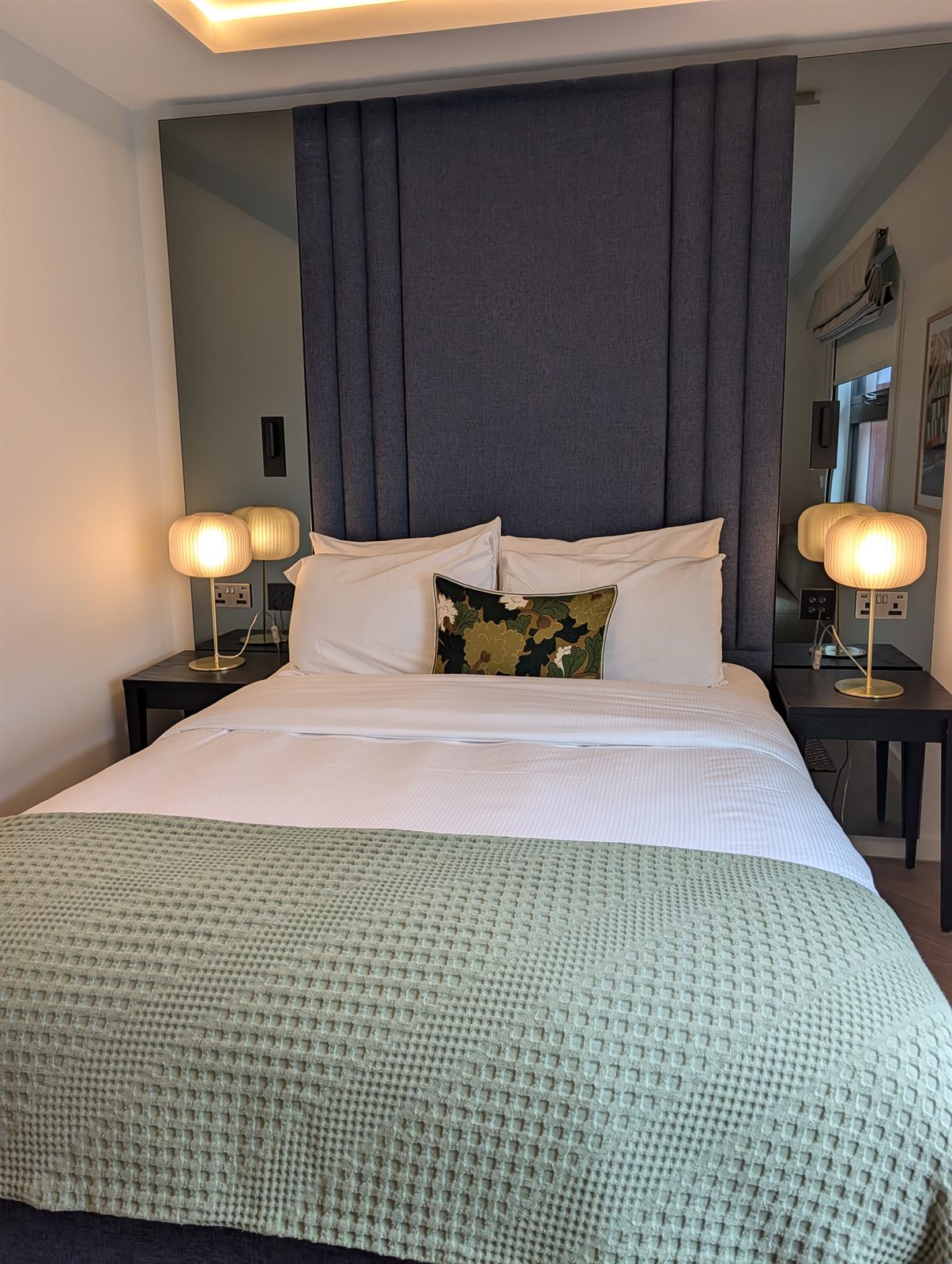
Stay over for a slower morning and a proper dinner. We had the Hobson, 42 to 44 St Andrew’s Street, a former police station with POLICE still carved above the door. £142.68 for the Friday night for two, £71.34 each.
Book somewhere on the decor and you might get what I got. Mine was an Australian hotel. I didn’t clock that until the koala turned up in the bar. Early check-in was quoted at £30 and we said no. We left the bags and went for lunch instead.
The bar downstairs, Oz & Isle, does a Gold Rush at £14 and a no and low option at £11. That’s drinks only. I can’t tell you anything about the food there.
For dinner, Tradizioni at 18 The Broadway. It was our anniversary, so I’d put that on the booking the way you would for a birthday, with no expectations. They had read it. We were wished happy anniversary on the way in. There was a glass of prosecco each waiting. The whole team said it again on the way out.
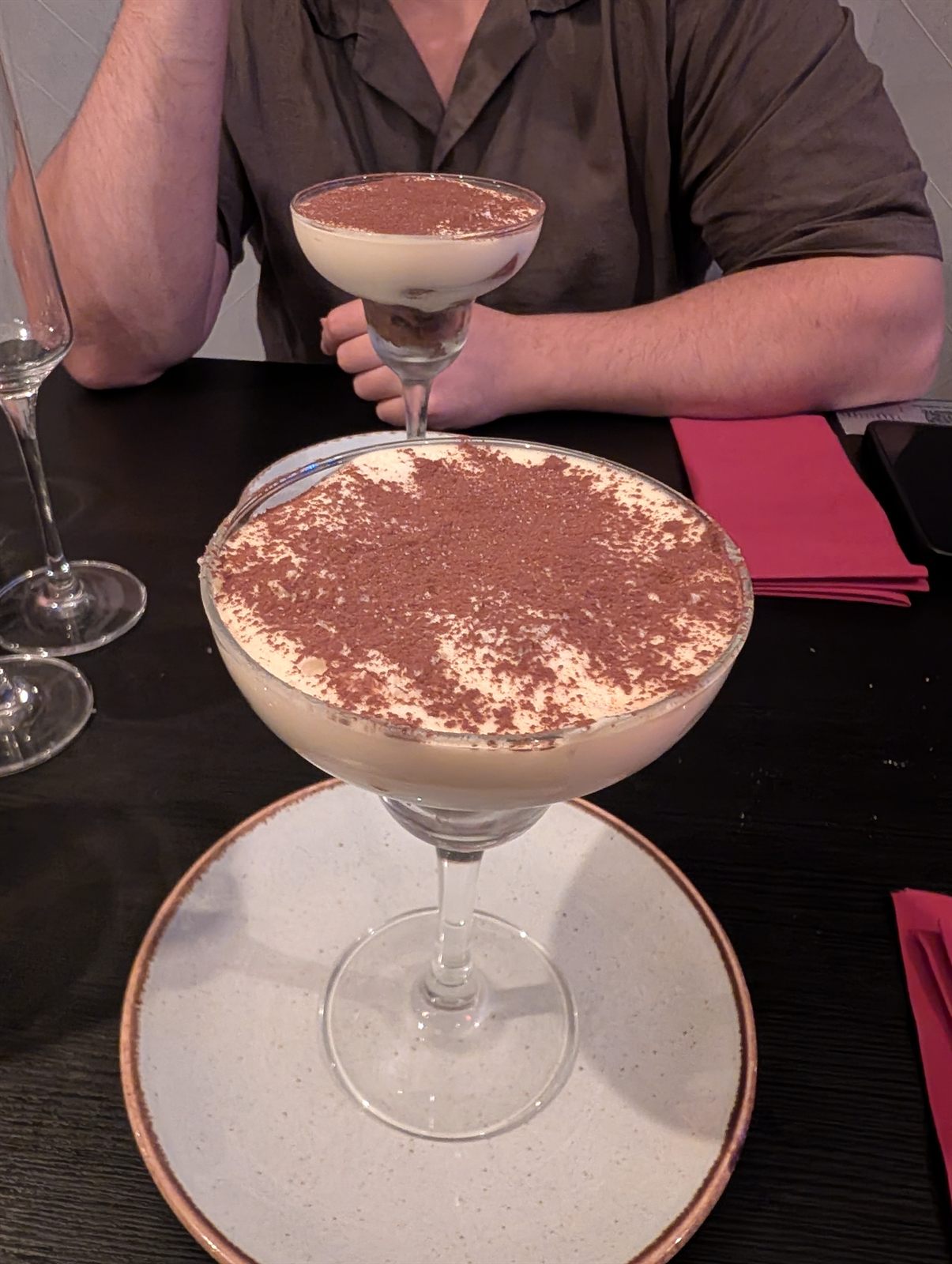
Order what you actually want. I asked for pasta and ordered the aubergine lasagne, which is not the same thing. Tiramisù is £8.50 and the menu prints it as a UK Italian Awards finalist. Pizza runs £9.90 to £19.90 and pasta is about £20, written loosely because we didn’t keep the bill. Uber from the hotel both ways.
Worth it
Worth It: Tradizioni for a night that matters. Put the occasion on the booking and they make it one.
Not worth it
Not Worth It: £30 for early check-in. Leave the bags and go for lunch.
What I’d cut if it runs late
Cut the market and the gelato first. They’re the softest part of the day and nothing hinges on them.
Next goes the wine bar at the end, lovely but skippable if you’re chasing a train. Never cut the Trinity tour or the punt. Everything else in the day exists to protect those two.
The rain plan
Move indoors and salvage it. Our Friday was the cold one. We gave up on the afternoon and sat in the wine bar window with a red. Checked in at three, warm in the hotel until dinner.
Ask about a deal on the punt while you’re at it. The companies are quieter on a grey day.
FAQ
Do you need to book anything?
Two things. The Trinity College tour, reserved online for the 10am slot, £10 paid at the door. And in high summer a punt. Trinity Lane cannot be booked and the queue will be long, so book at a dock that does. Everything else is walk-up.
How much is a day in Cambridge?
Every stop carries what we paid: the tour £10, the punt £12 each, lunch around £25, drinks about £30. The train sits on top of that.
Can you punt yourself?
Yes, self-hire at Trinity Lane is £24 for the hour and they show you how before you set off. No advance booking, first come first served. You can bring your own drinks.
Is Cambridge doable in a day from London?
Yes. It’s about an hour on the fast train from King’s Cross. An Off-Peak Day Return is £27. You’ll miss staying for dinner, but the whole route above fits into a day.
Cambridge or Oxford?
I won’t pick for a stranger. Ask yourself if you’re more literature or more scientist. Then which way you’re heading after London and how long you’ve got. Cambridge vs Oxford has the full breakdown.
Worth It: the Eagle before noon. One drink each and the good table, because we walked in ahead of the rush.
The bit I didn’t plan for came later, on the water. A boat selling Pimm’s pulled alongside near the Mathematical Bridge and two pints were £25.20, more than we’d paid for the punt. That’s the Controlled Chaos version of this weekend: the drinks on the river costing more than the river.
No matter how great London is, sometimes you’ll find yourself needing a change in scenery. London is surrounded by towns and cities which are full of history, culture and attractive scenery. Here are the best day trips from London by coach.
Coach travel is often the cheapest way to get around England if you don’t drive. The two main coach companies, National Express and Megabus, offer routes to many destinations around the country, and at bargain prices.
Below is a list of places that are only a short coach journey from London. Perhaps these can inspire your next day out!
Colchester
Colchester Essex with River Colne
Just under three hours by coach from London Victoria is Colchester, a historic town in Essex. It’s known as Britain’s first city and was once the capital of Roman Britain (then called Camulodunum). With a history of over 2,000 years, there is plenty to explore here.
To kickstart your historic tour of Colchester, the best place to start is the Colchester Castle Museum. The castle is home to the largest Norman castle keep in Europe, and was built on the foundations of the Roman Temple of Claudius. You can take a guided tour of the castle and visit the museum, where you can admire artefacts like mosaics and the Colchester Gladiator Vase.
Castle Park is a lovely place to relax and have a picnic, with a boating lake, play park and crazy golf course. To explore more of the town’s Roman heritage, you can trace the remains of the Roman walls that were built around the city, including the Balkerne Gate, Britain’s oldest Roman gate.
One of the most popular attractions in the town is Colchester Zoo. With a large emphasis on conservation, the zoo is home to over 260 species from around the world. There are themed zones such as the Orangutan Forest, the Kingdom of the Wild and Edge of Africa.
If you’re after more of a cultural day out, Colchester has some excellent museums and art galleries. Hollytrees Museum is a free, local history museum with a particularly interesting array of Colchester-made clocks.
If it’s nature you’re interested in, the Natural History Museum has plenty of fascinating things to uncover. Make sure to visit Firstsite, an architecturally stunning art museum showcasing contemporary visual art, exhibitions, films and events.
Margate
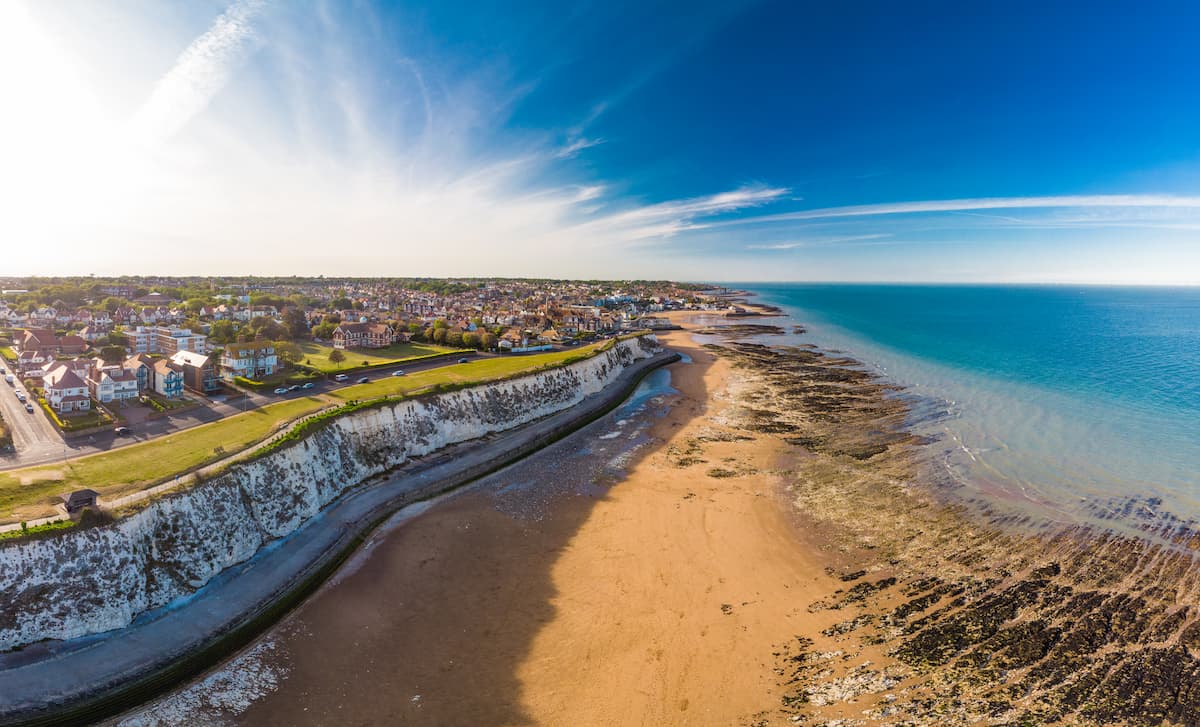
Aerial view of the beach and white cliffs, Margate
Two hours and 40 minutes by coach, Margate is a seaside town on the southeast coast of Kent. Being so close to London, Margate has been a popular seaside resort for at least 250 years, with city-dwellers drawn to its sandy beaches. With all the classic fittings of a traditional seaside town like a theme park, arcades and theatres, the town is also artsy, young and uber cool.
Margate Main Sands is a Blue Flag winning beach. Alongside the huge stretch of golden sands, you’ll find plenty of cafes, attractions and children’s rides. Just behind the beach is the Old Town, full of gorgeous Georgian and Victorian buildings housing independent shops, boutiques, galleries and cafes.
Along the Main Sands you’ll also find Old Kent Market, an indoor market housed within an old cinema building from 1911. Find all sorts of things in here, from food and crafts, to vinyl and cocktails.
A must visit in Margate is Shell Grotto. Discovered in 1835, this mysterious structure consists of 70 ft of winding passages decorated with 4.6 million shells, forming mosaics of gods and goddesses, trees and patterns. No one actually knows why it was built, but there are plenty of interesting theories.
If you’re into the arts then make sure to visit Turner Contemporary, an art museum built on the site of a boarding house in which J. M. W. Turner once lived in. You’ll find ever-changing exhibitions from local and international artists, focusing on art from 1750 to the present day.
If you’re interested in learning more about Margate, the Margate Museum has engaging exhibitions on the evolution of the town as a seaside resort.
Brighton
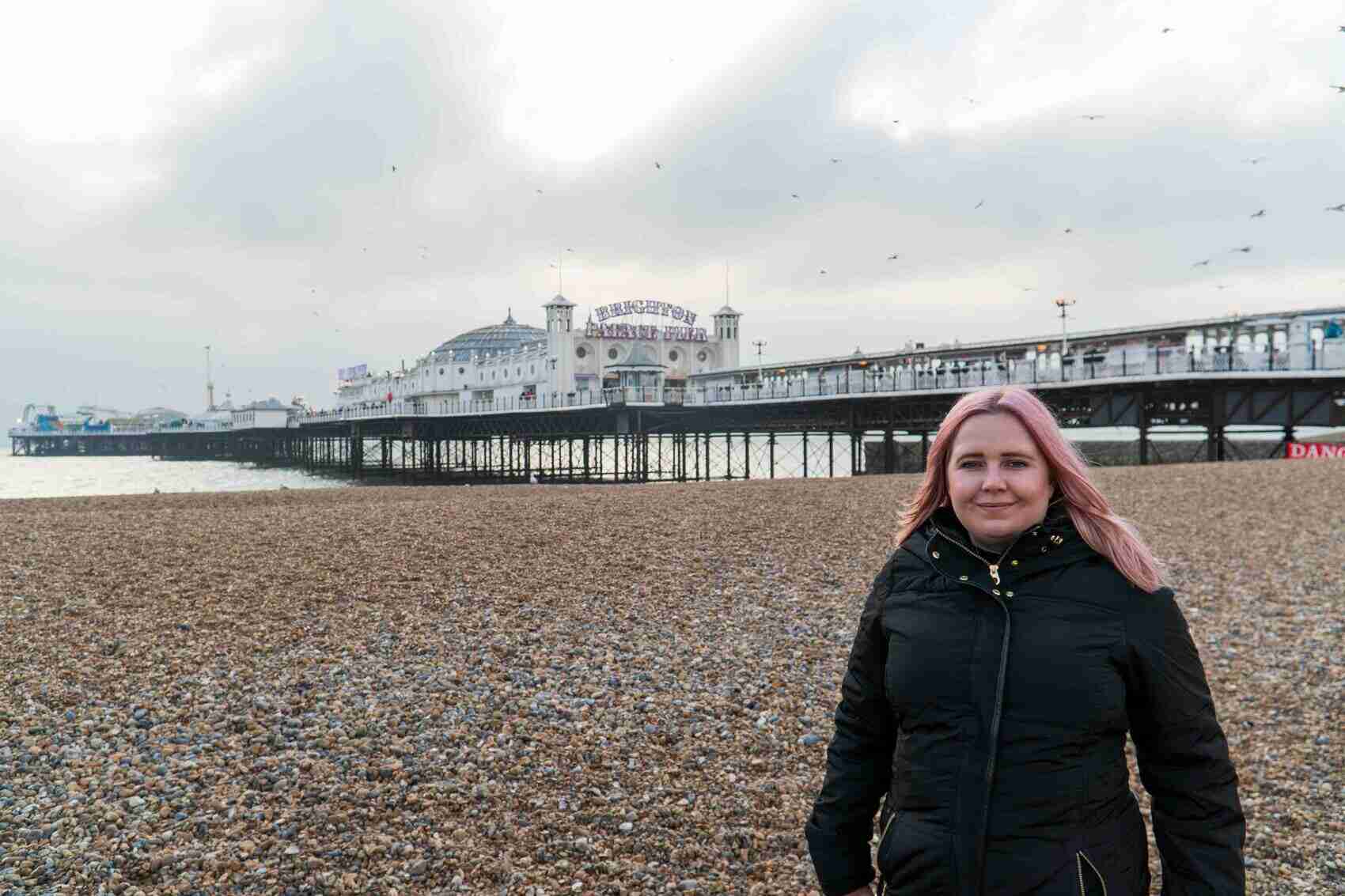
It wouldn’t be a list of London day trips without Brighton. You can get to ‘London-by-the-Sea’ in two hours and 25 minutes from London Victoria. This seaside resort on the south coast of England attracts day-trippers from all over the south for days at the beach, shopping and partying.
It’s home to Brighton Palace Pier, the UK’s biggest tourist attraction outside of London. The pier pushes out into the sea for half a kilometer and has fairground rides, traditional games, two arcades and a giant soft play area. Definitely a must-see.
Down on Brighton Beach and Seafront, you’ll find a pebble beach that stretches over five miles long, as well as plenty of bars, clubs and cafes. One of the most popular attractions on the seafront is the British Airways i360. This observation tower has 360° panoramic views at 162 meters above the city. While you’re there, splash out on a cocktail at the Nyetimber Sky Bar.
If you’re celebrating something, Brighton is the place to be. There are numerous bars and clubs to suit your needs, whether it’s gastropubs, gay bars, live music venues, stylish cocktail bars or mega-clubs. You can find them dotted around the Lanes, North Laine, Trafalgar Street, Churchill Square and Western Road.
Need to find a last-minute gift? Brighton is a fab place for a spot for shopping. The Lanes, once an old fishing quarter, is now a maze of narrow alleys packed with restaurants, cafes, independent shops, boutiques and antique stores. You can also head to North Laine, a hip shopping district with over 300 shops. It’s a particularly great place to find artwork and designs, including glassware, jewellery, ceramics, sculptures and clothing.
Canterbury
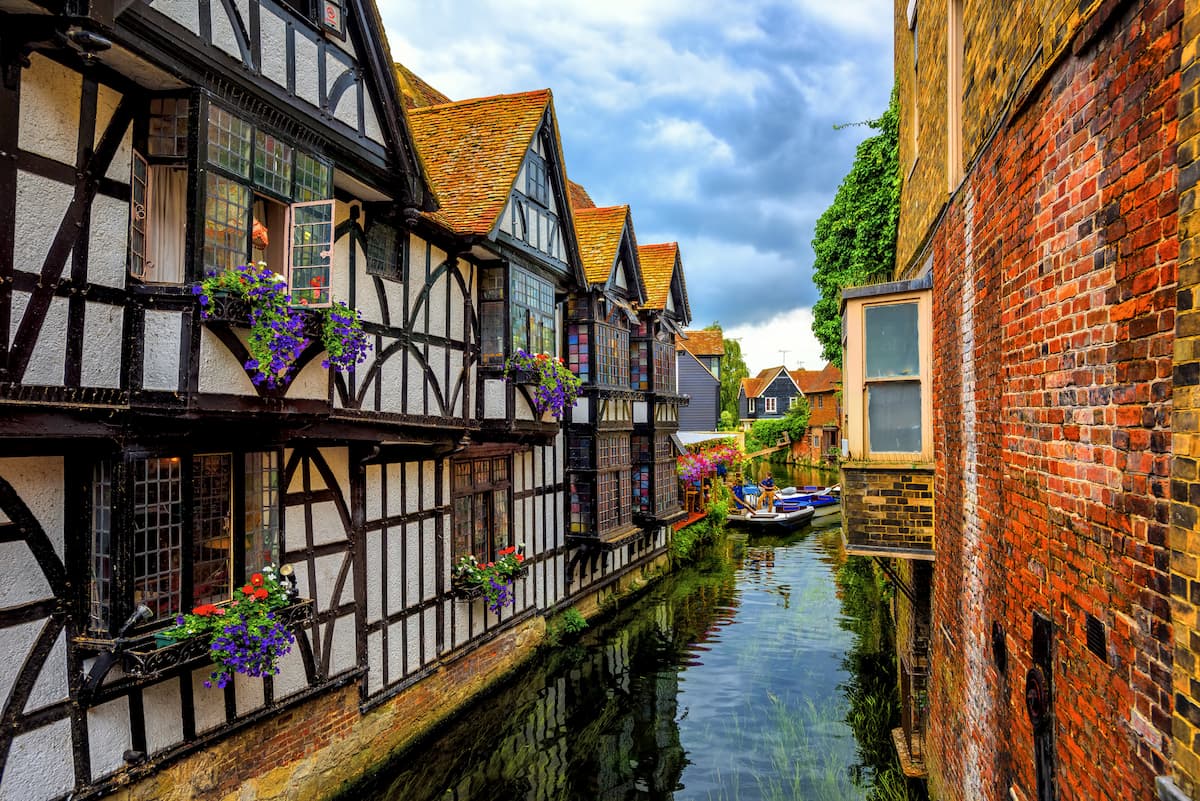
Medieval houses and river Stour in Canterbury Old Town
Just two hours by coach will take you to Canterbury, a cathedral city and UNESCO World Heritage Site. With the River Stour winding through it, Canterbury is a beautiful city with plenty of old buildings and cobbled streets.
No trip to the city is complete without visiting the famous cathedral, one of the oldest Christian structures in England. It’s best known as the site of the murder of Thomas Beckett, killed by King Henry II’s army in 1170. You can take a guided tour of the cathedral and admire the stunning architecture.
The Romans have also made their mark on the city, and you can discover more about their legacy at the Canterbury Roman Museum. Built on the remains of a former Roman townhouse, there are a wide range of artefacts and original mosaics to see.
Another fun museum is the Beaney House of Art & Knowledge. It showcases everything from paintings and ancient Egyptian artefacts, to Anglo-Saxon antiques and pilgrim badges.
Although the city is pedestrian-friendly, a fun way of sightseeing is by taking a boat tour down the river. From this vantage point, you can see landmarks like the Dominican Priory and Greyfriars Chapel from unique angles. After the boat tour, stop off for lunch at one of Canterbury’s many cafes (Cafe St Pierre is one of my favourites), or have a picnic at one of the city’s green spaces.
Westgate Gardens are a huge area of different landscapes including woodland, meadows, formal gardens and riverside. After lunch, catch a show at Marlowe Theatre, Canterbury’s leading performing arts venue. Whatever you’re interested in, whether it’s concerts, dramas, musicals, contemporary dance shows, ballets, operas, comedy shows, you’ll definitely find something you enjoy.
Winchester
Nestled in the rolling chalk hills of the South Downs, Winchester is only one hour and 50 minutes from London. This ancient cathedral city has some of the country’s oldest institutions.
The best place to start is Winchester Cathedral, and at over 170 metres long, is the world’s longest Gothic Cathedral. Step inside and discover over 1,000 years of history. Admire the 12th century wall paintings, medieval carvings and the illuminated Winchester Bible.
Another stop you should make is the Winchester City Museum. Dating back to 1861, the museum has exhibits on historical Winchester, Jane Austen, the Romans and the Anglo-Saxons. While you won’t be able to see Winchester Castle in all its glory, you can still see the Great Hall, which is all that remains. One of the best remaining medieval halls in the country, the Hall has beautiful stained glass, marble columns and the perfectly manicured Queen Eleanor’s Garden.
As the city is surrounded by the South Downs, it would be rude not to get out in nature. While a long hike might not be practical on a day trip, there are still plenty of short walks in and around Winchester. One of the best ones is Watermeadows and St Catherines Hill. As you wander along the River Itchen, you’ll be spoilt with lush scenery and some of the city’s most dramatic landmarks.
Cambridge
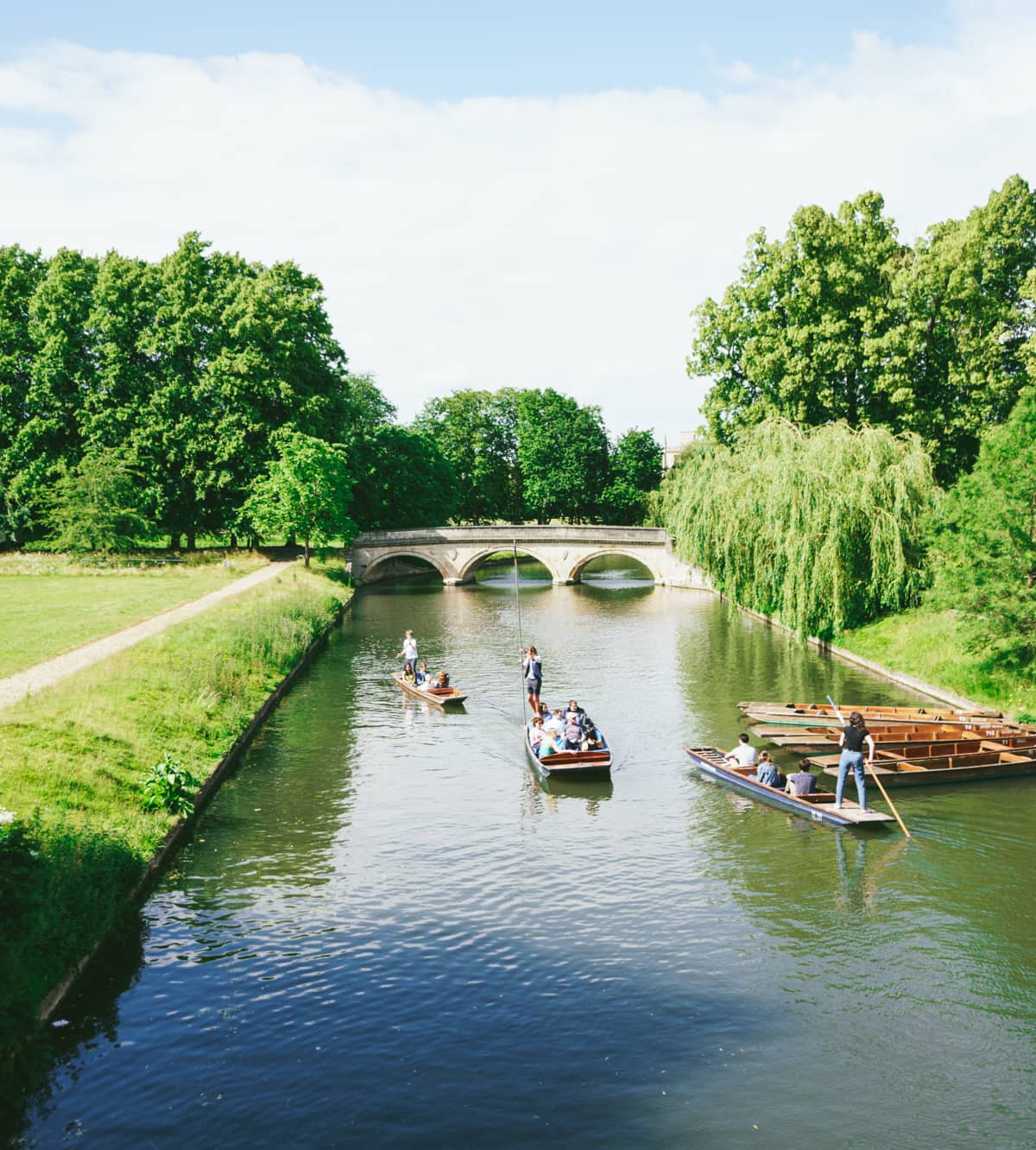
Punting Down the River Cam
While it may be more touristy than the other destinations on this list, you could argue that it’s popular for a reason. A two hour and 15 minute coach journey from London takes you to one of England’s finest cities.
Synonymous with the world-renowned Cambridge University, the city boasts culture, history, architecture and plenty of things to do. If you want to learn more about the university, official tours of the colleges are offered by Blue Badge Guides. See exclusive parts of the campus and learn more about its history and quirky customs.
Speaking of history, the Fitzwilliam Museum is the best place to step back in time. The museum is far from boring – it’s home to over half a million pieces of art that dates as far back as 2,500 BC. Whether it’s paintings, ancient artefacts, jewellery, textiles, arms and armour, the museum has it all.
If it’s a sunny day, one of the top activities in Cambridge is punting. A punt is a flat-bottomed boat that is propelled down a river by a punter. First introduced at the start of the 20th century, it has since become a popular local activity. Glide down the River Cam and see how many landmarks you can spot (spoiler: you’ll see King’s College Chapel, the Mathematical Bridge and the Bridge of Sighs).
Another fun activity is visiting the Cambridge University Botanic Garden. Stretched over 40 acres, this heritage garden boasts over 8,000 plant species from all around the world. The gardens are divided into different sections, including the Mediterranean Beds, Scented Garden and Stream Garden. There are also several glasshouses full of tropical rainforests, desert flowers and alpine flora.
Salisbury
Two hours and 30 minutes by coach from London is Salisbury. This city is mostly known for one of the most famous visitor attractions in the UK, Stonehenge. It’s less than 10 miles from Salisbury, and you can get a coach tour from the city centre if you wish to visit it.
Salisbury offers a lot more than just Stonehenge. The medieval cathedral city and its surrounding area is bursting with Neolithic, Bronze Age and Iron Age history, so there is plenty of history to explore. Salisbury Cathedral is a must-see. At 123 metres, this magnificent Gothic cathedral currently holds the record for the tallest spire in the UK.
It’s also home to the largest cloister in the country, as well as housing one of the oldest working clocks in the world. If you can hack the 332 stairs, the tower tours are a must. The cathedral is home to the Magna Carta Chapter House, where the best-preserved copy of the 1215 Magna Carta lies. This is just one of four originals in the world and is definitely worth a viewing.
If you’re interested in historic houses, then Salisbury doesn’t disappoint. Mompesson House is a townhouse constructed in the 18th century. Look out for the stucco work on the walls and ceiling, the oak staircase and period furniture.
Arundells is another beautiful home, once the residence of former prime minister Sir Edward Heath. Guided tours are available and there are plenty of interesting things to see, including Heath’s personal collections.
On a sunny day, there’s nothing better than a walk through Harnham Water Meadows. A source of inspiration for English painter John Constable, you can trace his footsteps on a two-mile circular walk that sets off from the cathedral. Sit beside the river and admire the lush views over to the cathedral.
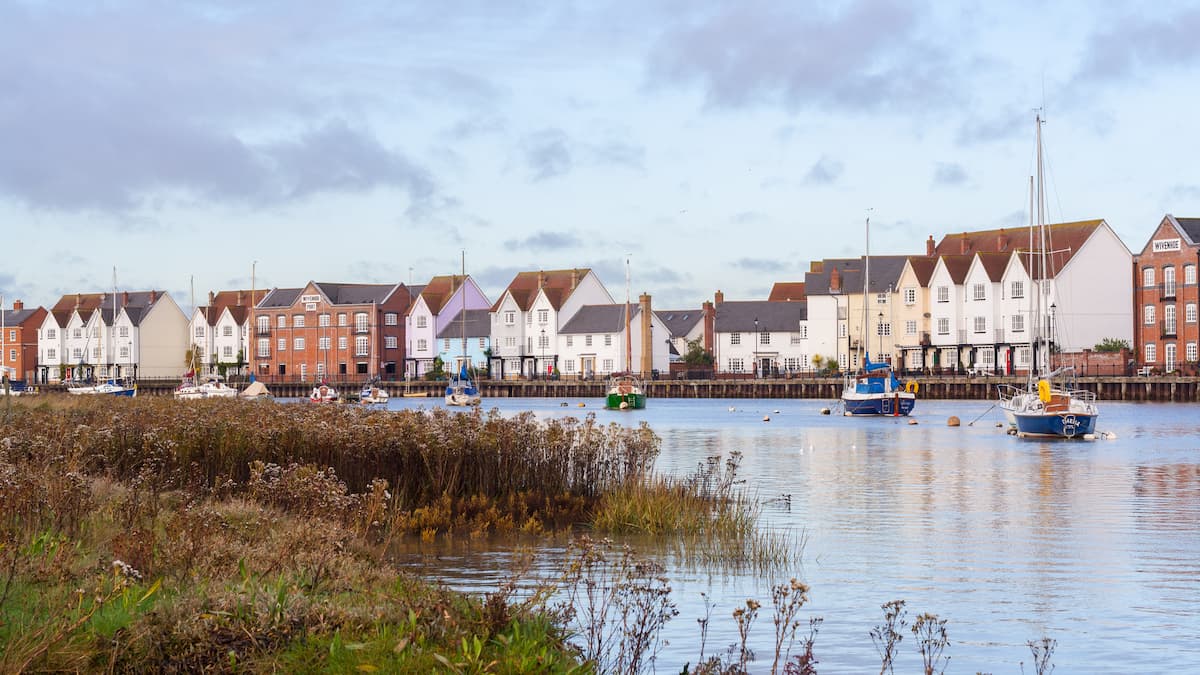
Folkestone
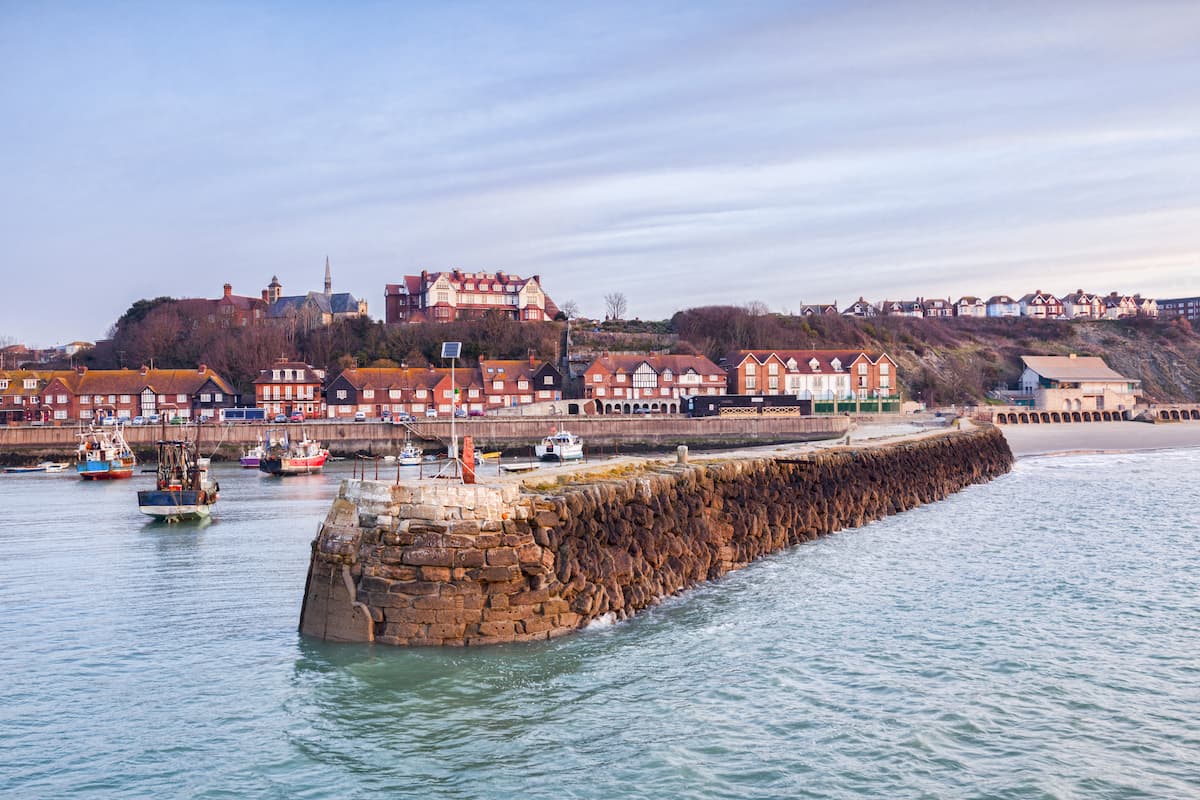
Folkestone Harbour and Jetty
Two hours and 35 minutes from London is Folkestone, a lovely seaside town in Kent. Right on the southern edge of the North Downs, the town lies in a valley between two cliffs. This position made it an important harbour and shipping port during the 19th and 20th centuries.
Today, there are plenty of things to explore in the town, from Victorian architecture and waterfront parks, to a bustling harbour and exciting attractions. The main beach in Folkestone is Sunny Sands, a clean, sandy beach popular all year round. On the cliffs right above the beach is The Leas, a pretty promenade landscaped in the mid 19th century.
Along the promenade you’ll find cafes, monuments and the Leas Cliff Hall Theatre. If you don’t fancy the zig-zagging steps up to the promenade, you can also take the cliff lift. One of the main attractions in Folkestone is the Harbour Arm. Until the turn of the millennium, this structure was used as a transport hub that linked Folkestone to mainland Europe. It fell into disuse for a number of years, before recently being rejuvenated. It’s now the best summer dining destination, with street food stalls, semi-permanent eateries and live music. You can even watch movies and sporting events at the Harbour Screen.
Within the historic town centre, you’ll find the Folkestone Creative Quarter. It’s home to a collection of galleries, artists’ studios and performance spaces, as well as quirky shops, cafes and restaurants. There is also the Quarterhouse, a performing arts venue with live music, film screenings, comedy and plays. To learn more about the history of the town, the Folkestone Museum covers five main themes: fashion, frontline, maritime, natural and ancient, and is a great place to spend an hour or so.
Folkestone is surrounded by natural beauty, and getting outside is a must. Towards the east of the harbour is East Cliff and Warren Country Park, a 300 acre park and Site of Special Scientific Interest. As you walk along the paths, enjoy stunning views of the famous White Cliffs. Don’t forget to look down too, as this is one of the best places to go fossil hunting in the South East.
Southampton
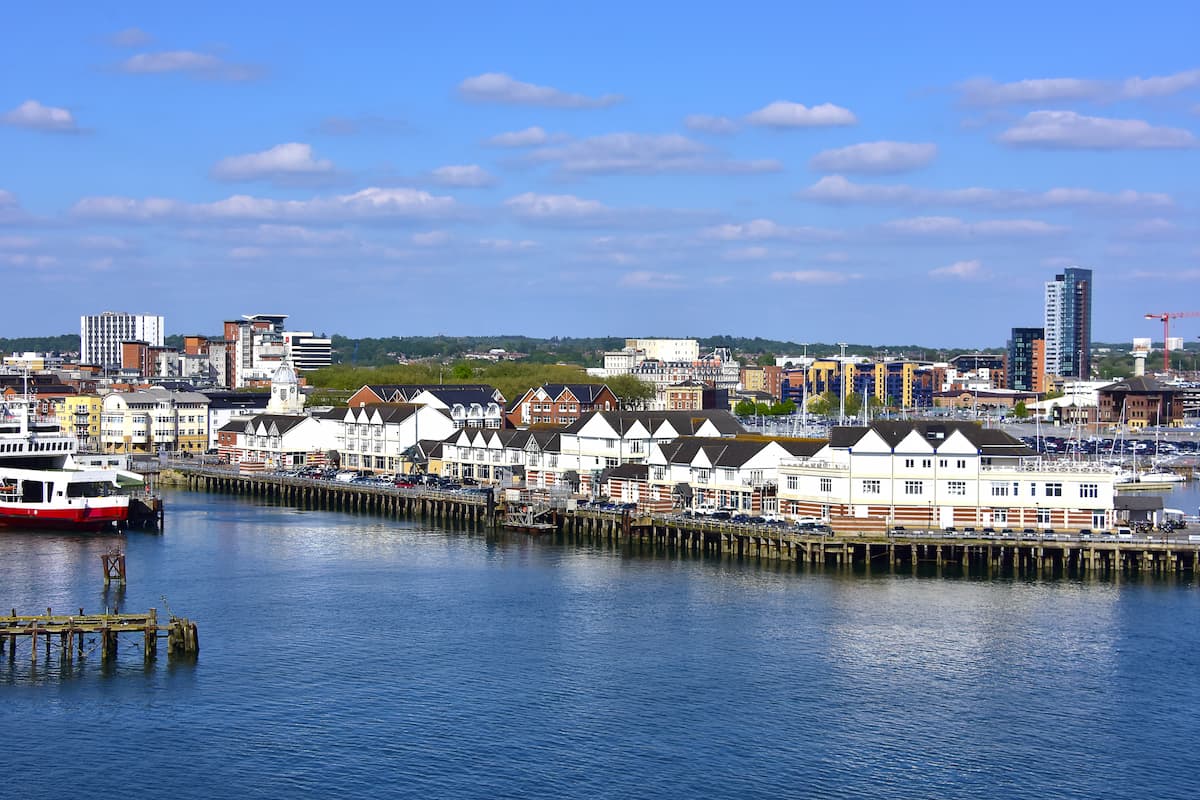
Southampton England
Southampton is two hours and 20 minutes away from London by coach. Hampshire’s largest city, a visit to Southampton is a fantastic day out as there are plenty of things to do and see. The ill-fated Titanic departed from here and on the 100th anniversary of its departure, the SeaCity Museum was opened. Find out about Southampton’s history as a key port, and hear the stories of the people and goods that travelled through the city since the Middle Ages.
Another interesting museum is the Solent Sky Museum. In the early 20th century, the city was home to the aviation manufacturer Supermarine who designed the Spitfire fighter plane. The museum showcases the story of the Supermarine brand, and you can check out the vast collection of planes, propellers and jet engines.
A fun way to see Southampton is from a ferry. With frequent departures from Southampton Town Pier, the Hythe Ferry makes a short, scenic trip over to the village of Hythe on the west side of the estuary. The trip also includes a ride on the world’s smallest gauge electric pier train, dating back to the First World War.
One of the main draws for culture vultures is the Mayflower Theatre. This 2,300 capacity theatre first opened in 1928 as the Empire Theatre. Catch theatre productions, musicals, operas and stand-up comedy.
If you’re keen to see some art, the Southampton City Art Gallery has one of the best art collections in the south of England, with up to 5,000 pieces of art covering eight centuries.
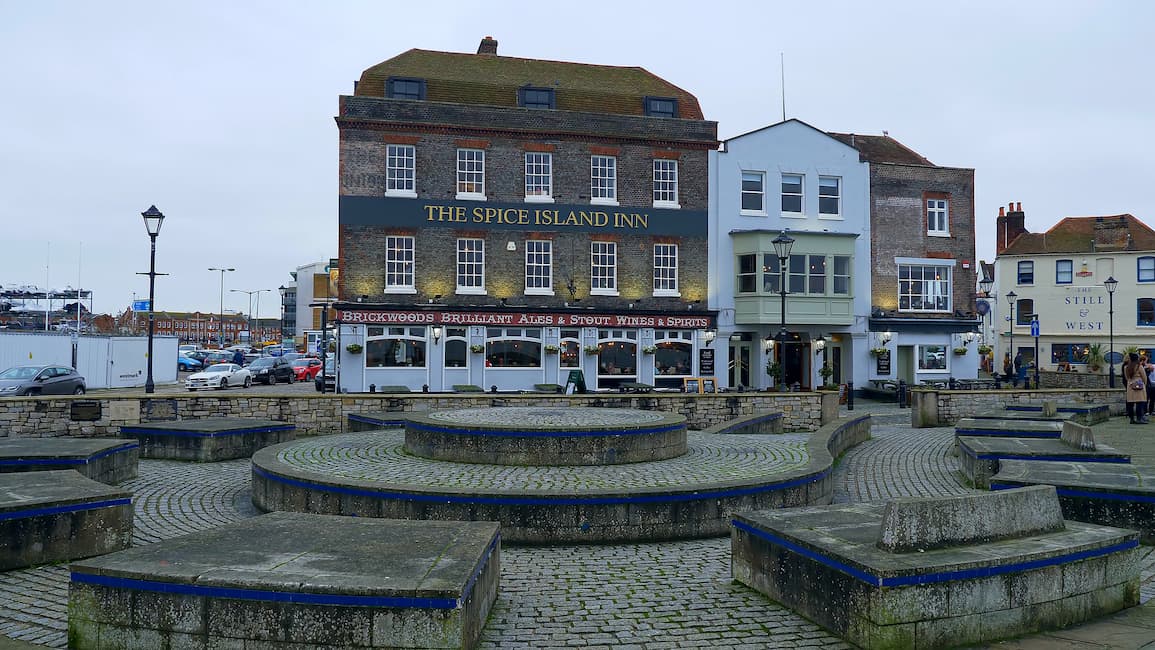
Portsmouth
In just two hours, you can get from London to Portsmouth, a historic port city. There are tons of interesting attractions here, from museums and castles, to beaches and shopping. Portsmouth has been a significant naval base for centuries, and two thirds of the Royal Navy’s modern surface fleet is docked here.
There are many ways you can explore this city’s rich maritime history. Portsmouth Historic Dockyard is an area of the HM Naval Base that is open to the public. You’ll find a collection of historic buildings and some of the most famous ships, like the HMS Victory, HMS Warrior and the HMS M33 which fought in the Battle of Gallipoli. You’ll also find the Royal Navy Submarine Museum, the Explosion Museum of Naval Firepower, National Museum of the Royal Navy and the Mary Rose Museum.
Once you’re clued up on your naval history, take a break along the seafront. The beach stretches along the entire southern end of Portsea Island, from Old Portsmouth to Eastney. One of the best attractions along the seafront is Southsea Castle. Built in 1544, the castle was constructed by King Henry VIII as part of a series of fortifications to protect the country from invaders. Explore the keep and enjoy panoramic views from the top all the way over to the Isle of Wight. Another interesting attraction along the seafront is the D-Day Story. This museum tells the story of the Allied invasion of Normandy in 1944, where Portsmouth was a key embarkation point. See the collection of artefacts including tanks, jeeps and machine guns.
Portsmouth is a shopper’s paradise, with countless boutiques, markets and unique finds. Gunwharf Quays is a great place to find designer goods. It’s also the site of the Emirates Spinnaker Tower which offers stunning views across the city and sea. Commercial Road and Cascades Shopping Centre is also a fab place to find bargains. You can also take a short bus journey to Southsea which has plenty of antique shops, boutiques and independent stores.
One of the best ways to see what England and Scotland have to offer is by completing a self-drive road trip from London to Edinburgh. Today, I’ve added all my favourite places for the ideal London to Edinburgh road trip, full of the best stops along the way.
The two itineraries cover everything from historic towns, Area of Outstanding Natural Beauty, UNESCO heritage sites, film locations and much more!
Starting your trip in London without a car (honestly, you don’t want the headache of driving there) then choose whether you want to do the east or west route of England before ending up in Edinburgh. Unless you live here and have no choice but to drive through London.
If you have enough time make sure you do the full loop and soak in what England and Scotland have to offer.
I am so excited to share all the things I love about these countries! Let’s get started!
Things to Know Before Driving From London to Edinburgh
If you are looking for the best options for car rental then I always use Europcar or Enterprise cars in the UK.
For my great British road trip, I used Europcars long rental option which gave us the car for half the price for 28 days, unlimited drivers and delivered to my door! The only drawback to this option is we were limited to 2,520 miles which just covered our round trip. There is another option at 3,360 miles.
Don’t forget to take out a travel insurance policy before travelling, even if you are local this will protect your belongings whilst you travel. I always like to use World Nomadsfor my travels – get a quote from WorldNomads here.
Other things to know before travelling:
Don’t rent a car in London! – Chances are that you will be staying in Central London (unless you live here then skip to option 1 and 2 routes) and it’s honestly a total nightmare to drive here. Not only that there are congestion charges which cover quite a large radius. For each option I have added a recommended airport to pick up a rental car, this will save you driving time and the stress of driving in London.
Fill-up at supermarket petrol stations – Asda, Morrisons, Sainsburys, Tesco etc. will all offer cheaper petrol by some margin. If you stop at any of the petrol stations along the motorway you could easily see prices increased by 10 to 20 pence per litre!
Choose to either drive the East or West Route – I’ve split the itinerary into two routes as it’s more logical to follow these routes rather than zig-zagging across the country.
Overloading your trip – Try not to cram half of England and Scotland into a two-day trip otherwise you will not see much apart from the road.
Don’t drive from London to Edinburgh in one go – Unless you are familiar with driving long distances I don’t recommend trying the 8-hour drive. As someone that grew up with long distant driving across Australia, I still struggle with driving over here and recommend at least having 1 overnight stop. Plus you will be missing all the amazing things to see driving straight there!
Potential Tolls – Some routes suggested can have tolls but I have found these pretty easy to avoid. Check Google maps before driving and it will highlight toll roads. For example, the M6 has one (west route) however, you can just take the non-toll M6 route to save the money.
Download Parking Apps – A lot of parking around the country is paid and I am not sure about you but I never really carry cash any more. Download these apps before hitting the road; Just Park, Pay by Phone and Ring Go. They were by far the most frequent ones I encountered. Another way I have saved money with parking in cities is by booking in advance on Just Park. Weirdly in Bristol, it was cheaper to pay for a week’s worth of parking than two days!
English Heritage – If you’re interested in visiting a bunch of different historic sites, you can purchase an Overseas Visitors Pass or if you’re living in England a yearly membership. Not only does this save you money at each individual place it includes parking! Valid at over 100 places, you can choose between a 9 or a 16 day passes.
Start in London: 2 Day Itinerary
Before starting your road trip to Edinburgh it’s time to explore London! It’s a good idea to stay somewhere within close proximity to attractions and activities so here are some of the best places to stay in London.
Looking for something a little more off the beaten path to visit in London? Here is a list ofalternative things to do in London that will not disappoint!
Psstt… To make the most of your time in London make sure you read my London sightseeing tips to get the most of your time in the city!
Day 1: West of London
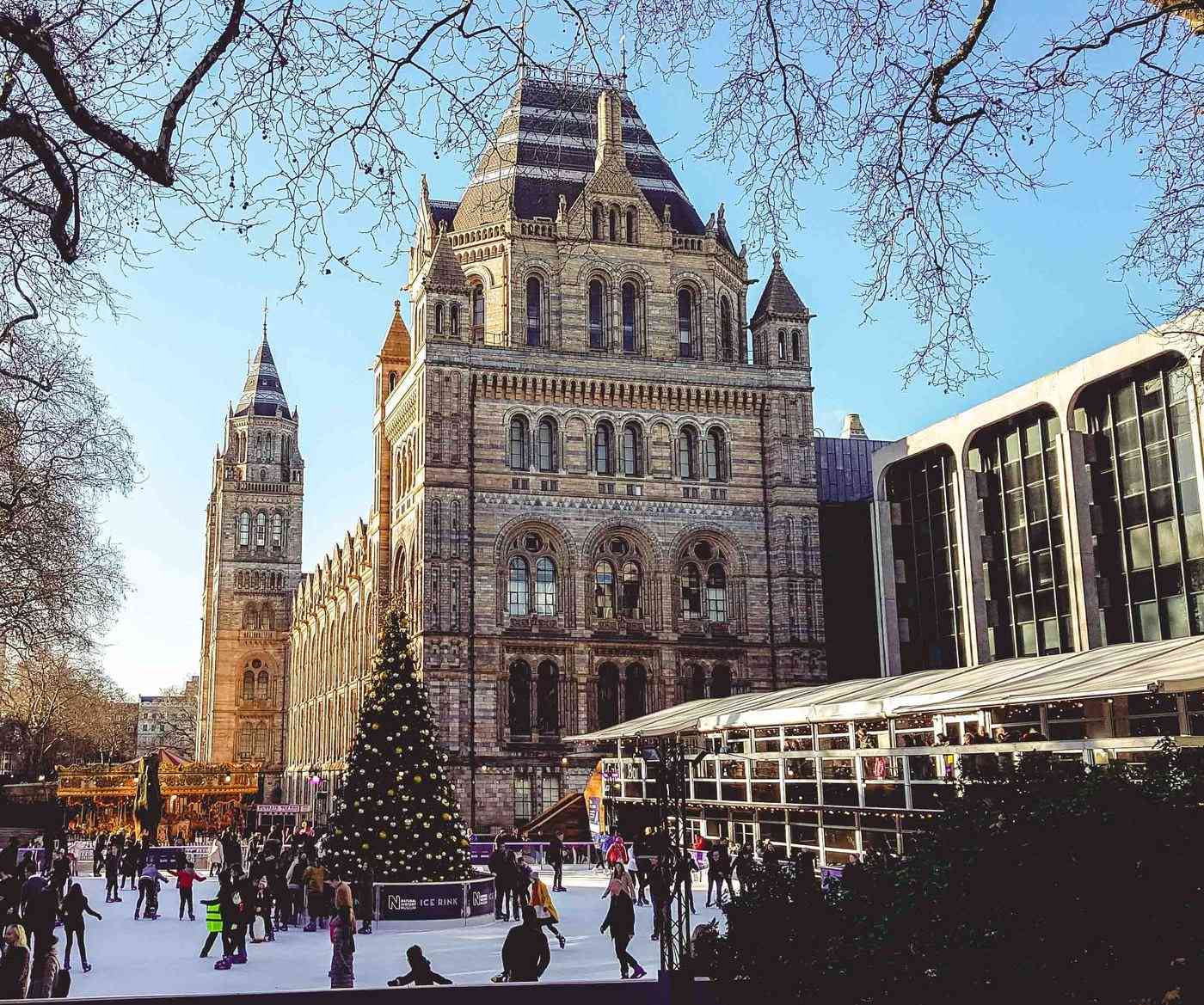
Christmas time at Natural History Muesum is such a magical time.
Start the day by going to Kensington and pick one of the fantastic free museums:
Natural History Museum – In my opinion this is the best museum in London. I always think of David Attenborough speaking whilst I am walking through the gorgeous building learning about dinosaurs.
Victoria and Albert Museum
Science Museum
If you get there by 9am you will beat all the crowds and fewer crowds means you will be able to walk around faster.
Next walk through Kensington Palace & Gardens, through Hyde Park finally reaching Buckingham Palace. If watching the changing of the Guards is on your list then make sure you get to Buckingham Palace by 10:45 (I also have some tips in my London sightseeing tips on the best spot to watch this). I would say it would be impossible to do the changing of the Guard and a muesum so if it’s high on your list choose one or the other.
Afterwards head to Westminster Abbey and Big Ben before crossing Westminster Bridge to Waterloo.
Once you’re in Waterloo you can explore Leake Street Tunnel which became a famous street art spot after Banksy hosted the Cans Festival there in 2008. It’s the largest area in London for street art so it’s frequently having new pieces added or replaced.
Ready for a drink? The Waterloo Tap is also a short walk from Waterloo Station and set up in a converted railway arch, this funky bar boasts 20 kegs and 6 casks on constant rotation. They also serve bar snacks but not full meals.
Head back to the Thames path (i.e. The Queen’s Walk) and you’ll arrive at the London Eye. Make sure you read my guide on what to book in London where I cover everything you need to know about booking the London Eye.
Continue east down the Thames and you will see either the Underbelly Festival (summer event) or Rekorderlig Cider Lodge (winter event). There are lots of stalls that offer food and drinks, alternatively there plenty of restaurants around the Southbank.
Cross back over the Golden Jubilee Bridge to Embankment. Just a short way up Villiers Street you will find Gordon’s Wine Bar which is a 19th-century wine bar in a candlelit vaulted cellar. It’s lovely to grab a glass of wine here and just relax your feet for a bit.
Finish your day off in Covent Garden and Soho. There are lots of bars, restaurants and theatre options in the area, plenty to keep you entertained for an evening!
Day 2: East of London
Here’s an example of one of the street art peices you can see in Shoreditch.
Start the day off at St Paul’s Cathedral, on the weekend the area is super quiet apart from the tourists in the area. For a great view head to One New Change and go to the viewing platform.
Afterward, you can go by the Monument which commemorates The Great Fire of London, decide whether you want to climb the 311 steps or just have a sneak peek at it.
Cross London Bridge to Borough Market. Everyone gets confused with London Bridge and Tower Bridge. The first one is the functional one and Tower Bridge is the beautifully designed bridge originally opened in 1894 which you can see across the Thames from London Bridge.
Have a late breakfast or early lunch (brunch) stop at Borough Market. I am always overwhelmed by the choice of food options. It suits all dietary requirements as well!
Head back to the Thames Path and you will pass HMS Belfast, get a great photo opportunity of the London Skyline before crossing Tower Bridge.
Once you are finished the next place is the Tower of London! If you decide to go inside check out the 2 for 1 on Days Out Guide or buy tickets online to save a little bit of money.
Shoreditch is a great place to stop for food, find street art, have a drink on a rooftop, explore BOXPARK for food and shopping or find a secret bar like the Mayor of Scardy Cat Town.
Brick Lane is known as the curry mile and to really get the authentic feel you need to haggle for Indian food. Otherwise, head to one of the amazing restaurants like the famous Dishoom. If you’re lucky enough to be there on Sunday then Brick Lane hosts markets full of food stalls until 5pm.
East and West England Routes to Edinburgh
Both of these routes can be customised to how many days you have available to you. As a minimum give yourself two days to allow two pit stops and one overnight stay somewhere. Seven days will truly allow you to see the best of both routes and if you want to do the loop then allow at least 14 days!
This is not including the days you wish to spend in London and Edinburgh.
Option 1: East England Route to Edinburgh
The best place to pick up a hire car for option 1 is Stansted Airport. This will cost a little bit more money to get to if you’re catching the train as it’s a National Rail line, however, booking your tickets in advance or getting the coach will save you money.
The east route will mainly take you on the A1 and A1(M)/A1 to Edinburgh.
Cambridge
Drive: Roughly 1hr 30mins depending on where you start your journey in London.
Cambridge is one of the most well-known cities in England, and it’s easy to see why it is so popular with tourists! The city has some of the most amazing architecture in all of England and a world-famous university as well. Due to the large student population there is so much to do as well as numerous great places to eat and drink in the centre of the city!
There are many things that are fun to do when you visit Cambridge, but an absolute must-try is the famous punting! A punt is a flat bottomed boat, which is used for leisure time and pushed across the water using a quant pole. This is a popular method of seeing some of the Colleges on the university, as well as the Bridge of Sighs which is very popular among tourists.
Some other popular tourist attractions in Cambridge include:
King’s College Chapel – A huge and stunning chapel with beautiful ceilings and carvings.
The Botanic Gardens – The gardens are home to several greenhouses and a seriously impressive collection of different plants!
Mathematical Bridge – Officially known as the Wooden Bridge, this is one of the most famous bridges in the UK due to its unique design and structure.
St. John’s College – If you want to see the most incredible college in Cambridge then this is certainly one of the most impressive. It is known across the UK for its annual May Ball, one of the best parties going!
Just to bear in mind that the preferred option for parking in Cambridge is to park and ride. Unless your accommodation offers parking as a part of your stay.
Stamford
Drive: 55 minutes from Cambridge.
Fancy a quick stop off in a picturesque and historic town? Why not take a drive to the cobbled streets of Stamford, the gorgeous Georgian town in Southwest Lincolnshire. You may not have heard of the town before, but you’re sure to recognise parts of it, such as Burghley House, if you’ve seen the films Pride and Prejudice or The Da Vinci Code as it was used as a filming location in both.
Stamford is the kind of place where you can simply wander; behind every corner and down every alley is more stunning architecture to see. The town is incredibly walkable and has many pretty churches, such as St Mary’s Church (12th century) and All Saint’s Church (13th century).
Sheffield and the Peak District
Drive: 1hr 30mins from Stamford.
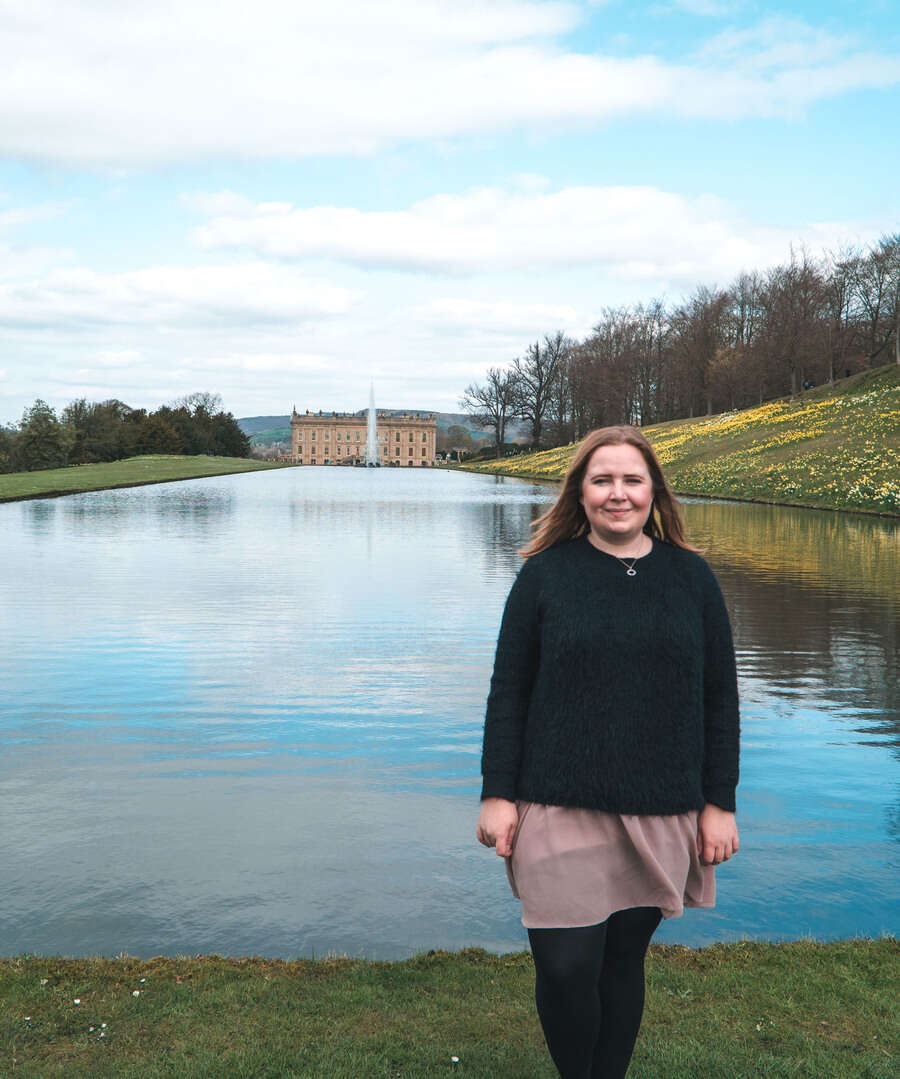
Kat standing in front of the lake with Chatsworth House in the background.
Sheffield is one of the greenest cities in the UK, and is right on the doorstep of the Peak District National Park.
The Peak District offers many opportunities for outdoor activities such as hiking, paragliding and rock climbing – what’s not to love? It’s also the UK’s first ever National Park back in 1951.
For a nice and easy stroll, I suggest the Mam Tor Walk trail which takes you to one of the Peak’s most iconic views. This 4.5km circular route is steeped in ancient history and you’ll be rewarded with views of the Vale of Edale, Peveril Castle and the Hope Valley.
The world famous Chatsworth House was used as Pemberleyin Pride and Prejudice; Hardwick Hall was used as Malfoy Manor in the Harry Potter films and the medieval Haddon Hall was used in Kit Harrington’s Gunpowder.
If the great outdoors isn’t for you, there are plenty of other things that Sheffield can offer:
For a spot of shopping go to Meadowhall.
Sheffield has the largest theatre complex outside London, the two major theatres are the Lyceum Theatre and the Crucible Theatre.
Visit the tropical butterfly house which is popular with the locals.
Visit Our Cow Molly which is a working dairy farm and makes delicious icecream.
Leeds
Drive: 50 minutes from Sheffield.
Leeds is a thriving city and one of the larger cities in England. It’s a hub for art, culture and history so the city offers something for everyone.
For museums and art galleries, I recommend visiting:
Royal Armouries Museum
Leeds City Museum
Thackray Medical Museum
the National Coal Mining Museum
Leeds Art Gallery
Henry Moore Institute
The Tetley
Microbreweries have really popped up all over the UK in the last few years and Leeds has some you should add to your list. Many of the breweries will hold tours and tasting. Some of the most established ones are Leeds Brewery, Northern Monk and North Brewing Company.
York
Drive: 40 minutes from Leeds.
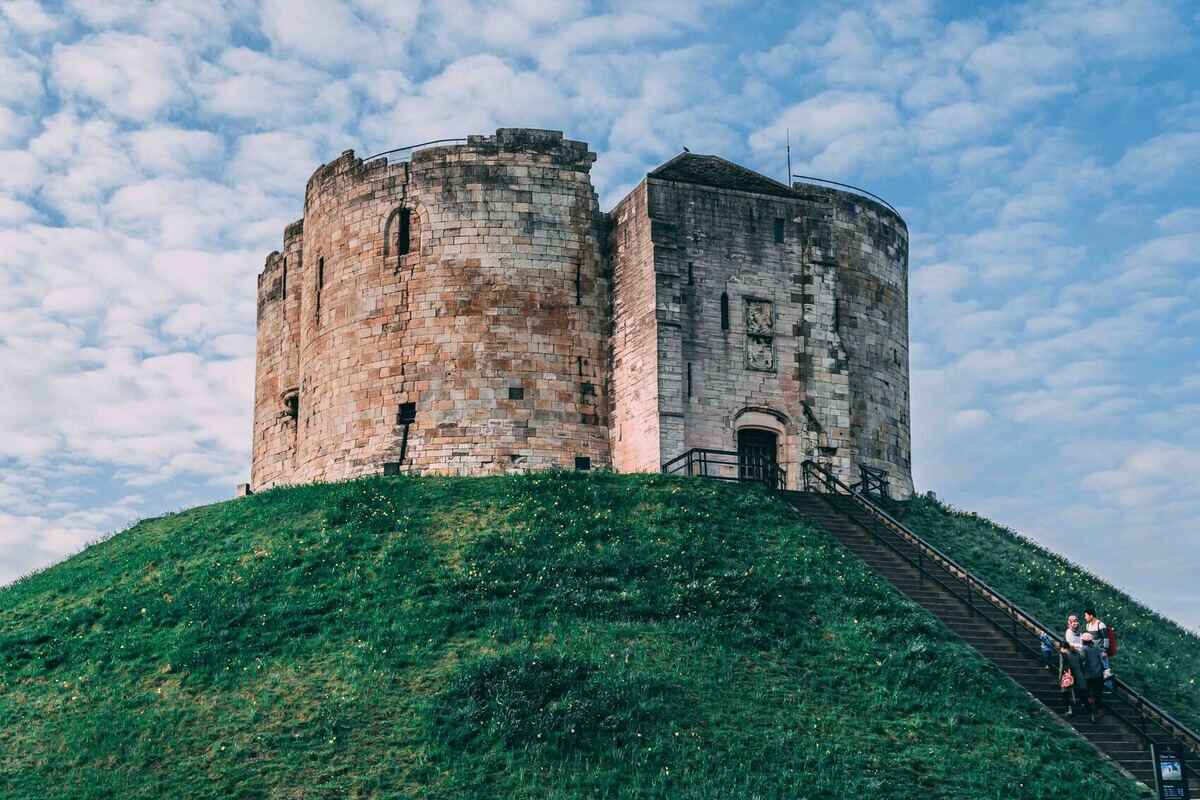
Clifford’s Tower, North Yorkshire
Step back into medieval times with York’s winding cobbled streets, magnificent cathedral and stone walls surrounding the city. The best thing about York is that everything is within walking distance so it gives you a break from all that driving.
Things to add to your list include:
Walking the city walls
Climbing Clifford’s Tower
Rascal buns at Betty’s tearoom
Walk down the Shambles to see the beautiful shop fronts
If you happen to be in York on the first Friday of the month then you need to visit York’s Farmers Market
Newcastle-Upon-Tyne
Drive: 1hr 40mins from York.
Newcastle has a great reputation for its lively atmosphere and friendly people. There are numerous cocktail bars, trendy clubs, traditional pubs and restaurants all over the city.
The city gets its name from the fortress sitting on the River Tyne which you can go and see as a part of your tour, including the great hall and the view from the roof. To learn more about the history of the city check out the Laing Art Gallery. Alternatively visit the Discovery Museum which gives an interesting account of Newcastle’s background in shipbuilding and coal mining, and how that evolved over time through technological innovation.
Here are a few more sights to check out:
BALTIC centre for contemporary art
Live theatre – check out a theatrical performance
The Biscuit Factory – a great art gallery and awesome brunch spot
St. Nicholas Cathedral
North Berwick
Drive: 2hrs from Newcastle Upon Tyne
This is one of the most stunning towns in Great Britain offering beautiful beaches, amazing food and a great castle! Here are some of the best things to do:
The Scottish Seabird Centre – See a variety of birds at this charitable research centre which dedicates itself to protecting indigenous wildlife in the area. You can also take a boat tour at some times of the year to see some seabirds in the wild! Depending on the season you may even see puffins!
The Lobster Shack – This is known to be one of the best places in the area to enjoy a fresh catch right from the ocean! Enjoy a half lobster and chips and appreciate how incredible the fresh produce is!
Tantallon Castle – The castle ruins sit right on the Firth of Forth overlooking the sea. It has a rich history of sieges and feuds dating back to the 14th century!
Bass Rock – This famous rock sits proudly in the Firth of Forth and is a site of special scientific interest due to the fact that it homes the world’s largest local gannet colony.
Yellowcraig Beach – This is a gorgeous beach that should not be missed on your travels – it makes for one of the most stunning coastal walks in the area!
Option 2: West England Route to Edinburgh
The best place to pick up a hire car for option 2 is Heathrow Airport. It will save you driving through London and therefore is a lot less stressful!
Windsor Castle (Stop en route to Oxford)
Drive: 40 minutes from Heathrow Airport.
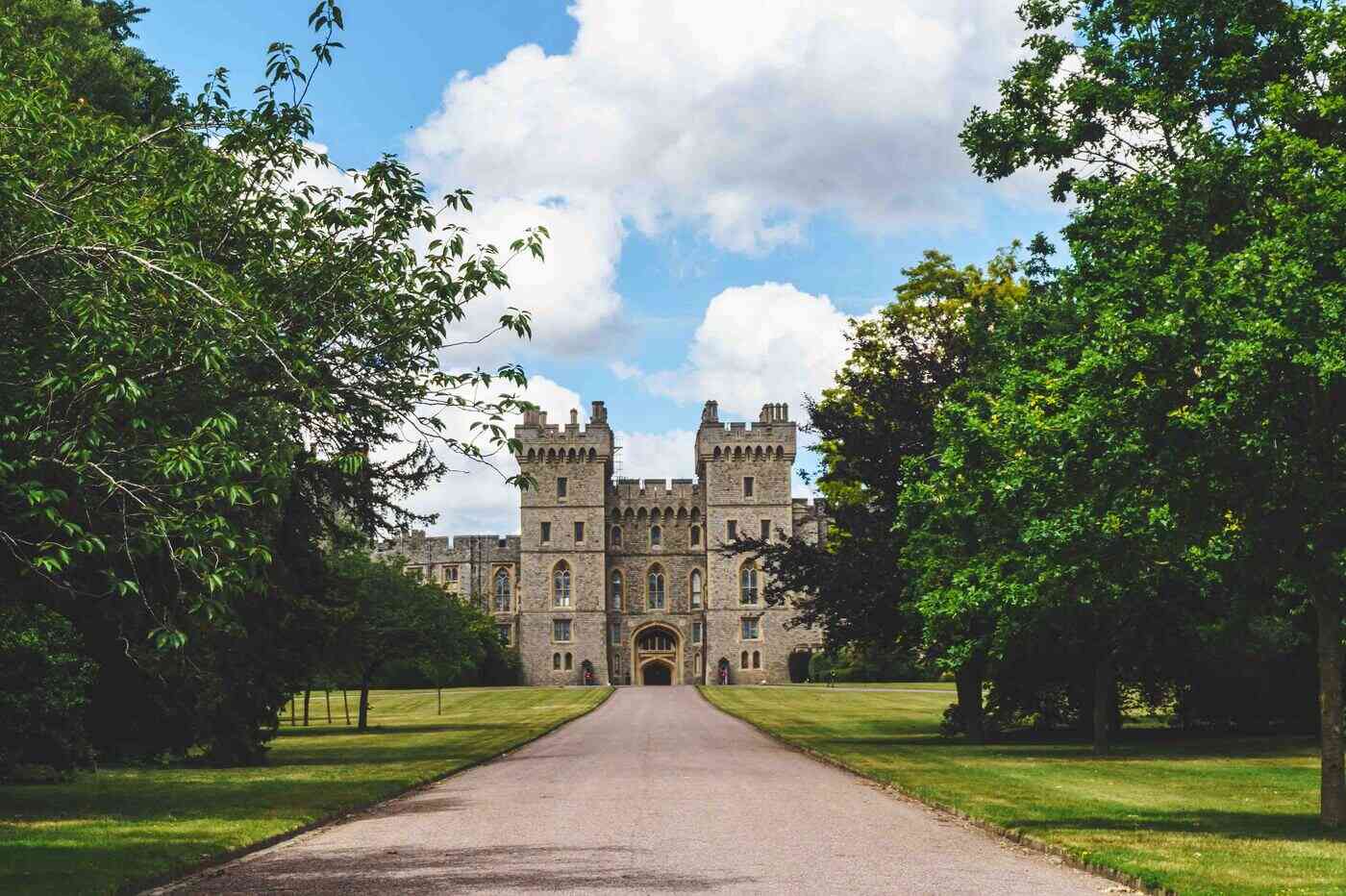
The view of Windsor Castle from the entrance gates.
Windsor is a stunning town and walking through it on the way to the castle is an absolute treat in itself. And the awe certainly does not stop when you reach the glorious 1,000-year-old castle. To explore the castle and its grounds in full, it will take around two hours. The highlight of visiting the castle is certainly the beautiful St. George’s Chapel where the Duke and Duchess of Sussex were married in 2018.
Windsor Castle is open Thursday to Monday, entry times start at 10am and the last admission at 3.30pm. Buy tickets to Windsor Castle here.
Oxford
Drive: 50 minutes from Windsor.
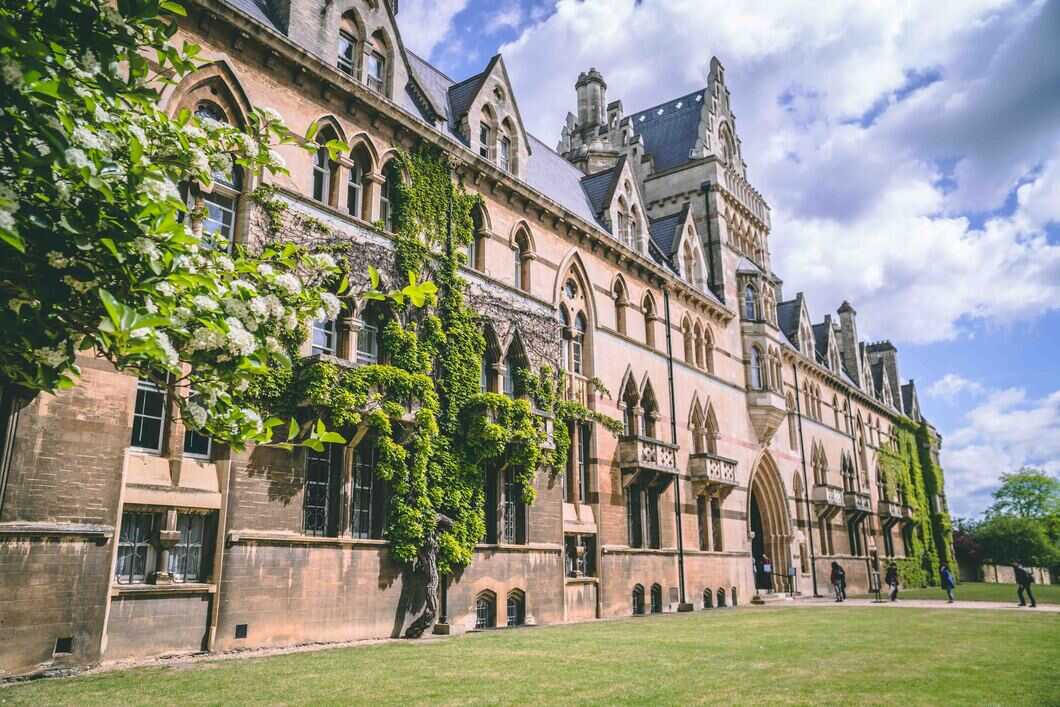
Christ Church in Oxford
One of the best things about Oxford is that you can see the city on foot, from the most famous colleges, to historic pubs, to the many free museums.
The historic Oxford University was first established in the 12th century and is the oldest speaking English university in the world. The university does not have a campus so you will see the buildings spread across the city.
Famous works of literature were written in Oxford such as Alice in Wonderland, The Lord of the Rings and the Chronicles of Narnia.
After exploring the town, why not take some time to visit Highclere Castle which is very nearby. You may recognise the castle from the opening scenes of popular period drama Downton Abbey, and it certainly lives up to how excellent it looks on screen. The castle was built in the 17th century and encompasses 5,000 acres of land that you can explore at your leisure, including the Secret Garden, the Monk’s Garden, the White Border and some beautiful woodlands.
Bath
Drive: 1 hour and 30 minutes from Oxford.
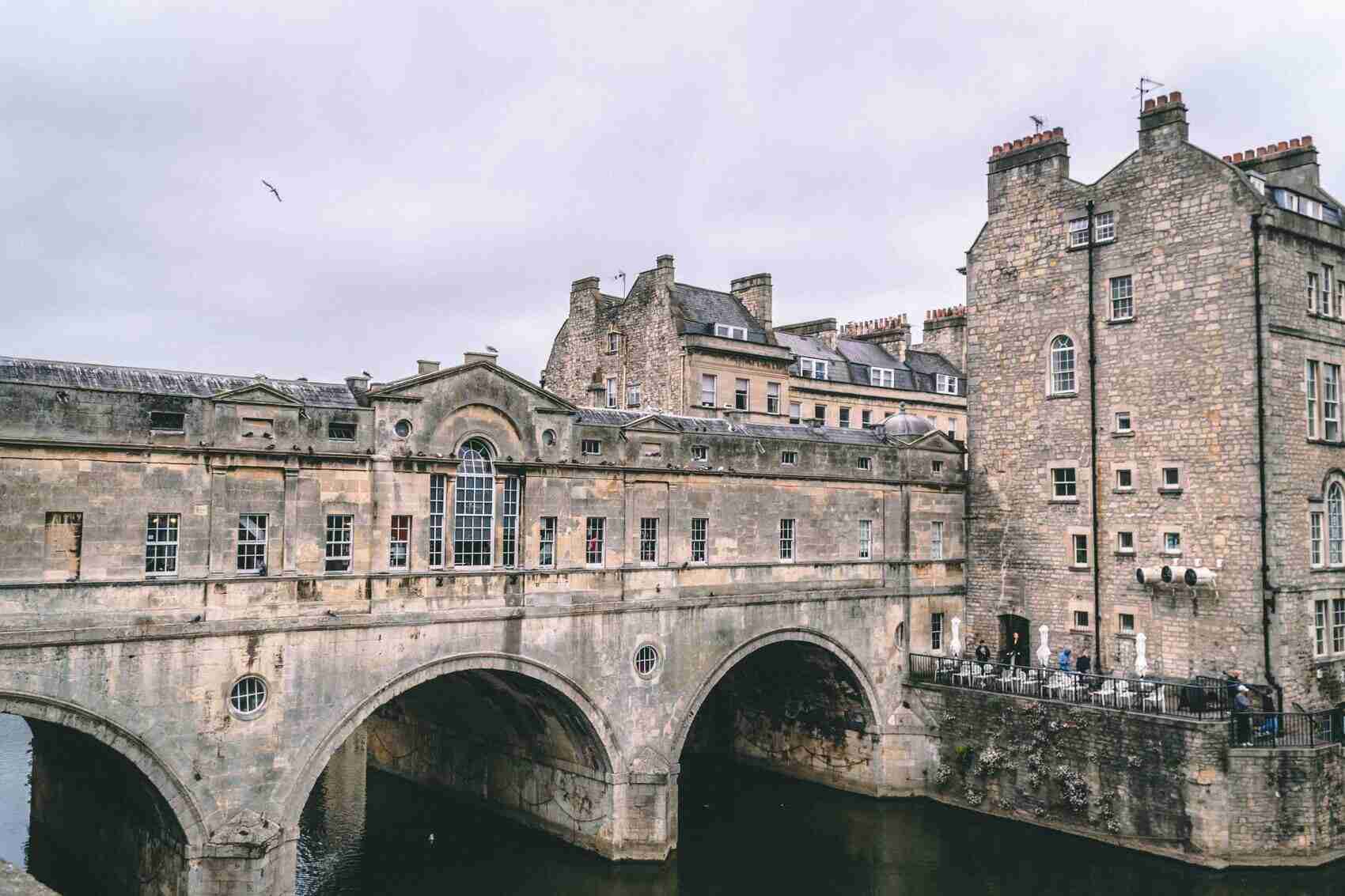
Pulteney Bridge in Bath
An essential of visiting Bath is of course to visit the famous Roman Baths, which are surprisingly well preserved given how old they are. Continuing with the stunning architecture of the baths, Bath Abbey should be your next stop, where you can climb the gothic tower and admire the views.
Booking a walking tour for Bath is a great idea if you want to make sure that you see all the sights as well as getting some highly valuable and interesting information on the history of this fascinating town.
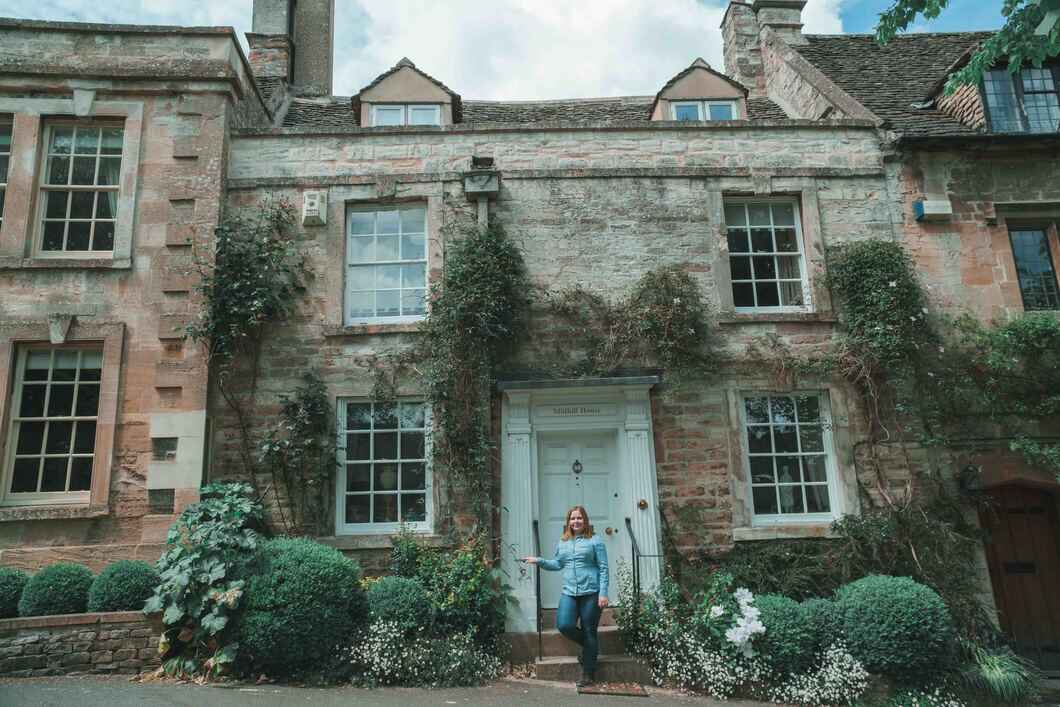
Drive: As Bath is on the edge of the Cotswolds it will be right at your doorstep. Castle Combe is an easy 30 minutes drive from Bath. It depends on which towns are on your list.
The Cotswolds is a continuous stream of picturesque villages and beautiful natural landscape, truly resembling something out of a storybook or fairytale. As the Cotswolds is a collection of villages it is best to know where it is that you want to go in advance of getting on the road.
Bilbury
On the banks of the River Coln, Bilbury is home to one of the most well-known streets in the area, Arlington Row. If you are looking for the quintessential fairytale style streets and crooked brick cottages that the Cotswolds are so well known for, then this is the place for you.
Stow-on-the-Wold
This sweet little town is perched right at the top of a hill and features a gorgeous church, a small gallery and a famous farmers market held on the second Thursday of each month. You will definitely want to grab a bite at Lucy’s Tearoom for some yummy freshly baked goods!
Castlecombe
This is without a doubt one of the best places in the Cotswolds to admire the beautiful honey-coloured bricks of the cottages and get the ultimate photos. The southern tip of the village is where you will get that classic shot of the village.
Bourton-on-the-Water
Right on the River Windrush, Bourton-on-the-Water is a pretty Cotswolds town and is known as the Venice of the Cotswolds. Walk down the river and see what the Cotswolds is most famous for the honey-coloured bricks. Alternatively, enjoy a drink or food at one of the village’s cafes.
Gloucester
Drive: Gloucester is on the northeast edge of the Cotswolds so this will be a short drive as well.
Start by exploring the area around College Court where you will find The House of the Tailor of Gloucester, which inspired the author Beatrix Potter. The building is now a museum with a shop that is dedicated to the author.
Next head over to Gloucester Docks which is Britain’s most inland port. You will discover Victorian warehouses, a working dry dock and a Mariners Chapel. A lot of the buildings have been converted into restaurants, tap rooms and shops.
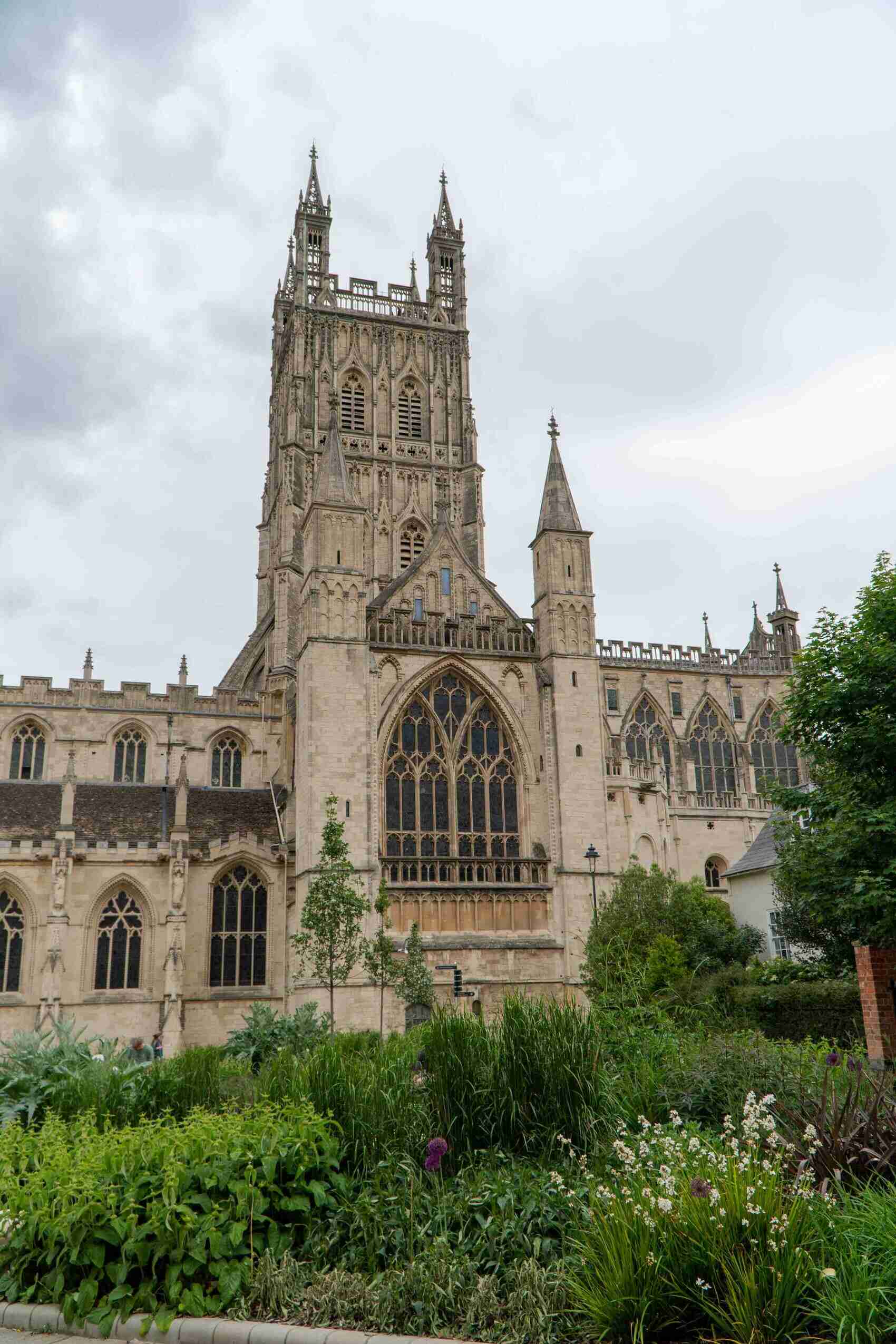
Don’t forget to see Gloucester Cathedral. It is an 11th century Romanesque and Gothic masterpiece. You may even recognise the cathedral’s corridor as it’s featured in the Harry Potter movies!
There is quite a lot to do in Gloucester so this could be a stop in itself but if you are short for time then a few hours will cover the main sites.
Stratford-Upon-Avon
Gloucester to Stratford-Upon-Avon is 1 hour drive.
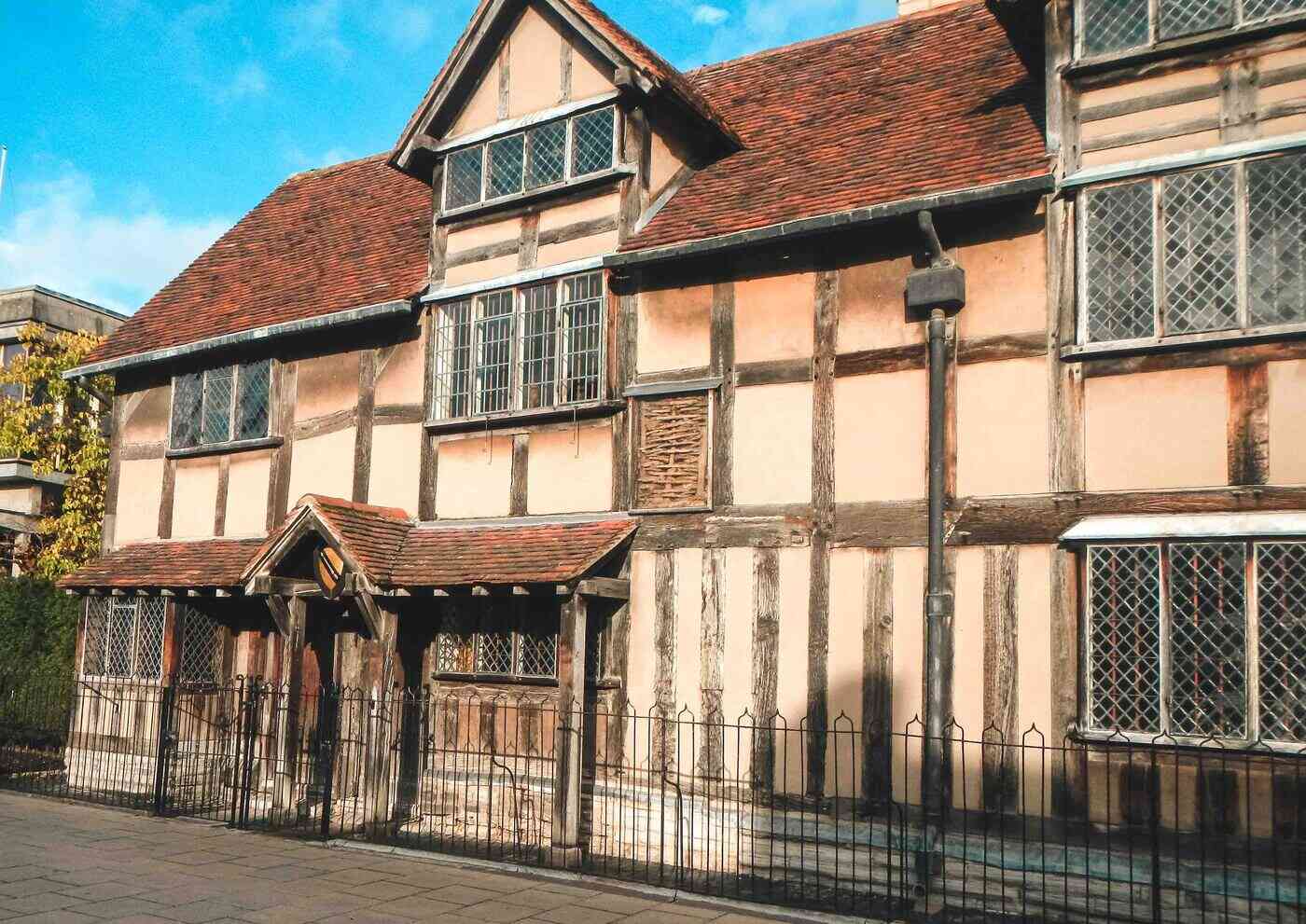
Shakespeares Birthplace
Stratford-upon-Avon is where William Shakespeare was born and most activities in this town are based around Shakespeare.
The Stratford’s Historic Spine is where the most important buildings of the town are and some of the buildings date back to the 15th century. The walk through the spine is approximately 0.6 miles (0.9 km) and will take you to mosts of the iconic sites in the town.
Starting at Henley Street you can see the building where Shakespeare was born. Tours are offered to see Shakespeares’ birthplace.
Anne Hathaway’s cottage is where Shakespeare courted his bride to be. You can pay to go inside the 500 years old cottage and see items from the 13 generations that lived there including the original furniture. Consider buying a ticket online which gets you into all of these attractions!
There are also lots of wonderful independent restaurants, cafes and bars in the heart of the city where you can have a great dining experience no matter what you’re after.
I would recommend going for some afternoon tea as it is a British tradition; this is arguably one of the most quintessentially British places you could have it!
Fancy something savoury instead? Chef Gordon Ramsay swears that Barnaby’s is the absolute best place to get yourself some fish and chips, and it’s right next to the Royal Shakespeare Company.
Chester
Drive: Stratford-Upon-Avon to Chester is around 2 hours and 30 minutes. Makes sure you avoid the toll road on the M6 and carry on the non-toll M6 route.
You are now pretty much at the halfway point between London and Edinburgh and sitting right on the Welsh border. This city has a rich history for you to explore; learn about Roman Legionnaires, Vikings, Normans and Anglo Saxons on your travels through the city.
The city is nearly completely surrounded by walls, which are considered to be the most well preserved in Great Britain running nearly two miles long. Other historic sites include:
The oldest racecourse in Great Britain
The largest Roman amphitheater in Great Britain
A one thousand year old Cathedral, with some amazing medieval carvings within
Seven hundred year old Rows galleries
Chester has one of the largest zoos in the UK and dedicates some of its resources to the conservation of endangered species. This makes for a great day out for visitors of all ages!
Liverpool
Drive: the drive to Liverpool is a quick one at 40 minutes.
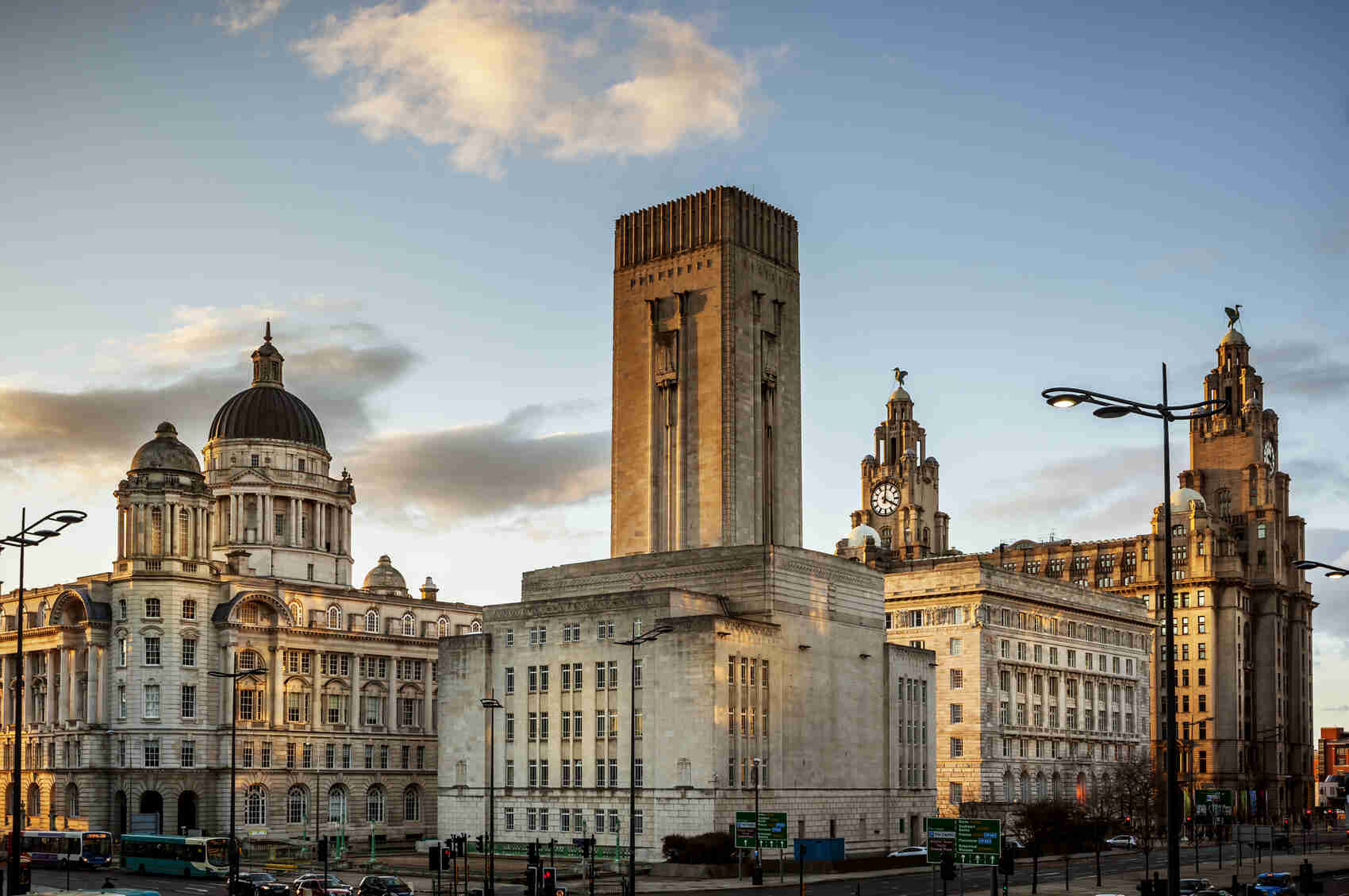
Pier Head Liverpool
Time to visit one of England’s major cities – the home of The Beatles, it’s Liverpool! This is the UK’s fifth biggest city, and there is so much to see and do that you could spend your entire trip there! Check out some of the historic areas, which have been granted World Heritage Status by UNESCO, like the Royal Albert Dock Area and William Brown Street.
There is also a great art and creative scene making for some awesome murals and street art as well as some art galleries. Here are some locations to check out:
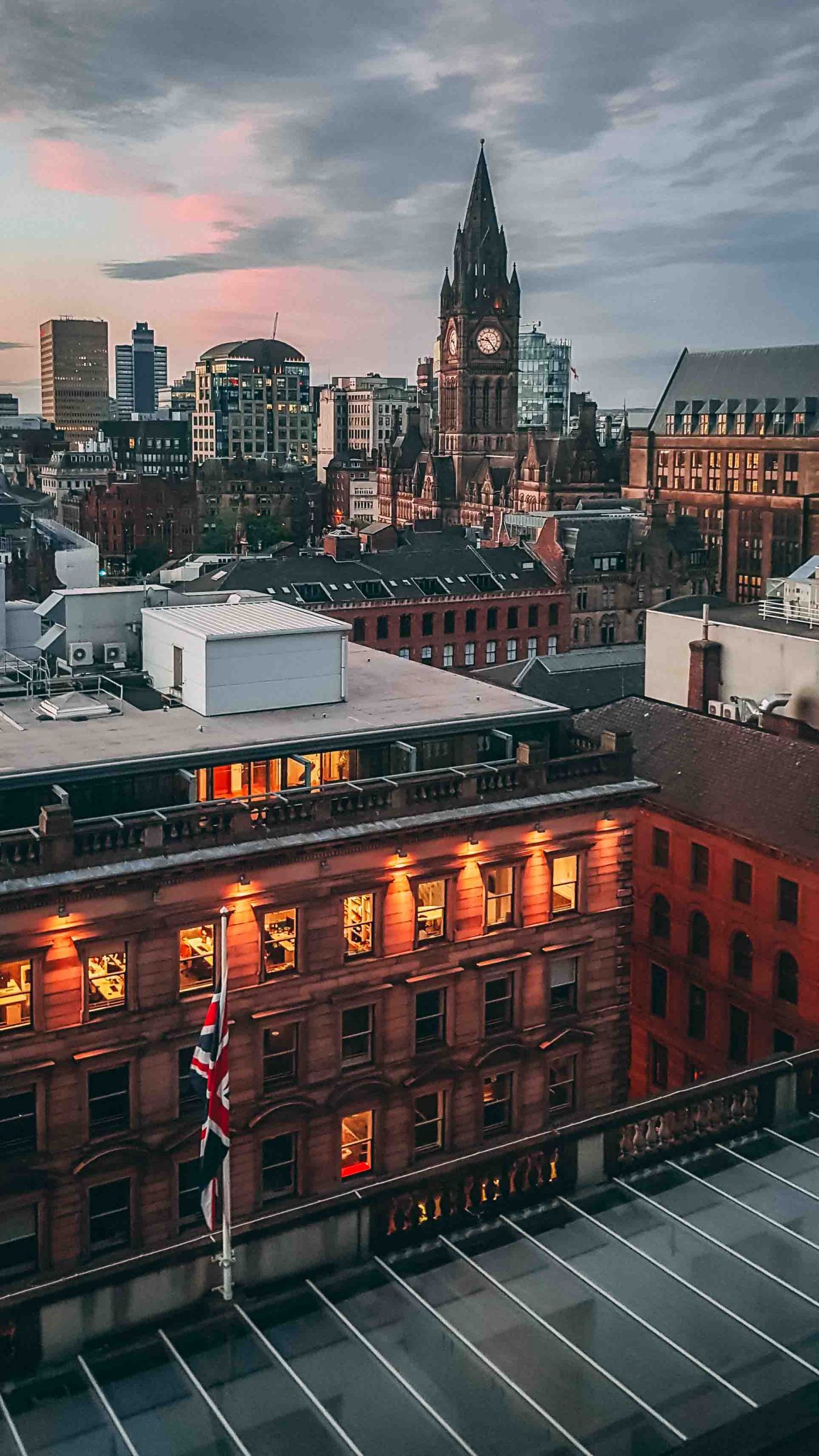
Manchester is known across the UK for its rich and diverse cultural scene! After all, it is the home of The Smiths, Oasis, and the Stone Roses. It also has numerous other sights such as galleries, museums and plenty of pubs and restaurants too! Here are some of the highlights:
Afflecks Palace – This is one of the best things to do in Manchester; it is ‘an emporium of eclecticism, a totem of indie commerce in Manchester’s Northern Quarter’ – enjoy looking through craft stores and at jewellery and trinkets. It is truly a unique place.
Chinatown – You will know that you have reached Chinatown when you see the giant red archway that leads into the area. The area has a large number of Asian restaurants and cafes serving delicious food and even some karaoke! One of my favourite places to eat is Try Thai (I know it’s not Chinese!) but it offers great food and I often visit on my trips to Manchester.
Federal Cafe – This place is known across the city as a trendy brunch spot with fantastic coffee – it’s totally instagrammable!
PLY – Best pizza in the city, and very affordable – enough said!
Football – Manchester is home to premier league teams Manchester United and Manchester City. As you can imagine that means there is a football atmosphere! You can try and catch a game or visit the National Football Museum.
John Rylands Library – This building is one of the best examples of neo-Gothic architecture in Europe and an incredible library. One of the cool facts about the building is that it was the first place in Manchester to be lit by electricity.
As I travel to Manchester a lot, I’ve tried a significant amount of hotels in the city! By far my favourite is the Great John Street Hotel which is a 4-star hotel. The building is a Victorian former schoolhouse so it has a lot of wonderful architecture. The rooms are beautiful! Last time I stayed here I had a second floor just for my bathroom which had a free-standing bath. My other hotel recommendations are the Lowry Hotel and the Midland.
Drive: 1 hour and 30 minutes to reach the outskirts of the Lake District.
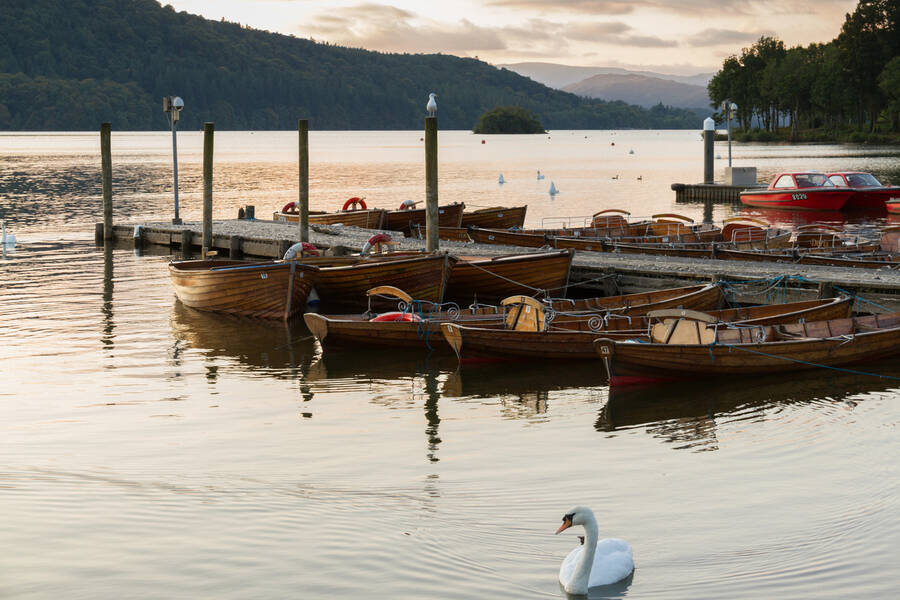
Swan and moored boats in Lake Windermere.
The Lake District has some incredible things to do – you’ll want to take your time and make sure you’ve seen all that you wish to!
Rydal Mount
Whether you’re a literature buff or not, you’re definitely not going to want to miss visiting the home of Wordsworth, Rydal Mount in the small village of Ambleside. The famous poet resided here for the latter part of his life, and you can walk in the beautiful gardens that were once landscaped by Wordsworth himself! You can even take a look at the place where he wrote, as well as his library!
The Lakes Distillery
This distillery was founded in 2014 and has become one of the most popular in the Cumbria area in recent years. It produces gin, vodka and whisky. Even better? It uses local produce to do so!
The distillery is awesome to visit – it even has alpacas! Plus, there is a shop, so you can buy your favourite drinks and take them home with you!
Lake Windermere
This is the largest natural lake in England, and gives a great picture of the beauty of the Lake District. If you are going to go to any lakes in the Lake District, make sure its this one. There are tonnes of amazing things to do around the lake, such as boating, running, hiking and cycling!
Grasmere Gingerbread
One of the most famous things you can buy in the Lake District is Grasmere Gingerbread. When you walk into the shop you will smell the spices and the aroma of gingerbread. The perfect snack to grab for your road trip! If it is winter then pair it with a nice hot drink alongside a fireplace.
You have finally arrived at your destination; Scotland’s capital city of Edinburgh! This city is great to spend a couple of days exploring, particularly the old town which is where you will find the castle!
For ideas of what to see and do during your time here, check out my article on the 7 Day Drive Loop from Edinburgh to Glasgow.